
Tensorflow 解决MNIST问题的重构程序
分为三个文件:mnist_inference.py:定义前向传播的过程以及神经网络中的参数,抽象成为一个独立的库函数;mnist_train.py:定义神经网络的训练过程,在此过程中,每个一段时间保存一次模型训练的中间结果;mnist_eval.py:定义测试过程。
mnist_inference.py:
#coding=utf8
import tensorflow as tf

#1. 定义神经网络结构相关的参数。

INPUT_NODE = 784
OUTPUT_NODE = 10
LAYER1_NODE = 500

#2. 通过tf.get_variable函数来获取变量。
def get_weight_variable(shape, regularizer):
    weights = tf.get_variable("weights", shape, initializer=tf.truncated_normal_initializer(stddev=0.1))
    if regularizer != None: tf.add_to_collection('losses', regularizer(weights))
    return weights

#3. 定义神经网络的前向传播过程。使用命名空间方式,不需要把所有的变量都作为变量传递到不同的函数中提高程序的可读性

def inference(input_tensor, regularizer):
    with tf.variable_scope('layer1'):

        weights = get_weight_variable([INPUT_NODE, LAYER1_NODE], regularizer)
        biases = tf.get_variable("biases", [LAYER1_NODE], initializer=tf.constant_initializer(0.0))
        layer1 = tf.nn.relu(tf.matmul(input_tensor, weights) + biases)

    with tf.variable_scope('layer2'):
        weights = get_weight_variable([LAYER1_NODE, OUTPUT_NODE], regularizer)
        biases = tf.get_variable("biases", [OUTPUT_NODE], initializer=tf.constant_initializer(0.0))
        layer2 = tf.matmul(layer1, weights) + biases

    return layer2
mnist_train.py:
#coding=utf8
import tensorflow as tf
from tensorflow.examples.tutorials.mnist import input_data
import mnist_inference
import os
#1. 定义神经网络结构相关的参数。

BATCH_SIZE = 100
LEARNING_RATE_BASE = 0.8
LEARNING_RATE_DECAY = 0.99
REGULARIZATION_RATE = 0.0001
TRAINING_STEPS = 30000
MOVING_AVERAGE_DECAY = 0.99
MODEL_SAVE_PATH="MNIST_model/"
MODEL_NAME="mnist_model"

#2. 定义训练过程。

def train(mnist):

    # 定义输入输出placeholder。
    x = tf.placeholder(tf.float32, [None, mnist_inference.INPUT_NODE], name='x-input')
    y_ = tf.placeholder(tf.float32, [None, mnist_inference.OUTPUT_NODE], name='y-input')

    regularizer = tf.contrib.layers.l2_regularizer(REGULARIZATION_RATE)
    y = mnist_inference.inference(x, regularizer)
    global_step = tf.Variable(0, trainable=False)

    # 定义损失函数、学习率、滑动平均操作以及训练过程。
    variable_averages = tf.train.ExponentialMovingAverage(MOVING_AVERAGE_DECAY, global_step)
    variables_averages_op = variable_averages.apply(tf.trainable_variables())
    cross_entropy = tf.nn.sparse_softmax_cross_entropy_with_logits(logits=y, labels=tf.argmax(y_, 1))
    cross_entropy_mean = tf.reduce_mean(cross_entropy)
    loss = cross_entropy_mean + tf.add_n(tf.get_collection('losses'))
    learning_rate = tf.train.exponential_decay(
        LEARNING_RATE_BASE,
        global_step,
        mnist.train.num_examples / BATCH_SIZE, LEARNING_RATE_DECAY,
        staircase=True)
    train_step = tf.train.GradientDescentOptimizer(learning_rate).minimize(loss, global_step=global_step)
    with tf.control_dependencies([train_step, variables_averages_op]):
        train_op = tf.no_op(name='train')

    # 初始化TensorFlow持久化类。
    saver = tf.train.Saver()
    with tf.Session() as sess:
        tf.global_variables_initializer().run()

        for i in range(TRAINING_STEPS):
            xs, ys = mnist.train.next_batch(BATCH_SIZE)
            _, loss_value, step = sess.run([train_op, loss, global_step], feed_dict={x: xs, y_: ys})
            if i % 1000 == 0:
                print("After %d training step(s), loss on training batch is %g." % (step, loss_value))
                saver.save(sess, os.path.join(MODEL_SAVE_PATH, MODEL_NAME), global_step=global_step)

def main(argv=None):
    mnist = input_data.read_data_sets("MNIST_data", one_hot=True)
    train(mnist)

if __name__ == '__main__':
    main()

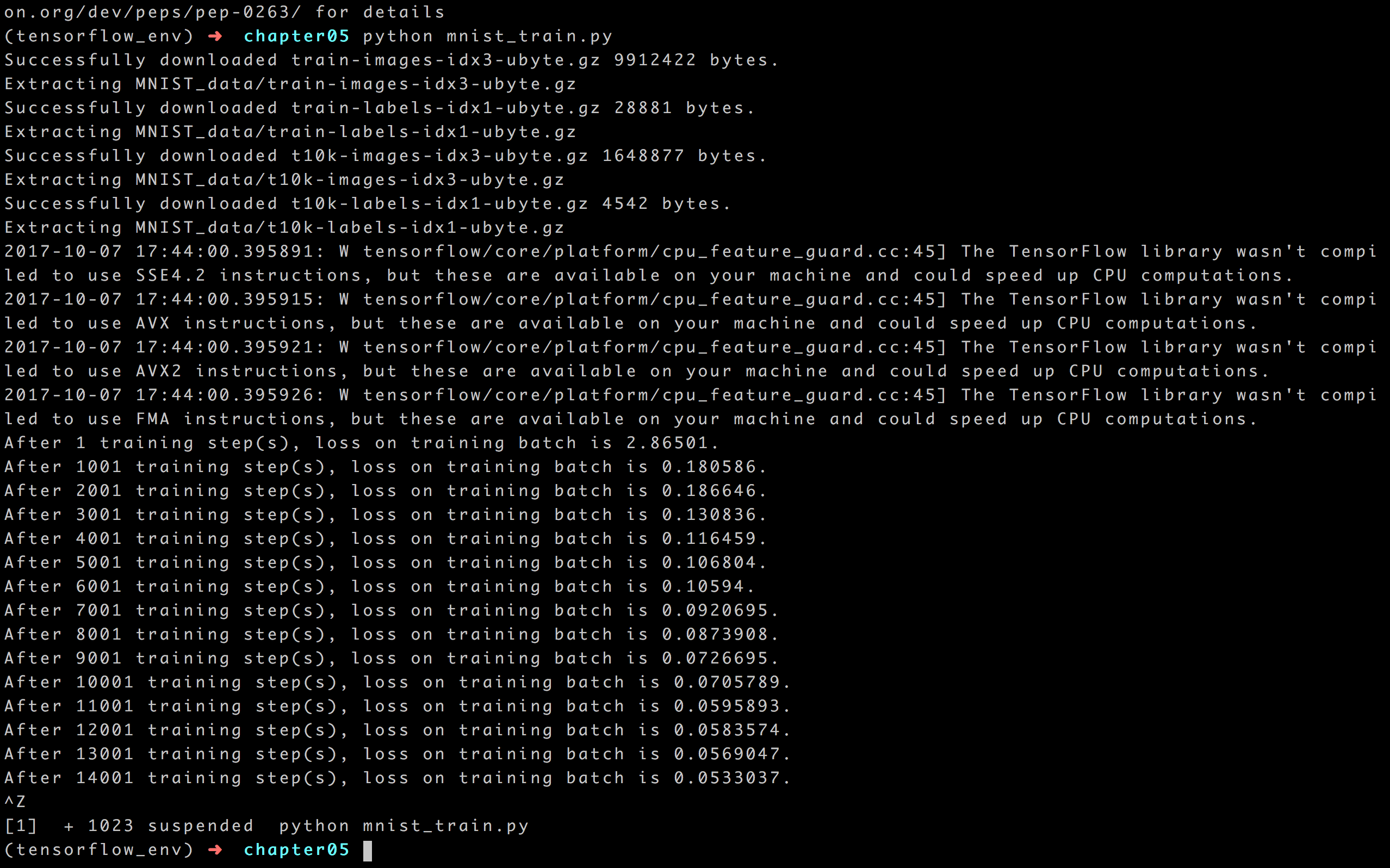
结果如下:
mnist_eval.py:
import time
import tensorflow as tf
from tensorflow.examples.tutorials.mnist import input_data
import mnist_inference
#coding=utf8
import mnist_train

#1. 每10秒加载一次最新的模型

# 加载的时间间隔。
EVAL_INTERVAL_SECS = 10

def evaluate(mnist):
    with tf.Graph().as_default() as g:
        x = tf.placeholder(tf.float32, [None, mnist_inference.INPUT_NODE], name='x-input')
        y_ = tf.placeholder(tf.float32, [None, mnist_inference.OUTPUT_NODE], name='y-input')
        validate_feed = {x: mnist.validation.images, y_: mnist.validation.labels}

        y = mnist_inference.inference(x, None)
        correct_prediction = tf.equal(tf.argmax(y, 1), tf.argmax(y_, 1))
        accuracy = tf.reduce_mean(tf.cast(correct_prediction, tf.float32))

        variable_averages = tf.train.ExponentialMovingAverage(mnist_train.MOVING_AVERAGE_DECAY)
        variables_to_restore = variable_averages.variables_to_restore()
        saver = tf.train.Saver(variables_to_restore)

        while True:
            with tf.Session() as sess:
                ckpt = tf.train.get_checkpoint_state(mnist_train.MODEL_SAVE_PATH)
                if ckpt and ckpt.model_checkpoint_path:
                    saver.restore(sess, ckpt.model_checkpoint_path)
                    global_step = ckpt.model_checkpoint_path.split('/')[-1].split('-')[-1]
                    accuracy_score = sess.run(accuracy, feed_dict=validate_feed)
                    print("After %s training step(s), validation accuracy = %g" % (global_step, accuracy_score))
                else:
                    print('No checkpoint file found')
                    return
            time.sleep(EVAL_INTERVAL_SECS)

def main(argv=None):
    mnist = input_data.read_data_sets("MNIST_data", one_hot=True)
    evaluate(mnist)

if __name__ == '__main__':
    main()
结果如下:

Tensorflow 解决MNIST问题的重构程序的更多相关文章
- 深入浅出TensorFlow(二):TensorFlow解决MNIST问题入门
2017年2月16日,Google正式对外发布Google TensorFlow 1.0版本,并保证本次的发布版本API接口完全满足生产环境稳定性要求.这是TensorFlow的一个重要里程碑,标志着 ...
- tensorflow学习笔记——使用TensorFlow操作MNIST数据(2)
tensorflow学习笔记——使用TensorFlow操作MNIST数据(1) 一:神经网络知识点整理 1.1,多层:使用多层权重,例如多层全连接方式 以下定义了三个隐藏层的全连接方式的神经网络样例 ...
- 一个简单的TensorFlow可视化MNIST数据集识别程序
下面是TensorFlow可视化MNIST数据集识别程序,可视化内容是,TensorFlow计算图,表(loss, 直方图, 标准差(stddev)) # -*- coding: utf-8 -*- ...
- 基于tensorflow的MNIST手写数字识别(二)--入门篇
http://www.jianshu.com/p/4195577585e6 基于tensorflow的MNIST手写字识别(一)--白话卷积神经网络模型 基于tensorflow的MNIST手写数字识 ...
- tensorflow学习笔记——使用TensorFlow操作MNIST数据(1)
续集请点击我:tensorflow学习笔记——使用TensorFlow操作MNIST数据(2) 本节开始学习使用tensorflow教程,当然从最简单的MNIST开始.这怎么说呢,就好比编程入门有He ...
- Android+TensorFlow+CNN+MNIST 手写数字识别实现
Android+TensorFlow+CNN+MNIST 手写数字识别实现 SkySeraph 2018 Email:skyseraph00#163.com 更多精彩请直接访问SkySeraph个人站 ...
- win10下通过Anaconda安装TensorFlow-GPU1.3版本,并配置pycharm运行Mnist手写识别程序
折腾了一天半终于装好了win10下的TensorFlow-GPU版,在这里做个记录. 准备安装包: visual studio 2015: Anaconda3-4.2.0-Windows-x86_64 ...
- Tensorflow之MNIST的最佳实践思路总结
Tensorflow之MNIST的最佳实践思路总结 在上两篇文章中已经总结出了深层神经网络常用方法和Tensorflow的最佳实践所需要的知识点,如果对这些基础不熟悉,可以返回去看一下.在< ...
- tensorflow处理mnist(二)
用卷积神经网络解决mnist的分类问题. 简单的例子 一行一行解释这个代码. 这个不是google官方的例子,但是很简洁,便于入门.tensorflow是先定义模型,最后赋值,计算.为了讨论问题方便, ...
随机推荐
- 分析 HTML 代码并提取数据
在前面的内容中,我们已经学习了 HTML.CSS 和 XPath 的基础知识.从真实世界的网页中获取数据,关键在于如何编写合适的 CSS 或者 XPath 选择器.本节介绍一些确定选择器的简单方法.假 ...
- eclipse开发go语言入门案例
1.配置eclipse下配置GO语言的插件 点击eclipse的“Help”菜单,找到“Install New Software…”菜单项.如下图: 点击“Install New Software…” ...
- 基于 Flutter 以两种方式实现App主题切换
概述 App主题切换已经成为了一种流行的用户体验,丰富了应用整体UI视觉效果.例如,白天夜间模式切换.实现该功能的思想其实不难,就是将涉及主题的资源文件进行全局替换更新.说到这里,我想你肯定能联想到一 ...
- Codeforces A - Bear and Prime 100(交互题)
A - Bear and Prime 100 思路:任何一个合数都可以写成2个以上质数的乘积.在2-100中,除了4,9,25,49外都可以写成两个以上不同质数的乘积. 所以打一个质数加这四个数的表: ...
- Knight Probability in Chessboard
2018-07-14 09:57:59 问题描述: 问题求解: 本题本质上是个挺模板的题目.本质是一个求最后每个落点的数目,用总的数目来除有所可能生成的可能性.这种计数的问题可以使用动态规划来进行解决 ...
- Java 访问权限修饰符以及protected修饰符的理解
2017-11-04 22:28:39 访问权限修饰符的权限 访问修饰符protected的权限理解 在Core Java中有这样一段话“在Object类中,clone方法被声明为protected, ...
- 雷林鹏分享:C# 预处理器指令
C# 预处理器指令 预处理器指令指导编译器在实际编译开始之前对信息进行预处理. 所有的预处理器指令都是以 # 开始.且在一行上,只有空白字符可以出现在预处理器指令之前.预处理器指令不是语句,所以它们不 ...
- 雷林鹏分享:Ruby 安装 - Unix
Ruby 安装 - Unix 下面列出了在 Unix 机器上安装 Ruby 的步骤. 注意:在安装之前,请确保您有 root 权限. 下载最新版的 Ruby 压缩文件.请点击这里下载. 下载 Ruby ...
- php新手第一次安装mongo
以下是我走位php新手第一次安装mongo模块的步骤: 1.首先从在网上选取适当版本的mongoDB扩展包下载; 2.解压扩展包,并且进入解压目录; tar -zxf mongo-1.4.1.tgz ...
- 12月13日 什么是help_method,session的简单理解, find_by等finder method
helper_method Declare a controller method as a helper. For example, helper_method :link_to def link_ ...