
How to Set Up a NFS Server on Debian 10 Buster
How to Set Up a NFS Server on Debian 10 Buster
- Nick Congleton
- Debian
- 24 May 2019
There are plenty of reasons why you'd want to share files across computers on your network, and Debian makes a perfect file server, whether you're running it from a workstation, dedicated server, or even a Raspberry Pi. Since NFS functionality comes from the kernel, everything is fairly simple to set up and well integrated.
In this tutorial you will learn:
- How to Install the NFS Packages
- How to Configure Your Shares
- How to Connect to a Share

Software Requirements and Conventions Used
| Category | Requirements, Conventions or Software Version Used |
|---|---|
| System | Debian 10 Buster |
| Software | NFS Server |
| Other | Privileged access to your Linux system as root or via the sudo command. |
| Conventions | # - requires given linux commands to be executed with root privileges either directly as a root user or by use of sudo command$ - requires given linux commands to be executed as a regular non-privileged user |
Install the NFS Packages

NFS is super simple to install on Debian. It's connected to the kernel, and it's a common package. You can install everything you need from the main repositories.
$ sudo apt install nfs-kernel-server
Subscribe to Linux Career NEWSLETTER and receive latest Linux news, jobs, career advice and tutorials.
Configure Your Shares
Start by creating a directory that you want to share or choosing an existing one. Make sure that the directory that you choose doesn't have root-only permissions.
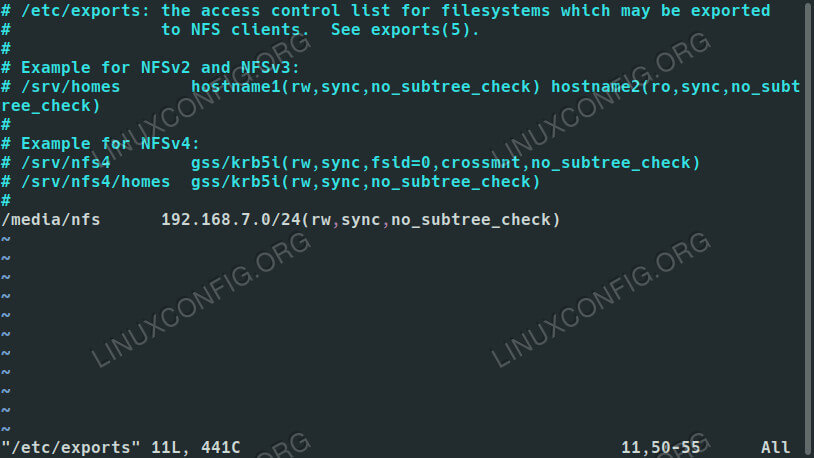
Next, open up /etc/exports with your favorite text editor. This is the file that you'll use to set up your shares. Here, you can configure which directories you're sharing and who can access them. You can also set specific permissions for the shares to further limit access.
In the file, each share gets its own line. That line begins with the location of the share on the server machine. Across from that, you can list the hostname of an accepted client, if is available in the server's hosts file, or an IP or range of IPs. Directly behind the IP address, place the rules for the share in a set of parenthesis. Altogether, it should look something like this:
/media/nfs 192.168.1.0/24(rw,sync,no_subtree_check)
You can include as many shares as you like, provided each has its own line. You can also include more than one hostname or IP in each line and assign them different permissions. For example:
/media/nfs 192.168.1.112(rw,sync,no_subtree_check) 192.168.1.121(ro,sync,no_subtree_check)
In that instance, each of those machines could view and read from the share, but only the computer at 192.168.1.112 could write to it.
There are plenty more options that you can choose from to configure how the server handles you share for each guest. Here is a complete breakdown of what's available:
- ro: specifies that the directory may only be mounted as read only
- rw: grants both read and write permissions on the directory
- no_root_squash: is an extremely dangerous option that allows remote “root” users the same privilege as the “root” user of the host machine
- subtree_check: specifies that, in the case of a directory is exported instead of an entire filesystem, the host should verify the location of files and directories on the host filesystem
- no_subtree_check: specifies that the host should not check the location of the files being accessed withing the host filesystem
- sync: this just ensures that the host keeps any changes uploaded to the shared directory in sync
- async: ignores synchronization checks in favor of increased speed
Once you have everything set up the way you want, save and exit the file. Then, restart the server to load your new exports configuration.
$ sudo systemctl restart nfs-kernel-server
Connect to a Share
Your share is now accessible from the client machines that you configured in your exports. Assuming that your clients are Ubuntu or Debian based, you can install the required package to connect with:
$ sudo apt install nfs-common

With that, you'll be able to mount the NFS shares. So, to try it out, pick a directory to mount to, and run the mount command as root privileges to mount the networked share.
$ sudo mount -t nfs4 192.168.1.110:/media/nfs /media/share
Provided the mount succeeded, you'll be able to access your shared files in the directory where you mounted them.
For a more permanent solution, you can add the share to your client's /etc/fstab file. The overall syntax looks a lot like the command that you just used to mount your share. Start with the location of the share on your network. Follow that with where the share is to be mounted. The filesystem type here is nfs4. The options are up to you, but using the defaults and allowing user access are pretty common for non-sensitive shares. The end result should look a bit like the example below.
192.168.1.110:/media/nfs /media/share nfs4 defaults,user,exec 0 0
If you aren't certain if the share will always be available on the client, add noauto to the list of options to prevent your system from trying to mount it automatically.
192.168.1.110:/media/nfs /media/share nfs4 defaults,user,exec,noauto 0 0
Try mounting it on the client using /etc/fstab.
$ sudo mount -a
Your share should be mounted exactly where you specified.
Conclusion
Your Debian server is now ready to start serving files, and you shouldn't have any trouble setting up the rest of your client machines. Remember that NFS doesn't have much in the way of security, so you're going to need other methods to restrict access to your files, should you choose to share anything more sensitive.
How to Set Up a NFS Server on Debian 10 Buster的更多相关文章
- nfs server的配置 Starting NFS daemon: [FAILED]
总结了一下是nfs server的制作过程:nfs(Network File System)其实就是说,这个机器的硬盘不够了,我要把文件放到别的服务器上去,服务器端的配置如下:首先(1)确保你的机器上 ...
- nfs:server 172.168.1.22 not responding,still trying问题解决方法 平台为RealARM 210平台
nfs:server 172.168.1.22 not responding,still trying问题解决方法 ,平台为RealARM 210平台. 这里的问题是在使用nfs挂载文件系统时遇到的, ...
- windows nfs server for linux
摘要 在开发嵌入式系统的过程中,为了方便调试与文件共享,需要使用到nfs,即网络文件系统,这位板子的调试测试带来了很大的方便.之前在linux系统下开发,与ARM11核心板 linux系统对接共享也比 ...
- Ubuntu 12.04安装NFS server
首先安装nfs-kernel-server apt-get install nfs-kernel-server 然后创建一个目录: mkdir -p /opt/share 并赋予权限777: chmo ...
- nfs:server is not responding,still trying 原因与解决
方案(学自他人) nfs:server is not responding,still trying的解决方法 (2009-04-20 10:20) 方法1 : 我在arm上通过NFS共享文件时出现下 ...
- Linux 文件服务---------- nfs Server
Linux 文件服务nfs (Network file system)#网络文件系统 ---> 远程文件调用samba #文件共享(unix /linux /windows ) ,只能适用于局域 ...
- 树莓派 nfs server安装
安装服务 sudo apt-get install portmap sudo apt-get install nfs-kernel-server 配置: sudo nano /etc/expo ...
- CentOS 7下NFS Server作rootfs时的兼容性问题
最近新装CentOS 7,发现原先CentOS 6.3下可用的一块ARM Dev board不能用了,表现为VFS mount挂载rootfs失败. 使用WireShark发现,服务器对client发 ...
- NFS Server宕机后,NFS Client主机上df命令挂死
方法1: 使用root用户:Oracle@NDMCDB05:~> su -Password: NDMCDB05:~ # cat /etc/mtab /dev/sda2 / reiserfs rw ...
随机推荐
- 剑指offer13:数组[奇数,偶数],奇数偶数相对位置不变。
1. 题目描述 输入一个整数数组,实现一个函数来调整该数组中数字的顺序,使得所有的奇数位于数组的前半部分,所有的偶数位于数组的后半部分,并保证奇数和奇数,偶数和偶数之间的相对位置不变. 2. 思路和方 ...
- zabbix+orabbix安装
zabbix + orabbix 监控oracle数据库 zabbix 监控搭建 一,LNMP环境搭建 LNMP环境搭建.md 二,zabbix服务端安装配置 (1)下载zabbix并安装 所有版本下 ...
- Python开发【第二章】:模块和运算符
一.模块初识: Python有大量的模块,从而使得开发Python程序非常简洁.类库有包括三中: Python内部提供的模块 业内开源的模块 程序员自己开发的模块 1.Python内部提供一个 sys ...
- SOS dp
设$ans=\sum\limits_{A \cap B=\varnothing} f(A)g(B) $ 直接暴力枚举子集是$O(3^n)$, 一个技巧是先预处理出$h(S)=\sum\limits_{ ...
- 怎样获取全局对象 window
1. 使用window.self window.self === window; // true 2. 使用window.window window.window === window; // tru ...
- ZooKeeper学习笔记(四)——shell客户端命令操作
ZooKeeper客户端命令行操作 启动服务端 [simon@hadoop102 zookeeper-3.4.10]$ bin/zkServer.sh start 查看状态信息 Using confi ...
- J.U.C之AQS:阻塞和唤醒线程
此篇博客所有源码均来自JDK 1.8 在线程获取同步状态时如果获取失败,则加入CLH同步队列,通过通过自旋的方式不断获取同步状态,但是在自旋的过程中则需要判断当前线程是否需要阻塞,其主要方法在acqu ...
- UI5-技术篇-SAPUI5创建自定义控件
转载:https://www.nabisoft.com/tutorials/sapui5/creating-custom-controls-in-sapui5 https://sapui5.h ...
- HTML5 - 初识
众所周知,我们现在的手机APP开发模式分为一下几大类: 一.原生APP 二.纯HTML5 三.原生+HTML5 四.React Native 公司的职位划分: 1.平面设计师 : 作图.切图.HTM ...
- Yarn介绍(设计理念与基本架构)
Yarn : 新的计算框架,是一个全局资源管理器,负责整个集群的资源管理和分配 一. Yarn产生背景 Hadoop1.0MR有局限性,概括为以下几个方面 : 扩展性差 可靠性差 资 ...