
关于 Dev-C++ 中缺少 iconv.h 的问题
前言
在 C++ 中有个扩展库 ext,里面有一些黑科技(hash, splay, binomial_heap 等等),
在 Windows 环境中,我们运行 Dev-C++ 并在头文件写 #include<bits/extc++.h> 时,经常会收到 [Error] iconv.h: No such file or directory 的编译报错。
所以为了代替他,我们会写很多
#include<ext/pb_ds/hash_policy.hpp>

#include<ext/pb_ds/assoc_container.hpp>
诸如此类。这不失为一个解决方案,但是万能头显然更加方便快捷。
现在我们来试着解决这个问题。
Step 1
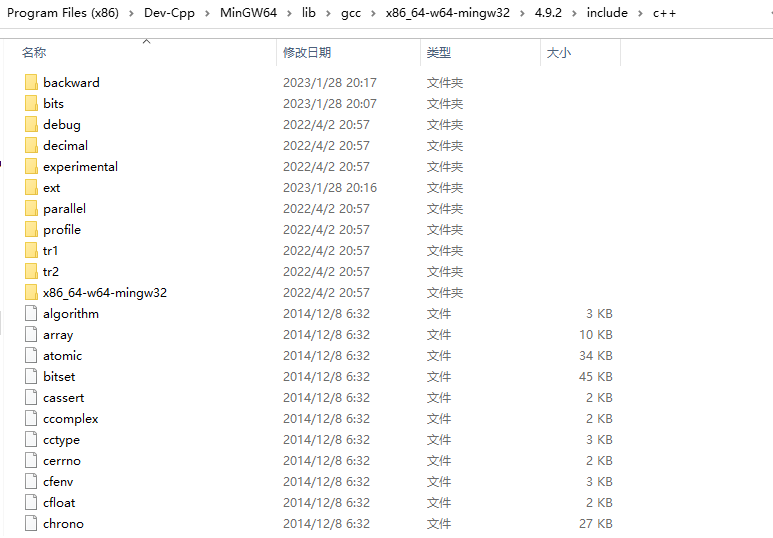
找到您电脑上头文件的存储位置。通常为 C:\Program Files (x86)\Dev-Cpp\MinGW64\lib\gcc\x86_64-w64-mingw32\4.9.2\include\c++。
如果找不到可以新建一个 cpp 文件,开头写上 #include<iostream> 然后 Ctrl+左键点一下就可以知道文件目录了。
Step 2
在此目录下新建一个 iconv.h 文件,把下列内容复制进去:
/* Copyright (C) 1999-2019 Free Software Foundation, Inc.

   This file is part of the GNU LIBICONV Library.

   The GNU LIBICONV Library is free software; you can redistribute it

   and/or modify it under the terms of the GNU Library General Public

   License as published by the Free Software Foundation; either version 2

   of the License, or (at your option) any later version.

   The GNU LIBICONV Library is distributed in the hope that it will be

   useful, but WITHOUT ANY WARRANTY; without even the implied warranty of

   MERCHANTABILITY or FITNESS FOR A PARTICULAR PURPOSE.  See the GNU

   Library General Public License for more details.

   You should have received a copy of the GNU Library General Public

   License along with the GNU LIBICONV Library; see the file COPYING.LIB.

   If not, see <https://www.gnu.org/licenses/>.  */

/* When installed, this file is called "iconv.h". */

#ifndef _LIBICONV_H

#define _LIBICONV_H

#define _LIBICONV_VERSION 0x0110    /* version number: (major<<8) + minor */

extern __declspec (dllimport) int _libiconv_version; /* Likewise */

/* We would like to #include any system header file which could define

   iconv_t, 1. in order to eliminate the risk that the user gets compilation

   errors because some other system header file includes /usr/include/iconv.h

   which defines iconv_t or declares iconv after this file, 2. when compiling

   for LIBICONV_PLUG, we need the proper iconv_t type in order to produce

   binary compatible code.

   But gcc's #include_next is not portable. Thus, once libiconv's iconv.h

   has been installed in /usr/local/include, there is no way any more to

   include the original /usr/include/iconv.h. We simply have to get away

   without it.

   Ad 1. The risk that a system header file does

   #include "iconv.h"  or  #include_next "iconv.h"

   is small. They all do #include <iconv.h>.

   Ad 2. The iconv_t type is a pointer type in all cases I have seen. (It

   has to be a scalar type because (iconv_t)(-1) is a possible return value

   from iconv_open().) */

/* Define iconv_t ourselves. */

#undef iconv_t

#define iconv_t libiconv_t

typedef void* iconv_t;

/* Get size_t declaration.

   Get wchar_t declaration if it exists. */

#include <stddef.h>

/* Get errno declaration and values. */

#include <errno.h>

/* Some systems, like SunOS 4, don't have EILSEQ. Some systems, like BSD/OS,

   have EILSEQ in a different header.  On these systems, define EILSEQ

   ourselves. */

#ifndef EILSEQ

#define EILSEQ

#endif

#ifdef __cplusplus

extern "C" {

#endif

/* Allocates descriptor for code conversion from encoding ‘fromcode’ to

   encoding ‘tocode’. */

#ifndef LIBICONV_PLUG

#define iconv_open libiconv_open

#endif

extern iconv_t iconv_open (const char* tocode, const char* fromcode);

/* Converts, using conversion descriptor ‘cd’, at most ‘*inbytesleft’ bytes

   starting at ‘*inbuf’, writing at most ‘*outbytesleft’ bytes starting at

   ‘*outbuf’.

   Decrements ‘*inbytesleft’ and increments ‘*inbuf’ by the same amount.

   Decrements ‘*outbytesleft’ and increments ‘*outbuf’ by the same amount. */

#ifndef LIBICONV_PLUG

#define iconv libiconv

#endif

extern size_t iconv (iconv_t cd,  char* * inbuf, size_t *inbytesleft, char* * outbuf, size_t *outbytesleft);

/* Frees resources allocated for conversion descriptor ‘cd’. */

#ifndef LIBICONV_PLUG

#define iconv_close libiconv_close

#endif

extern int iconv_close (iconv_t cd);

#ifdef __cplusplus

}

#endif

#ifndef LIBICONV_PLUG

/* Nonstandard extensions. */

#if 1

#if 0

/* Tru64 with Desktop Toolkit C has a bug: <stdio.h> must be included before

   <wchar.h>.

   BSD/OS 4.0.1 has a bug: <stddef.h>, <stdio.h> and <time.h> must be

   included before <wchar.h>.  */

#include <stddef.h>

#include <stdio.h>

#include <time.h>

#endif

#include <wchar.h>

#endif

#ifdef __cplusplus

extern "C" {

#endif

/* A type that holds all memory needed by a conversion descriptor.

   A pointer to such an object can be used as an iconv_t. */

typedef struct {

  void* dummy1[28];

#if 1

  mbstate_t dummy2;

#endif

} iconv_allocation_t;

/* Allocates descriptor for code conversion from encoding ‘fromcode’ to

   encoding ‘tocode’ into preallocated memory. Returns an error indicator

   (0 or -1 with errno set). */

#define iconv_open_into libiconv_open_into

extern int iconv_open_into (const char* tocode, const char* fromcode,

                            iconv_allocation_t* resultp);

/* Control of attributes. */

#define iconvctl libiconvctl

extern int iconvctl (iconv_t cd, int request, void* argument);

/* Hook performed after every successful conversion of a Unicode character. */

typedef void (*iconv_unicode_char_hook) (unsigned int uc, void* data);

/* Hook performed after every successful conversion of a wide character. */

typedef void (*iconv_wide_char_hook) (wchar_t wc, void* data);

/* Set of hooks. */

struct iconv_hooks {

  iconv_unicode_char_hook uc_hook;

  iconv_wide_char_hook wc_hook;

  void* data;

};

/* Fallback function.  Invoked when a small number of bytes could not be

   converted to a Unicode character.  This function should process all

   bytes from inbuf and may produce replacement Unicode characters by calling

   the write_replacement callback repeatedly.  */

typedef void (*iconv_unicode_mb_to_uc_fallback)

             (const char* inbuf, size_t inbufsize,

              void (*write_replacement) (const unsigned int *buf, size_t buflen,

                                         void* callback_arg),

              void* callback_arg,

              void* data);

/* Fallback function.  Invoked when a Unicode character could not be converted

   to the target encoding.  This function should process the character and

   may produce replacement bytes (in the target encoding) by calling the

   write_replacement callback repeatedly.  */

typedef void (*iconv_unicode_uc_to_mb_fallback)

             (unsigned int code,

              void (*write_replacement) (const char *buf, size_t buflen,

                                         void* callback_arg),

              void* callback_arg,

              void* data);

#if 1

/* Fallback function.  Invoked when a number of bytes could not be converted to

   a wide character.  This function should process all bytes from inbuf and may

   produce replacement wide characters by calling the write_replacement

   callback repeatedly.  */

typedef void (*iconv_wchar_mb_to_wc_fallback)

             (const char* inbuf, size_t inbufsize,

              void (*write_replacement) (const wchar_t *buf, size_t buflen,

                                         void* callback_arg),

              void* callback_arg,

              void* data);

/* Fallback function.  Invoked when a wide character could not be converted to

   the target encoding.  This function should process the character and may

   produce replacement bytes (in the target encoding) by calling the

   write_replacement callback repeatedly.  */

typedef void (*iconv_wchar_wc_to_mb_fallback)

             (wchar_t code,

              void (*write_replacement) (const char *buf, size_t buflen,

                                         void* callback_arg),

              void* callback_arg,

              void* data);

#else

/* If the wchar_t type does not exist, these two fallback functions are never

   invoked.  Their argument list therefore does not matter.  */

typedef void (*iconv_wchar_mb_to_wc_fallback) ();

typedef void (*iconv_wchar_wc_to_mb_fallback) ();

#endif

/* Set of fallbacks. */

struct iconv_fallbacks {

  iconv_unicode_mb_to_uc_fallback mb_to_uc_fallback;

  iconv_unicode_uc_to_mb_fallback uc_to_mb_fallback;

  iconv_wchar_mb_to_wc_fallback mb_to_wc_fallback;

  iconv_wchar_wc_to_mb_fallback wc_to_mb_fallback;

  void* data;

};

/* Requests for iconvctl. */

#define ICONV_TRIVIALP            0  /* int *argument */

#define ICONV_GET_TRANSLITERATE   1  /* int *argument */

#define ICONV_SET_TRANSLITERATE   2  /* const int *argument */

#define ICONV_GET_DISCARD_ILSEQ   3  /* int *argument */

#define ICONV_SET_DISCARD_ILSEQ   4  /* const int *argument */

#define ICONV_SET_HOOKS           5  /* const struct iconv_hooks *argument */

#define ICONV_SET_FALLBACKS       6  /* const struct iconv_fallbacks *argument */

/* Listing of locale independent encodings. */

#define iconvlist libiconvlist

extern void iconvlist (int (*do_one) (unsigned int namescount,

                                      const char * const * names,

                                      void* data),

                       void* data);

/* Canonicalize an encoding name.

   The result is either a canonical encoding name, or name itself. */

extern const char * iconv_canonicalize (const char * name);

/* Support for relocatable packages.  */

/* Sets the original and the current installation prefix of the package.

   Relocation simply replaces a pathname starting with the original prefix

   by the corresponding pathname with the current prefix instead.  Both

   prefixes should be directory names without trailing slash (i.e. use ""

   instead of "/").  */

extern void libiconv_set_relocation_prefix (const char *orig_prefix,

                                            const char *curr_prefix);

#ifdef __cplusplus

}

#endif

#endif

#endif /* _LIBICONV_H */
Step 3
保存。再次编译时可以顺利通过。
关于 Dev-C++ 中缺少 iconv.h 的问题的更多相关文章
- 【DirectX SDK Extra】提示缺少Qedit.h问题 (转)
原文转自 http://blog.csdn.net/joeblackzqq/article/details/10944005 DirectX 9.0 SDK 开发包以及扩展包下载(February 2 ...
- 编译过程中,termcap.h 文件找不到路径 licli.a终于生成
编译过程中,termcap.h 文件找不到路径 查看是linux 源码下找不到termcap.h文件 安装了所有关于*cap*的源码包也不起作用 今天终于解决了这个问题,搜 ...
- 【android-cocos2d-X iconv.h】在android下使用iconv
(1) 下载文件 首先下载iconv文件 下载地址:http://download.csdn.net/detail/dingkun520wy/6703113 把解压后的iconv文件夹放到cocos ...
- 提示缺少python.h解决办法
在安装uwsgi时,提示缺少python.h In file included :: plugins/python/uwsgi_python.h::: fatal error: Python.h: N ...
- cocos2dx中使用iconv转码(win32,iOS,Android)
首先贴下环境:Win7 64, NDK r8e, libiconv-1.14, cygwin 一 Win32环境配置 Cocos2D-X自带有win32上的iconv库.仅仅须要配置一下就可以使用. ...
- dev c++ 提示没有iostream.h文件
dev c++ 提示没有iostream.h文件 解决办法路径没有打通最好是这样写:#include <iostream>using namespace std;int main(int ...
- .NET程序员项目开发必知必会—Dev环境中的集成测试用例执行时上下文环境检查(实战)
Microsoft.NET 解决方案,项目开发必知必会. 从这篇文章开始我将分享一系列我认为在实际工作中很有必要的一些.NET项目开发的核心技术点,所以我称为必知必会.尽管这一系列是使用.NET/C# ...
- win32 Dll 中添加afx.h 出现如下错误 error LNK2005: _DllMain@12 already defined
win32 Dll 中添加afx.h 出现如下错误 nafxcwd.lib(dllmodul.obj) : error LNK2005: _DllMain@12 already defined in ...
- C中头文件在cpp文件中引用和.h文件引用
1.编译器会单独编译每个cpp文件.头文件会复制到cpp文件中. 2.有时会遇到这样的一个问题a.cpp要调用b.cpp中的函数,而b.cpp又要调用a.cpp中的函数.这就牵扯到相互调用.这时如果我 ...
- C语言中 *.c和*.h文件的区别!
C语言中 *.c和*.h文件的区别! http://blog.163.com/jiaoruijun07@126/blog/static/68943278201042064246409/ ...
随机推荐
- 闻道Go语言,6月龄必知必会
大家好,我是马甲哥, 学习新知识, 我的策略是模仿-->归纳--->举一反三, 在同程倒腾Go语言一年有余,本次记录<闻道Go语言,6月龄必知必会>,形式是同我的主力语言C#做 ...
- VirtualBox 下 CentOS7 静态 IP 的配置 → 多次踩坑总结,蚌埠住了!
开心一刻 一个消化不良的病人向医生抱怨:我近来很不正常,吃什么拉什么,吃黄瓜拉黄瓜,吃西瓜拉西瓜,怎样才能恢复正常呢? 医生沉默片刻:那你只能吃屎了 环境准备 VirtualBox 6.1 网络连接方 ...
- 第2-1-1章 FastDFS分布式文件服务背景及系统架构介绍
目录 1 背景 1.1 为什么需要分布式文件服务 1.1.1 单机时代 1.1.2 独立文件服务器 1.1.3 分布式文件系统 1.2 什么是FastDFS 2 系统架构 2.1 Tracker集群 ...
- VUE学习2
目录分析 public目录 index.html是起始的html文件 # 这是关键 <div id="app"></div> src目录 main.js是V ...
- Nginx重写功能(rewrite与location)
一.常用的Nginx 正则表达式 二.访问路由location 2.1location的分类 location 大致可以分为三类: 精准匹配:location = / {} 一般匹配:location ...
- [leetcode] 706. Design HashMap
题目 Design a HashMap without using any built-in hash table libraries. Implement the MyHashMap class: ...
- vue引用MarkDown(mavonEditor)编辑器,文档
mavonEditor Install mavon-editor (安装) npm install mavon-editor --save 如何引入: 全局引用: // 全局注册 import Vue ...
- Python冷知识:如何找出新版本增加或删除了哪些标准库?
"内置电池"是 Python 最为显著的特性之一,它提供了 200 多个开箱即用的标准库.但是,历经了 30 多年的发展,很多标准库已经成为了不得不舍弃的历史包袱,因为它们正在&q ...
- C++编程笔记(智能指针学习)
目录 scoped_ptr unique_ptr shared_ptr 智能指针简单应用 智能指针简单应用 scoped_ptr 拷贝构造和 =赋值操作均为私有,不允许 内部重载了解引用(*)操作符和 ...
- 【每日一题】【快速排序过程、循环过程无=、递归参数】2022年1月16日-NC140 排序
快速排序 对时间复杂度和空间复杂度有要求 方法1:快速排序-递归 import java.util.*; public class Solution { /** * 代码中的类名.方法名.参数名已经指 ...