
Lists, Maps and Sets in Java
ArrayList vs LinkedList vs Vector
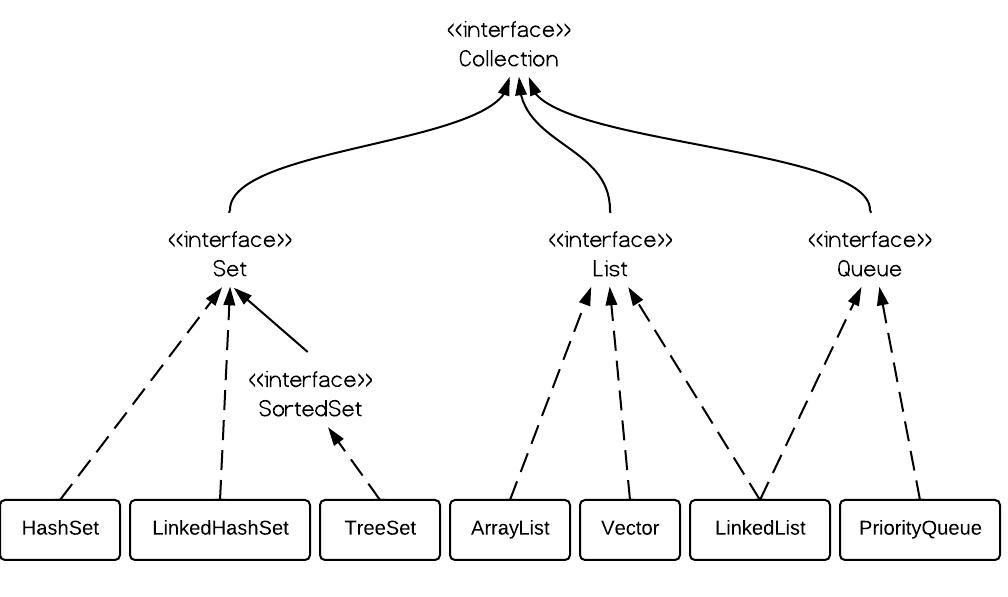
From the hierarchy diagram, they all implement List interface. They are very similar to use. Their main difference is their implementation which causes different performance for different operations.
ArrayList is implemented as a resizable array. As more elements are added to ArrayList, its size is increased dynamically. It's elements can be accessed directly by using the get and set methods, since ArrayList is essentially an array.
LinkedList is implemented as a double linked list. Its performance on add and remove is better than Arraylist, but worse on get and set methods.
Vector is similar with ArrayList, but it is synchronized. ArrayList is a better choice if your program is thread-safe. Because of this, it has an overhead than ArrayList. Normally, most Java programmers use ArrayList instead of Vector because they can synchronize explicitly by themselves.
Vector and ArrayList require space as more elements are added. Vector each time doubles its array size, while ArrayList grow 50% of its size each time.
LinkedList, however, also implements Queue interface which adds more methods than ArrayList and Vector, such as offer(), peek(), poll(), etc.
Note: The default initial capacity of an ArrayList is pretty small. It is a good habit to construct the ArrayList with a higher initial capacity. This can avoid the resizing cost.
In brief, LinkedList should be preferred if:
there are no large number of random access of element
there are a large number of add/remove operations
HashMap vs TreeMap vs LinkedHashMap

All three classes implement the Map interface and offer mostly the same functionality. The most important difference is the order in which iteration through the entries will happen:
HashMap makes absolutely no guarantees about the iteration order. It can (and will) even change completely when new elements are added.
TreeMap is a tree based mapping. Its put/get operations take O(log n) time. It requires items to have some comparison mechanism, either with Comparable or Comparator. TreeMap will iterate according to the "natural ordering" of the keys according to their compareTo() method (or an externally supplied Comparator). It also implements the SortedMap interfacer. It doesn’t use equals() and hashCode() methods for comparison of elements.
LinkedHashMap is very similar to HashMap, but it adds awareness to the order at which items are added (or accessed), so the iteration order is the same as insertion order (or access order, depending on construction parameters)
HashSet Vs TreeSet Vs LinkedHashSet In Java
HashSet is Implemented using a hash table. Elements are not ordered. The add, remove, and contains methods have constant time complexity O(1).
TreeSet is implemented using a tree structure(red-black tree in algorithm book). The elements in a set are sorted, but the add, remove, and contains methods has time complexity of O(log (n)). It offers several methods to deal with the ordered set like first(), last(), headSet(), tailSet(), etc. It doesn’t use equals() and hashCode() methods for comparision of elements.
LinkedHashSet is between HashSet and TreeSet. It is implemented as a hash table with a linked list running through it, so it provides the order of insertion. The time complexity of basic methods is O(1).
Lists, Maps and Sets in Java的更多相关文章
- 使用Maps与Sets处理集合的交差运算
import com.google.common.collect.MapDifference; import com.google.common.collect.Maps; import java.u ...
- Spring EL Lists, Maps example
In this article, we show you how to use Spring EL to get value from Map and List. Actually, the way ...
- Java Garbage Collection Basics--转载
原文地址:http://www.oracle.com/webfolder/technetwork/tutorials/obe/java/gc01/index.html Overview Purpose ...
- HIBERNATE - 符合Java习惯的关系数据库持久化(精华篇)
HIBERNATE - 符合Java习惯的关系数据库持久化 下一页 HIBERNATE - 符合Java习惯的关系数据库持久化 Hibernate参考文档 3.0.4 目录 前言 1. ...
- Guava 集合框架
在本系列中我们首先来学习一些Guava的集合框架,也就是这个package:com.google.common.collect 在这个包下面有一些通用的集合接口和一些相关的类. 集合类型: BiM ...
- G1垃圾收集器官方文档透彻解读【官方解读】
在前几次中已经对G1的理论进行了一个比较详细的了解了,对于G1垃圾收集器最权威的解读肯定得上官网,当咱们将官网的理解透了,那基本上网上对于G1的说明其实最终都是来自于官网,所以接下来会详细来解读Ora ...
- Hibernate4教程六:性能提升和二级缓存
抓取策略(fetching strategy)是指:当应用程序需要在(Hibernate实体对象图的)关联关系间进行导航的时候,Hibernate如何获取关联对象的策略.抓取策略可以在O/R映射的元数 ...
- 005-guava 集合-集合工具类-java.util.Collections中未包含的集合工具[Maps,Lists,Sets],Iterables、Multisets、Multimaps、Tables
一.概述 工具类与特定集合接口的对应关系归纳如下: 集合接口 属于JDK还是Guava 对应的Guava工具类 Collection JDK Collections2:不要和java.util.Col ...
- java基础之 GC
Java程序员在编码过程中通常不需要考虑内存问题,JVM经过高度优化的GC机制大部分情况下都能够很好地处理堆(Heap)的清理问题.以至于许多Java程序员认为,我只需要关心何时创建对象,而回收对象, ...
随机推荐
- 老李分享:持续集成学好jenkins之Git和Maven配置 2
8.检查代码更新并编译 可以通过Poll SCM来设置定时检查编译功能 比如*/5 * * * * 就是每隔5分钟检查一次,如果git仓库中有更新,则执行build操作. 9.使用Maven私服加快下 ...
- 利用<meta http-equiv="refresh" content="0;URL=?id='.$id.'" />一条一条的更新数据
<meta http-equiv="refresh" content="0;URL=?id='.$id.'" /> 解释:页面定时刷新,后面加url ...
- SpringMVC基础学习(一)—初识SpringMVC
一.HelloWorld 1.导入SpringMVC所需的jar包 2.配置web.xml 配置DispatcherServlet.DispatcherServlet默认加载/ ...
- java 基础知识八 正则表达式
java 基础知识八 正则表达式 正则表达式是一种可以用于模式匹配和替换的规范,一个正则表达式就是由普通的字符(例如字符a到z)以及特殊字符(元字符)组成的文字模式,它 用以描述在查找文字主体时待 ...
- Java 基础知识总结
作者QQ:1095737364 QQ群:123300273 欢迎加入! 1.数据类型: 数据类型:1>.基本数据类型:1).数值型: 1}.整型类型(byte 8位 (by ...
- 使用纯CSS方案,解决垂直居中
CSS是HTML元素的剪刀手,它极度的丰富了web页面的修饰.在众多CSS常见的样式需求中,有一奇葩式的存在[垂直居中],因为不管是从逻辑实现方面还是从正常需求量来讲,这都没理由让这个需求在实践过程中 ...
- ajax发送异步请求
一:得到XMLHttpRequest对象 ajax其实只需要学习XMLHttpRequest一个对象 大多数浏览器都支持: var xmlHttp = new XMLHttprequest(); IE ...
- 防止微信浏览器video标签全屏的问题
在微信浏览器里面使用video标签,会自动变成全屏,改成下面就好了,起码可以在video标签之上加入其他元素. <video id="videoID" webkit-play ...
- 用惯了Task,你应该也需要了解它的内部调度机制TaskScheduler
平时我们在用多线程开发的时候少不了Task,确实task给我们带来了巨大的编程效率,在Task底层有一个TaskScheduler,它决定了task该如何执行,而在 .net framework中有两 ...
- 让Dev C++支持C++11
打开编译选项