
spring IOC 装配一个bean
1.0属性注入
新建一个people类
package com.java.test3;

/**

 * @author nidegui

 * @create 2019-06-22 14:45

 */

public class People {

    private Integer id;

    private String name;

    private String age;

    public Integer getId() {

        return id;

    }

    public void setId(Integer id) {

        this.id = id;

    }

    public String getName() {

        return name;

    }

    public void setName(String name) {

        this.name = name;

    }

    public String getAge() {

        return age;

    }

    public void setAge(String age) {

        this.age = age;

    }

    @Override

    public String toString() {

        return "People{" +

                "id=" + id +

                ", name='" + name + '\'' +

                ", age='" + age + '\'' +

                '}';

    }

}
装配在bean里面
<?xml version="1.0" encoding="UTF-8"?>

<beans xmlns="http://www.springframework.org/schema/beans"

    xmlns:xsi="http://www.w3.org/2001/XMLSchema-instance"

    xsi:schemaLocation="http://www.springframework.org/schema/beans

        http://www.springframework.org/schema/beans/spring-beans.xsd">

	<bean id="helloWorld" class="com.java.test.Helloworld"></bean>

  	<bean id="people" class="com.java.test3.People"></bean>

	<!--属性注入-->

	<bean id="people2" class="com.java.test3.People">

		<property name="name" value="nidegui"></property>

		<property name="id" value="1"></property>

		<property name="age" value="12"></property>

	</bean>

</beans>
测试:
package com.java.test3;

import org.springframework.context.ApplicationContext;

import org.springframework.context.support.ClassPathXmlApplicationContext;

/**

 * @author nidegui

 * @create 2019-06-22 14:47

 */

public class Test {

    public static void main(String[] args) {

        /*属性注入*/

       ApplicationContext ac = new ClassPathXmlApplicationContext("bean.xml");

        People people =(People) ac.getBean("people2");

        System.out.println(people);

    }

}

2.0构造函数注入
1.0通过类型注入
在实体中添加构造方法
    public People(Integer id, String name, String age) {

        this.id = id;

        this.name = name;

        this.age = age;

    }

}
bean.xml里面配置文件
<?xml version="1.0" encoding="UTF-8"?>

<beans xmlns="http://www.springframework.org/schema/beans"

    xmlns:xsi="http://www.w3.org/2001/XMLSchema-instance"

    xsi:schemaLocation="http://www.springframework.org/schema/beans

        http://www.springframework.org/schema/beans/spring-beans.xsd">

	<!--构造方法通过类型注入-->

  	<bean id="people3" class="com.java.test3.People">

		<constructor-arg type="java.lang.Integer" value="1"></constructor-arg>

		<constructor-arg type="java.lang.String" value="nideg"></constructor-arg>

		<constructor-arg type="java.lang.String" value="15"></constructor-arg>

	</bean>

	<!--属性注入-->

	<!--<bean id="people2" class="com.java.test3.People">

		<property name="name" value="nidegui"></property>

		<property name="id" value="1"></property>

		<property name="age" value="12"></property>

	</bean>-->

</beans>

3.0按照索引注入
<?xml version="1.0" encoding="UTF-8"?>

<beans xmlns="http://www.springframework.org/schema/beans"

    xmlns:xsi="http://www.w3.org/2001/XMLSchema-instance"

    xsi:schemaLocation="http://www.springframework.org/schema/beans

        http://www.springframework.org/schema/beans/spring-beans.xsd">

	<!--构造方法类型注入-->

  	<bean id="people3" class="com.java.test3.People">

		<constructor-arg type="java.lang.Integer" value="1"></constructor-arg>

		<constructor-arg type="java.lang.String" value="nideg"></constructor-arg>

		<constructor-arg type="java.lang.String" value="15"></constructor-arg>

	</bean>

	<!--索引注入,按照构造方法的顺序注入-->

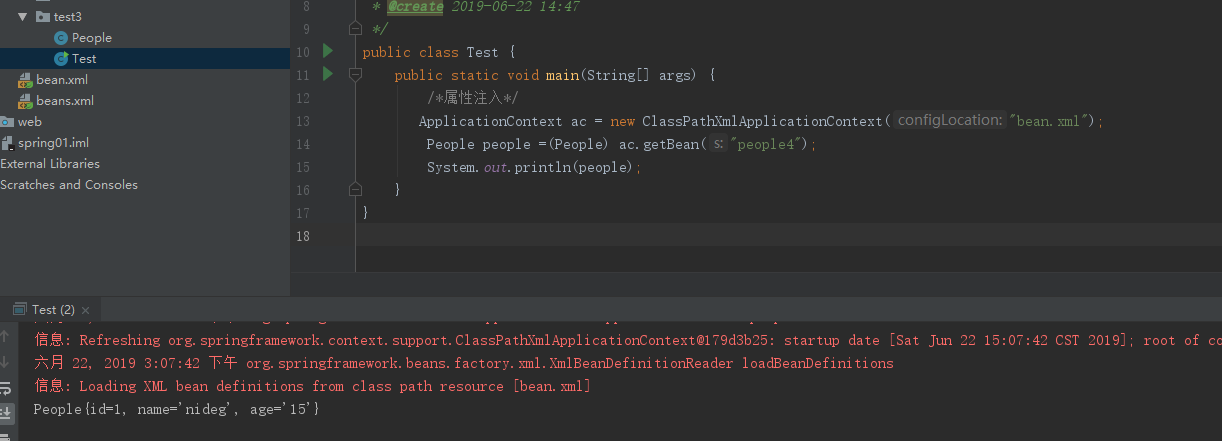
	<bean id="people4" class="com.java.test3.People">

		<constructor-arg index="0" value="1"></constructor-arg>

		<constructor-arg index="1" value="nideg"></constructor-arg>

		<constructor-arg index="2" value="15"></constructor-arg>

	</bean>

	<!--属性注入-->

	<!--<bean id="people2" class="com.java.test3.People">

		<property name="name" value="nidegui"></property>

		<property name="id" value="1"></property>

		<property name="age" value="12"></property>

	</bean>-->

</beans>
3.0工厂方法注入
创建一个工厂
package com.java.test3;

/**

 * @author nidegui

 * @create 2019-06-22 15:15

 */

public class Factory {

    /**

     * 定义一个非静态工厂

     * @return

     */

    public People createFactoty(){

        People p=new People();

        p.setId(1);

        p.setName("ni");

        p.setAge("25");

        return p;

    }

}
注入bena.xml中
<?xml version="1.0" encoding="UTF-8"?>

<beans xmlns="http://www.springframework.org/schema/beans"

    xmlns:xsi="http://www.w3.org/2001/XMLSchema-instance"

    xsi:schemaLocation="http://www.springframework.org/schema/beans

        http://www.springframework.org/schema/beans/spring-beans.xsd">

	<!--构造方法注入-->

  	<bean id="people3" class="com.java.test3.People">

		<constructor-arg type="java.lang.Integer" value="1"></constructor-arg>

		<constructor-arg type="java.lang.String" value="nideg"></constructor-arg>

		<constructor-arg type="java.lang.String" value="15"></constructor-arg>

	</bean>

	<!--索引注入,按照构造方法的顺序注入-->

	<bean id="people4" class="com.java.test3.People">

		<constructor-arg index="0" value="1"></constructor-arg>

		<constructor-arg index="1" value="nideg"></constructor-arg>

		<constructor-arg index="2" value="15"></constructor-arg>

	</bean>

	<!--属性注入-->

	<!--<bean id="people2" class="com.java.test3.People">

		<property name="name" value="nidegui"></property>

		<property name="id" value="1"></property>

		<property name="age" value="12"></property>

	</bean>-->

	<!--工厂模式注入-->

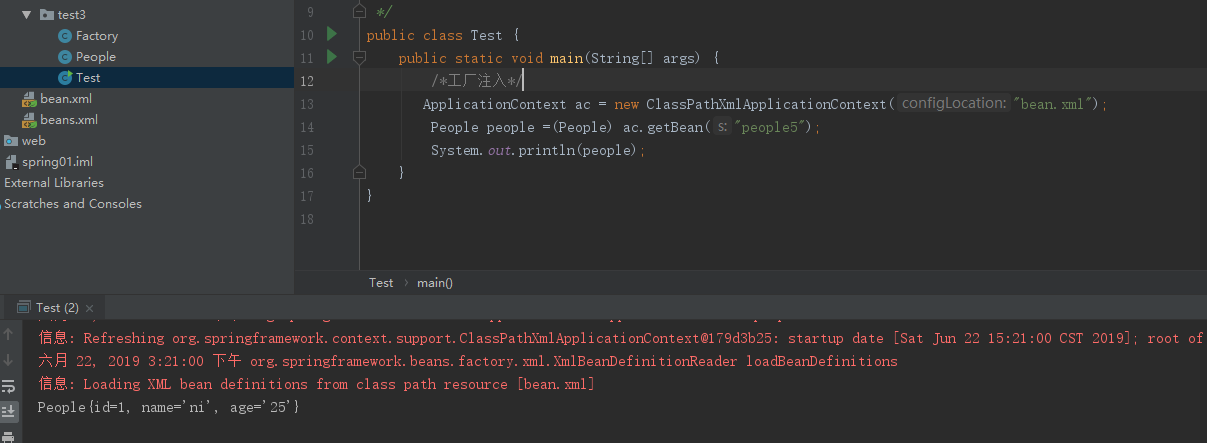
	<bean id="peopeFactoty" class="com.java.test3.Factory"></bean>

	<bean id="people5" factory-bean="peopeFactoty" factory-method="createFactoty"></bean>

</beans>
工厂模式的静态方法注入
 public static People createFactoty2(){

        People p=new People();

        p.setId(1);

        p.setName("ni");

        p.setAge("25");

        return p;

    }
<?xml version="1.0" encoding="UTF-8"?>

<beans xmlns="http://www.springframework.org/schema/beans"

    xmlns:xsi="http://www.w3.org/2001/XMLSchema-instance"

    xsi:schemaLocation="http://www.springframework.org/schema/beans

        http://www.springframework.org/schema/beans/spring-beans.xsd">

	<!--构造方法注入-->

  	<bean id="people3" class="com.java.test3.People">

		<constructor-arg type="java.lang.Integer" value="1"></constructor-arg>

		<constructor-arg type="java.lang.String" value="nideg"></constructor-arg>

		<constructor-arg type="java.lang.String" value="15"></constructor-arg>

	</bean>

	<!--索引注入,按照构造方法的顺序注入-->

	<bean id="people4" class="com.java.test3.People">

		<constructor-arg index="0" value="1"></constructor-arg>

		<constructor-arg index="1" value="nideg"></constructor-arg>

		<constructor-arg index="2" value="15"></constructor-arg>

	</bean>

	<!--属性注入-->

	<!--<bean id="people2" class="com.java.test3.People">

		<property name="name" value="nidegui"></property>

		<property name="id" value="1"></property>

		<property name="age" value="12"></property>

	</bean>-->

	<!--工厂模式注入-->

	<bean id="peopeFactoty" class="com.java.test3.Factory"></bean>

	<bean id="people5" factory-bean="peopeFactoty" factory-method="createFactoty"></bean>

	           <!--静态方法注入-->

	<bean id ="people6" class="com.java.test3.Factory" factory-method="createFactoty2"></bean>

</beans>
spring IOC 装配一个bean的更多相关文章
- Spring IOC容器创建bean过程浅析
1. 背景 Spring框架本身非常庞大,源码阅读可以从Spring IOC容器的实现开始一点点了解.然而即便是IOC容器,代码仍然是非常多,短时间内全部精读完并不现实 本文分析比较浅,而完整的IOC ...
- spring IOC容器实例化Bean的方式与RequestContextListener应用
spring IOC容器实例化Bean的方式有: singleton 在spring IOC容器中仅存在一个Bean实例,Bean以单实例的方式存在. prototype 每次从容器中调用Bean时, ...
- spring-framework-中文文档一:IoC容器、介绍Spring IoC容器和bean
5. IoC容器 5.1介绍Spring IoC容器和bean 5.2容器概述 本章介绍Spring Framework实现控制反转(IoC)[1]原理.IoC也被称为依赖注入(DI).它是一个过程, ...
- Spring IoC 容器和 bean 对象
程序的耦合性: 耦合性(Coupling),又叫耦合度,是对模块间关联程度的度量.耦合的强弱取决于模块间接口的复杂性.调用模块的方式以及通过界面传送数据的多少.模块间的耦合度是指模块之间的依赖关系,包 ...
- Spring IoC介绍与Bean的使用
1. 介绍 IoC IoC-Inversion of Control,即"控制反转",它不是什么技术,而是一种设计思想.在 Java 开发中, IoC意味着将设计好的对象交给容 ...
- Spring IOC容器中Bean的生命周期
1.IOC容器中Bean的生命周期 构造器函数 设置属性 初始化函数(在Bean配置中 init-method) 使用Bean 结束时关闭容器(在Bean中配置destroy-method) 2.Be ...
- spring IOC 容器中 Bean 的生命周期
IOC 容器中 Bean 的生命周期: 1.通过构造器或工厂方法创建 Bean 实例 2.为 Bean 的属性设置值和对其他 Bean 的引用 3.调用 Bean 后置处理器接口(BeanPostPr ...
- spring IOC装配Bean(注解方式)
1 Spring的注解装配Bean (1) Spring2.5 引入使用注解去定义Bean @Component 描述Spring框架中Bean (2) Spring的框架中提供了与@Componen ...
- Spring Ioc介绍和Bean的实例化
一.IoC:Inverse of Control 控制反转 // 依赖注入 Dependency Injection 控制:某一接口具体实现类的选择权 反转:从调用者中移除控制权,转交第三方 ...
随机推荐
- hdu 3657最大点权独立集变形(方格取数变形)
/* 分奇偶为二部图,s与奇建图,t与偶建图,权值为当前数的值,如果遇到必取的权值置为inf. 奇偶建边为相邻的权值为2*(x&y):所有数的值-最小点全覆盖. 置为inf意为不能割掉.奇偶边 ...
- M - Substrings
You are given a number of case-sensitive strings of alphabetic characters, find the largest string X ...
- OceanBase架构浅析(一)
简介 OceanBase是阿里集团研发的可扩展的关系数据库,实现了数千亿条记录.数百TB数据上的跨行跨表事务,截止到2012年8月,支持了收藏夹.直通车报表.天猫评价等OLTP和OLAP在线业务,线上 ...
- fixed_date , 赋权技巧 ,procedure执行方式, PL/SQL注意的地方
本文讨论4个知识点, 1. fixed_date参数 2. 赋权技巧 3. procedure执行的方式 4. PL/SQL中要注意的几个地方 fixed_date参数 客户想修改oracle的 系统 ...
- java.net.MalformedURLException: unknown protocol: c 这个错一般有两种原因导致: 1、URL协议、格式或者路径错误,
java.net.MalformedURLException: unknown protocol: c这个错一般有两种原因导致:1.URL协议.格式或者路径错误, 好好检查下你程序中的代码如果是路径问 ...
- [WebView学习之二]:使用Web Apps 支持不同分辨率屏
上一篇我们学习了(1.[WebView学习之中的一个]:Web Apps简单介绍),今天我们来继续学习. (博客地址:http://blog.csdn.net/developer_jiangqq),转 ...
- Makefile 文件怎么写
跟我一起写Makefile:MakeFile介绍 Makefile 使用总结 1. make 命令与 Makefile 文件 在 Linux 平台,执行 make 命令时,会在当前目录下寻找 Make ...
- B1922 [Sdoi2010]大陆争霸 最短路
我一直都不会dij的堆优化,今天搞了一下...就是先弄一个优先队列,存每个点的数据,然后这个题就加了一点不一样的东西,每次的最短路算两次,一次是自己的最短路,另一次是机关的最短路,两者取最大值才是该点 ...
- python 46 盒模型 与盒模型布局
一:盒模型 1. 盒模型的概念 广义盒模型:文档中所有功能性及内容性标签,及文档中显示性标签 侠义盒模型:文档中以块级形式存在的标签(块级标签拥有盒模型100%特性且最常用) 盒模型组成:margi ...
- EditPlus 4:设置字体
打开软件上面菜单栏点击Tools,在此下拉栏点击Configure User Tools,在弹出的设置框在左边框框中找到General->Fonts,显示的左边框即为字体框,具体如图: