
java之线程(线程的创建方式、java中的Thread类、线程的同步、线程的生命周期、线程之间的通信)
CPU:10核 主频100MHz
1核 主频 3GHz
那么哪一个CPU比较好呢?
CPU核不是越多越好吗?并不一定。主频用于衡量GPU处理速度的快慢,举个例子10头牛运送货物快还是1架飞机运算货物快?显然是1架飞机,因此1核3GHz的CPU较好,当然,在相同主频的情况下,CPU当然是越多越好。
在Java中,JVM虚拟机允许运行多个线程,他通过java.lang.Thread类来实现
Thread类特性:
- 每个线程都是通过某个特定的Thread对象的run()方法来完成操作的,经常把run()方法主体称为线程体;
- 通过该Thread()对象的start()方法来调用这个线程;
构造方法:
- Thread():创建新的Thread对象;
- Thread(String threadname):创建线程并为其指定线程实例名;
- Thread(Runnable target):指定创建线程的目标对象,它实现了Runnable接口中的run方法;
- Thread(Runnable target,String name):创建新的Thread对象;
一、创建线程的两种方式:
1.继承Thread类
- 定义子类并继承Thread类
- 子类中重写Thread类中run方法
- 创建Thread子类对象,即创建了线程对象
- 调用线程对象的start方法:启动线程,调用run方法
package testThread;

public class TestThread extends Thread{

    public void run() {

        System.out.println("多线程运行的代码");

        for(int i=0;i<10;i++) {

            System.out.println("这是多线程的逻辑代码");

        }

    }

}
package testThread;

public class Test {

    public static void main(String[] args) {

        Thread t0 = new TestThread();

        //在开启了线程后,线程与main()方法并行运行

        t0.start();//启动线程

    }

}
2.实现Runnable接口
- 定义子类,实现Runnable接口
- 子类中重写Runnable接口中的run方法
- 通过Thread类含参构造器创建线程对象
- 将Runanable接口的子类对象作为实际参数传递给Thread类的构造方法中
- 调用Thread类的start方法:开启线程、调用Runnable子类接口的run方法
package testThread;

public class TestRunnable implements Runnable{

    @Override

    public void run() {

        // TODO Auto-generated method stub

        System.out.println(Thread.currentThread().getName()+"开始运行");

        for(int i=0;i<10;i++) {

            System.out.println("这是多线程的逻辑代码");

        }

    }

}
package testThread;

public class Test {

    public static void main(String[] args) {

        Thread t0 = new Thread(new TestRunnable());

        t0.start();

        Thread t1 = new Thread(new TestRunnable(),"线程t1");

        t1.start();

    }

}
对于这种方式创建线程,可以给每个线程进行命名,否则默认为Thread-num。
利用实现方式:避免了单继承的局限性、多个线程可以共享同一个接口实现类对象,非常适合多个相同线程来处理同一份资源。
二、Thread类的相关方法
(1)基础方法
void start():启动线程
run():线程在被调度时执行的操作名称
String getName():返回线程的名称
void setName(String name):设置线程的名称
static currentThread():返回当前线程
(2)优先级方法
- 数字越大,优先级越高:MAX_PRIORITY(10)、MIN_PRIORITY(1)、NORM_PRIORITY(5)
getPriority():获得优先级
setPriority(int newPriority):设置优先级
线程创建时继承父线程的优先级
(3)其它方法
static void yield():线程让步
- 暂停当前正在执行的线程,把执行机会让给优先级相同或更高的线程;
- 若队列中没有同优先级的线程,忽略此方法;
join():当某个程序执行流中调用其它线程的join()方法时,调用线程将被阻塞,直到join()方法加入的join线程执行完毕为止。
- 低优先级的线程也可以获得执行
static void sleep(long millis):指定时间,毫秒
- 令当前活动线程在指定时间段内放弃对CPU控制,使其它线程有机会被执行,时间到后排队;
- 抛出InterruptedException异常
stop():强制线程生命周期结束
boolean isAlive():判断线程是否还活着
三、线程的生命周期
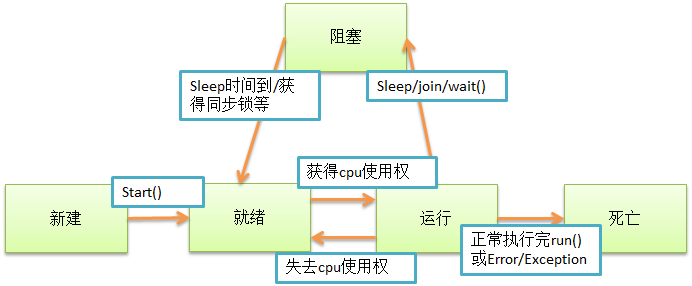
JDK中用Thread.State来表示线程的状态,包括:
新建:声明并实例化之后;
就绪:执行start之后;
运行:得到cpu的使用权,run()方法开始运行;
阻塞:run()方法停止执行,处于等待状态;
死亡:线程完成了全部工作或被提前终止;
四、线程的同步
问题:假设账户上有4000,现在有两个线程,分别各取2000,由于这两个线程是并行的,因此都可能取成功,此时账户上就是-1000了,这显然是不合法的。因此,要引入线程的同步,所谓同步,并不是指同时运行,而是指协同步伐,也就是线程按先后顺序依次执行,这样当取出2000后,账户剩余1000,再进行取2000就不会成功了。
package testThread;

public class Test2 {

    public static void main(String[] args) {

        Account account = new Account();

        User u_weChat = new User(account,);

        User u_zhifubao = new User(account,);

        Thread wechat = new Thread(u_weChat,"微信");

        Thread zhifubao = new Thread(u_zhifubao,"支付宝");

        wechat.start();

        zhifubao.start();

    }

}

class Account{

    public static int money = ;

    public void get(int m) {

        String thread = Thread.currentThread().getName();

        System.out.println("正在运行:"+thread);

        if(money<m) {

            System.out.println(thread+"操作-账户金额不足:" + money);

        }else {

            System.out.println(thread+"操作-账户原有金额:"+money);

            System.out.println(thread+"操作-取款金额:"+m);

            money = money - m;

            System.out.println(thread+"操作-取款后的余额:"+money);

        }

    }

}

class User implements Runnable{

    Account account;

    int money;

    public User(Account account,int money) {

        this.account = account;

        this.money = money;

    }

    @Override

    public void run() {

        // TODO Auto-generated method stub

        account.get();

    }

}
输出:
正在运行:微信
正在运行:支付宝
微信操作-账户原有金额:3000
支付宝操作-账户原有金额:3000
支付宝操作-取款金额:2000
支付宝操作-取款后的余额:1000
微信操作-取款金额:2000
微信操作-取款后的余额:-1000
此时,正如以上我们所说的,取款不合法了,那么如何解决呢?可以给方法加上同步锁。但是,需要注意的是:
package testThread;

public class Test2 {

    public static void main(String[] args) {

        Account account = new Account();

        Account account1 = new Account();
        //意思是这里创建了不同的Account对象,获得的锁是不同对象的锁

        User u_weChat = new User(account,);

        User u_zhifubao = new User(account1,);

        Thread wechat = new Thread(u_weChat,"微信");

        Thread zhifubao = new Thread(u_zhifubao,"支付宝");

        wechat.start();

        zhifubao.start();

    }

}

class Account{

    public static int money = ;

    //在普通方法上加synchronized,锁的是整个对象,而不是某一个方法

    //不同的对象就是不同的锁

    public synchronized void wGet(int m) {

        String thread = Thread.currentThread().getName();

        System.out.println("正在运行:"+thread);

        if(money<m) {

            System.out.println(thread+"操作-账户金额不足:" + money);

        }else {

            System.out.println(thread+"操作-账户原有金额:"+money);

            System.out.println(thread+"操作-取款金额:"+m);

            money = money - m;

            System.out.println(thread+"操作-取款后的余额:"+money);

        }

    }

    public synchronized void zGet(int m) {

        String thread = Thread.currentThread().getName();

        System.out.println("正在运行:"+thread);

        if(money<m) {

            System.out.println(thread+"操作-账户金额不足:" + money);

        }else {

            System.out.println(thread+"操作-账户原有金额:"+money);

            System.out.println(thread+"操作-取款金额:"+m);

            money = money - m;

            System.out.println(thread+"操作-取款后的余额:"+money);

        }

    }

}

class User implements Runnable{

    Account account;

    int money;

    public User(Account account,int money) {

        this.account = account;

        this.money = money;

    }

    @Override

    public void run() {

        // TODO Auto-generated method stub

        if(Thread.currentThread().getName().equals("微信")) {

            account.wGet(money);

        }else {

            account.zGet(money);

        }

    }

}
输出:
正在运行:微信
正在运行:支付宝
微信操作-账户原有金额:3000
微信操作-取款金额:2000
支付宝操作-账户原有金额:3000
微信操作-取款后的余额:1000
支付宝操作-取款金额:2000
支付宝操作-取款后的余额:-1000
因为此时不同对象获得的是不同的锁,所以这种方式并不行,那么如何进行改动呢?只需要使用同一个对象即可,即:
        Account account = new Account();

        User u_weChat = new User(account,);

        User u_zhifubao = new User(account,);
此时输出:
正在运行:微信
微信操作-账户原有金额:3000
微信操作-取款金额:2000
微信操作-取款后的余额:1000
正在运行:支付宝
支付宝操作-账户金额不足:1000
同时,还可以进一步简化:
    public synchronized void get(int m) {

        String thread = Thread.currentThread().getName();

        System.out.println("正在运行:"+thread);

        if(money<m) {

            System.out.println(thread+"操作-账户金额不足:" + money);

        }else {

            System.out.println(thread+"操作-账户原有金额:"+money);

            System.out.println(thread+"操作-取款金额:"+m);

            money = money - m;

            System.out.println(thread+"操作-取款后的余额:"+money);

        }

    }
在最后调用时,只需要在run()方法中调用account.get()即可,不用将两个方法分开来写。
获得锁的线程会执行完毕后,才将锁交给下一个线程继续执行。
对于在静态方法上加锁:
package testThread;

public class Test2 {

    public static void main(String[] args) {

        Account account = new Account();

        Account account1 = new Account();
        //意思是这里虽然创建了两个不同的Account对象,但是获得的锁是同一个锁

        User u_weChat = new User(account,);

        User u_zhifubao = new User(account1,);

        Thread wechat = new Thread(u_weChat,"微信");

        Thread zhifubao = new Thread(u_zhifubao,"支付宝");

        wechat.start();

        zhifubao.start();

    }

}

class Account{

    public static int money = ;

    //静态方法加同步锁之后,对于所有的对象都是同一个锁

    public static synchronized void get(int m) {

        String thread = Thread.currentThread().getName();

        System.out.println("正在运行:"+thread);

        if(money<m) {

            System.out.println(thread+"操作-账户金额不足:" + money);

        }else {

            System.out.println(thread+"操作-账户原有金额:"+money);

            System.out.println(thread+"操作-取款金额:"+m);

            money = money - m;

            System.out.println(thread+"操作-取款后的余额:"+money);

        }

    }

}

class User implements Runnable{

    Account account;

    int money;

    public User(Account account,int money) {

        this.account = account;

        this.money = money;

    }

    @Override

    public void run() {

        // TODO Auto-generated method stub

        account.get(money);

    }

}
对于这种方式,即使传入的是该类的不同对象,仍然获得的是同一个锁。
正在运行:微信
微信操作-账户原有金额:3000
微信操作-取款金额:2000
微信操作-取款后的余额:1000
正在运行:支付宝
支付宝操作-账户金额不足:1000
还有一种方式是利用同步锁修饰代码块:
package testThread;

public class Test2 {

    public static void main(String[] args) {

        Account account = new Account();

        Account account1 = new Account();

        User u_weChat = new User(account,);

        User u_zhifubao = new User(account1,);

        Thread wechat = new Thread(u_weChat,"微信");

        Thread zhifubao = new Thread(u_zhifubao,"支付宝");

        wechat.start();

        zhifubao.start();

    }

}

class Account{

    public static int money = ;

    public void get2(int m) {
        //用this锁代码块是代表当前的对象,如果在其它方法中也有synchronized(this)的代码块用的是同一个同步锁

        synchronized (this) {

            String thread = Thread.currentThread().getName();

            System.out.println("正在运行:"+thread);

            if(money<m) {

                System.out.println(thread+"操作-账户金额不足:" + money);

            }else {

                System.out.println(thread+"操作-账户原有金额:"+money);

                System.out.println(thread+"操作-取款金额:"+m);

                money = money - m;

                System.out.println(thread+"操作-取款后的余额:"+money);

            }

        }

    }

}

class User implements Runnable{

    Account account;

    int money;

    public User(Account account,int money) {

        this.account = account;

        this.money = money;

    }

    @Override

    public void run() {

        // TODO Auto-generated method stub

        account.get2(money);

    }

}
输出:
正在运行:支付宝
支付宝操作-账户原有金额:3000
支付宝操作-取款金额:2000
支付宝操作-取款后的余额:1000
正在运行:微信
微信操作-账户金额不足:1000
想要不同的对象有不同的锁:
package testThread;

public class Test2 {

    public static void main(String[] args) {

        Account account = new Account();

        Account account1 = new Account();

        User u_weChat = new User(account,);

        User u_zhifubao = new User(account1,);

        Thread wechat = new Thread(u_weChat,"微信");

        Thread zhifubao = new Thread(u_zhifubao,"支付宝");

        wechat.start();

        zhifubao.start();

    }

}

class Account{

    public static int money = ;

    public void get3(int m,Account a) {

        //表示通过方法的参数传递进来的对象的代码块加了同步锁

        //不同的对象有不同的同步锁

        synchronized (a) {

            String thread = Thread.currentThread().getName();

            System.out.println("正在运行:"+thread);

            if(money<m) {

                System.out.println(thread+"操作-账户金额不足:" + money);

            }else {

                System.out.println(thread+"操作-账户原有金额:"+money);

                System.out.println(thread+"操作-取款金额:"+m);

                money = money - m;

                System.out.println(thread+"操作-取款后的余额:"+money);

            }

        }

    }

}

class User implements Runnable{

    Account account;

    int money;

    public User(Account account,int money) {

        this.account = account;

        this.money = money;

    }

    @Override

    public void run() {

        // TODO Auto-generated method stub

        account.get3(money,account);

    }

}
输出:
正在运行:微信
正在运行:支付宝
微信操作-账户原有金额:3000
支付宝操作-账户原有金额:3000
微信操作-取款金额:2000
微信操作-取款后的余额:1000
支付宝操作-取款金额:2000
支付宝操作-取款后的余额:-1000
此时,这种加锁方式就没有效果了,与最开始的那种是一样的。
总而言之,要想使加锁有效果,必须获得的是同一个对象的锁。
五、线程之间的通信
wait():令当前线程挂起并放弃CPU、同步资源,使别的线程可访问并修改共享资源,而当前线程排队等候再次对资源的访问。
notify():唤醒正在排队等待同步资源的线程中优先级较高者结束等待。
notifyAll():唤醒正在排队等待资源的所有线程结束等待。
java.lang.Object提供的三个方法只有在sychronized方法或synchronized代码块中才能使用。
对于第四节提到到最后一种方式,只要将使用同一个Account对象,加锁机制就还是成功。但是我们会发现,之前的结果都是微信在支付宝之前进行操作,假设我们要让支付宝先操作,又应该怎么办呢?这时就需要利用线程之间的通信。
package testThread;

public class Test2 {

    public static void main(String[] args) {

        Account account = new Account();

        User u_weChat = new User(account,);

        User u_zhifubao = new User(account,);

        Thread wechat = new Thread(u_weChat,"微信");

        Thread zhifubao = new Thread(u_zhifubao,"支付宝");

        wechat.start();

        zhifubao.start();

    }

}

class Account{

    public static int money = ;

    public void get4(int m,Account a) throws InterruptedException {

        //表示通过方法的参数传递进来的对象的代码块加了同步锁

        //不同的对象有不同的同步锁

        synchronized (a) {

            String thread = Thread.currentThread().getName();

            //如果是微信操作,则暂时挂起,让支付宝先操作

            if (thread.equals("微信")){

                try {

                    a.wait();

                } catch (InterruptedException e) {

                    // TODO Auto-generated catch block

                    e.printStackTrace();

                }

            }

//            System.out.println("正在运行:"+thread);

            if(money<m) {

                System.out.println(thread+"操作-账户金额不足:" + money);

            }else {

                System.out.println(thread+"操作-账户原有金额:"+money);

                System.out.println(thread+"操作-取款金额:"+m);

                money = money - m;

                System.out.println(thread+"操作-取款后的余额:"+money);

            }

            if (thread.equals("支付宝")){

                a.notify();

            }

        }

    }

}

class User implements Runnable{

    Account account;

    int money;

    public User(Account account,int money) {

        this.account = account;

        this.money = money;

    }

    @Override

    public void run() {

        // TODO Auto-generated method stub

        try {

            account.get4(money,account);

        } catch (InterruptedException e) {

            // TODO Auto-generated catch block

            e.printStackTrace();

        }

    }

}
我们先让线程为“微信”的暂时挂起,先执行其它的,也就是支付宝,然后当支付宝执行完毕之后告知微信,这样就可以了。
输出:
支付宝操作-账户原有金额:3000
支付宝操作-取款金额:2000
支付宝操作-取款后的余额:1000
微信操作-账户金额不足:1000
这时,我们又想到,假设我们现在传入的是不同的Account对象呢?
我们先看下输出结果:
支付宝操作-账户原有金额:3000
支付宝操作-取款金额:2000
支付宝操作-取款后的余额:1000
程序一直在运行(这是我在notify if语句之前加的)
这说明了什么?支付宝运行结束后并没有成功告知微信,微信一直处于等待状态,其原因在于它们拥有的是不同对象的锁,因此之间不能通信。
java之线程(线程的创建方式、java中的Thread类、线程的同步、线程的生命周期、线程之间的通信)的更多相关文章
- Java:多线程概述与创建方式
目录 Java:多线程概述与创建方式 进程和线程 并发与并行 多线程的优势 线程的创建和启动 继承Thread类 start()和run() 实现Runnable接口 实现Callable接口 创建方 ...
- 【多线程】创建线程方式一:继承Thread类
创建线程方式一:继承Thread类 代码示例: /** * @Description 继承Thread类,重写run方法,调用start开启线程 * @Author hzx * @Date 2022- ...
- java多线程的两种创建方式
方式一:继承Thread类 1.创建一个继承于Thread类的子类 2.重写Thread类的run()方法---> 将此线程执行的操作声明在run()中 3.创建Thread类的子类的对象 4. ...
- 编写Java程序,创建Dota游戏中的兵营类,兵营类有一个类成员变量count、一个实例变量name和另一个实例变量selfCount。
返回本章节 返回作业目录 需求说明: 创建Dota游戏中的兵营类 兵营类有一个类成员变量count.一个实例变量name和另一个实例变量selfCount. count表示的是兵营已经创建士兵的总数: ...
- 多线程——Java中继承Thread类与实现Runnable接口的区别
线程我只写过继承Thread类的,后来知道java多线程有三种方式,今天首先比较一下常用的继承Thread类和实现Runnable接口的区别. 按着Ctrl键进入Thread之后,发现Thread类也 ...
- 多线程创建的方式一(继承Thread类)
1 package multithread; 2 3 /* 4 * 如何创建一个线程呢? 5 * 6 * 创建线程方式一:继承Thread类. 7 * 8 * 步骤: 9 * 1,定义一个类继承Thr ...
- Java线程的实现/创建方式
1.继承Thread类: Thread 类本质上是实现了 Runnable 接口的一个实例,代表一个线程的实例. 启动线程的唯一方法就是通过 Thread 类的 start()实例方法. start( ...
- [原创]java WEB学习笔记94:Hibernate学习之路---session 的管理,Session 对象的生命周期与本地线程绑定
本博客的目的:①总结自己的学习过程,相当于学习笔记 ②将自己的经验分享给大家,相互学习,互相交流,不可商用 内容难免出现问题,欢迎指正,交流,探讨,可以留言,也可以通过以下方式联系. 本人互联网技术爱 ...
- day 33 什么是线程? 两种创建方式. 守护线程. 锁. 死锁现象. 递归锁. GIL锁
一.线程 1.进程:资源的分配单位 线程:cpu执行单位(实体) 2.线程的创建和销毁开销特别小 3.线程之间资源共享,共享的是同一个进程中的资源 4.线程之间不是隔离的 5.线程可不需 ...
随机推荐
- Linux安装redis数据库
这几天在搞redis数据库,花了好大功夫,才成功安装在Linux上,这里将自己的安装步骤分享出来,同时也做个记录,备忘. 新人一枚,不对之处,请多指教! 首先登陆Linux服务器 Linux里,我习惯 ...
- JavaScript笔记三
1.数据类型 - JS中一共分成六种数据类型 - String 字符串 - Number 数值 - Boolean 布尔值 - Null 空值 - Undefined 未定义 - Object 对象 ...
- JavaScript基础目录
一.JavaScript简介 1.JavaScript用途 2.JavaScript的诞生 3.JavaScript从丑小鸭到金凤凰 4.JavaScript非常好学 5.学习方法 二.Hello W ...
- 二叉查找树的平衡(DSW算法)
树适合于表示某些领域的层次结构(比如Linux的文件目录结构),使用树进行查找比使用链表快的多,理想情况下树的查找复杂度O(log(N)),而链表为O(N),但理想情况指的是什么情况呢?一般指树是完全 ...
- Spring 框架基础(05):事务管理机制,和实现方式
本文源码:GitHub·点这里 || GitEE·点这里 一.Spring事务管理 1.基础描述 Spring事务管理的本质就是封装了数据库对事务支持的操作,使用JDBC的事务管理机制,就是利用jav ...
- adb查看Android app包名
1. 确保电脑已经安装了adb.exe文件 2. 使用USB连接你的手机到电脑上,输入下图所示的命令后按下回车键:adb devices 3. 使用手机打开某个应用程序 4.回到命令号窗口,输入代码如 ...
- Vue项目解析
各个文件夹 node_modules:用来放环境依赖 public:用来放公共资源,里面的index.html文件,就是初始的挂载点.被app.vue给取代了. src:放各种资源的. assets: ...
- Linux发展历史(简略)
LINUX UNIX历史发展 1969肯 汤姆森在DEC PDP-7机器上开发出了UNIX系统 1971肯 汤姆森的同事丹尼斯 里奇发明了C语言 1973UNIX系统绝大部分用C语言重写,为提高UNI ...
- 大白话OSI七层协议
目录 一.物理层 二.数据链路层 2.1 以太网协议 2.2 Mac地址 2.3 广播地址 三.网络层 3.1 IP协议详解 3.1.1 IP地址的两部分 3.2 子网掩码详解 3.3 IP数据包详解 ...
- php 设置临时内存和超时设置脚本最大执行时间
ini_set('memory_limit','3072M'); // 临时设置最大内存占用为3G set_time_limit(0); // 设置脚本最大执行时间 为0 永不过期