
mybatis之关联关系
前言:
在我们之前的hibernate中我们是学过了关联关系的,
所以我们在本章给讲一讲mybatis的关联关系。
mybatis的关联关系
一对多的测试
1.通过逆向工程生成Hbook,HbookCategory,Category
如何生成,可以参考之前的
这次我们要用到五张数据库表
<table schema="" tableName="t_hibernate_order" domainObjectName="Order"

               enableCountByExample="false" enableDeleteByExample="false"

               enableSelectByExample="false" enableUpdateByExample="false">

        </table>

        <table schema="" tableName="t_hibernate_order_item" domainObjectName="OrderItem"

               enableCountByExample="false" enableDeleteByExample="false"

               enableSelectByExample="false" enableUpdateByExample="false">

        </table>

        <table schema="" tableName="t_hibernate_book" domainObjectName="Hbook"

               enableCountByExample="false" enableDeleteByExample="false"

               enableSelectByExample="false" enableUpdateByExample="false">

        </table>

        <table schema="" tableName="t_hibernate_category" domainObjectName="Category"

               enableCountByExample="false" enableDeleteByExample="false"

               enableSelectByExample="false" enableUpdateByExample="false">

        </table>

        <table schema="" tableName="t_hibernate_book_category" domainObjectName="HbookCategory"

               enableCountByExample="false" enableDeleteByExample="false"

               enableSelectByExample="false" enableUpdateByExample="false">

        </table>
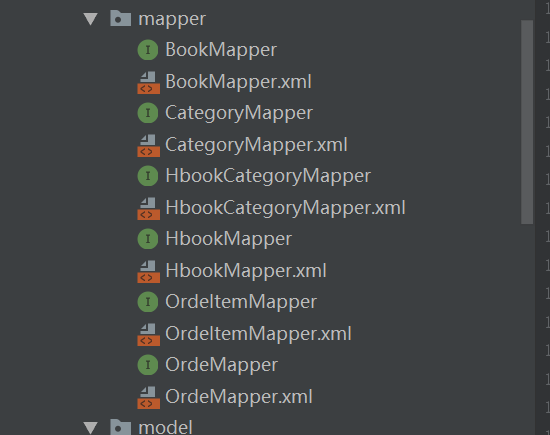
生成之后目录
OrderVo
package com.jt.model.vo;

import com.jt.model.Orde;

import com.jt.model.OrdeItem;

import java.util.ArrayList;

import java.util.List;

/**

 * @author jt

 * @site www.xiaomage.com

 * @company xxx公司

 * @create  2019-10-23 18:59

 */

public class OrderVo extends Orde {

    private List<OrdeItem> orderItems=new ArrayList<>();

    public List<OrdeItem> getOrderItems() {

        return orderItems;

    }

    public void setOrderItems(List<OrdeItem> orderItems) {

        this.orderItems = orderItems;

    }

}
OrderItemVo
package com.jt.model.vo;

import com.jt.model.Orde;

import com.jt.model.OrdeItem;

/**

 * @author jt

 * @site www.xiaomage.com

 * @company xxx公司

 * @create  2019-10-23 19:01

 */

public class OrderItemVo extends OrdeItem {

    private Orde orde;

    public Orde getOrde() {

        return orde;

    }

    public void setOrde(Orde orde) {

        this.orde = orde;

    }

}
CategoryVo
package com.jt.model.vo;

import com.jt.model.Category;

import com.jt.model.Hbook;

import java.util.ArrayList;

import java.util.List;

/**

 * @author jt

 * @site www.xiaomage.com

 * @company xxx公司

 * @create  2019-10-23 20:08

 */

public class CategoryVo  extends Category {

    private List<Hbook> hbooks=new ArrayList<>();

    public List<Hbook> getHbooks() {

        return hbooks;

    }

    public void setHbooks(List<Hbook> hbooks) {

        this.hbooks = hbooks;

    }

}
HbookVo
package com.jt.model.vo;

import com.jt.model.Category;

import com.jt.model.Hbook;

import java.util.ArrayList;

import java.util.List;

/**

 * @author jt

 * @site www.xiaomage.com

 * @company xxx公司

 * @create  2019-10-23 20:06

 */

public class HbookVo extends Hbook {

    private List<Category> categories=new ArrayList<>();

//    public List<Category> getCategories() {

//        return categories;

//    }

//

//    public void setCategories(List<Category> categories)

//    {

//        this.categories = categories;

//    }

    public List<Category> getCategories() {

        return categories;

    }

    public void setCategories(List<Category> categories) {

        this.categories = categories;

    }

}
4.做一个测试(根据id来查询)
 @Test

    public void selectByOrderItemId() {

        List<OrderItemVo> orderItemVos = oneToManyService.selectByOrderItemId();

        OrderItemVo orderItemVo=orderItemVos.get();

        System.out.println(orderItemVo);

        System.out.println(orderItemVo.getOrde());

    }

    @Test

    public void selectByOrderId() {

        List<OrderVo> orderVos = oneToManyService.selectByOrderId();

        OrderVo orderVo=orderVos.get();

//        System.out.println(orderVos.size());

        System.out.println(orderVo);

        for (OrdeItem orderItem : orderVo.getOrderItems()) {

            System.out.println(orderItem);

        }

    }
通过一个订单项的id,查询出订单项信息的同时,查询出所属的订单
通过一个订单id,查询出订单信息的同时,查询出所有的订单项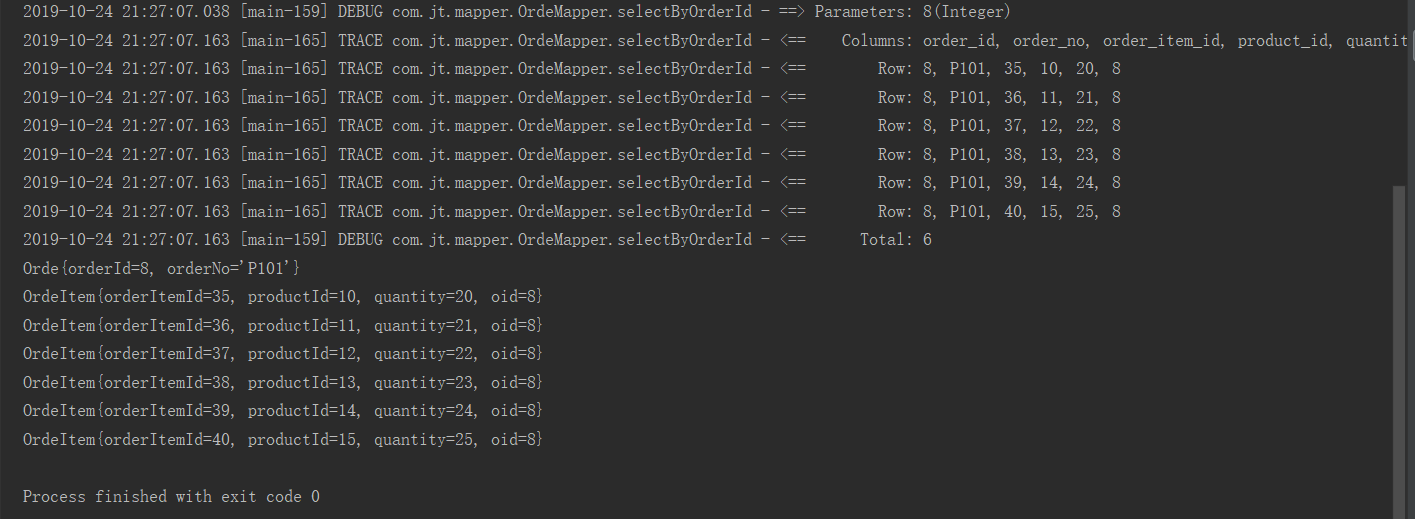
2、多对多关联关系
首先先用逆向生成工具生成t_hibernate_book、t_hibernate_book_category(可生成可不生成)、t_hibernate_category,这两张表对应的model与mapper
generatorConfig.xml
<?xml version="1.0" encoding="UTF-8" ?>
<!DOCTYPE generatorConfiguration PUBLIC "-//mybatis.org//DTD MyBatis Generator Configuration 1.0//EN"
"http://mybatis.org/dtd/mybatis-generator-config_1_0.dtd" >
<generatorConfiguration>
<!-- 引入配置文件 -->
<properties resource="jdbc.properties"/> <!--指定数据库jdbc驱动jar包的位置-->
<classPathEntry location="D:\\initpath\\mvn_repository\\mysql\\mysql-connector-java\\5.1.44\\mysql-connector-java-5.1.44.jar"/> <!-- 一个数据库一个context -->
<context id="infoGuardian">
<!-- 注释 -->
<commentGenerator>
<property name="suppressAllComments" value="true"/><!-- 是否取消注释 -->
<property name="suppressDate" value="true"/> <!-- 是否生成注释代时间戳 -->
</commentGenerator> <!-- jdbc连接 -->
<jdbcConnection driverClass="${jdbc.driver}"
connectionURL="${jdbc.url}" userId="${jdbc.username}" password="${jdbc.password}"/> <!-- 类型转换 -->
<javaTypeResolver>
<!-- 是否使用bigDecimal, false可自动转化以下类型(Long, Integer, Short, etc.) -->
<property name="forceBigDecimals" value="false"/>
</javaTypeResolver> <!-- 指定javaBean生成的位置 -->
<!-- targetPackage:指定生成的model生成所在的包名 -->
<!-- targetProject:指定在该项目下所在的路径 -->
<javaModelGenerator targetPackage="com.jt.model"
targetProject="src/main/java">
<!-- 是否允许子包,即targetPackage.schemaName.tableName -->
<property name="enableSubPackages" value="false"/>
<!-- 是否对model添加构造函数 -->
<property name="constructorBased" value="true"/>
<!-- 是否针对string类型的字段在set的时候进行trim调用 -->
<property name="trimStrings" value="false"/>
<!-- 建立的Model对象是否 不可改变 即生成的Model对象不会有 setter方法,只有构造方法 -->
<property name="immutable" value="false"/>
</javaModelGenerator> <!-- 指定sql映射文件生成的位置 -->
<sqlMapGenerator targetPackage="com.jt.mapper"
targetProject="src/main/java">
<!-- 是否允许子包,即targetPackage.schemaName.tableName -->
<property name="enableSubPackages" value="false"/>
</sqlMapGenerator> <!-- 生成XxxMapper接口 -->
<!-- type="ANNOTATEDMAPPER",生成Java Model 和基于注解的Mapper对象 -->
<!-- type="MIXEDMAPPER",生成基于注解的Java Model 和相应的Mapper对象 -->
<!-- type="XMLMAPPER",生成SQLMap XML文件和独立的Mapper接口 -->
<javaClientGenerator targetPackage="com.jt.mapper"
targetProject="src/main/java" type="XMLMAPPER">
<!-- 是否在当前路径下新加一层schema,false路径com.oop.eksp.user.model, true:com.oop.eksp.user.model.[schemaName] -->
<property name="enableSubPackages" value="false"/>
</javaClientGenerator> <!-- 配置表信息 -->
<!-- schema即为数据库名 -->
<!-- tableName为对应的数据库表 -->
<!-- domainObjectName是要生成的实体类 -->
<!-- enable*ByExample是否生成 example类 -->
<!--<table schema="" tableName="t_book" domainObjectName="Book"-->
<!--enableCountByExample="false" enableDeleteByExample="false"-->
<!--enableSelectByExample="false" enableUpdateByExample="false">-->
<!--<!– 忽略列,不生成bean 字段 –>-->
<!--<!– <ignoreColumn column="FRED" /> –>-->
<!--<!– 指定列的java数据类型 –>-->
<!--<!– <columnOverride column="LONG_VARCHAR_FIELD" jdbcType="VARCHAR" /> –>-->
<!--</table>--> <!-- <table schema="" tableName="t_hibernate_order" domainObjectName="Orde"
enableCountByExample="false" enableDeleteByExample="false"
enableSelectByExample="false" enableUpdateByExample="false">
<!– 忽略列,不生成bean 字段 –>
<!– <ignoreColumn column="FRED" /> –>
<!– 指定列的java数据类型 –>
<!– <columnOverride column="LONG_VARCHAR_FIELD" jdbcType="VARCHAR" /> –>
</table>--> <!--<table schema="" tableName="t_hibernate_order_item" domainObjectName="OrdeItem"
enableCountByExample="false" enableDeleteByExample="false"
enableSelectByExample="false" enableUpdateByExample="false">
<!– 忽略列,不生成bean 字段 –>
<!– <ignoreColumn column="FRED" /> –>
<!– 指定列的java数据类型 –>
<!– < columnOverride column="LONG_VARCHAR_FIELD" jdbcType="VARCHAR" /> –>
</table>--> <table schema="" tableName="t_hibernate_book`" domainObjectName="Hbook"
enableCountByExample="false" enableDeleteByExample="false"
enableSelectByExample="false" enableUpdateByExample="false">
<!-- 忽略列,不生成bean 字段 -->
<!-- <ignoreColumn column="FRED" /> -->
<!-- 指定列的java数据类型 -->
<!-- <columnOverride column="LONG_VARCHAR_FIELD" jdbcType="VARCHAR" /> -->
</table> <!--<table schema="" tableName="t_hibernate_category" domainObjectName="Category"
enableCountByExample="false" enableDeleteByExample="false"
enableSelectByExample="false" enableUpdateByExample="false">
<!– 忽略列,不生成bean 字段 –>
<!– <ignoreColumn column="FRED" /> –>
<!– 指定列的java数据类型 –>
<!– <columnOverride column="LONG_VARCHAR_FIELD" jdbcType="VARCHAR" /> –>
</table>--> <!-- <table schema="" tableName="t_hibernate_book_category" domainObjectName="HbookCategory"
enableCountByExample="false" enableDeleteByExample="false"
enableSelectByExample="false" enableUpdateByExample="false">
<!– 忽略列,不生成bean 字段 –>
<!– <ignoreColumn column="FRED" /> –>
<!– 指定列的java数据类型 –>
<!– <columnOverride column="LONG_VARCHAR_FIELD" jdbcType="VARCHAR" /> –>
</table>--> </context>
</generatorConfiguration>
HBookMapper
package com.jt.mapper;

import com.jt.model.Hbook;

import com.jt.model.vo.HbookVo;

import org.apache.ibatis.annotations.Param;

import org.springframework.stereotype.Repository;

@Repository

public interface HbookMapper {

    int deleteByPrimaryKey(Integer bookId);

    int insert(Hbook record);

    int insertSelective(Hbook record);

    Hbook selectByPrimaryKey(Integer bookId);

    int updateByPrimaryKeySelective(Hbook record);

    int updateByPrimaryKey(Hbook record);

    HbookVo selectByBid(@Param("bid") Integer bid);

}
HBookMapper.xml
<?xml version="1.0" encoding="UTF-8" ?>

<!DOCTYPE mapper PUBLIC "-//mybatis.org//DTD Mapper 3.0//EN" "http://mybatis.org/dtd/mybatis-3-mapper.dtd" >

<mapper namespace="com.jt.mapper.HbookMapper" >

  <resultMap id="BaseResultMap" type="com.jt.model.Hbook" >

    <constructor >

      <idArg column="book_id" jdbcType="INTEGER" javaType="java.lang.Integer" />

      <arg column="book_name" jdbcType="VARCHAR" javaType="java.lang.String" />

      <arg column="price" jdbcType="REAL" javaType="java.lang.Float" />

    </constructor>

  </resultMap>

  <resultMap id="HbookVoMap" type="com.jt.model.vo.HbookVo">

    <result property="bookId" column="book_id"></result>

    <result property="bookName" column="book_name"></result>

    <result property="price" column="price"></result>

    <!--    <result property="orderItems"></result>-->

    <collection property="categories" ofType="com.jt.model.Category">

      <result property="categoryId" column="category_id"></result>

      <result property="categoryName" column="category_name"></result>

    </collection>

  </resultMap>

  <sql id="Base_Column_List" >

    book_id, book_name, price

  </sql>

  <select id="selectByPrimaryKey" resultMap="BaseResultMap" parameterType="java.lang.Integer" >

    select

    <include refid="Base_Column_List" />

    from t_hibernate_book

    where book_id = #{bookId,jdbcType=INTEGER}

  </select>

  <delete id="deleteByPrimaryKey" parameterType="java.lang.Integer" >

    delete from t_hibernate_book

    where book_id = #{bookId,jdbcType=INTEGER}

  </delete>

  <insert id="insert" parameterType="com.jt.model.Hbook" >

    insert into t_hibernate_book (book_id, book_name, price

      )

    values (#{bookId,jdbcType=INTEGER}, #{bookName,jdbcType=VARCHAR}, #{price,jdbcType=REAL}

      )

  </insert>

  <insert id="insertSelective" parameterType="com.jt.model.Hbook" >

    insert into t_hibernate_book

    <trim prefix="(" suffix=")" suffixOverrides="," >

      <if test="bookId != null" >

        book_id,

      </if>

      <if test="bookName != null" >

        book_name,

      </if>

      <if test="price != null" >

        price,

      </if>

    </trim>

    <trim prefix="values (" suffix=")" suffixOverrides="," >

      <if test="bookId != null" >

        #{bookId,jdbcType=INTEGER},

      </if>

      <if test="bookName != null" >

        #{bookName,jdbcType=VARCHAR},

      </if>

      <if test="price != null" >

        #{price,jdbcType=REAL},

      </if>

    </trim>

  </insert>

  <update id="updateByPrimaryKeySelective" parameterType="com.jt.model.Hbook" >

    update t_hibernate_book

    <set >

      <if test="bookName != null" >

        book_name = #{bookName,jdbcType=VARCHAR},

      </if>

      <if test="price != null" >

        price = #{price,jdbcType=REAL},

      </if>

    </set>

    where book_id = #{bookId,jdbcType=INTEGER}

  </update>

  <update id="updateByPrimaryKey" parameterType="com.jt.model.Hbook" >

    update t_hibernate_book

    set book_name = #{bookName,jdbcType=VARCHAR},

      price = #{price,jdbcType=REAL}

    where book_id = #{bookId,jdbcType=INTEGER}

  </update>

  <select id="selectByBid" resultMap="HbookVoMap" >

    select * from t_hibernate_book b,t_hibernate_book_category bc,t_hibernate_category c

    where b.book_id=bc.bid and bc.cid=c.category_id

    and b.book_id=#{bid}

  </select>

</mapper>
HBookCategoryMapper
package com.jt.mapper;

import com.jt.model.HbookCategory;

public interface HbookCategoryMapper {

    int deleteByPrimaryKey(Integer bcid);

    int insert(HbookCategory record);

    int insertSelective(HbookCategory record);

    HbookCategory selectByPrimaryKey(Integer bcid);

    int updateByPrimaryKeySelective(HbookCategory record);

    int updateByPrimaryKey(HbookCategory record);

}
HBookCategoryMapper.xml
<?xml version="1.0" encoding="UTF-8" ?>

<!DOCTYPE mapper PUBLIC "-//mybatis.org//DTD Mapper 3.0//EN" "http://mybatis.org/dtd/mybatis-3-mapper.dtd" >

<mapper namespace="com.jt.mapper.HbookCategoryMapper" >

  <resultMap id="BaseResultMap" type="com.jt.model.HbookCategory" >

    <constructor >

      <idArg column="bcid" jdbcType="INTEGER" javaType="java.lang.Integer" />

      <arg column="bid" jdbcType="INTEGER" javaType="java.lang.Integer" />

      <arg column="cid" jdbcType="INTEGER" javaType="java.lang.Integer" />

    </constructor>

  </resultMap>

  <sql id="Base_Column_List" >

    bcid, bid, cid

  </sql>

  <select id="selectByPrimaryKey" resultMap="BaseResultMap" parameterType="java.lang.Integer" >

    select

    <include refid="Base_Column_List" />

    from t_hibernate_book_category

    where bcid = #{bcid,jdbcType=INTEGER}

  </select>

  <delete id="deleteByPrimaryKey" parameterType="java.lang.Integer" >

    delete from t_hibernate_book_category

    where bcid = #{bcid,jdbcType=INTEGER}

  </delete>

  <insert id="insert" parameterType="com.jt.model.HbookCategory" >

    insert into t_hibernate_book_category (bcid, bid, cid

      )

    values (#{bcid,jdbcType=INTEGER}, #{bid,jdbcType=INTEGER}, #{cid,jdbcType=INTEGER}

      )

  </insert>

  <insert id="insertSelective" parameterType="com.jt.model.HbookCategory" >

    insert into t_hibernate_book_category

    <trim prefix="(" suffix=")" suffixOverrides="," >

      <if test="bcid != null" >

        bcid,

      </if>

      <if test="bid != null" >

        bid,

      </if>

      <if test="cid != null" >

        cid,

      </if>

    </trim>

    <trim prefix="values (" suffix=")" suffixOverrides="," >

      <if test="bcid != null" >

        #{bcid,jdbcType=INTEGER},

      </if>

      <if test="bid != null" >

        #{bid,jdbcType=INTEGER},

      </if>

      <if test="cid != null" >

        #{cid,jdbcType=INTEGER},

      </if>

    </trim>

  </insert>

  <update id="updateByPrimaryKeySelective" parameterType="com.jt.model.HbookCategory" >

    update t_hibernate_book_category

    <set >

      <if test="bid != null" >

        bid = #{bid,jdbcType=INTEGER},

      </if>

      <if test="cid != null" >

        cid = #{cid,jdbcType=INTEGER},

      </if>

    </set>

    where bcid = #{bcid,jdbcType=INTEGER}

  </update>

  <update id="updateByPrimaryKey" parameterType="com.jt.model.HbookCategory" >

    update t_hibernate_book_category

    set bid = #{bid,jdbcType=INTEGER},

      cid = #{cid,jdbcType=INTEGER}

    where bcid = #{bcid,jdbcType=INTEGER}

  </update>

</mapper>
测试方法
   @Autowired

    private ManyToManyService manyToManyService;

    @Test

    public void selectByBid() {

        HbookVo hbookVo = manyToManyService.selectByBid();

        System.out.println(hbookVo);

        for (Category category : hbookVo.getCategories()) {

            System.out.println(category);

        }

    }

    @Test

    public void selectByCid() {

        CategoryVo categoryVo=this.manyToManyService.selectByCid();

        System.out.println(categoryVo);

        for (Hbook hbook : categoryVo.getHbooks()) {

            System.out.println(hbook);

        }

    }

mybatis之关联关系的更多相关文章
- mybatis一对一关联关系映射
mybatis一对一关联关系映射 在关联关系中,有一对一,一对多,多对多三种关联关系. 一对一关系:在操作上,任意一方引入对方的主键作为外键. 一对多关系:在"多"的一方添加&qu ...
- MyBatis对象关联关系---- association与collection
Mybatis处理“一对多”的关系时,需要用到associasion元素.处理”多对一“用collection元素来实现(这两个元素在之前mapper文件中提到过). 本例子中,假设一名User可以有 ...
- mybatis之关联关系映射
Mybatis关联关系映射 1.一对多 首先先用逆向生成工具生成t_hibernate_order.t_hibernate_order_item 这两张表对应的model与mapper OrderVo ...
- MyBatis的关联关系补充 多对多 继承
多对多 一个学生有多个课程 一个课程有多个学生 思路分析 :使用一个中间表 用学生表和课程表的主键作为中间表的联合主键 1数据库表的设计 课程表 学生表 中间表 2/实体类的设计 课程类 public ...
- MyBatis的关联关系 一对一 一对多 多对多
一对一示例 一个妻子对应一个丈夫 数据库表设计时 在妻子表中添加一个丈夫主键的作为外键 1 对应的JavaBean代码虽然在数据库里只有一方配置的外键,但是这个一对一是双向的关系. Husband实体 ...
- Mybatis之关联关系(一对多、多对多)
目的: Mybatis关系映射之一对多 Mybatis关系映射之多对多 Mybatis关系映射之一对多 一对多 (订单对应多个订单项) 多对一 (订单项对应一个订单) 其是映射关系的基层思维是一样的 ...
- MyBatis对象关联关系----多对多的保存与查询
模拟情景: 对象:学生,课程 关系:一个学生可选多个课程,一门课程可被多个学生选择 一.保存 1.创建数据库表,student,course,student_course,其中student_cour ...
- mybatis学习笔记三(关联关系)
学习mybatis的关联关系,主要注解在代码上,这里不做解释.配置文件一样的就不贴了 1.关联关系表创建(学生对应老师 多对一) 学生老师表 2.表对应的实体类 package com.home.en ...
- Mybatis的关联映射案例
主要是对之前学习的关联映射做一个案例,自己动手实践一下,可以理解的更好一点. 开发环境 开发工具:idea Java环境: jdk1.8.0_121 数据库:SQLServer 项目结构,里面包含了三 ...
随机推荐
- Python - 文件管理系统
一.概述 前段时间帮公司写了一个资产管理的网站,(https://www.cnblogs.com/ddzj01/p/11316837.html),系统运行的比较稳定,小白的第一个项目得到了领导的肯定. ...
- CefSharp 修复Demo无法在其它路径下启动问题
CefSharp编译后,在直接点击打开CefSharp.Wpf.Example.exe,启动没问题但是复制demo包到其它路径下,无法打开demo.原因:代码中含有相对路径下的资源文件引用. CefS ...
- Python中使用class(),面向对象有什么优势
首先我是辣鸡,然后这个问题的确有点意思 首先,类是一个集合,包含了数据,操作描述的一个抽象集合 你可以首先只把类当做一个容器来使用 class Cycle: def __init__(self,r): ...
- 5.Ansible Jinja2 模板
1.jinja2渲染NginxProxy配置文件 jinja2 房屋建筑设计固定的 jinja2模板与Ansible关系 Ansible如何使用jinja2模板 template模块 拷贝文件? te ...
- iOS中nil、 Nil、 NULL和NSNull的区别
参考链接:https://www.jianshu.com/p/c3017ae6684a
- 45.QT-连接外部dll,lib库导入问题
dll库问题 查看MZ_Card.dll对应的文档手册,如下图所示: 所以代码写为: typedef BOOL (*Fun)(BOOL IsOpenComm,unsigned long Port, u ...
- 在服务器的tomcat中部署手机apk项目,浏览器或手机下载不能根据URL下载和安装apk文件
Android的APK包不能下载或安装,需在tomcat的web.xml加入 <mime-mapping> <extension>apk</extensio ...
- 12.2 中的Data Guard Standby 密码文件自动同步 (Doc ID 2307365.1)
Data Guard Standby Automatic Password file Synchronization in 12.2 (Doc ID 2307365.1) APPLIES TO: Or ...
- s3c2440裸机-清bss原理及实现
1.清bss的引入(为什么要清bss) 我们先举个例子: #include "s3c2440_soc.h" #include "uart.h" char g_C ...
- C# 序列化和反序列化(xml 文件)
序列化是将对象保存为文本文件或二进制文件: 反序列化则是读取文件信息,还原为对象: 序列化保存为文本内容,主要是 xml 和 json 两种,这里介绍序列化为 xml 文件的方式. 想要序列化,先要在 ...