
golang开发:类库篇(五)go测试工具goconvey的使用
为什么要使用goconvey测试程序
goconvey 集成go test,go test 无缝接入。管理运行测试用例,而且提供了丰富的函数断言、非常友好的WEB界面,直观的查看测试结果。
如果没有goconvey的话,编写一个测试结果,首先运行被测试函数,然后判断被测试函数的运行结果,各种if判断,各种输出提示信息,而且回归测试也比较麻烦。但是如果使用了goconvey这些都就变得无比的简单。
还是看些使用代码比较简单明了。
怎么使用goconvey测试程序
第一步当然是安装goconvey
go get github.com/smartystreets/goconvey
看下被测试的代码
package main

import "fmt"

type Student struct {

	Num int

	Name string

	Chinaese int

	English int

	Math int

}

func NewStudent(num int, name string) (*Student,error) {

	if num < 1 || len(name) < 1 {

		return nil,fmt.Errorf("num name empty")

	}

	stu := new(Student)

	stu.Num = num

	stu.Name = name

	return stu,nil

}

func (this *Student) GetAve() (int,error) {

	score := this.Chinaese + this.English + this.Math

	if score == 0 {

		return 0,fmt.Errorf("score is 0")

	}

	return score/3,nil

}
主要看下goconvey的测试代码
package main

import (

	"testing"

	. "github.com/smartystreets/goconvey/convey"

)

func TestNew(t *testing.T) {

	Convey("start test new", t, func() {

		stu,err := NewStudent(0,"")

		Convey("have error", func() {

			So(err, ShouldBeError)

		})

		Convey("stu is nil", func() {

			So(stu, ShouldBeNil)

		})

	})

}

func TestScore(t *testing.T) {

	stu,_ := NewStudent(1,"test")

	Convey("if error", t, func() {

		_,err := stu.GetAve()

		Convey("have error", func() {

			So(err, ShouldBeError)

		})

	})

	Convey("normal", t, func() {

		stu.Math = 60

		stu.Chinaese = 70

		stu.English = 80

		score,err := stu.GetAve()

		Convey("have error", func() {

			So(err, ShouldBeError)

		})

		Convey("score > 60", func() {

			So(score, ShouldBeGreaterThan, 60)

		})

	})

}
进入到test代码目录,执行 go test
=== RUN   TestNew

  start test new

    have error ✔

    stu is nil ✔

2 total assertions

--- PASS: TestNew (0.00s)

=== RUN   TestScore

  if error

    have error ✔

3 total assertions

  normal

    have error ✘

    score > 60 ✔

Failures:

  * /data/www/go/src/test/student_test.go

  Line 35:
其实命令行显示的是有颜色标识的。期望出现的结果都会打上对勾,如果期望出现而没有出现的都会打上叉。
还有更好玩的WEB界面。进入的test代码的目录,然后执行 goconvey 会打开一个WEB界面,更加友好的标识出了测试的结果,测试了多少次,有几个通过,几个失败,一目了然。
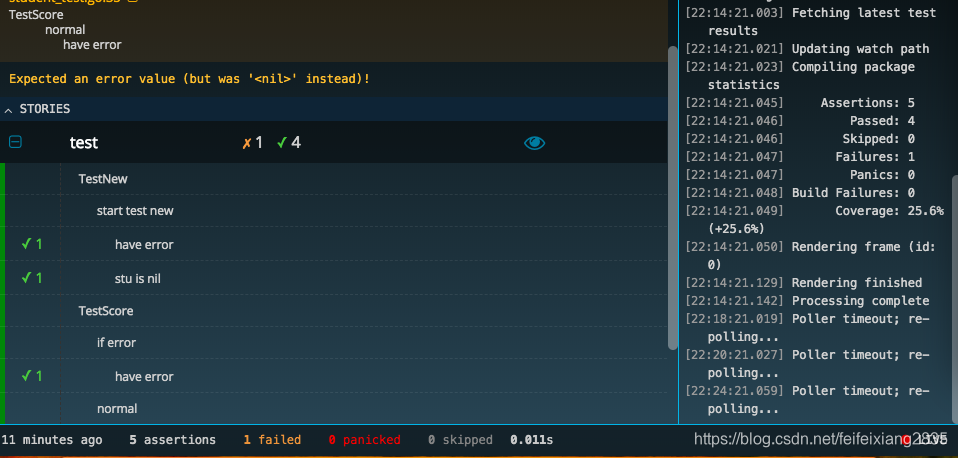
其实使用特别简单
引入类库,启动Convey函数,剩下的就是调用So各种断言各种比较
import (

	"testing"

	. "github.com/smartystreets/goconvey/convey"

)

Convey("desc", t, func() {

So(var, function)

})
基本平常开发中的比较函数基本都有,看下比较的函数列表,看着貌似都涵盖了。
Convey("Equality assertions should be accessible", t, func() {

		thing1a := thing{a: "asdf"}

		thing1b := thing{a: "asdf"}

		thing2 := thing{a: "qwer"}

		So(1, ShouldEqual, 1)

		So(1, ShouldNotEqual, 2)

		So(1, ShouldAlmostEqual, 1.000000000000001)

		So(1, ShouldNotAlmostEqual, 2, 0.5)

		So(thing1a, ShouldResemble, thing1b)

		So(thing1a, ShouldNotResemble, thing2)

		So(&thing1a, ShouldPointTo, &thing1a)

		So(&thing1a, ShouldNotPointTo, &thing1b)

		So(nil, ShouldBeNil)

		So(1, ShouldNotBeNil)

		So(true, ShouldBeTrue)

		So(false, ShouldBeFalse)

		So(0, ShouldBeZeroValue)

		So(1, ShouldNotBeZeroValue)

	})

	Convey("Numeric comparison assertions should be accessible", t, func() {

		So(1, ShouldBeGreaterThan, 0)

		So(1, ShouldBeGreaterThanOrEqualTo, 1)

		So(1, ShouldBeLessThan, 2)

		So(1, ShouldBeLessThanOrEqualTo, 1)

		So(1, ShouldBeBetween, 0, 2)

		So(1, ShouldNotBeBetween, 2, 4)

		So(1, ShouldBeBetweenOrEqual, 1, 2)

		So(1, ShouldNotBeBetweenOrEqual, 2, 4)

	})

	Convey("Container assertions should be accessible", t, func() {

		So([]int{1, 2, 3}, ShouldContain, 2)

		So([]int{1, 2, 3}, ShouldNotContain, 4)

		So(map[int]int{1: 1, 2: 2, 3: 3}, ShouldContainKey, 2)

		So(map[int]int{1: 1, 2: 2, 3: 3}, ShouldNotContainKey, 4)

		So(1, ShouldBeIn, []int{1, 2, 3})

		So(4, ShouldNotBeIn, []int{1, 2, 3})

		So([]int{}, ShouldBeEmpty)

		So([]int{1}, ShouldNotBeEmpty)

		So([]int{1, 2}, ShouldHaveLength, 2)

	})

	Convey("String assertions should be accessible", t, func() {

		So("asdf", ShouldStartWith, "a")

		So("asdf", ShouldNotStartWith, "z")

		So("asdf", ShouldEndWith, "df")

		So("asdf", ShouldNotEndWith, "as")

		So("", ShouldBeBlank)

		So("asdf", ShouldNotBeBlank)

		So("asdf", ShouldContainSubstring, "sd")

		So("asdf", ShouldNotContainSubstring, "af")

	})

	Convey("Panic recovery assertions should be accessible", t, func() {

		So(panics, ShouldPanic)

		So(func() {}, ShouldNotPanic)

		So(panics, ShouldPanicWith, "Goofy Gophers!")

		So(panics, ShouldNotPanicWith, "Guileless Gophers!")

	})

	Convey("Type-checking assertions should be accessible", t, func() {

		// NOTE: Values or pointers may be checked.  If a value is passed,

		// it will be cast as a pointer to the value to avoid cases where

		// the struct being tested takes pointer receivers. Go allows values

		// or pointers to be passed as receivers on methods with a value

		// receiver, but only pointers on methods with pointer receivers.

		// See:

		// http://golang.org/doc/effective_go.html#pointers_vs_values

		// http://golang.org/doc/effective_go.html#blank_implements

		// http://blog.golang.org/laws-of-reflection

		So(1, ShouldHaveSameTypeAs, 0)

		So(1, ShouldNotHaveSameTypeAs, "1")

		So(bytes.NewBufferString(""), ShouldImplement, (*io.Reader)(nil))

		So("string", ShouldNotImplement, (*io.Reader)(nil))

	})

	Convey("Time assertions should be accessible", t, func() {

		january1, _ := time.Parse(timeLayout, "2013-01-01 00:00")

		january2, _ := time.Parse(timeLayout, "2013-01-02 00:00")

		january3, _ := time.Parse(timeLayout, "2013-01-03 00:00")

		january4, _ := time.Parse(timeLayout, "2013-01-04 00:00")

		january5, _ := time.Parse(timeLayout, "2013-01-05 00:00")

		oneDay, _ := time.ParseDuration("24h0m0s")

		So(january1, ShouldHappenBefore, january4)

		So(january1, ShouldHappenOnOrBefore, january1)

		So(january2, ShouldHappenAfter, january1)

		So(january2, ShouldHappenOnOrAfter, january2)

		So(january3, ShouldHappenBetween, january2, january5)

		So(january3, ShouldHappenOnOrBetween, january3, january5)

		So(january1, ShouldNotHappenOnOrBetween, january2, january5)

		So(january2, ShouldHappenWithin, oneDay, january3)

		So(january5, ShouldNotHappenWithin, oneDay, january1)

		So([]time.Time{january1, january2}, ShouldBeChronological)

	})
特别实用的一个测试类库,养成写完代码使用goconvey做测试的好习惯,也顺便覆盖下使用方法和案例,定能让开发事半功倍,减少Bug率。
golang开发:类库篇(五)go测试工具goconvey的使用的更多相关文章
- golang开发:类库篇(三)命令行工具cli的使用
为什么要使用命令行 觉得这个问题不应该列出来,又觉得如果初次进行WEB开发的话,可能会觉得所有的东西都可以使用API去做,会觉得命令行没有必要. 其实,一个生产的项目命令行是绕不过去的.比如运营需要导 ...
- golang开发:环境篇(五)实时加载工具gin的使用
gin 工具是golang开发中非常有用且有效的工具,有效的提高了开发调试go程序的效率. 为什么要使用gin 我们知道golang是编译型语言,这就表示go程序的每次改动,如果需要查看改动结果都必须 ...
- golang开发:类库篇(一) Zap高性能日志类库的使用
为什么要用zap来写日志 原来是写PHP的,一直用的error_log,第一次写Go项目的时候,还真不知道该怎么写日志,后来就按照PHP的写法自己不成规范的捣鼓写.去了新公司之后,发现用的是zap.后 ...
- golang开发:类库篇(二) Redis连接池的使用
为什么要使用连接池 一个数据库服务器只拥有有限的连接资源,一旦所有的连接资源都在使用,那么其它需要连接的资源就只能等待释放连接资源.所以,在连接资源有限的情况下,提高单位时间的连接的使用效率,缩短连接 ...
- golang开发:类库篇(四)配置文件解析器goconfig的使用
为什么要使用goconfig解析配置文件 目前各语言框架对配置文件书写基本都差不多,基本都是首先配置一些基础变量,基本变量里面有环境的配置,然后通过环境变量去获取该环境下的变量.例如,生产环境跟测试环 ...
- modern.IE – Web 开发必备的 IE 浏览器测试工具
modern.IE 是微软推出的一个开发人员中心,提供免费的工具和资源,旨在使您能够花更少的时间来测试各种版本的 Internet Explorer,并留出更多时间在现代 Web 上构建重要的内容.m ...
- Golang之框架篇-Windows环境bee工具运行beego
bee工具简介及好处 bee 工具是一个为了协助快速开发 beego 项目而创建的项目,通过 bee 你可以很容易的进行 beego 项目的创建.热编译.开发.测试.和部署. 强烈推荐新手或J ...
- golang开发:环境篇(六) Go运行监控Supervisord的使用
为什么要使用Supervisord 17年第一次写Go项目的时候,用Go开发项目倒没没费多大劲,很快就开发完成了.到了在测试环境部署的时候,由于不知道有 Supervisord 这个软件,着实花了些功 ...
- golang开发:环境篇(四)包管理器 glide的使用
glide 是golang项目开发中是特别重要的软件,没有它,golang的项目可能都无法发布. 为什么要使用glide 平时我们开发Go项目的时候,使用第三方的包的时候都直接使用go get 去获取 ...
随机推荐
- Caddy 源码全解析
caddy源码全解析 Caddy 源码全解析 Preface Caddy 是 Go 语言构建的轻量配置化服务器.同时代码结构由于 Go 语言的轻便简洁,比较易读,推荐学弟学妹学习 Go 的时候也去查看 ...
- 微信分享(移动web端)
create-at 2019-02-16 引入微信JS-SDK http://res.wx.qq.com/open/js/jweixin-1.4.0.js (当前最新版本) js 相关代码 (移动端实 ...
- android ——网络编程
一.WebView 这个View就是一个浏览器,用于展示网页的. 布局文件: <LinearLayout xmlns:android="http://schemas.android.c ...
- 【java提高】(17)---Java 位运算符
Java 位运算符 &.|.^.~.<<.>> 以前学过有关java的运算符,不过开发了这么久也很少用过这个.现在由于开发需要,所以现在再来回顾整理下有关java的运算 ...
- vs 中本地 git 的基本使用
用 svn 有个毛病就是只有在改好了之后,才能提交.当周期比较长的时候,连自己都不知道自己改了什么东西,或者意外断电的时候,vs 中已保持的项目都有可能被 vs 去掉. 这个时候,使用 git 创建 ...
- Go-如何读取yaml,json,ini等配置文件
1. json使用 JSON 应该比较熟悉,它是一种轻量级的数据交换格式.层次结构简洁清晰 ,易于阅读和编写,同时也易于机器解析和生成. 创建 conf.json: { "enabled&q ...
- iOS 11 变化
首先我是开发者,更关心对技术的影响,我又需要关注.学习哪些技术,猫神的文章:http://www.cocoachina.com/ios/20170607/19457.html 介绍了 ******** ...
- js设置,取得,清除cookie
//取得cookie function getCookie(name) { var nameEQ = name + "="; var ca = document.cookie. ...
- Centos知识
1.看系统的版本: cat /etc/redhat-release 2.看内核版本: uname -r 3.查看系统是32位还是64位 uname - m 4.磁盘: 磁盘分区有主分区.扩展分区和逻辑 ...
- GIT和SVN教程
各种版本控制工具的简单比较 特性 CVS SVN GIT 并发修改 支持 支持 支持 并发提交 不支持 支持 支持 历史轨迹 不支持更名 支持更名 支持更名 分布式 不支持 不支持 支持 SVN SV ...