
Flink学习(三)状态机制于容错机制,State与CheckPoint
摘自Apache官网
一、State的基本概念
什么叫State?搜了一把叫做状态机制。可以用作以下用途。为了保证 at least once, exactly once,Flink引入了State和Checkpoint
- 某个task/operator某时刻的中间结果
- 快照(snapshot)
- 程序一旦crash,恢复用的
- 机器学习模型的参数
二、Flink中包含的State
Keyed State和Opreator State
1、Keyed State基于KeyedStream的状态。这个状态是跟特定的key绑定的。对KeyedStream流上的每一个key,可能都对应一个state。
2、Operator State。于Keyed State不同。Operator State根一个特定的Operator绑定。整个Operator对应一个State。相比较而言一个State上有多个Keyed State。举例子来说,在Flink中的Kafka Connector就使用了Operator State。会在每个connector实例中,保存该实例中消费topic的所有(partition, offset)映射。
一些原子State
ValueState:即类型为T的单值状态。这个状态与对应的key绑定,是最简单的状态了。它可以通过update方法更新状态值,通过value()方法获取状态值。
ListState:即key上的状态值为一个列表。可以通过add方法往列表中附加值;也可以通过get()方法返回一个Iterable<T>来遍历状态值。
ReducingState:这种状态通过用户传入的reduceFunction,每次调用add方法添加值的时候,会调用reduceFunction,最后合并到一个单一的状态值。
MapState:即状态值为一个map。用户通过put或putAll方法添加元素。
上述的State仅仅与状态进行交互。而真正的状态值,有可能是存在内存,磁盘、或者其它分布式系统中。相当于只是我们持有了这个句柄。那么我们如何得到这个状态的句柄呢?Flink通过StateDescriptor来定义一个状态。这是一个抽象类,内部定义了状态名称、类型、序列化器等基础信息。与上面的状态对应、从StateDescriptor派生了ValueStateDescriptor,ListStateDescriptor等descriptor。
3、研究下Keyed State内部的结构
在StreamingRuntimeContext这个类中可以看到各个State的get方法
/*

 * Licensed to the Apache Software Foundation (ASF) under one

 * or more contributor license agreements.  See the NOTICE file

 * distributed with this work for additional information

 * regarding copyright ownership.  The ASF licenses this file

 * to you under the Apache License, Version 2.0 (the

 * "License"); you may not use this file except in compliance

 * with the License.  You may obtain a copy of the License at

 *

 *     http://www.apache.org/licenses/LICENSE-2.0

 *

 * Unless required by applicable law or agreed to in writing, software

 * distributed under the License is distributed on an "AS IS" BASIS,

 * WITHOUT WARRANTIES OR CONDITIONS OF ANY KIND, either express or implied.

 * See the License for the specific language governing permissions and

 * limitations under the License.

 */

package org.apache.flink.streaming.api.operators;

import org.apache.flink.annotation.PublicEvolving;

import org.apache.flink.api.common.accumulators.Accumulator;

import org.apache.flink.api.common.functions.BroadcastVariableInitializer;

import org.apache.flink.api.common.functions.util.AbstractRuntimeUDFContext;

import org.apache.flink.api.common.state.AggregatingState;

import org.apache.flink.api.common.state.AggregatingStateDescriptor;

import org.apache.flink.api.common.state.FoldingState;

import org.apache.flink.api.common.state.FoldingStateDescriptor;

import org.apache.flink.api.common.state.KeyedStateStore;

import org.apache.flink.api.common.state.ListState;

import org.apache.flink.api.common.state.ListStateDescriptor;

import org.apache.flink.api.common.state.MapState;

import org.apache.flink.api.common.state.MapStateDescriptor;

import org.apache.flink.api.common.state.ReducingState;

import org.apache.flink.api.common.state.ReducingStateDescriptor;

import org.apache.flink.api.common.state.StateDescriptor;

import org.apache.flink.api.common.state.ValueState;

import org.apache.flink.api.common.state.ValueStateDescriptor;

import org.apache.flink.runtime.execution.Environment;

import org.apache.flink.runtime.jobgraph.tasks.InputSplitProvider;

import org.apache.flink.streaming.api.CheckpointingMode;

import org.apache.flink.streaming.api.graph.StreamConfig;

import org.apache.flink.streaming.runtime.tasks.ProcessingTimeService;

import org.apache.flink.util.Preconditions;

import java.util.List;

import java.util.Map;

/**

 * Implementation of the {@link org.apache.flink.api.common.functions.RuntimeContext},

 * for streaming operators.

 */

@PublicEvolving

public class StreamingRuntimeContext extends AbstractRuntimeUDFContext {

    /** The operator to which this function belongs. */

    private final AbstractStreamOperator<?> operator;

    /** The task environment running the operator. */

    private final Environment taskEnvironment;

    private final StreamConfig streamConfig;

    public StreamingRuntimeContext(AbstractStreamOperator<?> operator,

                                    Environment env, Map<String, Accumulator<?, ?>> accumulators) {

        super(env.getTaskInfo(),

                env.getUserClassLoader(),

                operator.getExecutionConfig(),

                accumulators,

                env.getDistributedCacheEntries(),

                operator.getMetricGroup());

        this.operator = operator;

        this.taskEnvironment = env;

        this.streamConfig = new StreamConfig(env.getTaskConfiguration());

    }

    // ------------------------------------------------------------------------

    /**

     * Returns the input split provider associated with the operator.

     *

     * @return The input split provider.

     */

    public InputSplitProvider getInputSplitProvider() {

        return taskEnvironment.getInputSplitProvider();

    }

    public ProcessingTimeService getProcessingTimeService() {

        return operator.getProcessingTimeService();

    }

    // ------------------------------------------------------------------------

    //  broadcast variables

    // ------------------------------------------------------------------------

    @Override

    public boolean hasBroadcastVariable(String name) {

        throw new UnsupportedOperationException("Broadcast variables can only be used in DataSet programs");

    }

    @Override

    public <RT> List<RT> getBroadcastVariable(String name) {

        throw new UnsupportedOperationException("Broadcast variables can only be used in DataSet programs");

    }

    @Override

    public <T, C> C getBroadcastVariableWithInitializer(String name, BroadcastVariableInitializer<T, C> initializer) {

        throw new UnsupportedOperationException("Broadcast variables can only be used in DataSet programs");

    }

    // ------------------------------------------------------------------------

    //  key/value state

    // ------------------------------------------------------------------------

    @Override

    public <T> ValueState<T> getState(ValueStateDescriptor<T> stateProperties) {

        KeyedStateStore keyedStateStore = checkPreconditionsAndGetKeyedStateStore(stateProperties);

        stateProperties.initializeSerializerUnlessSet(getExecutionConfig());

        return keyedStateStore.getState(stateProperties);

    }

    @Override

    public <T> ListState<T> getListState(ListStateDescriptor<T> stateProperties) {

        KeyedStateStore keyedStateStore = checkPreconditionsAndGetKeyedStateStore(stateProperties);

        stateProperties.initializeSerializerUnlessSet(getExecutionConfig());

        return keyedStateStore.getListState(stateProperties);

    }

    @Override

    public <T> ReducingState<T> getReducingState(ReducingStateDescriptor<T> stateProperties) {

        KeyedStateStore keyedStateStore = checkPreconditionsAndGetKeyedStateStore(stateProperties);

        stateProperties.initializeSerializerUnlessSet(getExecutionConfig());

        return keyedStateStore.getReducingState(stateProperties);

    }

    @Override

    public <IN, ACC, OUT> AggregatingState<IN, OUT> getAggregatingState(AggregatingStateDescriptor<IN, ACC, OUT> stateProperties) {

        KeyedStateStore keyedStateStore = checkPreconditionsAndGetKeyedStateStore(stateProperties);

        stateProperties.initializeSerializerUnlessSet(getExecutionConfig());

        return keyedStateStore.getAggregatingState(stateProperties);

    }

    @Override

    public <T, ACC> FoldingState<T, ACC> getFoldingState(FoldingStateDescriptor<T, ACC> stateProperties) {

        KeyedStateStore keyedStateStore = checkPreconditionsAndGetKeyedStateStore(stateProperties);

        stateProperties.initializeSerializerUnlessSet(getExecutionConfig());

        return keyedStateStore.getFoldingState(stateProperties);

    }

    @Override

    public <UK, UV> MapState<UK, UV> getMapState(MapStateDescriptor<UK, UV> stateProperties) {

        KeyedStateStore keyedStateStore = checkPreconditionsAndGetKeyedStateStore(stateProperties);

        stateProperties.initializeSerializerUnlessSet(getExecutionConfig());

        return keyedStateStore.getMapState(stateProperties);

    }

    private KeyedStateStore checkPreconditionsAndGetKeyedStateStore(StateDescriptor<?, ?> stateDescriptor) {

        Preconditions.checkNotNull(stateDescriptor, "The state properties must not be null");

        KeyedStateStore keyedStateStore = operator.getKeyedStateStore();

        Preconditions.checkNotNull(keyedStateStore, "Keyed state can only be used on a 'keyed stream', i.e., after a 'keyBy()' operation.");

        return keyedStateStore;

    }

    // ------------------ expose (read only) relevant information from the stream config -------- //

    /**

     * Returns true if checkpointing is enabled for the running job.

     *

     * @return true if checkpointing is enabled.

     */

    public boolean isCheckpointingEnabled() {

        return streamConfig.isCheckpointingEnabled();

    }

    /**

     * Returns the checkpointing mode.

     *

     * @return checkpointing mode

     */

    public CheckpointingMode getCheckpointMode() {

        return streamConfig.getCheckpointMode();

    }

    /**

     * Returns the buffer timeout of the job.

     *

     * @return buffer timeout (in milliseconds)

     */

    public long getBufferTimeout() {

        return streamConfig.getBufferTimeout();

    }

}
所有的State都继承自StateDescpritor这个类。简单看一下构造函数。实际上包含了三个参数,
- 名称
- 类型--属于哪一类state
- 默认值
 protected StateDescriptor(String name, Class<T> type, T defaultValue) {

         this.name = requireNonNull(name, "name must not be null");

         requireNonNull(type, "type class must not be null");

         try {

             this.typeInfo = TypeExtractor.createTypeInfo(type);

         } catch (Exception e) {

             throw new RuntimeException(

                     "Could not create the type information for '" + type.getName() + "'. " +

                     "The most common reason is failure to infer the generic type information, due to Java's type erasure. " +

                     "In that case, please pass a 'TypeHint' instead of a class to describe the type. " +

                     "For example, to describe 'Tuple2<String, String>' as a generic type, use " +

                     "'new PravegaDeserializationSchema<>(new TypeHint<Tuple2<String, String>>(){}, serializer);'", e);

         }

         this.defaultValue = defaultValue;

     }
再具体的可以自己研究研究,建议工作遇到或者对源码有兴趣可以读读。或者结合实际应用理解下会更快
三、容错机制
1、Flink的核心容错机制是不断的给数据流绘制Snapshots。当系统回滚的时候,这些snapshots就扮演了checkpoints的作用。快照机制受Chandy-Lamport 算法的启发。
读了下论文研究了下这个算法。英文的看不太懂。找了个中文的。
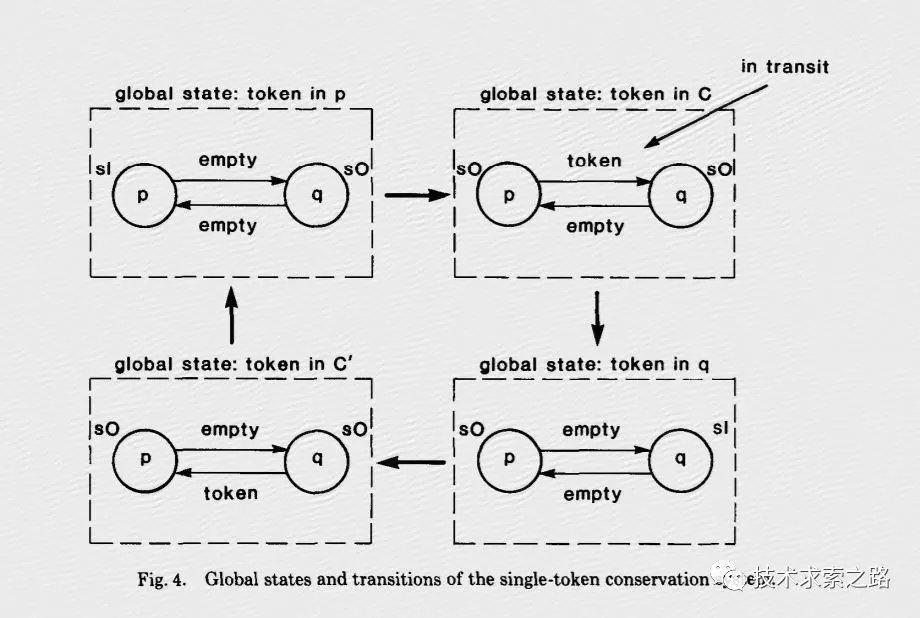
大概就是通过token 和marker来判断是哪里出了问题和需要恢复。
具体可以参考:
https://www.jianshu.com/p/938001e998f5
Flink学习(三)状态机制于容错机制,State与CheckPoint的更多相关文章
- 总结Flink状态管理和容错机制
本文来自8月11日在北京举行的 Flink Meetup会议,分享来自于施晓罡,目前在阿里大数据团队部从事Blink方面的研发,现在主要负责Blink状态管理和容错相关技术的研发. 本文主要内容如 ...
- Flink状态管理和容错机制介绍
本文主要内容如下: 有状态的流数据处理: Flink中的状态接口: 状态管理和容错机制实现: 阿里相关工作介绍: 一.有状态的流数据处理# 1.1.什么是有状态的计算# 计算任务的结果不仅仅依赖于输入 ...
- Flink的状态编程和容错机制(四)
一.状态编程 Flink 内置的很多算子,数据源 source,数据存储 sink 都是有状态的,流中的数据都是 buffer records,会保存一定的元素或者元数据.例如 : ProcessWi ...
- Flink资料(2)-- 数据流容错机制
数据流容错机制 该文档翻译自Data Streaming Fault Tolerance,文档描述flink在流式数据流图上的容错机制. ------------------------------- ...
- SpringCloud学习笔记(4):Hystrix容错机制
简介 在微服务架构中,微服务之间的依赖关系错综复杂,难免的某些服务会出现故障,导致服务调用方出现远程调度的线程阻塞.在高负载的场景下,如果不做任何处理,可能会引起级联故障,导致服务调用方的资源耗尽甚至 ...
- 入门大数据---Flink学习总括
第一节 初识 Flink 在数据激增的时代,催生出了一批计算框架.最早期比较流行的有MapReduce,然后有Spark,直到现在越来越多的公司采用Flink处理.Flink相对前两个框架真正做到了高 ...
- Flink 容错机制与状态
简介 Apache Flink提供了一种容错机制,可以持续恢复数据流应用程序的状态. 该机制确保即使出现故障,经过恢复,程序的状态也会回到以前的状态. Flink 主持 at least once 语 ...
- 关于 Flink 状态与容错机制
Flink 作为新一代基于事件流的.真正意义上的流批一体的大数据处理引擎,正在逐渐得到广大开发者们的青睐.就从我自身的视角看,最近也是在数据团队把一些原本由 Flume.SparkStreaming. ...
- Storm学习笔记 - 消息容错机制
Storm学习笔记 - 消息容错机制 文章来自「随笔」 http://jsynk.cn/blog/articles/153.html 1. Storm消息容错机制概念 一个提供了可靠的处理机制的spo ...
随机推荐
- 【Python使用】使用pip安装卸载Python包(含离线安装Python包)未完成???
pip 是 Python 包管理工具,该工具提供了对Python包的查找.下载.安装.卸载的功能.Python 2.7.9 + 或 Python 3.4+ 以上版本都自带 pip 工具. pip使用( ...
- 【English】20190320
valid有效的 [ˈvælɪd] solitary独立的 [ˈsɑ:ləteri] data definition not valid unless solitary qualifying有资格的 ...
- 【Teradata SQL】禁用和启用数据库用户登录
1.禁用数据库用户登录 禁用登录后,再次登录会报用户或密码错误.执行命令如下: //使用dbc用户执行SELECT 'REVOKE LOGON ON ALL FROM '||USERNAME||';' ...
- menu
<template> <el-row :gutter="10"> <div> <el-row :gutter="10" ...
- IDEA+循环语句 or 输出语句 快捷操作
IDEA+循环语句 or 输出语句 快捷操作:https://blog.csdn.net/shijiebei2009/article/details/44726433 for循环:仅输入fori然后回 ...
- Google Chrome等浏览器不允许关闭点击跟踪??
hrome.Safari.Opera 和 Microsoft Edge 的新版本将不再允许用户关闭“链接审计( hyperlink auditing)”的功能.链接审计是一项 HTML 标准,被用于跟 ...
- 【原创】分布式事务之TCC事务模型
引言 在上篇文章<老生常谈--利用消息队列处理分布式事务>一文中留了一个坑,今天来填坑.如下图所示 如果服务A和服务B之间是同步调用,比如服务C需要按流程调服务A和服务B,服务A和服务B要 ...
- 2019年美国大学生数学建模竞赛(MCM/ICM) E题解题思路
这也许是我大学生涯最后一次参加数学建模比赛了吧,这次我们选择的问题是E题,以下是我们解题时候的一些思路.很多不易体现的项目产生对环境造成影响的指标可以由一些等同类型的指标来代替,如土地.森林植被被破环 ...
- Git命令集
安装 Window https://gitforwindows.org/ MAC http://sourceforge.net/projects/git-osx-installer/ git conf ...
- ADO.NET之使用DataSet类更新数据库
1.首先从数据库获得数据填充到DataSet类,该类中的表和数据库中的表相互映射. 2.对DataSet类中的表进行修改(插入,更新,删除等) 3.同步到数据库中:使用SqlDataAdapter实例 ...