
Akka源码分析-Actor创建(续)
在上一遍博客中,我们已经分析了actor创建的大致过程,但只是涉及到了Dipatcher/Mailbox/ActorCell/InternalActorRef等对象的创建,并没有介绍我们自定义的继承Actor特质的类如何完成初始化。这篇文章对这一部分内容进行简单的补充。
在akka.actor.dungeon.init代码中,有一段代码我们当时没有分析,此处对此代码进行深入分析,然后才能找到Actor子类完成创建的真实过程。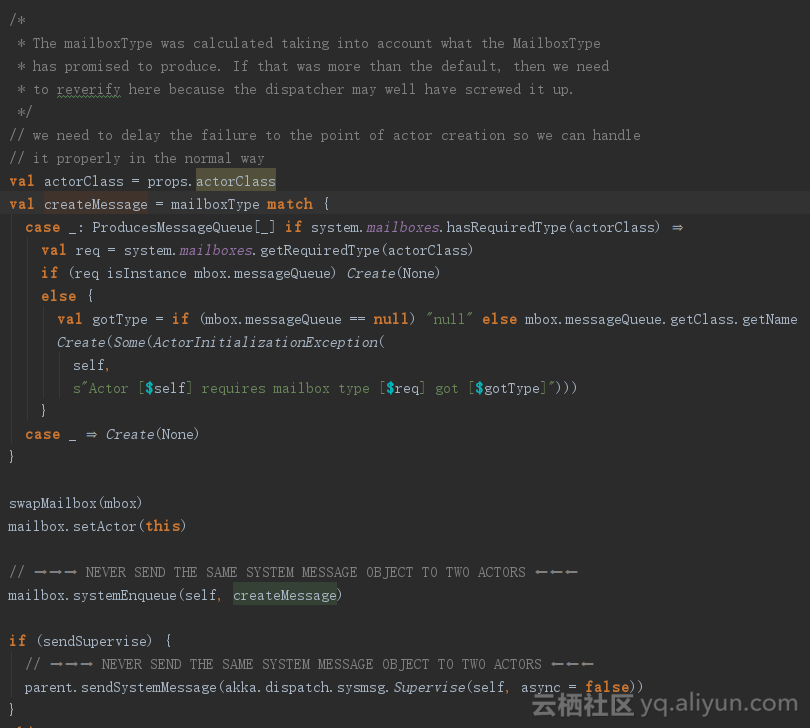
上面是init的代码片段,其中有一个局部变量createMessage,根据前后分析,它的值应该是Create这个case
class。最后mailbox.systemEnqueue(self,
createMessage)这个代码给actor对应的邮箱发送了该消息。
/**

 * INTERNAL API

 */

@SerialVersionUID(1L)

private[akka] final case class Create(failure: Option[ActorInitializationException]) extends SystemMessage // sent to self from Dispatcher.register
根据Create类名以及前后上下文分析,这应该是指示Actor完成初始化的。那么我们要分析一下actor是如何对该消息响应的。那么究竟是哪段代码对这个消息进行响应的呢?
如果读过之前的文章,你肯定能想起来Mailbox在循环处理消息时,有一个processAllSystemMessages方法,这个方法里面调用了actor的systemInvoke方法。具体源码如下:
/**

   * Will at least try to process all queued system messages: in case of

   * failure simply drop and go on to the next, because there is nothing to

   * restart here (failure is in ActorCell somewhere …). In case the mailbox

   * becomes closed (because of processing a Terminate message), dump all

   * already dequeued message to deadLetters.

   */

  final def processAllSystemMessages() {

    var interruption: Throwable = null

    var messageList = systemDrain(SystemMessageList.LNil)

    while ((messageList.nonEmpty) && !isClosed) {

      val msg = messageList.head

      messageList = messageList.tail

      msg.unlink()

      if (debug) println(actor.self + " processing system message " + msg + " with " + actor.childrenRefs)

      // we know here that systemInvoke ensures that only "fatal" exceptions get rethrown

      actor systemInvoke msg

      if (Thread.interrupted())

        interruption = new InterruptedException("Interrupted while processing system messages")

      // don’t ever execute normal message when system message present!

      if ((messageList.isEmpty) && !isClosed) messageList = systemDrain(SystemMessageList.LNil)

    }

    /*

     * if we closed the mailbox, we must dump the remaining system messages

     * to deadLetters (this is essential for DeathWatch)

     */

    // 忽略剩余源码

  }
我们来研究一下systemInvoke的代码
/*

   * MESSAGE PROCESSING

   */

  //Memory consistency is handled by the Mailbox (reading mailbox status then processing messages, then writing mailbox status

  final def systemInvoke(message: SystemMessage): Unit = {

    /*

     * When recreate/suspend/resume are received while restarting (i.e. between

     * preRestart and postRestart, waiting for children to terminate), these

     * must not be executed immediately, but instead queued and released after

     * finishRecreate returns. This can only ever be triggered by

     * ChildTerminated, and ChildTerminated is not one of the queued message

     * types (hence the overwrite further down). Mailbox sets message.next=null

     * before systemInvoke, so this will only be non-null during such a replay.

     */

    def calculateState: Int =

      if (waitingForChildrenOrNull ne null) SuspendedWaitForChildrenState

      else if (mailbox.isSuspended) SuspendedState

      else DefaultState

    @tailrec def sendAllToDeadLetters(messages: EarliestFirstSystemMessageList): Unit =

      if (messages.nonEmpty) {

        val tail = messages.tail

        val msg = messages.head

        msg.unlink()

        provider.deadLetters ! msg

        sendAllToDeadLetters(tail)

      }

    def shouldStash(m: SystemMessage, state: Int): Boolean =

      (state: @switch) match {

        case DefaultState                  ⇒ false

        case SuspendedState                ⇒ m.isInstanceOf[StashWhenFailed]

        case SuspendedWaitForChildrenState ⇒ m.isInstanceOf[StashWhenWaitingForChildren]

      }

    @tailrec

    def invokeAll(messages: EarliestFirstSystemMessageList, currentState: Int): Unit = {

      val rest = messages.tail

      val message = messages.head

      message.unlink()

      try {

        message match {

          case message: SystemMessage if shouldStash(message, currentState) ⇒ stash(message)

          case f: Failed ⇒ handleFailure(f)

          case DeathWatchNotification(a, ec, at) ⇒ watchedActorTerminated(a, ec, at)

          case Create(failure) ⇒ create(failure)

          case Watch(watchee, watcher) ⇒ addWatcher(watchee, watcher)

          case Unwatch(watchee, watcher) ⇒ remWatcher(watchee, watcher)

          case Recreate(cause) ⇒ faultRecreate(cause)

          case Suspend() ⇒ faultSuspend()

          case Resume(inRespToFailure) ⇒ faultResume(inRespToFailure)

          case Terminate() ⇒ terminate()

          case Supervise(child, async) ⇒ supervise(child, async)

          case NoMessage ⇒ // only here to suppress warning

        }

      } catch handleNonFatalOrInterruptedException { e ⇒

        handleInvokeFailure(Nil, e)

      }

      val newState = calculateState

      // As each state accepts a strict subset of another state, it is enough to unstash if we "walk up" the state

      // chain

      val todo = if (newState < currentState) unstashAll() reverse_::: rest else rest

      if (isTerminated) sendAllToDeadLetters(todo)

      else if (todo.nonEmpty) invokeAll(todo, newState)

    }

    invokeAll(new EarliestFirstSystemMessageList(message), calculateState)

  }
由于我们只是准备分析actor的创建过程,所以上面的代码,我们只关注对Create消息的处理:create(failure)。也就是说调用了create函数。
protected def create(failure: Option[ActorInitializationException]): Unit = {

    def clearOutActorIfNonNull(): Unit = {

      if (actor != null) {

        clearActorFields(actor, recreate = false)

        actor = null // ensure that we know that we failed during creation

      }

    }

    failure.foreach { throw _ }

    try {

      val created = newActor()

      actor = created

      created.aroundPreStart()

      checkReceiveTimeout

      if (system.settings.DebugLifecycle) publish(Debug(self.path.toString, clazz(created), "started (" + created + ")"))

    } catch {

      case e: InterruptedException ⇒

        clearOutActorIfNonNull()

        Thread.currentThread().interrupt()

        throw ActorInitializationException(self, "interruption during creation", e)

      case NonFatal(e) ⇒

        clearOutActorIfNonNull()

        e match {

          case i: InstantiationException ⇒ throw ActorInitializationException(

            self,

            """exception during creation, this problem is likely to occur because the class of the Actor you tried to create is either,

               a non-static inner class (in which case make it a static inner class or use Props(new ...) or Props( new Creator ... )

               or is missing an appropriate, reachable no-args constructor.

              """, i.getCause)

          case x ⇒ throw ActorInitializationException(self, "exception during creation", x)

        }

    }

  }
我们来分析一下这个create函数。其中主要的逻辑都在try中,首先调用newActor函数,创建了Actor实例,然后赋值给actor字段。actor字段我们已经知道,这是ActorCell的最终actor实例。
/*

   * ACTOR INSTANCE HANDLING

   */

  //This method is in charge of setting up the contextStack and create a new instance of the Actor

  protected def newActor(): Actor = {

    contextStack.set(this :: contextStack.get)

    try {

      behaviorStack = emptyBehaviorStack

      val instance = props.newActor()

      if (instance eq null)

        throw ActorInitializationException(self, "Actor instance passed to actorOf can't be 'null'")

      // If no becomes were issued, the actors behavior is its receive method

      behaviorStack = if (behaviorStack.isEmpty) instance.receive :: behaviorStack else behaviorStack

      instance

    } finally {

      val stackAfter = contextStack.get

      if (stackAfter.nonEmpty)

        contextStack.set(if (stackAfter.head eq null) stackAfter.tail.tail else stackAfter.tail) // pop null marker plus our context

    }

  }
newActor函数源码如上,抛去其他代码,该函数调用了props.newActor创建了最终的Actor实例,也就是我们自定义的Actor子类。通过源码注释我们知道behaviorStack是actor当前行为的一个栈。如果读者用过become的话,对这段代码应该比较好理解。我们在actor内部使用become方法改变当前actor实例的时候,其实是把新的receive函数压入栈顶,mailbox在调用receive时,其实是取出当前栈顶的receive函数进行处理的。当然这是akka以前版本的默认行为。为什么这样说呢?因为新版本默认行为就是简单的把最新的receive函数替换旧receive函数,如果想恢复旧receive函数,需要开发者在编码时,再次调用become用旧receive函数替换当前receive。为什么要这么做?当然是为了防止开发者恶意或者无意中胡乱调用become,造成栈溢出喽。
props.newActor我们不再深入分析,这应该就是通过反射创建Actor特质的子类,也就是我们自定义的actor。
至此,我们自定义的actor就真正完成了初始化。细心的读者一定会发现,就连actor最终的实例化,都是异步的。因为newActor是通过Create消息触发的,而Mailbox对所有消息的处理都是在单独的线程处理的。如果actor的创建过程中有一些线程不安全的代码,就需要注意喽。
Akka源码分析-Actor创建(续)的更多相关文章
- Akka源码分析-Actor创建
上一篇博客我们介绍了ActorSystem的创建过程,下面我们就研究一下actor的创建过程. val system = ActorSystem("firstActorSystem" ...
- Akka源码分析-Actor发消息(续)
上一篇博客我们分析道mailbox同时也是一个forkjointask,run方法中,调用了processMailbox处理一定数量的消息,然后最终调用dispatcher的registerForEx ...
- Akka源码分析-Actor&ActorContext&ActorRef&ActorCell
分析源码的过程中我们发现,Akka出现了Actor.ActorRef.ActorCell.ActorContext等几个相似的概念,它们之间究竟有什么区别和联系呢? /** * Actor base ...
- Akka源码分析-Actor发消息
前面两篇文章简单介绍了ActorSystem.actor以及dispatcher和mailbox的创建,下面我们就来看一下actor发消息的内部机制. val system = ActorSystem ...
- Akka源码分析-Remote-Actor创建
在之前的博客中,我们分析过local模式下Actor的创建过程,最终还是调用了provider的actorOf的函数创建了Actor,在remote模式下provider就是RemoteActorRe ...
- Akka源码分析-Akka-Streams-概念入门
今天我们来讲解akka-streams,这应该算akka框架下实现的一个很高级的工具.之前在学习akka streams的时候,我是觉得云里雾里的,感觉非常复杂,而且又难学,不过随着对akka源码的深 ...
- Akka源码分析-Cluster-Metrics
一个应用软件维护的后期一定是要做监控,akka也不例外,它提供了集群模式下的度量扩展插件. 其实如果读者读过前面的系列文章的话,应该是能够自己写一个这样的监控工具的.简单来说就是创建一个actor,它 ...
- Akka源码分析-Cluster-Distributed Publish Subscribe in Cluster
在ClusterClient源码分析中,我们知道,他是依托于“Distributed Publish Subscribe in Cluster”来实现消息的转发的,那本文就来分析一下Pub/Sub是如 ...
- Akka源码分析-Cluster-Singleton
akka Cluster基本实现原理已经分析过,其实它就是在remote基础上添加了gossip协议,同步各个节点信息,使集群内各节点能够识别.在Cluster中可能会有一个特殊的节点,叫做单例节点. ...
随机推荐
- (C/C++学习)20.基于C++改进的单目标遗传算法
说明:在学习生活中,经常会遇到各种各样的最优问题,其中最常见的就是求某个多维(多个自变量)函数在各个自变量各取何值时的最大值或最小值:例如求函数 f(x) = (x-5)2+(y-6)2+(z-7)2 ...
- c++运行程序闪退
以最简单程序为例 法一:在主函数末尾下一行getchar();即可.需要注意的是这种方法并不适合所有程序, 法二:<1>先在程序开头加上头文件#includ ...
- [USACO15JAN]Grass Cownoisseur
\(tarjan\)缩点+\(DAG\)上最长路. 求一个以\(1\)为起点的最长路和一个以\(1\)为终点的最长路,然后找那个逆行边就行了. 然后这个我\(RE\)了好久,原因是\(vector\) ...
- Oracle 参数文件
参数文件(10g中的参数文件) 主要用来记录数据库的配置文件,在数据库启动时,Oracle读取参数文件,并根据参数文件中的参数设置来配置数据库. 如内存池的分配,允许打开的进程数和会话数等. 两类参数 ...
- Linux学习笔记(五) 账号管理
1.用户与组账号 用户账号:包括实际人员和逻辑性对象(例如应用程序执行特定工作的账号) 每一个用户账号包含一个唯一的用户 ID 和组 ID 标准用户是系统安装过程中自动创建的用户账号,其中除 root ...
- 调用subprocess调用shell命令时屏蔽标准输出
import os, subprocessp = subprocess.Popen(args, stdout = subprocess.PIPE,stderr = subprocess.STDOUT)
- 关于一个css布局的小记录
这里我们采用一种最简单的 方式,至少我目前认为最简单的方式,使用flex布局来实现 下面是html结构: <div class="box1"> <div clas ...
- TensorFlow Ops
TensorFlow Ops 1. Fun with TensorBoard In TensorFlow, you collectively call constants, variables, op ...
- python——正则表达式的理解
概念:又称规则表达式,常用来检索.替换符合某个规则的文本. 理解:特殊字符--------->规则---------->过滤字符串 目的:1.匹配给定的字符串,2.从字符串中过滤出我们需要 ...
- [codeVS3943] 数学奇才琪露诺
题目描述 Description 作为上白泽慧音老师的出色弟子,数学奇才琪露诺在算术方面有很深的造诣.今天,codevs有幸请到了这位数学界的奇葩作为本场考试的第一题主考官. 琪露诺喜欢0-9之间的数 ...