
The Architectural Principles Behind Vrbo’s GraphQL Implementation
At Vrbo, we’ve been using GraphQL for over a year. But there are some differences in how we’ve implemented and used GraphQL compared to some examples we’ve seen in the wild.
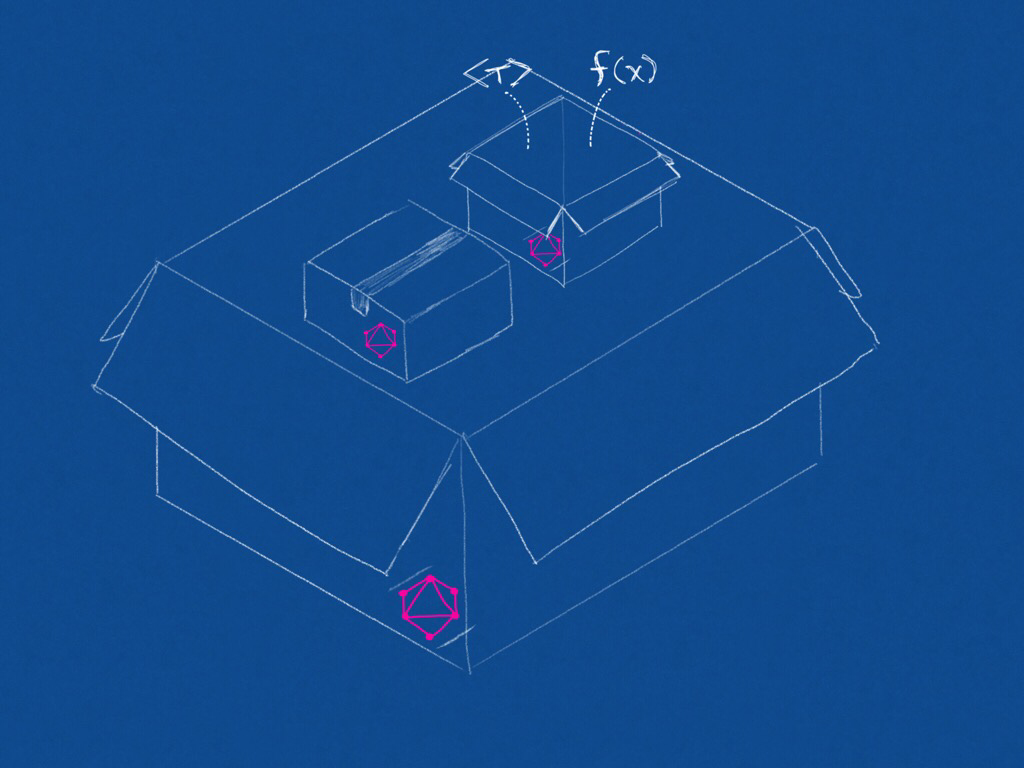
Components of components
This is because in adopting GraphQL at scale, we wanted to ensure not only the success of individual teams, but the scalability and predictability of that success from team to team across Vrbo.
In addition, we’ve learned from past mistakes with other orchestration models and wanted our new model to work differently.
Previously, we relied on dedicated orchestration services. These proved to be not only an unnecessary moving part, but created dependencies between teams that slowed them down and created a wider blast radius when something went wrong.
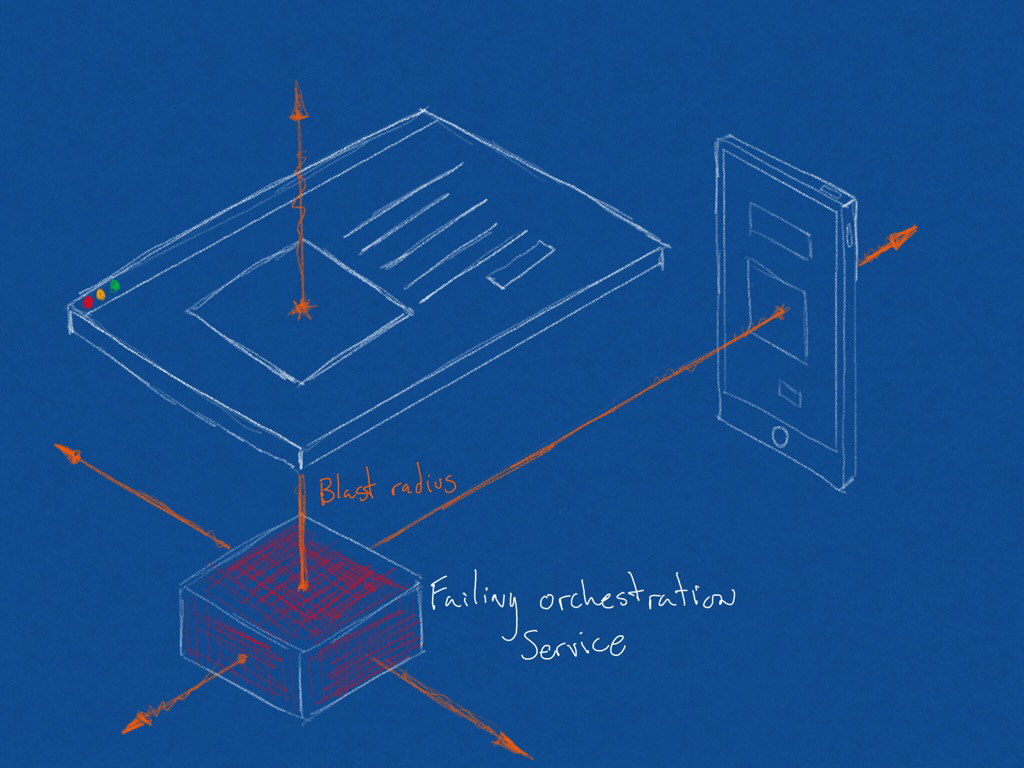
Diagram indicating blast radius of a failure
High level goals
In developing a new front-tier API (orchestration, public APIs) architecture, we had a few goals in mind.
- Increase team velocity by reducing dependencies between teams and services
- Reduce blast radius by:
* Insulating teams from change
* Reducing points of failure - Improve predictability of a team’s:
* Compute needs
* Cost expectations - Simplify collaboration and sharing
- Improve portability across environments
Breaking up GraphQL schema into components
A GraphQL schema is made up of types (type schema), root types (API operations) and resolvers (business logic).
An example type:
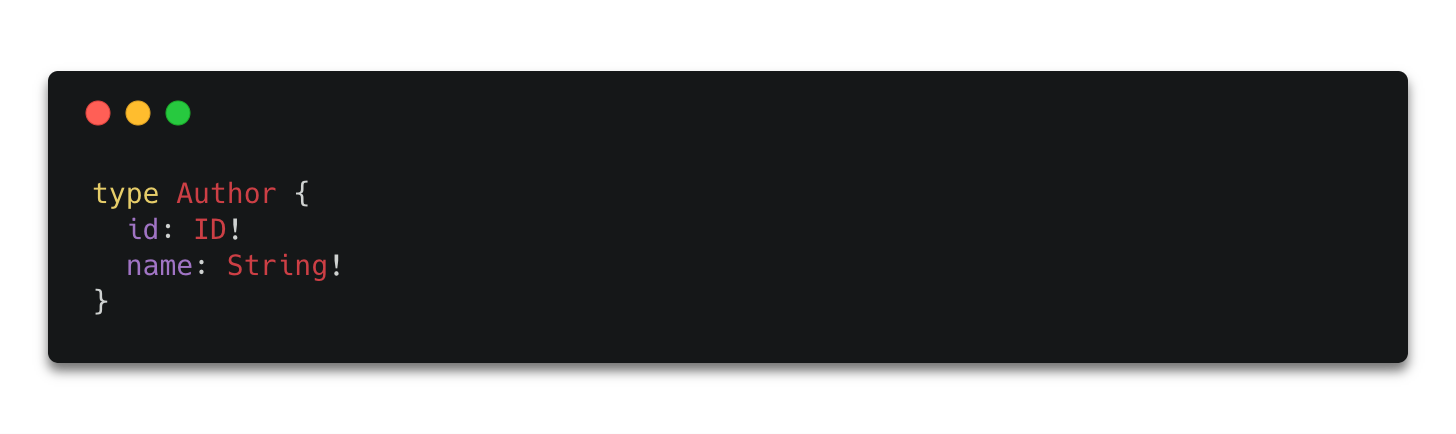
GraphQL type example
This defines a new type Author, which is merely a type definition. To perform operations on Author, such as a query, we must define a root type:

GraphQL root type example
This defines a query operation to the API’s surface called author that clients can now interact with.
But we still need to execute some code for the query to do work and this is where resolvers come in. In javascript, a resolver might look something like this:
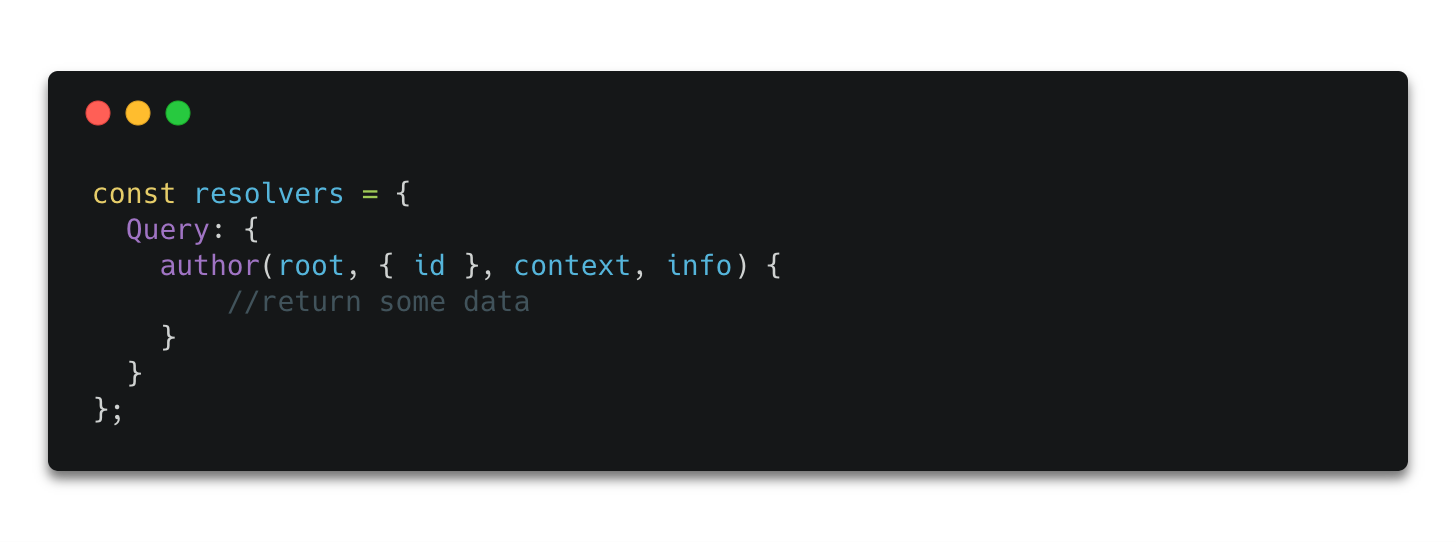
GraphQL resolver example
As you can imagine, a schema can grow quite large as our API surface area grows. This is in part why we break down and componentize these elements of a schema into independently versionable modules that can be imported and merged into an API based on the requirements of the use case.
An application or API can aggregate as many components as it needs to fulfill its UI or user needs.
Our first iteration of where schema is merged, which has been the basis of our success so far, is called “partials”. This brought the convenience and simplicity of node modules to GraphQL.
Our next major iteration for GraphQL includes a newer component model in which each component is its own fully independently executable schema, making both composition and aggregation easier.
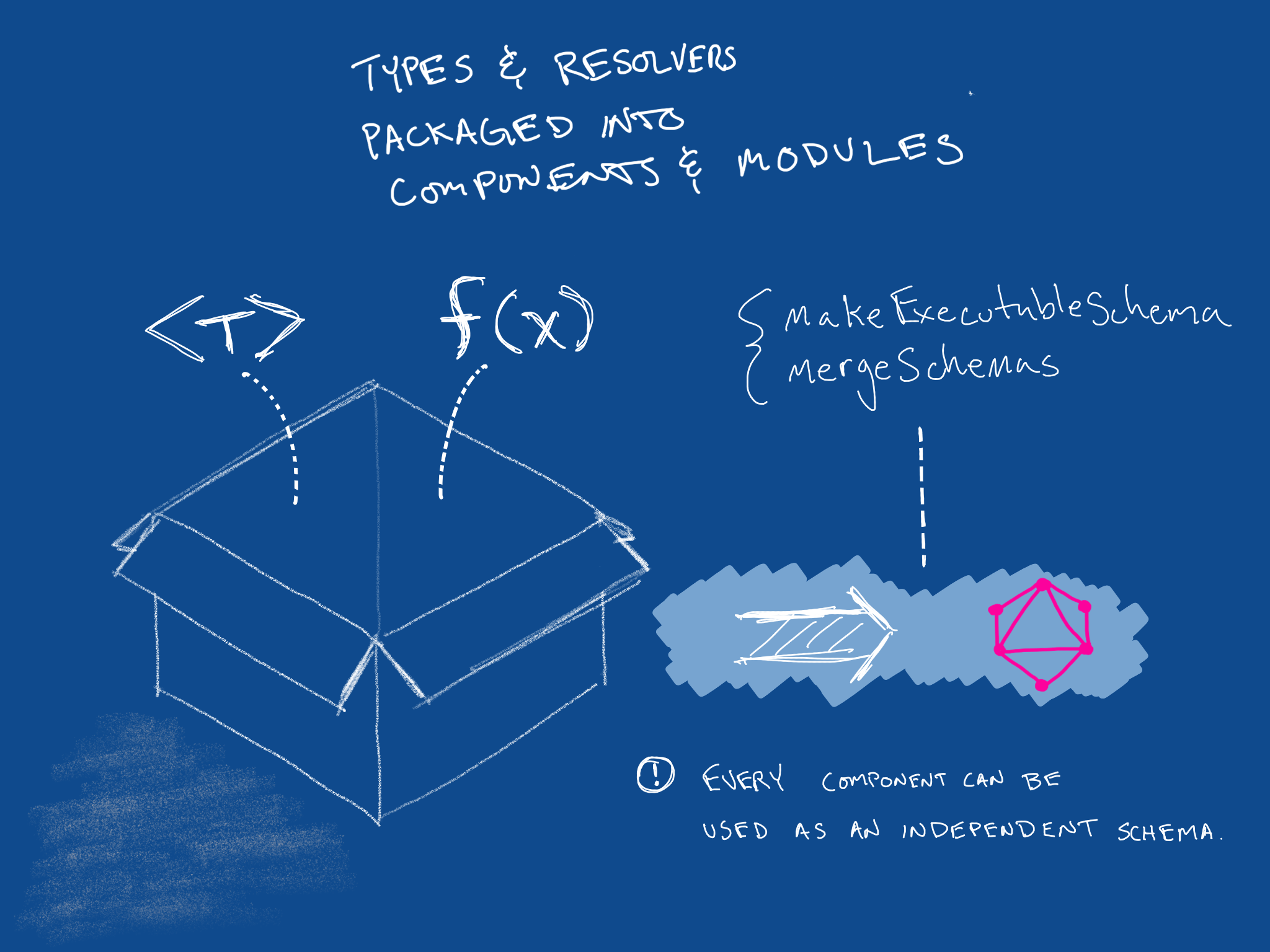
Diagram indicating what a package is comprised of
Implementation design principles
In developing tools to create component-based schemas, we want the following characteristics:
- Composable types
* Types can be made up of many shared types
* Extend and compose types for a use case without impacting others - Composable resolvers
* Invoke without invoking a new service (no network hops)
* Ability to reduce repetitive service calls within the same query tree - Portable
* Injectable upstream requirements (service clients, etc) - Easy to collaborate
* Shared code, not services
* Manage contributions, version as needed, simplify co-development - Schema first
* Easy to read, Easy to update
* Collaborate cross platform on API design in common language
Separate use cases, separate services
With a component model it is not necessary to provision, operationalize and share a service. Each application or API can provide for its own needs by specifying the components it needs.
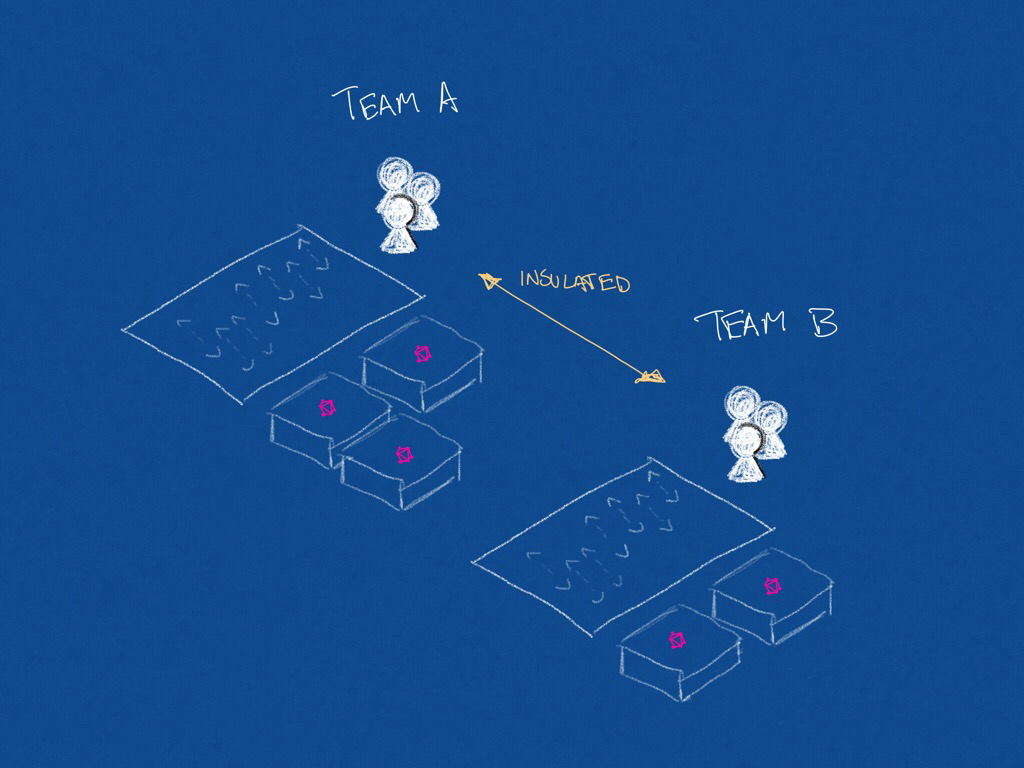
Diagram depicting independent team iteration / responsibility
Because components are composed and merged together without a centralized or shared service, teams can:
- Pick and choose their own orchestration needs
- Version independently of other teams
- Scale independently as their use case demands
- Perform better cost attribution
- Explicitly declare data requirements in UI components
This is a powerful model because it enables our goals for reducing dependencies between teams and the affected area caused by changes in a shared service.
Composition
One of the great aspects of GraphQL is its ability to compose types and resolvers. We don’t want to force two teams to constantly iterate on the same definitions just to satisfy all use cases.
Instead, it is easy for teams to compose new types or extend existing types as separate components that can then be versioned and developed independently.
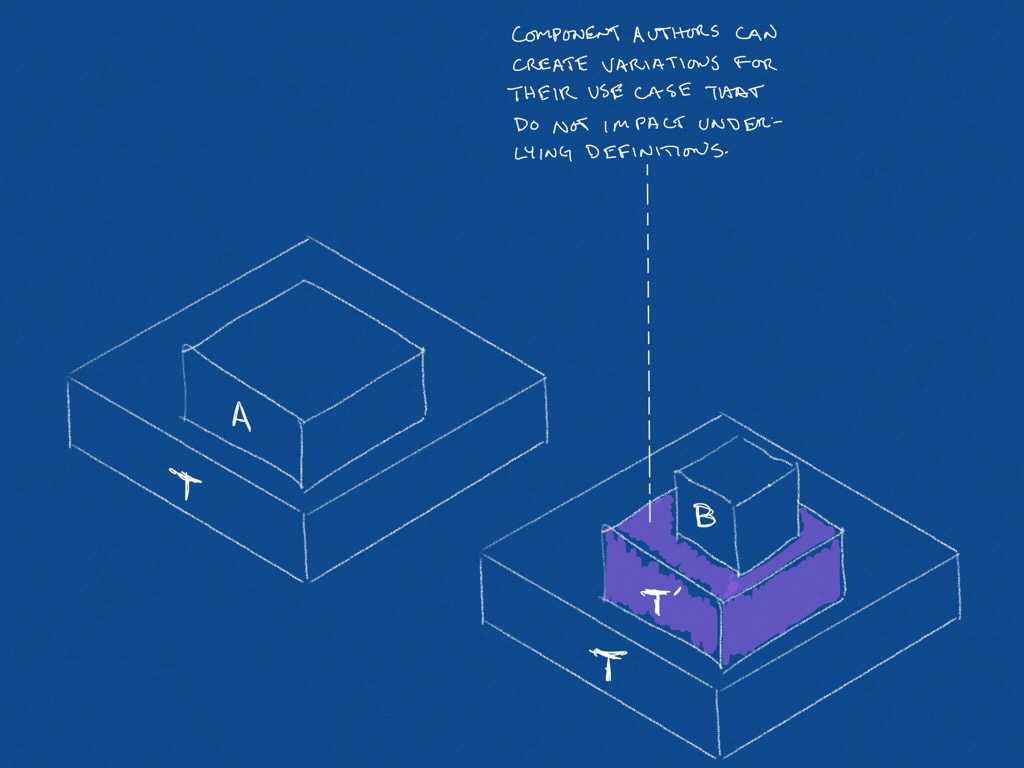
Diagram of component dependencies as packages
A component module A may be composed of an imported module and type T while another component module B, with slightly different needs than A has been composed from a T’ component.
This also allows components to take advantage of existing resolvers by simply invoking across a binding to the composed type. We can also cache results from these calls within a single execution of a query or mutation, reducing the number of times something must be resolved at all.
Components in code
So what might this look like from a code perspective? Let’s take a more real-world example for a property listing appearing on a site like Vrbo.
What is a Listing made up of? Let’s make it overly simple and assume:
- Property
- Reviews
Let’s start with the Property component.
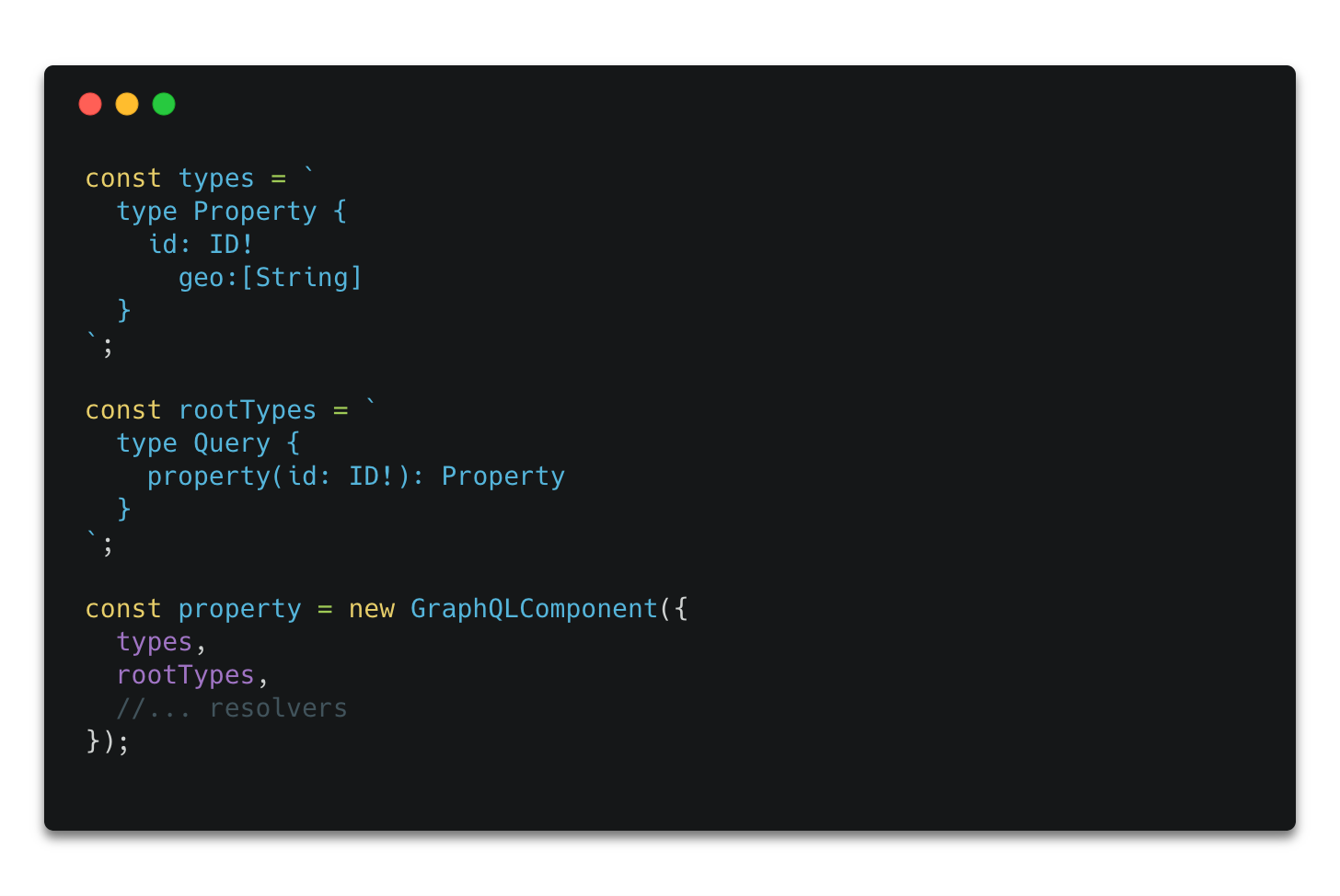
Example property component
Next, Reviews component:
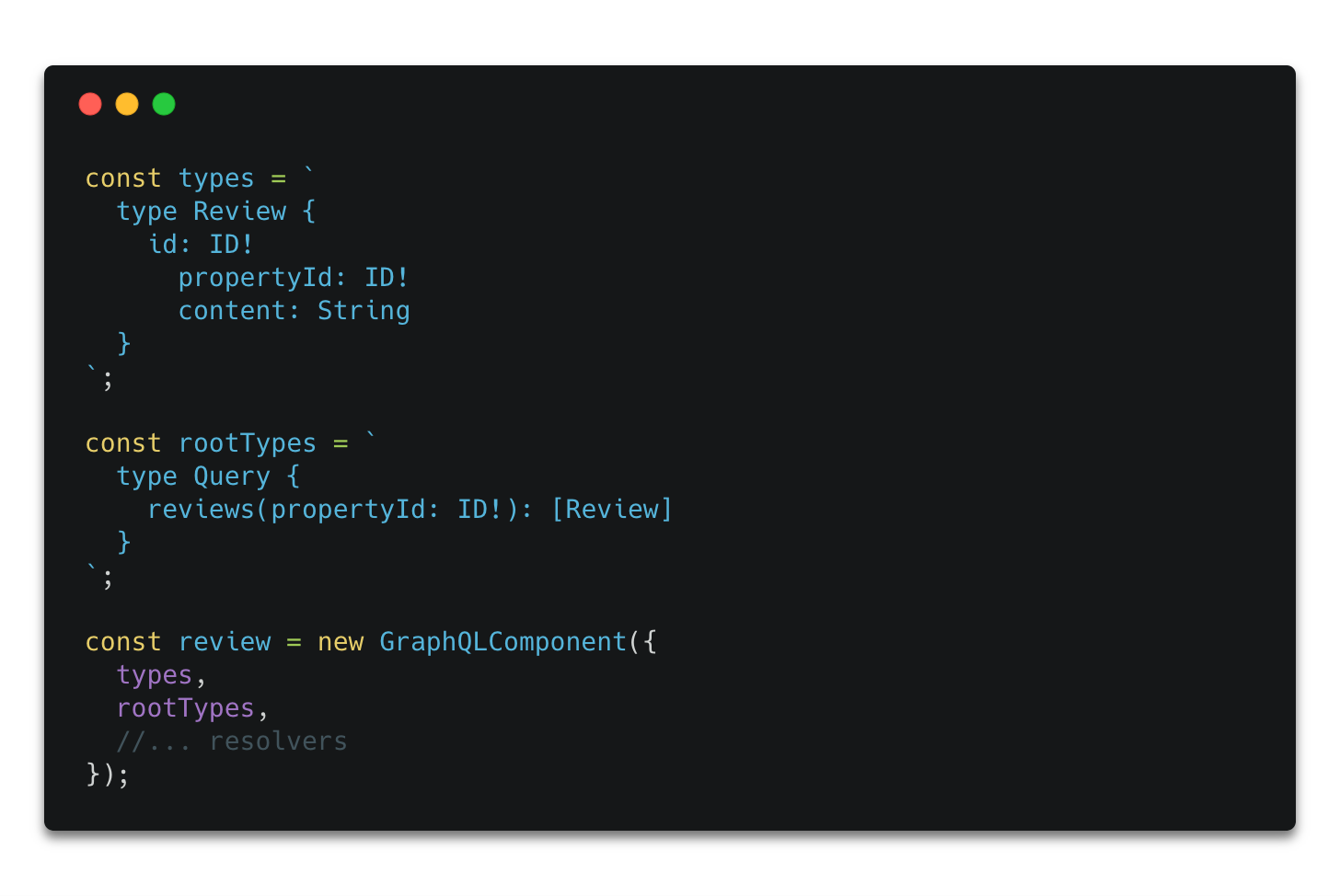
Example reviews component
Finally let’s compose these together into a Listing:
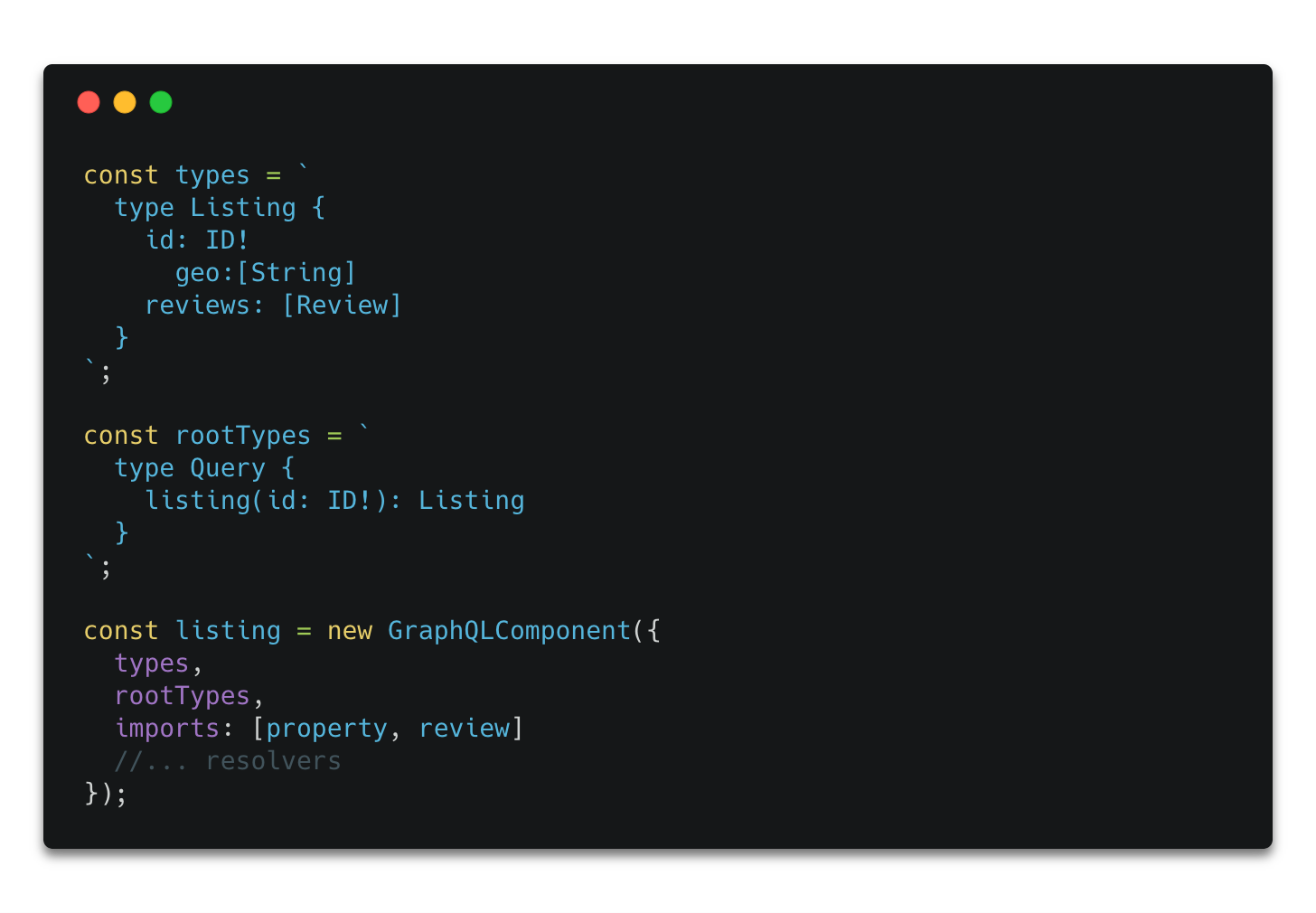
Example listing component
This is different because it also has a new declaration to import property and review. This enables listing to take advantage of both the types in these two components, as well as the resolvers.
In this last example, let’s take a look at the listing resolvers as well:

Example listing resolver
This makes the listing resolver delegate its primary query to property and review in parallel to form its base. The cool thing about this is that it does not simply invoke the resolver function, but rather executes through GraphQL. This lets both type validation and type resolvers to continue to run normally.
The rest of the shaping for Listing type is done with type resolvers (not shown here).
Collaboration
GraphQL is both a query language and type-based schema-first API specification.
One of the problems (and sometimes benefits) of REST is that it is not naturally schema-first. Tools like the OpenAPI specification often rely on after-the-fact generation of specification for documentation purposes only; there is no strict binding of API schema to implementation.
With GraphQL, the schema is the API, and that is a powerful thing.
Because we have relied on inner-source collaboration to develop many of our GraphQL components, the importance of being able to do so in a more accessible way has been critical.
Plain test and even separate .graphql files for type and root type definitions are much easier to read and collaborate on than code, not to mention agnostic to any particular language or platform.
Keeping in sync
When you start versioning modules independently, keeping teams moving off of unsupported versions requires additional tooling to keep track of dependencies and notify developers.
We keep track by building dependency graphs from applications which we can query and run reports to see who is using what.
Finally
In this journey, our evolution has been from monoliths, to miniliths and BFFs (back-ends-for-front-ends), to node apps and modules. But the journey isn’t complete. The industry is evolving to serverless and static pages (JAMStack, etc) and we have begun to as well. As a result, part of our design has also been about runtime portability as well as environment portability.
When it comes down to what it takes to develop a modern web application at Vrbo, it looks something like this:
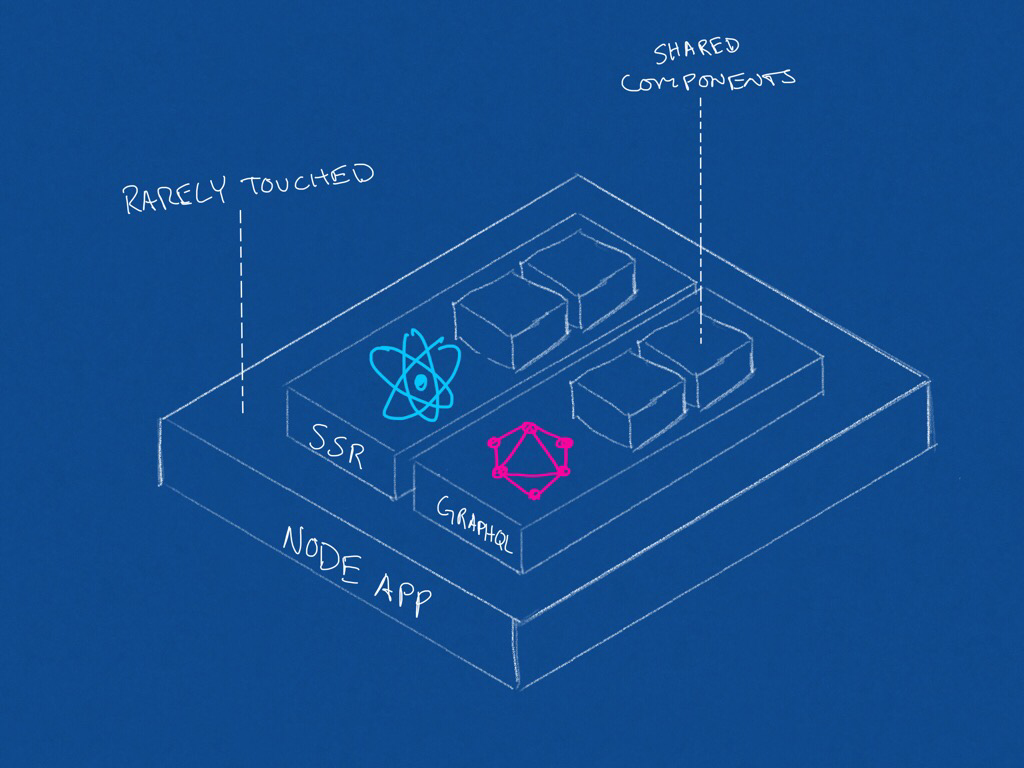
Diagram depicting an application comprised of SSR and GraphQL
Developers spend their time in two areas: React development and GraphQL development (which is usually just reused). This begs the question: why are we deploying applications at all?
With the advent of new capabilities in CDNs like compute with CloudFlare Workers, Fly.io, and others, a serverless (and even containerless) orchestration layer makes a lot of sense.

Diagram depicting GraphQL orchestration moving from web tier to CDN
We plan to experiment with pushing our model to the bleeding edge (pun intended), and it is made easier through a component model designed for flexibility and developer scale.
Further reading
While we were working on the next iteration of our partial schema / component model, a new open source project was released called GraphQL Modules. GraphQL follows an almost identical paradigm and looks great.
I’ve been working on a similar project in the open that is an iteration on our existing internal solution and that is what is used here for the examples. Currently, some simple examples can be seen here.
You can also read more about some of the history in these links:
The Architectural Principles Behind Vrbo’s GraphQL Implementation的更多相关文章
- Architectural principles
原文 "If builders built buildings the way programmers wrote programs, then the first woodpecker t ...
- Why GraphQL is Taking Over APIs
A few years ago, I managed a team at DocuSign that was tasked with re-writing the main DocuSign web ...
- Training - An Introduction to Enterprise Integration
What is EI? Enterprise Integration (EI) is a business computing term for the plans, methods, and too ...
- Three Sources of a Solid Object-Oriented Design
pingback :http://java.sys-con.com/node/84633?page=0,1 Object-oriented design is like an alloy consis ...
- Windows Kernel Security Training Courses
http://www.codemachine.com/courses.html#kerdbg Windows Kernel Internals for Security Researchers Thi ...
- Angular vs React---React-ing to change
这篇文章的全局观和思路一级棒! The Fairy Tale Cast your mind back to 2010 when users started to demand interactive ...
- 斯坦福CS课程列表
http://exploredegrees.stanford.edu/coursedescriptions/cs/ CS 101. Introduction to Computing Principl ...
- (转)Web2.0 大型互联网站点的架构
这种资料.向来可遇不可求啊 WikiPedia 技术架构学习分享 http://www.dbanotes.net/opensource/wikipedia_arch.html YouTube 的架构扩 ...
- Awesome Go
A curated list of awesome Go frameworks, libraries and software. Inspired by awesome-python. Contrib ...
随机推荐
- AAct 一款 KMS 激活工具
AAct是一款由俄罗斯网友Ratiborus制作的非常小巧实用的KMS激活工具,能自动设置密钥管理服务激活Windows.Office VL版本.支持手动安装及删除激活产品密钥.手动创建及删除续期计划 ...
- Django ORM 数据库增删改查
Django ORM 数据库增删改查 增 # 创建.增加数据(推荐) models.UserInfo.objects.create(username=') # 创建.增加数据 dic = {'} mo ...
- SQL系列(七)—— 相似(like)
在看like之前先了解下通配符和搜索模式: 通 配 符 ( wildcard) 用来匹配值的一部分的特殊字符. 搜索模式(search pattern) 由字面值.通配符或两者组合构成的搜索条件. 目 ...
- 3、Vue实例的属性
1.获取Vue实例的属性 2.data属性 每个Vue实例都会代理其data对象里所有的属性.如果实例创建之后添加或者更改属性,他不会触发视图更新. 这句话说了下面两件事情 1.每个Vue实例都会代理 ...
- .NET Core MD5加密 32位和16位
public class MD5Help { //此代码示例通过创建哈希字符串适用于任何 MD5 哈希函数 (在任何平台) 上创建 32 个字符的十六进制格式哈希字符串官网案例改编 /// <s ...
- .Net调用ffmpeg对视频截图
2019/10/27, .Net c#代码片段 摘要:借助ffmpeg对视频/图片截图.生成缩略图,使用命令行调用ffmpeg工具,支持Linux和Windows 网上很多版本都是需要等待4s的做法, ...
- ASP.NET 异步编程之Async await
本文重点介绍的是.NET Framework4.5 推出的异步编程方案 async await 请先看个5分钟的微软演示的视频:视频地址: https://channel9.msdn.com/Blo ...
- window当mac用,VirtualBox虚拟机安装os系统
mac的环境让开发者很享受,既可以像在linux环境下开发,又可以享受到几乎window所有支持的工具软件,比如ide,note,browser 我的安装过程 1.首先你有了64位的window7操作 ...
- 【真】CSP2019退役记(upd:12.21)
这是第一次CSP(Counter-Strike Professor),也是最后一次. Day-1 上午考试,日常被虐. 下午颓mc Day0 上午考试,日常被虐. 下午颓mc 晚上看了下悬线法.最小表 ...
- Java小知识点总结01
1. 整数相乘或者相加,如果超过最大整数值,会变成负数 2. 字符串比较可以使用:s1.compareTo(s2) ,如果s1大于s2返回值大于1,等于返回值等于0,小于返回值小于1 3. char值 ...