
机器学习 Logistic 回归
Logistic regression
适用于二分分类的算法,用于估计某事物的可能性。
logistic分布表达式
$ F(x) = P(X<=x)=\frac{1}{1+e^{\frac{-(x-\mu)}{\gamma}}} $
$ f(x) = F{'}(x)=\frac{e{\frac{-(x-\mu)}{\gamma}}}{\gamma(1+e{\frac{-(x-\mu)}{\gamma}}){2}} $
函数图像
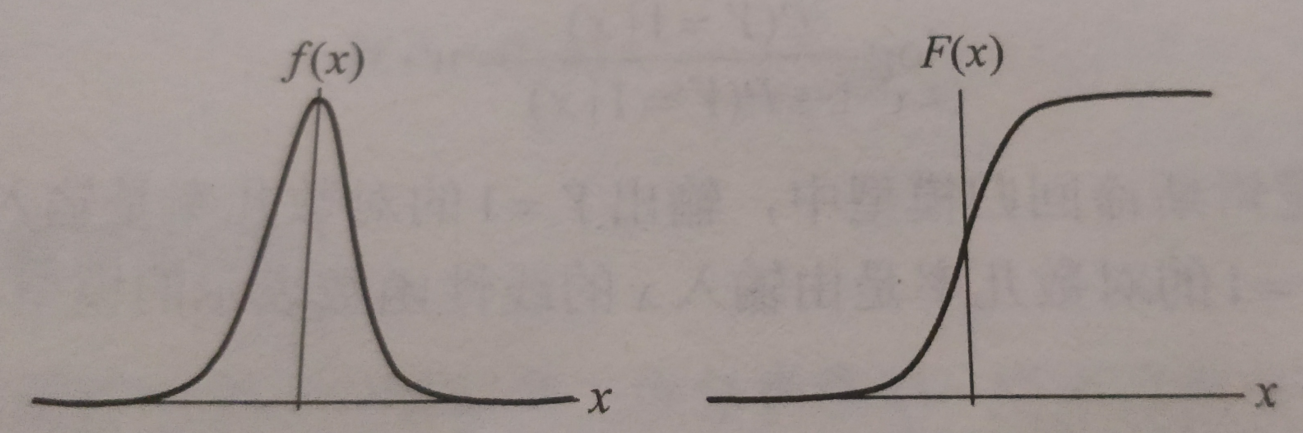
分布函数属于逻辑斯谛函数,以点 \((\mu,\frac{1}{2})\) 为中心对称
逻辑回归是一种学习算法,用于有监督学习问题时,输出y都是0或1。逻辑回归的目标是最小化预测和训练数据之间的误差。
公式推导

代码实现
from math import exp

import numpy as np

import pandas as pd

import matplotlib.pyplot as plt

from sklearn.datasets import load_iris

from sklearn.model_selection import train_test_split

def create_data():

    iris = load_iris()

    df = pd.DataFrame(iris.data, columns=iris.feature_names)

    df['label'] = iris.target

    df.columns = ['sepal length', 'sepal width', 'petal length', 'petal width', 'label']

    data = np.array(df.iloc[:100, [0, 1, -1]])

    return data[:, :2], data[:, -1]

class LogisticRegressionClassifier:

    def __init__(self, max_iter=200, learning_rate=0.01, random_state=4):

        self.max_iter = max_iter

        self.learning_rate = learning_rate

        self.weights = None

    def sigmoid(self, x):

        return 1 / (1 + exp(-x))

    def data_matrix(self, X):

        data_mat = []

        for d in X:

            data_mat.append([1.0, *d])

        return data_mat

    def fit(self, X, y):

        data_mat = self.data_matrix(X)

        self.weights = np.zeros((len(data_mat[0]), 1), dtype=np.float32)

        for iter_ in range(self.max_iter):

            for i in range(len(X)):

                result = self.sigmoid(np.dot(data_mat[i], self.weights))

                error = y[i] - result

                self.weights += self.learning_rate * error * np.transpose([data_mat[i]])

        print('LogisticRegression Model(learning_rate={},max_iter={})'.format(self.learning_rate, self.max_iter))

    def score(self, X_test, y_test):

        right = 0

        X_test = self.data_matrix(X_test)

        for x, y in zip(X_test, y_test):

            result = np.dot(x, self.weights)

            if (result > 0 and y == 1) or (result < 0 and y == 0):

                right += 1

        return right / len(X_test)

if __name__ == '__main__':

    X, y = create_data()

    X_train, X_test, y_train, y_test = train_test_split(X, y, test_size=0.3)

    lr_clf = LogisticRegressionClassifier()

    lr_clf.fit(X_train, y_train)

    print('the score = {}'.format(lr_clf.score(X_test, y_test)))

    x_ponits = np.arange(4, 8)

    y_ = -(lr_clf.weights[1] * x_ponits + lr_clf.weights[0]) / lr_clf.weights[2]

    plt.plot(x_ponits, y_)

    # lr_clf.show_graph()

    plt.scatter(X[:50, 0], X[:50, 1], label='0')

    plt.scatter(X[50:, 0], X[50:, 1], label='1')

    plt.legend()

    plt.show()
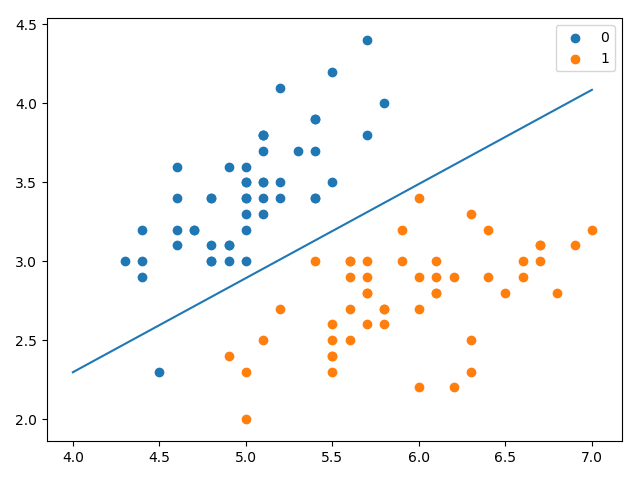
LogisticRegression Model(learning_rate=0.01,max_iter=200)

the score = 0.9666666666666667
sklearn中的logistic regression
sklearn.linear_model.LogisticRegression
LogisticRegression(C=1.0, class_weight=None, dual=False, fit_intercept=True,

          intercept_scaling=1, max_iter=200, multi_class='warn',

          n_jobs=None, penalty='l2', random_state=None, solver='liblinear',

          tol=0.0001, verbose=0, warm_start=False)
solver参数决定了我们对逻辑回归损失函数的优化方法,有四种算法可以选择,分别是:
- a) liblinear:使用了开源的liblinear库实现,内部使用了坐标轴下降法来迭代优化损失函数。
- b) lbfgs:拟牛顿法的一种,利用损失函数二阶导数矩阵即海森矩阵来迭代优化损失函数。
- c) newton-cg:也是牛顿法家族的一种,利用损失函数二阶导数矩阵即海森矩阵来迭代优化损失函数。
- d) sag:即随机平均梯度下降,是梯度下降法的变种,和普通梯度下降法的区别是每次迭代仅仅用一部分的样本来计算梯度,适合于样本数据多的时候。
from sklearn.linear_model import LogisticRegression

clf = LogisticRegression(max_iter=200,solver='liblinear')

clf.fit(X_train, y_train)

print(clf.score(X_test, y_test))

print(clf.coef_, clf.intercept_)
输出
0.9666666666666667

[[ 1.96863514 -3.31358598]] [-0.36853861]
机器学习 Logistic 回归的更多相关文章
- 机器学习——Logistic回归
1.基于Logistic回归和Sigmoid函数的分类 2.基于最优化方法的最佳回归系数确定 2.1 梯度上升法 参考:机器学习--梯度下降算法 2.2 训练算法:使用梯度上升找到最佳参数 Logis ...
- 机器学习——Logistic回归
参考<机器学习实战> 利用Logistic回归进行分类的主要思想: 根据现有数据对分类边界线建立回归公式,以此进行分类. 分类借助的Sigmoid函数: Sigmoid函数图: Sigmo ...
- 机器学习——logistic回归,鸢尾花数据集预测,数据可视化
0.鸢尾花数据集 鸢尾花数据集作为入门经典数据集.Iris数据集是常用的分类实验数据集,由Fisher, 1936收集整理.Iris也称鸢尾花卉数据集,是一类多重变量分析的数据集.数据集包含150个数 ...
- 机器学习--Logistic回归
logistic回归 很多时候我们需要基于一些样本数据去预测某个事件是否发生,如预测某事件成功与失败,某人当选总统是否成功等. 这个时候我们希望得到的结果是 bool型的,即 true or fals ...
- coursera机器学习-logistic回归,正则化
#对coursera上Andrew Ng老师开的机器学习课程的笔记和心得: #注:此笔记是我自己认为本节课里比较重要.难理解或容易忘记的内容并做了些补充,并非是课堂详细笔记和要点: #标记为<补 ...
- 机器学习-- Logistic回归 Logistic Regression
转载自:http://blog.csdn.net/linuxcumt/article/details/8572746 1.假设随Tumor Size变化,预测病人的肿瘤是恶性(malignant)还是 ...
- 吴恩达-机器学习+Logistic回归分类方案
- 机器学习简易入门(四)- logistic回归
摘要:使用logistic回归来预测某个人的入学申请是否会被接受 声明:(本文的内容非原创,但经过本人翻译和总结而来,转载请注明出处) 本文内容来源:https://www.dataquest.io/ ...
- 机器学习(4)之Logistic回归
机器学习(4)之Logistic回归 1. 算法推导 与之前学过的梯度下降等不同,Logistic回归是一类分类问题,而前者是回归问题.回归问题中,尝试预测的变量y是连续的变量,而在分类问题中,y是一 ...
随机推荐
- 阿里云服务器 ECS Linux 禁止IP 通过 SSH 登录
这几天买的服务器老是受到黑客攻击被破解登录密码,今天修改了登录规则发现只有固定ip可以访问,其他ip即使有密码也无法登录我的服务器,但是能通过ip访问我的网站,哈哈. 限制 IP SSH 登录解决步骤 ...
- python - class内置方法 doc/module/del(析构方法)/cal 方法
__doc__ # __doc__ #摘要信息 #这个属性不会继承给子类 class Test(): """这是摘要信息""" pass x ...
- Kali2.0更新
下载链接:猛戳这里 更新以后速度与界面友好性提高了! 界面仿造了ubuntu和fedora,应用也有很多小图标!这个对个人来说比较赞 安装以后的几件事 1.安装vmtools,方法跟1.0一样! ta ...
- JDK7与8内存参数解析与修改
JDK内存 jdk内存实际是jvm内存,jvm有一个运行时数据区,其实就是对这一部分的大小分配. 运行时数据区通常包括这几个部分:程序计数器(Program Counter Register).Jav ...
- C:malloc/calloc/realloc/alloca内存分配函数
原文地址:http://www.cnblogs.com/3me-linux/p/3962152.html calloc(), malloc(), realloc(), free(),alloca() ...
- freeradius 错误: error:140890C7:SSL routines:ssl3_get_client_certificate:peer did not return a certificate
在进行802.1x 测试时遇到如下问题: Waking up in 4.6 seconds.(156) Received Access-Request Id 82 from 192.168.1.126 ...
- centos6.5环境通达OA数据库mysql5.0.67升级至mysql5.5.48方案
centos6.5环境通达OA数据库mysql5.0.67升级至mysql5.5.42方案 整体方案: 环境准备,在备用服务器安装mysql5.5数据库 1.停用生产环境的应用访问 直接修改web的访 ...
- idea开发swing(二)
闲话少说,书接idea开发swing(一). 程序编译完成后,需要打包发布,如果有fat_jar的同学可以通过该插件打包,这里是使用ant来打包,步骤如下: 一.编写build.xml <?xm ...
- SQL代码整理
--SQL代码整理: create database mingzi--创建数据库go--连接符(可省略)create table biao--创建表( lieming1 int not null,-- ...
- python魔法函数(二)之__getitem__、__len__、__iter__
魔法函数会增强python类的类型,独立存在 __getitem class Company: def __init__(self, employees): self.employees = empl ...