
Flink(三) —— 运行架构
Flink运行时组件
- JobManager 作业管理器
- TaskManager 任务管理器
- ResourceManager 资源管理器
- Dispatcher 分发器
任务提交流程
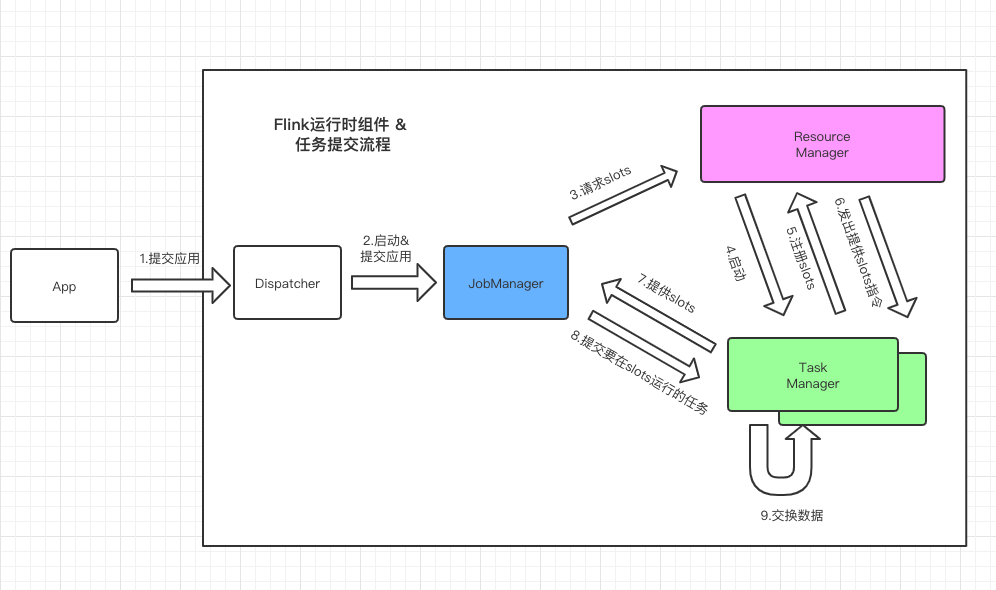
任务调度原理
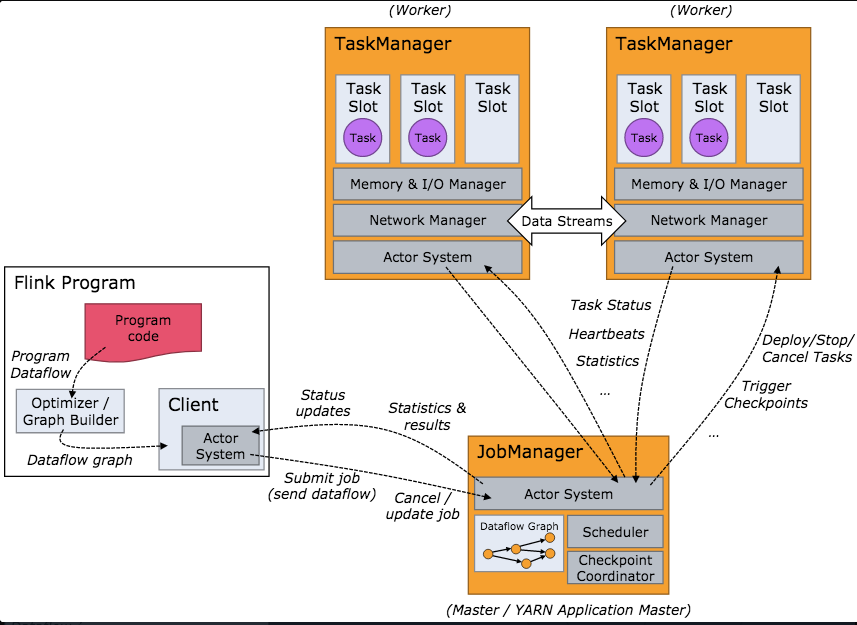
Job Managers, Task Managers, Clients
The Flink runtime consists of two types of processes:
The JobManagers (also called masters) coordinate the distributed execution. They schedule tasks, coordinate checkpoints, coordinate recovery on failures, etc.
There is always at least one Job Manager. A high-availability setup will have multiple JobManagers, one of which one is always the leader, and the others are standby.
The TaskManagers (also called workers) execute the tasks (or more specifically, the subtasks) of a dataflow, and buffer and exchange the data streams.
There must always be at least one TaskManager.
The JobManagers and TaskManagers can be started in various ways: directly on the machines as a standalone cluster, in containers, or managed by resource frameworks like YARN or Mesos. TaskManagers connect to JobManagers, announcing themselves as available, and are assigned work.
The client is not part of the runtime and program execution, but is used to prepare and send a dataflow to the JobManager. After that, the client can disconnect, or stay connected to receive progress reports. The client runs either as part of the Java/Scala program that triggers the execution, or in the command line process ./bin/flink run ....
Task Slots and Resources
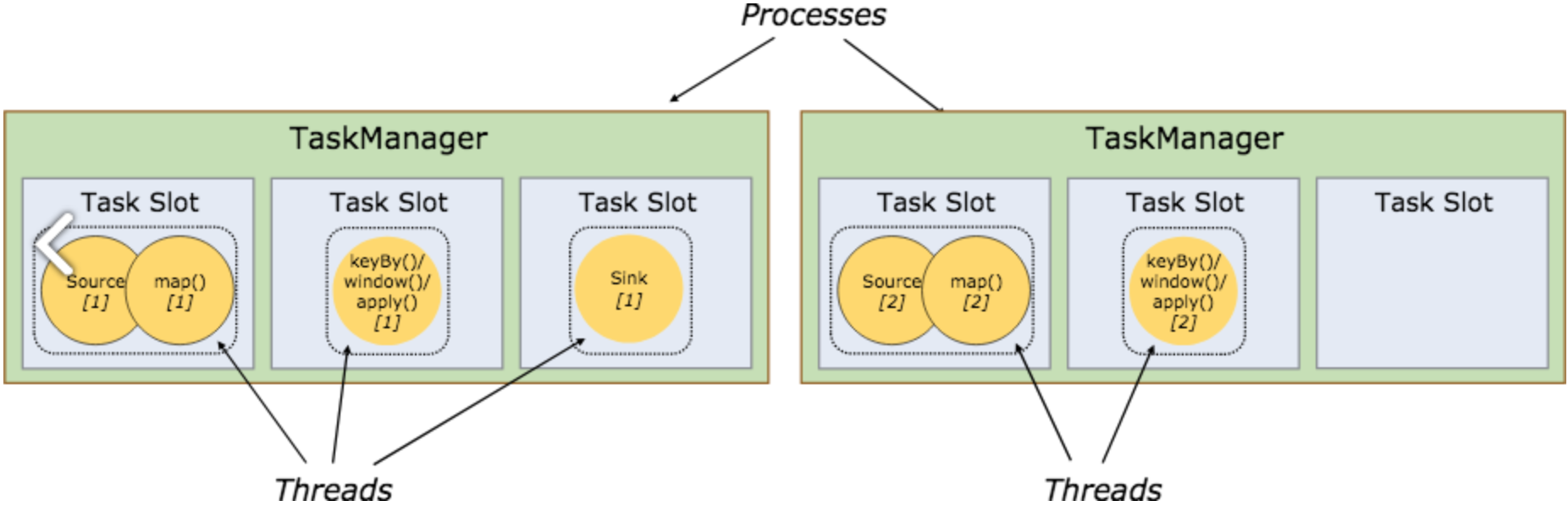
Each worker (TaskManager) is a JVM process, and may execute one or more subtasks in separate threads. To control how many tasks a worker accepts, a worker has so called task slots (at least one).
每个TaskManager都是一个JVM进程,可以在独立的线程中执行一个或多个子任务。TaskManager有Task Slots来控制可以接收多少个任务(一个TaskManager至少有一个Task Slot)。
Each task slot represents a fixed subset of resources of the TaskManager. A TaskManager with three slots, for example, will dedicate 1/3 of its managed memory to each slot. Slotting the resources means that a subtask will not compete with subtasks from other jobs for managed memory, but instead has a certain amount of reserved managed memory. Note that no CPU isolation happens here; currently slots only separate the managed memory of tasks.
By adjusting the number of task slots, users can define how subtasks are isolated from each other. Having one slot per TaskManager means each task group runs in a separate JVM (which can be started in a separate container, for example). Having multiple slots means more subtasks share the same JVM. Tasks in the same JVM share TCP connections (via multiplexing) and heartbeat messages. They may also share data sets and data structures, thus reducing the per-task overhead.
参考文档
Flink Distributed Runtime Environment
Flink(三) —— 运行架构的更多相关文章
- Flink 的运行架构详细剖析
1. Flink 程序结构 Flink 程序的基本构建块是流和转换(请注意,Flink 的 DataSet API 中使用的 DataSet 也是内部流 ).从概念上讲,流是(可能永无止境的)数据记录 ...
- Flink| 运行架构
1. Flink运行时组件 作业管理器(JobManager) 任务管理器(TaskManager) 资源管理器(ResourceManager) 分发器(Dispatcher) 2. 任务提交流程 ...
- hadoop记录-[Flink]Flink三种运行模式安装部署以及实现WordCount(转载)
[Flink]Flink三种运行模式安装部署以及实现WordCount 前言 Flink三种运行方式:Local.Standalone.On Yarn.成功部署后分别用Scala和Java实现word ...
- 01-Flink运行架构
1.flink运行时的组件 Flink 运行时架构主要包括四个不同的组件,它们会在运行流处理应用程序时协同工作: 作业管理器(JobManager).资源管理器(ResourceManager). ...
- Flink(二)【架构原理,组件,提交流程】
目录 一.运行架构 1.架构 2.组件 二.核心概念 TaskManager . Slots Parallelism(并行度) Task .Subtask Operator Chains(任务链) E ...
- Spark入门实战系列--4.Spark运行架构
[注]该系列文章以及使用到安装包/测试数据 可以在<倾情大奉送--Spark入门实战系列>获取 1. Spark运行架构 1.1 术语定义 lApplication:Spark Appli ...
- 【转载】Spark运行架构
1. Spark运行架构 1.1 术语定义 lApplication:Spark Application的概念和Hadoop MapReduce中的类似,指的是用户编写的Spark应用程序,包含了一个 ...
- Apache Flink 分布式运行时环境
Tasks and Operator Chains(任务及操作链) 在分布式环境下,Flink将操作的子任务链在一起组成一个任务,每一个任务在一个线程中执行.将操作链在一起是一个不错的优化:它减少了线 ...
- 朱晔的互联网架构实践心得S1E8:三十种架构设计模式(下)
朱晔的互联网架构实践心得S1E8:三十种架构设计模式(下) [下载本文PDF进行阅读] 接上文,继续剩下的15个模式. 数据管理模式 16.分片模式:将数据存储区划分为一组水平分区或分片 一直有一个说 ...
- spark 运行架构
spark 运行架构基本由三部分组成,包括SparkContext(驱动程序),ClusterManager(集群资源管理器)和Executor(任务执行过程)组成. 其中SparkContext负责 ...
随机推荐
- 九、CI框架之将URI转为数组原型
一.输入以下代码,uri_to_assoc的参数默认从3开始 二.输出效果如下: 不忘初心,如果您认为这篇文章有价值,认同作者的付出,可以微信二维码打赏任意金额给作者(微信号:382477247)哦, ...
- Python 操作csv和excel表格
1. 操作csv表格 使用的库 csv 1. csv文件里读取数据 代码 1. 以列表形式打开 import csv f = open('csv_test.csv', 'r') # 打开csv文件 c ...
- 获取ExtJS中开启Form.fileUpload时,返回的信息
当Form,开启fileUpload后,不能按默认的方式得到action.result,开启fileUpload与否,返回的action.result的内容是不一样的 未开启fileUpload时,返 ...
- 杂点-shell
使用while循环读取文件 cat file.txt |while read line do echo $line done 或者: while read line do echo $line don ...
- MySQL读写分离如何实现?
主要说下读写分离, 当我们的数据量很大时,数据库服务器的压力变大,这时候我们需要从架构方面来解决这一问题,在一个网站中读的操作很多,写的操作很少,这时候我们需要配置读写分离,把读操作和写操作分离出来, ...
- C语言中getopt()和getopt_long()函数的用法
一.参考文章 1.C语言中getopt()和getopt_long()函数的用法 2.linux 中解析命令行参数 (getopt_long用法) 二.调试经验
- Neo4j安装配置(mac)
Neo4j安装配置(mac) 1.下载APP 注意:无需配置变量 下载地址:https://neo4j.com/download/ 2.安装程序并启动 3.创建数据库(local) 选择版本 4.启动 ...
- Numa解释
原路径:http://www.sohu.com/a/126402403_609500 内容概要 今天的文章我们将简单学习下Hyper-V如何通过NUMA(Non-Uniform Memory Acce ...
- caffe-fasterrcnn程序理解
faster-rcnn 结构杂谈 参考博客:::https://www.cnblogs.com/longriyao/p/5832274.html http://www.cnblogs.com/cha ...
- DP模板
怕不是最后一篇(雾),过滤最基础的背包DP.状压DP.递推等 树上换根DP:https://www.luogu.org/problemnew/show/P4284 #include<bits/s ...