
POJ1573——Robot Motion
Robot Motion
Description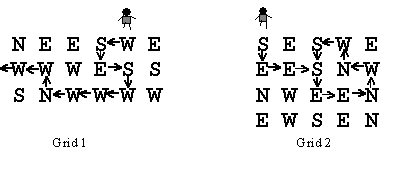
A robot has been programmed to follow the instructions in its path. Instructions for the next direction the robot is to move are laid down in a grid. The possible instructions are
N north (up the page)
S south (down the page)
E east (to the right on the page)
W west (to the left on the page)
For example, suppose the robot starts on the north (top) side of Grid 1 and starts south (down). The path the robot follows is shown. The robot goes through 10 instructions in the grid before leaving the grid.
Compare what happens in Grid 2: the robot goes through 3 instructions only once, and then starts a loop through 8 instructions, and never exits.
You are to write a program that determines how long it takes a robot to get out of the grid or how the robot loops around.
Input
There will be one or more grids for robots to navigate. The data for each is in the following form. On the first line are three integers separated by blanks: the number of rows in the grid, the number of columns in the grid, and the number of the column in which the robot enters from the north. The possible entry columns are numbered starting with one at the left. Then come the rows of the direction instructions. Each grid will have at least one and at most 10 rows and columns of instructions. The lines of instructions contain only the characters N, S, E, or W with no blanks. The end of input is indicated by a row containing 0 0 0.
Output
For each grid in the input there is one line of output. Either the robot follows a certain number of instructions and exits the grid on any one the four sides or else the robot follows the instructions on a certain number of locations once, and then the instructions on some number of locations repeatedly. The sample input below corresponds to the two grids above and illustrates the two forms of output. The word "step" is always immediately followed by "(s)" whether or not the number before it is 1.
Sample Input
3 6 5
NEESWE
WWWESS
SNWWWW
4 5 1
SESWE
EESNW
NWEEN
EWSEN
0 0 0
Sample Output
10 step(s) to exit
3 step(s) before a loop of 8 step(s)
题目大意:看图+样例基本就懂了。
解题思路:模拟
Code:
 #include<string>

 #include<iostream>

 #include<cstdio>

 #include<cstring>

 using namespace std;

 int a,b,first,px,py,date1,date2;

 struct Point

 {

     char dir;

     int vis,step;

 } P[];

 int move(int cnt)

 {

     int tmp=(py-)*a+px;

     if (P[tmp].dir=='N') py--;

     if (P[tmp].dir=='E') px++;

     if (P[tmp].dir=='S') py++;

     if (P[tmp].dir=='W') px--;

     if (px>=a+||px<=||py>=b+||py<=)

         return ;

     tmp=(py-)*a+px;

     if (P[tmp].vis)

     {

         date1=P[tmp].step-;

         date2=cnt-date1-;

         return -;

     }

     else P[tmp].vis=,P[tmp].step=cnt;

     return ;

 }

 int main()

 {

     while (cin>>b>>a>>first)

     {

         int k=;

         if (!a&&!b&&!first) break;

         for (int i=; i<=b; i++)

             for (int j=; j<=a; j++)

             {

                 cin>>P[k].dir;

                 P[k++].vis=;

             }

         px=first,py=;

         P[first].step=,P[first].vis=;

         int cnt=,ok;

         while ()

         {

             ok=move(cnt);

             if (ok) break;

             cnt++;

         }

         if (ok==) printf("%d step(s) to exit\n",cnt-);

         else printf("%d step(s) before a loop of %d step(s)\n",date1,date2);

     }

     return ;

 }
POJ1573——Robot Motion的更多相关文章
- poj1573 Robot Motion
Robot Motion Time Limit: 1000MS Memory Limit: 10000K Total Submissions: 12507 Accepted: 6070 Des ...
- POJ-1573 Robot Motion模拟
题目链接: https://vjudge.net/problem/POJ-1573 题目大意: 有一个N*M的区域,机器人从第一行的第几列进入,该区域全部由'N' , 'S' , 'W' , 'E' ...
- poj1573 Robot Motion(DFS)
题目链接 http://poj.org/problem?id=1573 题意 一个机器人在给定的迷宫中行走,在迷宫中的特定位置只能按照特定的方向行走,有两种情况:①机器人按照方向序列走出迷宫,这时输出 ...
- POJ1573(Robot Motion)--简单模拟+简单dfs
题目在这里 题意 : 问你按照图中所给的提示走,多少步能走出来??? 其实只要根据这个提示走下去就行了.模拟每一步就OK,因为下一步的操作和上一步一样,所以简单dfs.如果出现loop状态,只要记忆每 ...
- POJ1573 Robot Motion(模拟)
题目链接. 分析: 很简单的一道题, #include <iostream> #include <cstring> #include <cstdio> #inclu ...
- 【POJ - 1573】Robot Motion
-->Robot Motion 直接中文 Descriptions: 样例1 样例2 有一个N*M的区域,机器人从第一行的第几列进入,该区域全部由'N' , 'S' , 'W' , 'E' ,走 ...
- Robot Motion(imitate)
Robot Motion Time Limit: 1000MS Memory Limit: 10000K Total Submissions: 11065 Accepted: 5378 Des ...
- 模拟 POJ 1573 Robot Motion
题目地址:http://poj.org/problem?id=1573 /* 题意:给定地图和起始位置,robot(上下左右)一步一步去走,问走出地图的步数 如果是死循环,输出走进死循环之前的步数和死 ...
- POJ 1573 Robot Motion(BFS)
Robot Motion Time Limit: 1000MS Memory Limit: 10000K Total Submissions: 12856 Accepted: 6240 Des ...
随机推荐
- C/C++编译过程理解【转】
转载自:http://www.cppblog.com/woaidongmao/archive/2008/11/07/66254.aspx 今天,通过自己的努力终于对C/C++的编译过程有了个粗略的了解 ...
- linux 常用软件安装-目录
nginx apache php mysql oracle tomcat memcached mongodb sqlserver
- SSH连接时出现Host key verification failed的原因及解决方法
SSH连接的时候Host key verification failed. [root@cache001 swftools-0.9.0]# ssh 192.168.1.90@@@@@@@@@@@@@@ ...
- Hibernate的单向OneToMany、单向ManyToOne
单向OneToMany 一个用户有多张照片,User----->Images是一对多关系,在数据库中Images维护一个外键useid 1.在映射关系的主控方Image这边,我们什么都不做.(为 ...
- setTimeout/setInterval执行时机
setTimeout()和setInterval()经常被用来处理延时和定时任务.setTimeout() 方法用于在指定的毫秒数后调用函数或计算表达式,而setInterval()则可以在每隔指定的 ...
- JavaScript异步获取数据解析
<script type="text/javascript"> var xhr=false; function createXhr() { var x ...
- AngularJS(8)-指令directive
AngularJS 提供了很多内置的指令,你可以使用它们来为你的应用添加功能. 诸如这些: 此外,你可以使用模块来为你应用添加自己的指令: 运行结果:
- 在Linux上部署和操作Couchbase
couchbase属于nosql系列,个人感觉它要比mongodb操作简单,mongo的查询语句太复杂.在数据的持久性方面它区别于其他nosql 的唯一大亮点是不受限于其内存分配了多少,只要磁盘空间够 ...
- 用 .htaccess 实现网址规范化
网址规范化在 SEO 中是一个比较重要的环节,同时存在不同的网址版本,不但可能造成内容重复,还不能正确的集中权重.目前大多数网站,绑定的域名都有带 www 和不带两个版本,甚至很多网站同时绑定多个域名 ...
- Review PHP设计模式之——注册模式
注册模式: class DbConnections{ var $_store = array(); public function isValid($key) { return isset($this ...