
LEETCODE —— Linked List Cycle [Floyd's cycle-finding algorithm]
Linked List Cycle
Given a linked list, determine if it has a cycle in it.
Follow up:
Can you solve it without using extra space?
# Definition for singly-linked list.

# class ListNode(object):

#     def __init__(self, x):

#         self.val = x

#         self.next = None

class Solution(object):

    def hasCycle(self, head):

        """

        :type head: ListNode

        :rtype: bool

        """

        if head is None:

            return False

        rabbit = turtle = head

        while rabbit.next and rabbit.next.next:

            turtle = turtle.next

            rabbit = rabbit.next.next

            if rabbit == turtle:

                return True

        return False
佛洛依德龟兔算法
|
Let me try to clarify the cycle detection algorithm that is provided at http://en.wikipedia.org/wiki/Cycle_detection#Tortoise_and_hare in my own words. I refer to the figure How it works Let's have a tortoise and a hare (name of the pointers) pointing to the beginning of the list with a cycle. Let's hypothesize that if we move tortoise 1 step at a time, and hare 2 steps at a time, they will eventually meet at a point. Let's show that first of all this hypothesis is true. The figure illustrates a list with a cycle. The cycle has a length of n and we are initially m steps away from the cycle. Also let's say that the meeting point is k steps away from the cycle beginning and tortoise and hare meets after a total of i steps. The following 2 conditions must hold: 1) i = m + p * n + k 2) 2i = m + q * n + k The first one says that tortoise moves i steps and in these i steps it first gets to the cycle. Then it goes through the cycle p times for some positive number p. Finally it goes over k more nodes until it meets hare. A similar is true for hare. It moves 2i steps and in these 2i steps it first gets to the cycle. Then it goes through the cycle q times for some positive number q. Finally it goes over k more nodes until it meets tortoise. Therefore, 2 ( m + p * n + k ) = m + q * n + k => 2m + 2pn + 2k = m + nq + k => m + k = ( q - 2p ) n Among m, n, k, p, q, the first two are properties of the given list. If we can show that there is at least one set of values for k, q, p that makes this equation true we show that the hypothesis is correct. One such solution set is as follows: p = 0 q = m k = m n - m We can verify that these values work as follows: m + k = ( q - 2p ) n => m + mn - m = ( m - 2*0) n => mn = mn. For this set, i is i = m + p n + k => m + 0 * n + mn - m = mn. Of course, you should see that this is not necessarily the smallest i possible. In other words, tortoise and hare might have already met before many times. However, since we show that they meet at some point at least once we can say that the hypothesis is correct. So they would have to meet if we move one of them 1 step, and the other one 2 steps at a time. Now we can go to the second part of the algorithm which is how to find the beginning of the cycle. Cycle Beginning Once tortoise and hare meet, let's put tortoise back to the beginning of the list and keep hare where they met (which is k steps away from the cycle beginning). The hypothesis is that if we let them move at the same speed (1 step for both), the first time they ever meet again will be the cycle beginning. Let's prove this hypothesis. Let's first assume some oracle tells us what m is. Then, if we let them move m + k steps, tortoise would have to arrive at the point they met originally (k steps away from the cycle beginning - see in the figure). Previously we showed that m + k = (q - 2p) n. Since m + k steps is a multiple of cycle length n, hare, in the mean time, would go through the cycle (q-2p) times and would come back to the same point (k steps away from the cycle beginning). Now, instead of letting them move m + k steps, if we let them move only m steps, tortoise would arrive at the cycle beginning. Hare would go be k steps short of completing (q-2p) rotations. Since it started k steps in front of the cycle beginning, hare would have to arrive at the cycle beginning. As a result, this explains that they would have to meet at the cycle beginning after some number of steps for the very first time (very first time because tortoise just arrived at the cycle after m steps and it could never see hare which was already in the cycle). Now we know that the number of steps we need to move them until they meet turns out to be the distance from the beginning of the list to the cycle beginning, m. Of course, the algorithm does not need to know what m is. It will just move both tortoise and hare one step at a time until they meet. The meeting point has to be the cycle start and the number of steps must be the distance (m) to the cycle beginning. Assuming we know the length of the list, we can also, compute the length of the cycle of subtracting m from the list length. |
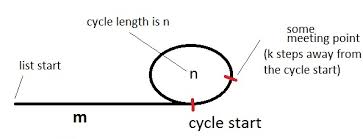 in my explanation.
LEETCODE —— Linked List Cycle [Floyd's cycle-finding algorithm]的更多相关文章
- LeetCode Linked List Cycle II 和I 通用算法和优化算法
Linked List Cycle II Given a linked list, return the node where the cycle begins. If there is no cyc ...
- Floyd's Cycle Detection Algorithm
Floyd's Cycle Detection Algorithm http://www.siafoo.net/algorithm/10 改进版: http://www.siafoo.net/algo ...
- LeetCode & linked list bug
LeetCode & linked list bug add-two-numbers shit test /** * Definition for singly-linked list. * ...
- [LeetCode] Linked List Cycle II 单链表中的环之二
Given a linked list, return the node where the cycle begins. If there is no cycle, return null. Foll ...
- [LeetCode] Linked List Cycle 单链表中的环
Given a linked list, determine if it has a cycle in it. Follow up: Can you solve it without using ex ...
- [LeetCode]Linked List Cycle II解法学习
问题描述如下: Given a linked list, return the node where the cycle begins. If there is no cycle, return nu ...
- LeetCode——Linked List Cycle
Given a linked list, determine if it has a cycle in it. Follow up: Can you solve it without using ex ...
- LeetCode——Linked List Cycle II
Given a linked list, return the node where the cycle begins. If there is no cycle, return null. Foll ...
- [算法][LeetCode]Linked List Cycle & Linked List Cycle II——单链表中的环
题目要求 Linked List Cycle Given a linked list, determine if it has a cycle in it. Follow up: Can you so ...
随机推荐
- 会游走的TextView
//自定义的TextView package com.bwie.androidtest; import android.content.Context; import android.graphics ...
- 使用CSS3动画模拟实现小球自由落体效果
使用纯CSS代码模拟实现小球自由落体效果: html代码如下: <div id="ballDiv"> <div id="ball">&l ...
- nexus7 二代 升级 android L
折腾了半天 ,最后发现其实很简单... 1.装好windows下gdb和bootloader的驱动,注意打开usb debug,另外进入bootloader是开机按电源键和音量减小键,至于要解锁这个想 ...
- 常用类String的方法
String str="hello"; 1.与数组相关的方法 System.out.println(str.length()); System.out.println(str.ch ...
- C++深拷贝与浅拷贝
当用一个已初始化过了的自定义类类型对象去初始化另一个新构造的对象的时候,拷贝构造函数就会被自动调用.也就是说,当类的对象需要拷贝时,拷贝构造函数将会被调用.以下情况都会调用拷贝构造函数: (1)一个对 ...
- 关于peersim样例配置文件的超详细解读(新手勿喷)
相信很多兄弟一开始接触peersim,对配置文件还是有点不适应,我看了好久的样例的配置文件,一层层去找对应的文件的方法,终于好像悟懂了一点,记下来以后回顾. 贴上代码,一点点分析. 首先要说下所谓的配 ...
- 传入的表格格式数据流(TDS)远程过程调用(RPC)协议流不正确。此 RPC 请求中提供了过多的参数。最多应为 2100
出现这个问题的背景是,判断一批激活码在系统中是否已经存在,很傻的一个作法是,把这一批激活码,以in(in (‘ddd‘,‘aaa‘))的形式来处理,导致问题的出现. 后来,查找资料,http://bb ...
- c++ sort降序排序
sort是c++ STL中提供的一个函数模板,可以用来对多种类型进行排序. 默认是升序排序.它有两种使用方法: default (1) template <class RandomAccessI ...
- <转>Win7系统下利用U盘安装Ubuntu_12.04实现双系统教程
目前网上流传的关于Linux 系统的安装教程可是说是五彩缤纷,之前想采用硬盘安装方式,由于配置问题未能正确安装,现研究了下U盘安装,根据互联网上的一些资料及自己的总结,在Windows7 系统下采用U ...
- 33条C#和.NET经典面试题目及答案
1. .NET中类和结构的区别? 答:结构和类具有大体的语法,但是结构受到的限制比类要多. a. 结构不能有默认的构造函数,因为结构的副本是用编译器创建和销毁的,所以不需要默认的构造函数和析构函数. ...