
leetcode-486-Predict the Winner
Given an array of scores that are non-negative integers. Player 1 picks one of the numbers from either end of the array followed by the player 2 and then player 1 and so on. Each time a player picks a number, that number will not be available for the next player. This continues until all the scores have been chosen. The player with the maximum score wins.
Given an array of scores, predict whether player 1 is the winner. You can assume each player plays to maximize his score.
Example 1:
Input: [1, 5, 2]

Output: False

Explanation: Initially, player 1 can choose between 1 and 2.
If he chooses 2 (or 1), then player 2 can choose from 1 (or 2) and 5. If player 2 chooses 5, then player 1 will be left with 1 (or 2).
So, final score of player 1 is 1 + 2 = 3, and player 2 is 5.
Hence, player 1 will never be the winner and you need to return False.
Example 2:
Input: [1, 5, 233, 7]

Output: True

Explanation: Player 1 first chooses 1. Then player 2 have to choose between 5 and 7. No matter which number player 2 choose, player 1 can choose 233.
Finally, player 1 has more score (234) than player 2 (12), so you need to return True representing player1 can win.
Note:
- 1 <= length of the array <= 20.
- Any scores in the given array are non-negative integers and will not exceed 10,000,000.
- If the scores of both players are equal, then player 1 is still the winner.
思路:
参考自
http://www.voidcn.com/blog/starstar1992/article/p-6497962.html
https://discuss.leetcode.com/topic/76472/clean-3ms-c-dp-solution-with-detailed-explanation
https://discuss.leetcode.com/topic/76327/c-dp-solution-with-explanation
bool PredictTheWinner(vector<int>& nums)

     {

         int n = nums.size();

         vector<vector<int>>dp(n, vector<int>(n));

         vector<int>sum(n);

         sum[] = nums[];

         dp[][] = nums[];

         for (int i = ; i < n;i++)

         {

             sum[i] += sum[i - ] + nums[i];

             dp[i][i] = nums[i];

         }

         for (int i = ; i < n;i++)

         {

             for (int j = ; i + j < n;j++)

             {

                 dp[j][i + j] = max(sum[i+j]-sum[j]+nums[j] -dp[j+][i+j],sum[i+j]-sum[j]+nums[j]-dp[j][i+j-]);

             }

         }

         return  * dp[][n - ] >= sum[n - ];

     }
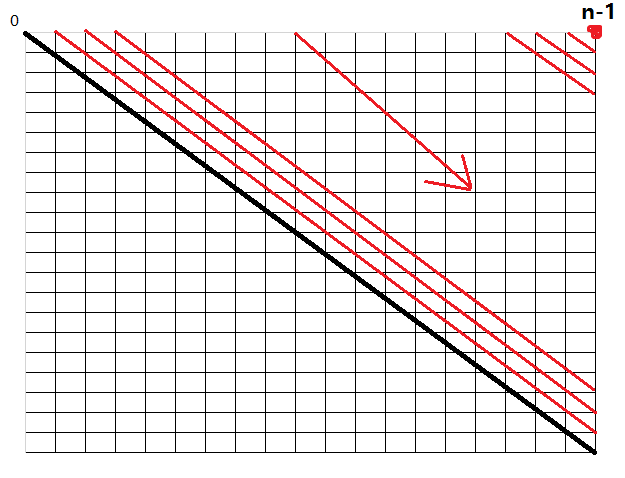
如上图所示,dp为二维数组,最终要求得是dp[0][n-1]那么,需要不断的去迭代更新dp[i][j]的值。求得过程类似上图,从对角线的上方
从左上到右下求dp[i][j]的值。也就是说求dp[i][j]需要用到它左边和下边的值 即左边dp[i][j-1]和下边dp[i+1][j]的值。
这一题用动态规划来解决。
对于原数组A[0,….,n-1],我们定义
dp[i][j]表示原数组中从i到j的这么多数中,按照游戏规则,某个玩家所能获得的最大分数。
假设这个分数此时属于palyer1,那么dp[i+1][j]或者dp[i][j-1]表示player2玩家所能获得的最大分数。因为对于player1来讲,他第一次选择要么是第i个数,要么是第j个数,所以对于player2来讲,就分两种情况取最大。
另外我们设从i到j的所有数的和是sum[i,j],则可以得到递推公式:(动态规划最明显的标识)
dp[i][j]=max(sum[i+1][j]-dp[i+1][j]+nums[i], sum[i][j-1]-dp[i][j-1]+nums[j]) 。
这个需要好好想想!其实不难!
化简一下:
dp[i][j]=max(sum[i][j]-dp[i+1][j], sum[i][j]-dp[i][j-1]) 。
但是写代码实现时,我们要注意:
首先要得到dp[i][i]的值,之后依次得到:
dp[0][1],dp[1,2],dp[2,3]…dp[n-2][n-1]
之后再得到dp[0][2],dp[1][3],…
for(int i=1;i<n;i++)

            for(int j=0;i+j<n;j++)

                dp[j][i+j]=max(sum[i+j]-sum[j]+nums[j]-dp[j+1][i+j],sum[i+j]-sum[j]+nums[j]-dp[j][i+j-1]);
所以这段代码的实现意图就比较明显了!
另外,注意sum[i+j]-sum[j]+nums[j]而不用sum[i+j]-sum[j-1]来求解从i到j的和,是为了考虑j=0时的情况。
细节处比较多,很考察能力!
leetcode-486-Predict the Winner的更多相关文章
- LN : leetcode 486 Predict the Winner
lc 486 Predict the Winner 486 Predict the Winner Given an array of scores that are non-negative inte ...
- [LeetCode] 486. Predict the Winner 预测赢家
Given an array of scores that are non-negative integers. Player 1 picks one of the numbers from eith ...
- 随手练——博弈论入门 leetcode - 486. Predict the Winner
题目链接:https://leetcode.com/problems/predict-the-winner/ 1.暴力递归 当前数组左边界:i,右边界:j: 对于先发者来说,他能取到的最大值是:max ...
- [leetcode] 486. Predict the Winner (medium)
原题 思路: 解法一: 转换比较拿取分数多少的思路,改为考虑 player拿的分数为正,把Player2拿的视为负,加上所有分数,如果最后结果大于0则Player1赢. 思考得出递归表达式: max( ...
- 【LeetCode】486. Predict the Winner 解题报告(Python)
[LeetCode]486. Predict the Winner 解题报告(Python) 标签(空格分隔): LeetCode 作者: 负雪明烛 id: fuxuemingzhu 个人博客: ht ...
- LC 486. Predict the Winner
Given an array of scores that are non-negative integers. Player 1 picks one of the numbers from eith ...
- 【leetcode】486. Predict the Winner
题目如下: Given an array of scores that are non-negative integers. Player 1 picks one of the numbers fro ...
- 486. Predict the Winner
Given an array of scores that are non-negative integers. Player 1 picks one of the numbers from eith ...
- 486 Predict the Winner 预测赢家
给定一个表示分数的非负整数数组. 玩家1从数组任意一端拿取一个分数,随后玩家2继续从剩余数组任意一端拿取分数,然后玩家1拿,…….每次一个玩家只能拿取一个分数,分数被拿取之后不再可取.直到没有剩余分数 ...
- Leetcode之动态规划(DP)专题-486. 预测赢家(Predict the Winner)
Leetcode之动态规划(DP)专题-486. 预测赢家(Predict the Winner) 给定一个表示分数的非负整数数组. 玩家1从数组任意一端拿取一个分数,随后玩家2继续从剩余数组任意一端 ...
随机推荐
- iis7 安装laravel5.4环境
laravel版本: Laravel5.4IIS版本:IIS7站点配置就不详细说啦,大家网上可以搜一坨很多的配置方法啦哈直接上图: 由于IIS没有像Apache.htaccess文件,创建一个Web. ...
- Java学习笔记——排序算法之简单排序
男儿何不带吴钩,收取关山五十州.请君暂上凌烟阁,若个书生万户侯? --南园十三首 三种排序法: 1.冒泡法 2.简单选择法 3.直接插入法 上代码: 1.冒泡排序 public class Bub ...
- iOS之copy、strong使用,block特性
身边一同事,我印象在过去三个月,有两次因为使用“copy”修饰UIKit控件的属性,导致程序崩溃.他还一本正经的说我以前一直使用copy. 好了,到这里我们就不得不说说什么时候使用copy.我的印象中 ...
- 门面(Facade)模式
门面模式是对象的结构模式,外部与一个子系统的通信必须通过一个统一的门面对象进行.门面模式提供一个高层次的接口,使得子系统更易于使用. 医院的例子 现代的软件系统都是比较复杂的,设计师处理复杂系统的一个 ...
- SpringData系列四 @Query注解及@Modifying注解
@Query注解查询适用于所查询的数据无法通过关键字查询得到结果的查询.这种查询可以摆脱像关键字查询那样的约束,将查询直接在相应的接口方法中声明,结构更为清晰,这是Spring Data的特有实现. ...
- 数组的重排序方法reverse()和sort()
js数组中存在两个可以直接用来重排序的方法:reverse()和sort(). reverse()方法比较简单,直接反转数组项的顺序: var arr = [1, 3, 2, 4, 5]; arr.r ...
- Java并发编程:Callable、Future和FutureTask的实现
启动线程执行任务,如果需要在任务执行完毕之后得到任务执行结果,可以使用从Java 1.5开始提供的Callable和Future 下面就分析一下Callable.Future以及FutureTask的 ...
- 数据库安全性操作——操作原则及SQL注入
转载请注明出处:http://www.cnblogs.com/Joanna-Yan/p/6893134.html 今天在进行支付宝开发时,看到支付宝开发文档<开放平台第三方应用安全开发指南> ...
- java中为什么实体类需要实现序列化
当客户端访问某个能开启会话功能的资源,web服务器就会创建一个HTTPSession对象,每个HTTPSession对象都会占用一定的内存,如果在同一个时间段内访问的用户太多,就会消耗大量的服务器内存 ...
- 模仿ICE的structured panorama小按钮
这个按钮的目的是用于手动排列图片序列,应该说写得比较精巧,我使用csharp进行模仿,主要采用的是自动控件创建技术.结果比较简陋,实现功能而已,放出来大家一起学习. ; ; ...