
Network Stack
OverviewThe network stack is a mostly single-threaded cross-platform library primarily for resource fetching. Its main interfaces are
URLRequest and URLRequestContext. URLRequest, as indicated by its name, represents the request for a URL. URLRequestContext contains all the associated context necessary to fulfill the URL request, such as cookies, host resolver, proxy resolver, cache, etc. Many URLRequest objects may share the same URLRequestContext. Most net objects are not threadsafe, although the disk cache can use a dedicated thread, and several components (host resolution, certificate verification, etc.) may use unjoined worker threads. Since it primarily runs on a single network thread, no operation on the network thread is allowed to block. Therefore we use non-blocking operations with asynchronous callbacks (typically CompletionCallback). The network stack code also logs most operations to NetLog, which allows the consumer to record said operations in memory and render it in a user-friendly format for debugging purposes.Chromium developers wrote the network stack in order to:
Code Layout
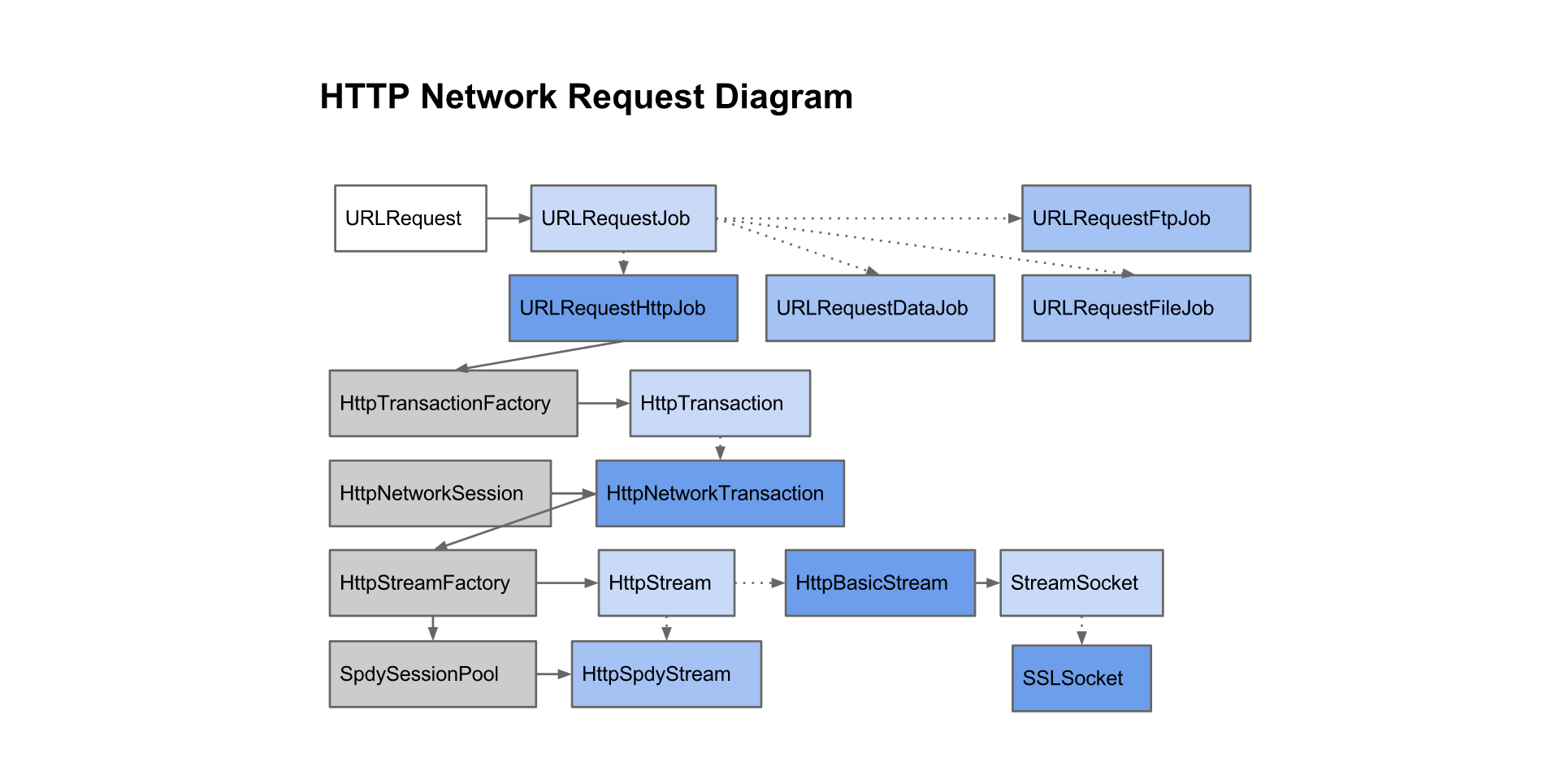
Anatomy of a Network Request (focused on HTTP)
 URLRequestclass URLRequest { public: // Construct a URLRequest for |url|, notifying events to |delegate|. URLRequest(const GURL& url, Delegate* delegate); // Specify the shared state void set_context(URLRequestContext* context); // Start the request. Notifications will be sent to |delegate|. void Start(); // Read data from the request. bool Read(IOBuffer* buf, int max_bytes, int* bytes_read);}; class URLRequest::Delegate { public: // Called after the response has started coming in or an error occurred. virtual void OnResponseStarted(...) = 0; // Called when Read() calls complete. virtual void OnReadCompleted(...) = 0;};
When a
URLRequest is started, the first thing it does is decide what type of URLRequestJob to create. The main job type is the URLRequestHttpJob which is used to fulfill http:// requests. There are a variety of other jobs, such as URLRequestFileJob (file://), URLRequestFtpJob (ftp://), URLRequestDataJob (data://), and so on. The network stack will determine the appropriate job to fulfill the request, but it provides two ways for clients to customize the job creation: URLRequest::Interceptor and URLRequest::ProtocolFactory. These are fairly redundant, except that URLRequest::Interceptor's interface is more extensive. As the job progresses, it will notify the URLRequest which will notify the URLRequest::Delegate as needed.URLRequestHttpJobURLRequestHttpJob will first identify the cookies to set for the HTTP request, which requires querying the
CookieMonster in the request context. This can be asynchronous since the CookieMonster may be backed by an sqlitedatabase. After doing so, it will ask the request context's HttpTransactionFactory to create a HttpTransaction. Typically, the HttpCache will be specified as the HttpTransactionFactory. The HttpCache will create a HttpCache::Transaction to handle the HTTP request. The HttpCache::Transaction will first check the HttpCache (which checks the disk cache) to see if the cache entry already exists. If so, that means that the response was already cached, or a network transaction already exists for this cache entry, so just read from that entry. If the cache entry does not exist, then we create it and ask the HttpCache's HttpNetworkLayer to create a HttpNetworkTransaction to service the request. The HttpNetworkTransaction is given a HttpNetworkSession which contains the contextual state for performing HTTP requests. Some of this state comes from the URLRequestContext.HttpNetworkTransactionclass HttpNetworkSession { ... private: // Shim so we can mock out ClientSockets. ClientSocketFactory* const socket_factory_; // Pointer to URLRequestContext's HostResolver. HostResolver* const host_resolver_;
// Reference to URLRequestContext's ProxyService
scoped_refptr<ProxyService> proxy_service_; // Contains all the socket pools. ClientSocketPoolManager socket_pool_manager_;
// Contains the active SpdySessions.
scoped_ptr<SpdySessionPool> spdy_session_pool_;
// Handles HttpStream creation.
HttpStreamFactory http_stream_factory_;
};HttpNetworkTransaction asks the HttpStreamFactory to create a HttpStream. The HttpStreamFactory returns a HttpStreamRequest that is supposed to handle all the logic of figuring out how to establish the connection, and once the connection is established, wraps it with a HttpStream subclass that mediates talking directly to the network.class HttpStream { public: virtual int SendRequest(...) = 0; virtual int ReadResponseHeaders(...) = 0; virtual int ReadResponseBody(...) = 0; ...};Currently, there are only two main
HttpStream subclasses: HttpBasicStream and SpdyHttpStream, although we're planning on creating subclasses for HTTP pipelining. HttpBasicStream assumes it is reading/writing directly to a socket. SpdyHttpStream reads and writes to a SpdyStream. The network transaction will call methods on the stream, and on completion, will invoke callbacks back to the HttpCache::Transaction which will notify the URLRequestHttpJob and URLRequest as necessary. For the HTTP pathway, the generation and parsing of http requests and responses will be handled by the HttpStreamParser. For the SPDY pathway, request and response parsing are handled by SpdyStream and SpdySession. Based on the HTTP response, the HttpNetworkTransaction may need to perform HTTP authentication. This may involve restarting the network transaction.HttpStreamFactoryHttpStreamFactory first does proxy resolution to determine whether or not a proxy is needed. The endpoint is set to the URL host or the proxy server. HttpStreamFactory then checks the SpdySessionPool to see if we have an available SpdySession for this endpoint. If not, then the stream factory requests a "socket" (TCP/proxy/SSL/etc) from the appropriate pool. If the socket is an SSL socket, then it checks to see if NPN indicated a protocol (which may be SPDY), and if so, uses the specified protocol. For SPDY, we'll check to see if a SpdySession already exists and use that if so, otherwise we'll create a new SpdySession from this SSL socket, and create a SpdyStreamfrom the SpdySession, which we wrap a SpdyHttpStream around. For HTTP, we'll simply take the socket and wrap it in a HttpBasicStream.Proxy ResolutionHttpStreamFactory queries the ProxyService to return the ProxyInfo for the GURL. The proxy service first needs to check if it has an up-to-date proxy configuration. If not, it uses the ProxyConfigService to query the system for the current proxy settings. If the proxy settings are set to no proxy or a specific proxy, then proxy resolution is simple (we return no proxy or the specific proxy). Otherwise, we need to run a PAC script to determine the appropriate proxy (or lack thereof). If we don't already have the PAC script, then the proxy settings will indicate we're supposed to use WPAD auto-detection, or a custom PAC url will be specified, and we'll fetch the PAC script with the ProxyScriptFetcher. Once we have the PAC script, we'll execute it via the ProxyResolver. Note that we use a shim MultiThreadedProxyResolver object to dispatch the PAC script execution to threads, which run a ProxyResolverV8 instance. This is because PAC script execution may block on host resolution. Therefore, in order to prevent one stalled PAC script execution from blocking other proxy resolutions, we allow for executing multiple PAC scripts concurrently (caveat: V8 is not threadsafe, so we acquire locks for the javascript bindings, so while one V8 instance is blocked on host resolution, it releases the lock so another V8 instance can execute the PAC script to resolve the proxy for a different URL).Connection ManagementAfter the
HttpStreamRequest has determined the appropriate endpoint (URL endpoint or proxy endpoint), it needs to establish a connection. It does so by identifying the appropriate "socket" pool and requesting a socket from it. Note that "socket" here basically means something that we can read and write to, to send data over the network. An SSL socket is built on top of a transport (TCP) socket, and encrypts/decrypts the raw TCP data for the user. Different socket types also handle different connection setups, for HTTP/SOCKS proxies, SSL handshakes, etc. Socket pools are designed to be layered, so the various connection setups can be layered on top of other sockets. HttpStream can be agnostic of the actual underlying socket type, since it just needs to read and write to the socket. The socket pools perform a variety of functions-- They implement our connections per proxy, per host, and per process limits. Currently these are set to 32 sockets per proxy, 6 sockets per destination host, and 256 sockets per process (not implemented exactly correctly, but good enough). Socket pools also abstract the socket request from the fulfillment, thereby giving us "late binding" of sockets. A socket request can be fulfilled by a newly connected socket or an idle socket (reused from a previous http transaction).Host ResolutionNote that the connection setup for transport sockets not only requires the transport (TCP) handshake, but probably already requires host resolution.
HostResolverImpl uses getaddrinfo() to perform host resolutions, which is a blocking call, so the resolver invokes these calls on unjoined worker threads. Typically host resolution usually involves DNS resolution, but may involve non-DNS namespaces such as NetBIOS/WINS. Note that, as of time of writing, we cap the number of concurrent host resolutions to 8, but are looking to optimize this value. HostResolverImpl also contains a HostCache which caches up to 1000 hostnames.SSL/TLSSSL sockets require performing SSL connection setup as well as certificate verification. Currently, on all platforms, we use NSS's libssl to handle the SSL connection logic. However, we use platform specific APIs for certificate verification. We are moving towards using a certificate verification cache as well, which will consolidate multiple requests for certificate verification of the same certificate into a single certificate verification job and cache the results for a period of time.
SSLClientSocketNSS roughly follows this sequence of events (ignoring advanced features like Snap Start or DNSSEC based certificate verification):
Note that Chromium has its own NSS patches which support some advanced features which aren't necessarily in the system's NSS installation, such as support for NPN, False Start, Snap Start , OCSP stapling, etc.
TODO: talk about network change notifications
|
Network Stack的更多相关文章
- Queueing in the Linux Network Stack !!!!!!!!!!!!!!!
https://www.coverfire.com/articles/queueing-in-the-linux-network-stack/ Queueing in the Linux Networ ...
- Contiki Network Stack
一.协议栈 主要有两大网络协议栈,uIP和Rime这两大协议栈(network stack): The uIP TCP/IP stack, which provides us with IPv4 ne ...
- Network Stack : HTTP authentication
HTTP authentication As specified in RFC 2617, HTTP supports authentication using the WWW-Authenticat ...
- Network Stack : HTTP Cache
HTTP Cache 目录 1 Operation 2 Sparse Entries 3 Truncated Entries 4 Byte-Range Requests 5 HttpCache::Tr ...
- Network Stack : CookieMonster
CookieMonster The CookieMonster is the class in Chromium which handles in-browser storage, managem ...
- Network Stack : Disk Cache
Disk Cache 目录 1 Overview 2 External Interface 3 Disk Structure 3.1 Cache Address 3.2 Index File Stru ...
- XV6学习(16)Lab net: Network stack
最后一个实验了,代码在Github上. 这一个实验其实挺简单的,就是要实现网卡的e1000_transmit和e1000_recv函数.不过看以前的实验好像还要实现上层socket相关的代码,今年就只 ...
- 【转】linux network namespace 学习
原文地址:https://segmentfault.com/a/1190000004059167 介绍 在专业的网络世界中,经常使用到Virtual Routing and Forwarding(VR ...
- Monitoring and Tuning the Linux Networking Stack: Receiving Data
http://blog.packagecloud.io/eng/2016/06/22/monitoring-tuning-linux-networking-stack-receiving-data/ ...
随机推荐
- root用户删除文件提示:Operation not permitted
root用户删除文件提示:Operation not permitted http://blog.csdn.net/evanbai/article/details/6187578
- chrome默认打开隐身模式
chrome图标右键属性,在“目标”后添加参数“ --incognito”(注意是双短划线,不包括双引号,双短划线前加一空格)就可以直接以隐身模式启动chrome了
- [MST] Create Dynamic Types and use Type Composition to Extract Common Functionality
Since MST offers a runtime type system, it can create and compose types on the fly, making it possib ...
- HDU4324 Triangle LOVE【拓扑排序】
Triangle LOVE Time Limit: 2000/1000 MS (Java/Others) Memory Limit: 65536/65536 K (Java/Others) To ...
- 轻松学习JavaScript二十二:DOM编程学习之节点操作
DOM编程不只能够查找三种节点,也能够操作节点.那就是创建,插入,删除.替换和复制节点.先来看节点 操作方法: watermark/2/text/aHR0cDovL2Jsb2cuY3Nkbi5uZXQ ...
- R语言适配问题集锦
画图时的中文乱码问题 我这是Mac Yousemite 10.10.5,在两个地方遇到了中文乱码 1.使用wordcloud包绘制中文标签云时. library(wordcloud) mydata & ...
- Canvas中的非零围绕规则原理
非零围绕规则:对于路径中指定范围区域,从该区域内部画一条足够长的线段.使此线段的全然落在路径范围之外. 非零围绕规则计数器:然后,将计数器初始化为0,每当这个线段与路径上的直线或曲线相交时,就改变计数 ...
- Python图像处理库PIL的ImageStat模块介绍
ImageStat模块用于计算整个图像或者图像的一个区域的统计数据. 一.ImageStat模块的函数 1. Stat 定义1:ImageStat.Stat(image)⇒ Stat instanc ...
- 英语影视台词---六、Saving Private Ryan Quotes
英语影视台词---六.Saving Private Ryan Quotes 一.总结 一句话总结: Saving Private Ryan is a 1998 American epic war fi ...
- IIS 7.5 配置
安装 MVC 3 对应版本. 或者对应的版本. 登陆时候报错 检查下面几项是否配置正确 检查ASP.net 是否开启. 检查网站的应用池是否配置正确 在处理程序映射当中检查这几项是否配置正确 如果都配 ...