
poj 1459 Power Network
题目连接
http://poj.org/problem?id=1459
Power Network
Description
A power network consists of nodes (power stations, consumers and dispatchers) connected by power transport lines. A node u may be supplied with an amount s(u) >= 0 of power, may produce an amount 0 <= p(u) <= pmax(u) of power, may consume an amount 0 <= c(u) <= min(s(u),cmax(u)) of power, and may deliver an amount d(u)=s(u)+p(u)-c(u) of power. The following restrictions apply: c(u)=0 for any power station, p(u)=0 for any consumer, and p(u)=c(u)=0 for any dispatcher. There is at most one power transport line (u,v) from a node u to a node v in the net; it transports an amount 0 <= l(u,v) <= lmax(u,v) of power delivered by u to v. Let Con=Σuc(u) be the power consumed in the net. The problem is to compute the maximum value of Con.
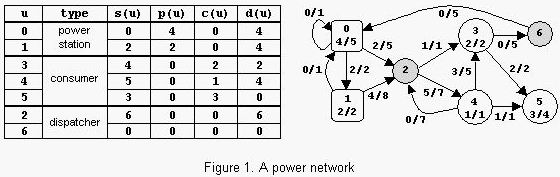
An example is in figure 1. The label x/y of power station u shows that p(u)=x and pmax(u)=y. The label x/y of consumer u shows that c(u)=x and cmax(u)=y. The label x/y of power transport line (u,v) shows that l(u,v)=x and lmax(u,v)=y. The power consumed is Con=6. Notice that there are other possible states of the network but the value of Con cannot exceed 6.
Input
There are several data sets in the input. Each data set encodes a power network. It starts with four integers: 0 <= n <= 100 (nodes), 0 <= np <= n (power stations), 0 <= nc <= n (consumers), and 0 <= m <= n^2 (power transport lines). Follow m data triplets (u,v)z, where u and v are node identifiers (starting from 0) and 0 <= z <= 1000 is the value of lmax(u,v). Follow np doublets (u)z, where u is the identifier of a power station and 0 <= z <= 10000 is the value of pmax(u). The data set ends with nc doublets (u)z, where u is the identifier of a consumer and 0 <= z <= 10000 is the value of cmax(u). All input numbers are integers. Except the (u,v)z triplets and the (u)z doublets, which do not contain white spaces, white spaces can occur freely in input. Input data terminate with an end of file and are correct.
Output
For each data set from the input, the program prints on the standard output the maximum amount of power that can be consumed in the corresponding network. Each result has an integral value and is printed from the beginning of a separate line.
Sample Input
2 1 1 2 (0,1)20 (1,0)10 (0)15 (1)20
7 2 3 13 (0,0)1 (0,1)2 (0,2)5 (1,0)1 (1,2)8 (2,3)1 (2,4)7
(3,5)2 (3,6)5 (4,2)7 (4,3)5 (4,5)1 (6,0)5
(0)5 (1)2 (3)2 (4)1 (5)4
Sample Output
15
6
Dinic求最大流。。
#include<algorithm>

#include<iostream>

#include<cstdlib>

#include<cstring>

#include<cstdio>

#include<vector>

#include<queue>

#include<map>

using std::min;

using std::find;

using std::sort;

using std::pair;

using std::queue;

using std::vector;

using std::multimap;

#define pb(e) push_back(e)

#define sz(c) (int)(c).size()

#define mp(a, b) make_pair(a, b)

#define all(c) (c).begin(), (c).end()

#define iter(c) __typeof((c).begin())

#define cls(arr, val) memset(arr, val, sizeof(arr))

#define cpresent(c, e) (find(all(c), (e)) != (c).end())

#define rep(i, n) for(int i = 0; i < (int)n; i++)

#define tr(c, i) for(iter(c) i = (c).begin(); i != (c).end(); ++i)

const int N = 210;

const int INF = 0x3f3f3f3f;

struct Dinic {

    struct edge { int to, cap, next, rev; }G[(N * N) << 1];

    int s, t, tot, level[N], ite[N], head[N];

    inline void init() {

        tot = 0, cls(head, -1);

    }

    inline void add_edge(int u, int v, int cap) {

        G[tot] = (edge){ v, cap, head[u], tot + 1 }; head[u] = tot++;

        G[tot] = (edge){ u,   0, head[v], tot - 1 }; head[v] = tot++;

    }

    inline void built(int n, int np, int nc, int m) {

        int u, v, f;

        s = 0, t = n + 1;

        rep(i, m) {

            scanf(" (%d,%d)%d", &u, &v, &f);

            add_edge(u + 1, v + 1, f);

        }

        rep(i, np) {

            scanf(" (%d)%d", &v, &f);

            add_edge(s, v + 1, f);

        }

        rep(i, nc) {

            scanf(" (%d)%d", &u, &f);

            add_edge(u + 1, t, f);

        }

    }

    inline void bfs(int s) {

        cls(level, -1);

        queue<int> q;

        q.push(s);

        level[s] = 0;

        while(!q.empty()) {

            int u = q.front(); q.pop();

            for(int i = head[u]; ~i; i = G[i].next) {

                edge &e = G[i];

                if(e.cap > 0 && level[e.to] < 0) {

                    level[e.to] = level[u] + 1;

                    q.push(e.to);

                }

            }

        }

    }

    inline int dfs(int u, int t, int f) {

        if(u == t) return f;

        for(int &i = ite[u]; ~i; i = G[i].next) {

            edge &e = G[i];

            if(e.cap > 0 && level[u] < level[e.to]) {

                int d = dfs(e.to, t, min(e.cap, f));

                if(d > 0) {

                    e.cap -= d;

                    G[e.rev].cap += d;

                    return d;

                }

            }

        }

        return 0;

    }

    inline int max_flow() {

        int flow = 0;

        while(true) {

            bfs(s);

            if(level[t] < 0) break;

            int f;

            rep(i, t) ite[i] = head[i];

            while((f = dfs(s, t, INF)) > 0) {

                flow += f;

            }

        }

        return flow;

    }

    inline void solve(int n, int np, int nc, int m) {

        init(), built(n, np, nc, m);

        printf("%d\n", max_flow());

    }

}go;

int main() {

#ifdef LOCAL

    freopen("in.txt", "r", stdin);

    freopen("out.txt", "w+", stdout);

#endif

    int n, np, nc, m;

    while(~scanf("%d %d %d %d", &n, &np, &nc, &m)) {

        go.solve(n, np, nc, m);

    }

    return 0;

}
poj 1459 Power Network的更多相关文章
- POJ 1459 Power Network / HIT 1228 Power Network / UVAlive 2760 Power Network / ZOJ 1734 Power Network / FZU 1161 (网络流,最大流)
POJ 1459 Power Network / HIT 1228 Power Network / UVAlive 2760 Power Network / ZOJ 1734 Power Networ ...
- poj 1459 Power Network : 最大网络流 dinic算法实现
点击打开链接 Power Network Time Limit: 2000MS Memory Limit: 32768K Total Submissions: 20903 Accepted: ...
- poj 1459 Power Network【建立超级源点,超级汇点】
Power Network Time Limit: 2000MS Memory Limit: 32768K Total Submissions: 25514 Accepted: 13287 D ...
- POJ 1459 Power Network(网络流 最大流 多起点,多汇点)
Power Network Time Limit: 2000MS Memory Limit: 32768K Total Submissions: 22987 Accepted: 12039 D ...
- 2018.07.06 POJ 1459 Power Network(多源多汇最大流)
Power Network Time Limit: 2000MS Memory Limit: 32768K Description A power network consists of nodes ...
- 网络流--最大流--POJ 1459 Power Network
#include<cstdio> #include<cstring> #include<algorithm> #include<queue> #incl ...
- poj 1459 Power Network(增广路)
题目:http://poj.org/problem?id=1459 题意:有一些发电站,消耗用户和中间线路,求最大流.. 加一个源点,再加一个汇点.. 其实,过程还是不大理解.. #include & ...
- POJ 1459 Power Network 最大流(Edmonds_Karp算法)
题目链接: http://poj.org/problem?id=1459 因为发电站有多个,所以需要一个超级源点,消费者有多个,需要一个超级汇点,这样超级源点到发电站的权值就是发电站的容量,也就是题目 ...
- POJ 1459 Power Network(网络最大流,dinic算法模板题)
题意:给出n,np,nc,m,n为节点数,np为发电站数,nc为用电厂数,m为边的个数. 接下来给出m个数据(u,v)z,表示w(u,v)允许传输的最大电力为z:np个数据(u)z,表示发电 ...
随机推荐
- 全局变量 urllib模块 json模块
1.vars() 查看一个.py文件中的全局变量 print(vars()) #重点 __name__': '__main__ '__file__': 'C:/Users/lenovo/Pychar ...
- 帕金森定律(Parkinson's Law)
帕金森定律(Parkinson's Law)是官僚主义或官僚主义现象的一种别称, 是由英国历史学家.政治学家西里尔·诺斯古德·帕金森(Cyril Northcote Parkinson)通过长期调查研 ...
- Git 图解剖析
git中文件内容并没有真正存储在索引(.git/index)或者提交对象中,而是以blob的形式分别存储在数据库中(.git/objects),并用SHA-1值来校验. 索引文件用识别码列出相关的bl ...
- VC与JavaScript交互(四) --- WebBrowser或CHtmlView中轻松屏蔽脚本错误(JavaScript)
1.什么是javascript脚本错误 1.1 概述 JavaScript脚本错误包含“运行时错误”和“语法错误”. 1.2 JavaScript“语法错误” JavaScript语法错误 ...
- VS2010之MFC串口通信的编写教程
http://wenku.baidu.com/link?url=K1XPdj9Dcf2of_BsbIdbPeeZ452uJqiF-s773uQyMzV2cSaPRIq6RddQQH1zr1opqVBM ...
- SVN 外部引用(svn:externals)处理相似系统的公用代码
一.创建外部引用 我们常常遇到这样一个场景,我们有两个系统,两个系统用的是同一套框架.如果我们用两套程序 去做,当我们修改这个公共的框架的时候,另外一个还是旧版本的,很容易造成混乱. SVN的外部用就 ...
- JS常用的设计模式(11)—— 中介者模式
中介者对象可以让各个对象之间不需要显示的相互引用,从而使其耦合松散,而且可以独立的改变它们之间的交互. 打个比方,军火买卖双方为了安全起见,找了一个信任的中介来进行交易.买家A把钱交给中介B,然后从中 ...
- c++ builder ListView实现可编辑任意列(转)
// --------------------------------------------------------------------------- // Form的构造函数中填充StrinG ...
- angular.extend(dst, src)对象拓展
angular.extend(dst, src) 作用:对象的拓展 参数: dst:拓展的对象 src:源对象 返回值:拓展的对象 var dst = {name: 'xxx', country: ...
- 简短总结一下C#里跨线程更新UI
摘自: http://my.oschina.net/sdqxcxh/blog/53707 跨线程更新UI是写多线程程序尤其是通信类的程序经常遇到的问题,这里面主要的问题是冲突,比如数据线程想要更新UI ...