
004-GoingDeeperConvolutions2014(googLeNet)
Going Deeper with Convolutions #paper
1. paper-info
1.1 Metadata
- Author:: [[Christian Szegedy]], [[Wei Liu]], [[Yangqing Jia]], [[Pierre Sermanet]], [[Scott Reed]], [[Dragomir Anguelov]], [[Dumitru Erhan]], [[Vincent Vanhoucke]], [[Andrew Rabinovich]]
- 作者机构::
- Keywords:: #DeepLearning , #GoogLeNet
- Journal:: -
- Date:: [[2014-09-16]]
- 状态:: #Doing
- 链接: PDF
1.2 Abstract
We propose a deep convolutional neural network architecture codenamed Inception, which was responsible for setting the new state of the art for classification and detection in the ImageNet Large-Scale Visual Recognition Challenge 2014 (ILSVRC14). The main hallmark of this architecture is the improved utilization of the computing resources inside the network. This was achieved by a carefully crafted design that allows for increasing the depth and width of the network while keeping the computational budget constant. To optimize quality, the architectural decisions were based on the Hebbian principle and the intuition of multi-scale processing. One particular incarnation used in our submission for ILSVRC14 is called GoogLeNet, a 22 layers deep network, the quality of which is assessed in the context of classification and detection.
设计了一个更宽更深的网络,设计原则符合Hebbian principle和多尺度处理原则。在2014的ImageNet比赛上取得了第一的好成绩。(分类和探测)
https://zh.m.wikipedia.org/zh-my/赫布理论
Hebbian principle
1.3 Introduction
GoogLeNet在分类和目标检测中都取得了重大的突破;并且算法复杂度和计算机资源利用率上都取得了重要的成功。最重要的一点,该算法由于优秀的性能,能够很好的部署到端设备中,方便使用。
提出了一种新的网络结构,命名为Inception,改名字来源于Network in network 和盗梦空间的台词we need to go deeper。

本网络结构中的deep有两种意思:
+ Inception module: 一种新的网络结构,更深层次的理解
+ 整体意义上的深层网络结构
`1x1`卷积在本结构中的作用:
+ 降维
+ 增加网络深度
+ 节约计算机资源
在目标检测中使用了`multi-box prediction` 以及更好地对边界框建议进行分类的集合方法。
1.4 Motivation
增加网络深度最容易的方法就是增加网络层数,但这容易带来过拟合和计算量过大的问题。解决问题的方法是从完全连接的架构转向稀疏连接的架构,即使在卷积内部也是如此。
The fundamental way of solving both issues would be by ultimately moving from fully connected to sparsely connected architectures, even inside the convolutions.
但是这种稀疏结构模型对计算机来说计算并不高效。
Also, non-uniform sparse models require more sophisticated engineering and computing infrastructure.
并且卷积是由密集连接的集合来实现的。
Inception 架构最初是作为第一作者的案例研究开始的,用于评估复杂网络拓扑构建算法的假设输出,该算法试图近似稀疏结构,并通过密集的,可读的可用组件覆盖假设的结果。
The Inception architecture started out as a case study of the first author for assessing the hypothetical output of a sophisticated network topology construction algorithm that tries to approximate a sparse structure implied by [2] for vision networks and covering the hypothesized outcome by dense, readily available components.
换句话说就是,Inception model 既可以满足构建稀疏连接的架构,又能够满足卷积在计算机上的密集计算。(全都要)
2. Architecture
Inception架构的主要思想是找出卷积视觉网络中的最佳局部稀疏结构,并近似由现成的密集组件替代。
所以提出了一种更wider的网络架构Inception module
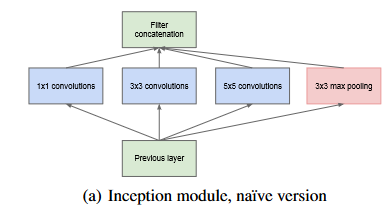
该处选用 `1x1` `3x3` `5x5`卷积核的原因是便于对齐。(每一种卷积核卷积之后会产生不同尺寸的输出,为了将所有通道数叠起来,需要保证长宽一致。 )此外由于各大经典网络结构已经证明了pooling 层的重要性,所有该处也增加了池化通道。
由于这些Inception module彼此堆叠在一起,他们的输出相关性统计数据必然也会有所不同:随着更高抽象的特征被高层捕捉,他们的空间集中度预计将会降低,这表明3x3.5x5卷积的比率应该随着层数的增加而增加。
As these “Inception modules” are stacked on top of each other, their output correlation statistics are bound to vary: as features of higher abstraction are captured by higher layers, their spatial concentration is expected to decrease suggesting that the ratio of 3×3 and 5×5 convolutions should increase as we move to higher layers.
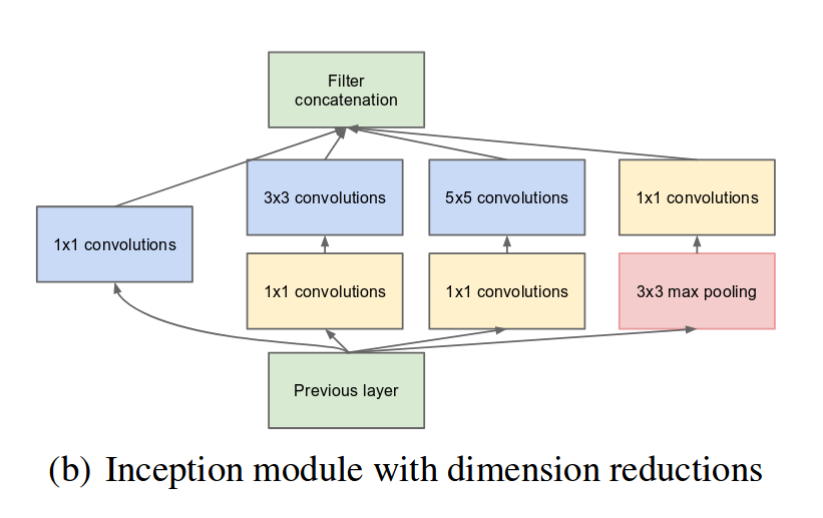
最初的模型有一个问题就是:即使是 5×5 卷积也会导致在计算方面需要大量资源。一旦添加池化,这个问题就会更多地出现。
解决办法就是:明智地运用维度缩减和投影。
This leads to the second idea of the proposed architecture: judiciously applying dimension reductions and projections wherever the computational requirements would increase too much otherwise.
为了解决这种问题,在3x3,5x5卷积的前面添加了1x1卷积。模型结构改进后如图 2-2
参数减少说明:
> https://medium.com/analytics-vidhya/paper-explanation-going-deeper-with-convolutions-googlenet-the-ai-blog-b79574ac8fe0
Inception网络就由上述类型的模块堆叠而成,偶尔会加入最大池化层,步幅为2。
而且由于设备处理效率低下,最好是将Inception module放在网络的higher layer,前面由传统的卷积神经网络替代。
Inception module的优点:允许显著增加每个阶段的单元数量,而不会产生参数爆炸的问题。并且由于是多卷积堆叠,抽取的特征是来自不同的尺度。
3. GoogLeNet
该名字是为了致敬 LeNet。
GoogLeNet 由 22 层深度网络(包括池化层的 27 层)组成。所有的卷积,包括 inception 模块内部的卷积,都使用ReLU激活函数。
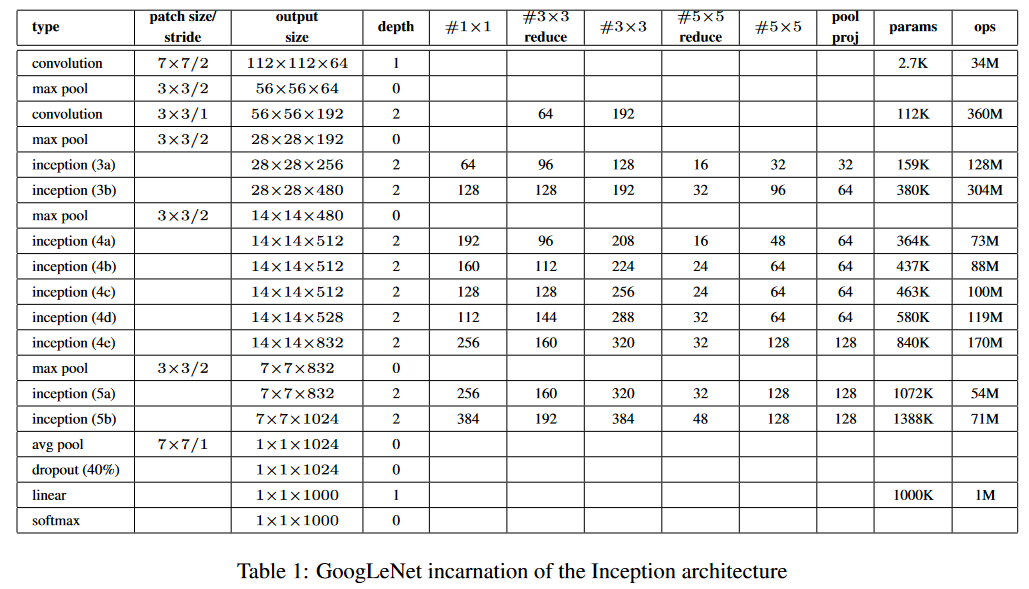
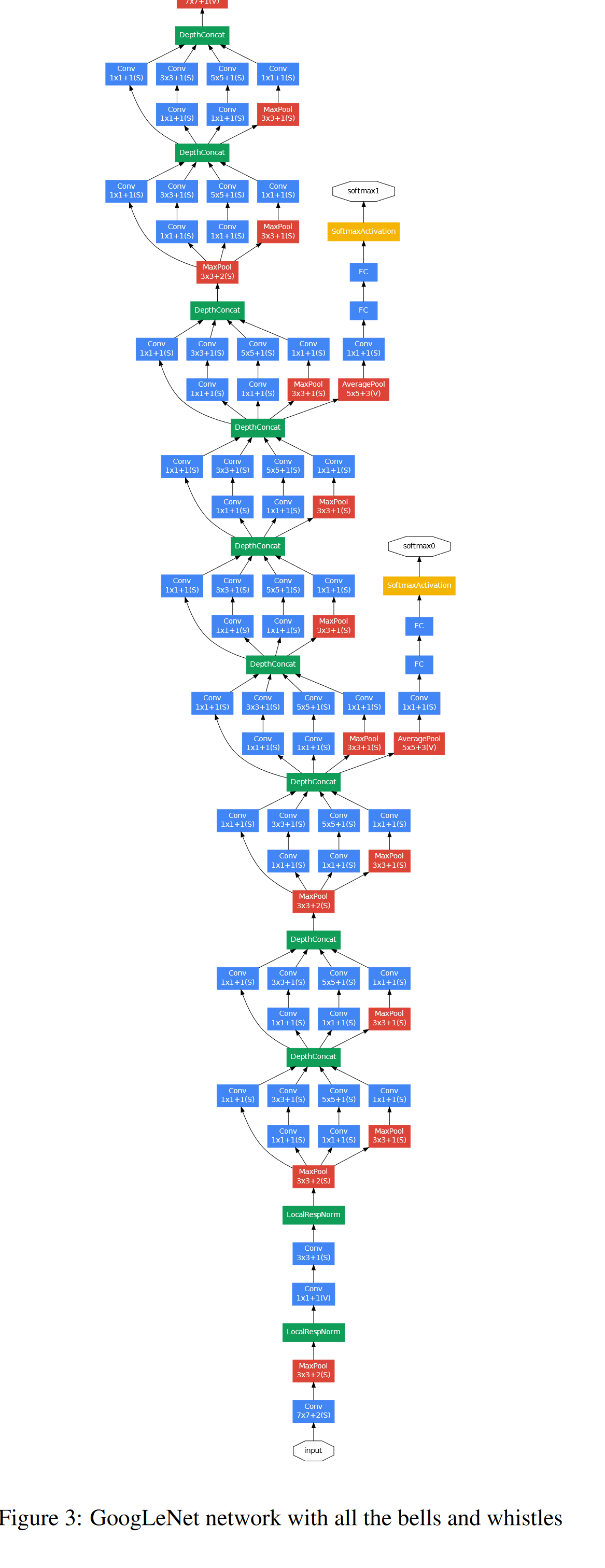
GoogLeNet 是一个 22 层的深度,只计算带有参数的层。使用如此深的网络,可能会出现诸如梯度消失之类的问题。为了消除这种情况,作者引入了连接到中间层的辅助分类器,并帮助梯度信号向后传播。这些辅助分类器添加在Inception (4a) 和 (4d)模块的输出之上。辅助分类器的损失在训练期间被添加并在推理期间被丢弃。
边上额外网络的确切结构,包括辅助分类器,配置如下:
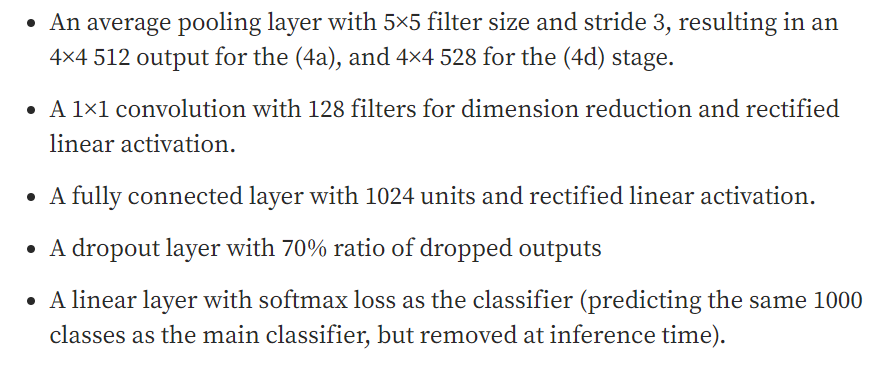
网络的整体结构如图 3-3
---
4. 代码实现
import torch

import torch.nn as nn

class Inception(nn.Module):

def __init__(self, input_channels, n1x1, n3x3_reduce, n3x3, n5x5_reduce, n5x5, pool_proj):

super().__init__()

#1x1conv branch

self.b1 = nn.Sequential(

nn.Conv2d(input_channels, n1x1, kernel_size=1),

nn.BatchNorm2d(n1x1),

nn.ReLU(inplace=True)

)

#1x1conv -> 3x3conv branch

self.b2 = nn.Sequential(

nn.Conv2d(input_channels, n3x3_reduce, kernel_size=1),

nn.BatchNorm2d(n3x3_reduce),

nn.ReLU(inplace=True),

nn.Conv2d(n3x3_reduce, n3x3, kernel_size=3, padding=1),

nn.BatchNorm2d(n3x3),

nn.ReLU(inplace=True)

)

#1x1conv -> 5x5conv branch

#we use 2 3x3 conv filters stacked instead

#of 1 5x5 filters to obtain the same receptive

#field with fewer parameters

self.b3 = nn.Sequential(

nn.Conv2d(input_channels, n5x5_reduce, kernel_size=1),

nn.BatchNorm2d(n5x5_reduce),

nn.ReLU(inplace=True),

nn.Conv2d(n5x5_reduce, n5x5, kernel_size=3, padding=1),

nn.BatchNorm2d(n5x5, n5x5),

nn.ReLU(inplace=True),

nn.Conv2d(n5x5, n5x5, kernel_size=3, padding=1),

nn.BatchNorm2d(n5x5),

nn.ReLU(inplace=True)

)

#3x3pooling -> 1x1conv

#same conv

self.b4 = nn.Sequential(

nn.MaxPool2d(3, stride=1, padding=1),

nn.Conv2d(input_channels, pool_proj, kernel_size=1),

nn.BatchNorm2d(pool_proj),

nn.ReLU(inplace=True)

)

def forward(self, x):

return torch.cat([self.b1(x), self.b2(x), self.b3(x), self.b4(x)], dim=1)

class GoogleNet(nn.Module):

def __init__(self, num_class=100):

super().__init__()

self.prelayer = nn.Sequential(

nn.Conv2d(3, 64, kernel_size=3, padding=1, bias=False),

nn.BatchNorm2d(64),

nn.ReLU(inplace=True),

nn.Conv2d(64, 64, kernel_size=3, padding=1, bias=False),

nn.BatchNorm2d(64),

nn.ReLU(inplace=True),

nn.Conv2d(64, 192, kernel_size=3, padding=1, bias=False),

nn.BatchNorm2d(192),

nn.ReLU(inplace=True),

)

#although we only use 1 conv layer as prelayer,

#we still use name a3, b3.......

self.a3 = Inception(192, 64, 96, 128, 16, 32, 32)

self.b3 = Inception(256, 128, 128, 192, 32, 96, 64)

##"""In general, an Inception network is a network consisting of

##modules of the above type stacked upon each other, with occasional

##max-pooling layers with stride 2 to halve the resolution of the

##grid"""

self.maxpool = nn.MaxPool2d(3, stride=2, padding=1)

self.a4 = Inception(480, 192, 96, 208, 16, 48, 64)

self.b4 = Inception(512, 160, 112, 224, 24, 64, 64)

self.c4 = Inception(512, 128, 128, 256, 24, 64, 64)

self.d4 = Inception(512, 112, 144, 288, 32, 64, 64)

self.e4 = Inception(528, 256, 160, 320, 32, 128, 128)

self.a5 = Inception(832, 256, 160, 320, 32, 128, 128)

self.b5 = Inception(832, 384, 192, 384, 48, 128, 128)

#input feature size: 8*8*1024

self.avgpool = nn.AdaptiveAvgPool2d((1, 1))

self.dropout = nn.Dropout2d(p=0.4)

self.linear = nn.Linear(1024, num_class)

def forward(self, x):

x = self.prelayer(x)

x = self.maxpool(x)

x = self.a3(x)

x = self.b3(x)

x = self.maxpool(x)

x = self.a4(x)

x = self.b4(x)

x = self.c4(x)

x = self.d4(x)

x = self.e4(x)

x = self.maxpool(x)

x = self.a5(x)

x = self.b5(x)

#"""It was found that a move from fully connected layers to

#average pooling improved the top-1 accuracy by about 0.6%,

#however the use of dropout remained essential even after

#removing the fully connected layers."""

x = self.avgpool(x)

x = self.dropout(x)

x = x.view(x.size()[0], -1)

x = self.linear(x)

return x
5. 总结
为了能够将稀疏性和计算的密集性结合起来,拓宽了网络结构。并且采用了1x1,3x3,5x5的小卷积形式。并且加入了1x1卷积层降低维度。在防止梯度消失时加入了辅助分类器。
参考
https://medium.com/analytics-vidhya/paper-explanation-going-deeper-with-convolutions-googlenet-the-ai-blog-b79574ac8fe0 # Paper Explanation: Going deeper with Convolutions (GoogLeNet)
https://towardsdatascience.com/deep-learning-googlenet-explained-de8861c82765 # Deep Learning: GoogLeNet Explained
https://machinelearningmastery.com/batch-normalization-for-training-of-deep-neural-networks/ # A Gentle Introduction to Batch Normalization for Deep Neural Networks
https://github.nowall.world/weiaicunzai/pytorch-cifar100 # 代码实现
004-GoingDeeperConvolutions2014(googLeNet)的更多相关文章
- #Deep Learning回顾#之LeNet、AlexNet、GoogLeNet、VGG、ResNet
CNN的发展史 上一篇回顾讲的是2006年Hinton他们的Science Paper,当时提到,2006年虽然Deep Learning的概念被提出来了,但是学术界的大家还是表示不服.当时有流传的段 ...
- GoogleNet tips
Inception Module googlenet的Inception Module Idea 1: Use 1x1, 3x3, and 5x5 convolutions in parallel t ...
- [网站公告]3月10日23:00-4:00阿里云SLB升级,会有4-8次连接闪断
大家好,阿里云将于3月10日23:00-4:00对负载均衡服务(SLB)做升级操作,升级期间SLB网络连接会有约4-8次闪断.由此给您带来麻烦,敬请谅解! 阿里云SLB升级公告内容如下: 尊敬的用户: ...
- 《zw版·Halcon-delphi系列原创教程》 Halcon分类函数004·edge,边缘处理
<zw版·Halcon-delphi系列原创教程> Halcon分类函数004·edge,边缘处理 为方便阅读,在不影响说明的前提下,笔者对函数进行了简化: :: 用符号“**”,替换:“ ...
- Drawing with GoogLeNet
Drawing with GoogLeNet In my previous post, I showed how you can use deep neural networks to generat ...
- Python练习题 004:判断某日期是该年的第几天
[Python练习题 004]输入某年某月某日,判断这一天是这一年的第几天? ---------------------------------------------- 这题竟然写了 28 行代码! ...
- [反汇编练习] 160个CrackMe之004
[反汇编练习] 160个CrackMe之004. 本系列文章的目的是从一个没有任何经验的新手的角度(其实就是我自己),一步步尝试将160个CrackMe全部破解,如果可以,通过任何方式写出一个类似于注 ...
- 解读(GoogLeNet)Going deeper with convolutions
(GoogLeNet)Going deeper with convolutions Inception结构 目前最直接提升DNN效果的方法是increasing their size,这里的size包 ...
- GoogLeNet学习心得
转自:http://blog.csdn.net/liumaolincycle/article/details/50471289#t0 综述: http://blog.csdn.net/sunbaigu ...
- [置顶] cocos2d-x 3.0游戏开发xcode5帅印博客教学 004.[HoldTail]主角的上下飞行跟移动
cocos2d-x 3.0游戏开发xcode5帅印博客教学 004.[HoldTail]主角的上下飞行跟移动 写给大家的前言,在学习cocos2d-x的时候自己走了很多的弯路,也遇到了很多很多问题,不 ...
随机推荐
- Linux shell脚本算术运算和逻辑运算
算术运算 默认不支持算数运算.所以需要特定的语法来完成, shell进行算数运算的工具: let declare (())或$(())或$[] bc let: 格式: let var=算术表达式 例如 ...
- 理解 Python 的 for 循环
在本篇博客中,我们将讨论 Python 中 for 循环的原理. 我们将从一组基本例子和它的语法开始,还将讨论与 for 循环关联的 else 代码块的用处. 然后我们将介绍迭代对象.迭代器和迭代器协 ...
- docker安装报错failure: repodata/repomd.xml from mirrors.aliyun.com_docker-ce_linux_centos_docker-ce.pro
1.进入 /etc/yum.repos.d 目录下,将所有有关 docker 的 repo 全部删掉 2.重新添加镜像 sudo yum-config-manager --add-repo https ...
- Linux sed工具的使用
基础知识 - 行编辑工具: 一行一行处理文件内容 - 全屏编辑工具:一次性将文件所有内容加载到内存中 sed编辑器: Stream Editor 工作原理: 逐行处理文件内容,一次读取一行内容到模式空 ...
- python requests 使用代理池访问https站点返回乱码
问题表现: 检查一下正常的请求头里面accept-encoding字段是否包含br,如果包含,果断pip install urllib3[brotli],详见ssl-warnings 记录另外一个问题 ...
- 2022徐特立科学营&BIT机器人队电控课程讲义
目录 \(\cdot\)电控简介 \(\cdot\)认识单片机 什么是单片机 时钟-单片机的脉搏 \(\cdot\)外设及应用 GPIO PWM 定时器 UART \(\cdo ...
- 如何在Excel/WPS表格中批量查询顺丰快递信息?
如何在Excel/WPS表格中批量查询顺丰快递信息? 上期我们讲了如何在Excel/WPS表格中批量查询快递信息(还不知道的小伙伴可以看这里:https://zhuanlan.zhihu.com/p/ ...
- Docker容器保姆:在centos7.6上利用docker-compose统一管理容器和服务
原文转载自「刘悦的技术博客」https://v3u.cn/a_id_108 众所周知,一个大型的Docker容器组成的微服务应用中,容器的数量是非常巨大的,如果依赖传统的人工配置方式进行维护,对于开发 ...
- Java学习(三)Java起源&发展
目录 Java的诞生 C&C++ Java初生 Java发展(三高: 高可用,高性能,高并发) Java特性和劣势 Java程序运行机制 Java的诞生 C&C++ **1972年 ...
- Computational Protein Design with Deep Learning Neural Networks
本文使用深度神经网络完成计算蛋白质设计去预测20种氨基酸概率. Introduction 针对特定结构和功能的蛋白质进行工程和设计,不仅加深了对蛋白质序列结构关系的理解,而且在化学.生物学和医学等领域 ...