
关于作用域范围Scope
举个例子,如下:
public class C {

	public int a = 2;

	public void test(int b) {
		int c = 3;
		for (int d = 3; a < 6; a++) {
		}
	}
}
形成的Scope作用域如下图:

属性table中存储的具体数据如下截图:

关于Scope的定义如下:
/** A scope represents an area of visibility in a Java program. The
 *  Scope class is a container for symbols which provides
 *  efficient access to symbols given their names.
 *
 *  Scopes are implemented as hash tables with "open addressing" and "double hashing".
 *  Scopes can be nested; the next field of a scope points
 *  to its next outer scope. Nested scopes can share their hash tables.
 *
 */
public class Scope {

    /** The number of scopes that share this scope's hash table.
     */
    private int shared;

    /** Next enclosing scope (with whom this scope may share a hashtable)
     *
     *  参考博文:https://www.cnblogs.com/extjs4/p/6386572.html
     */
    public Scope next;

    /** The scope's ownerSymbol.
     */
    public Symbol ownerSymbol;

    /** A hash table for the scope's entries.
     */
    Entry[] table;

    /** Mask for hash codes, always equal to (table.length - 1).
     */
    int hashMask;

    /** A linear list that also contains all entries in
     *  reverse order of appearance (i.e later entries are pushed on top).
     */
    public Entry elems;

    /** The number of elements in this scope.
     * This includes deleted elements, whose value is the sentinel.
     */
    int nelems = 0;

    // ...
}
Scope是符号的容器,通过Scope来查找及决定符号的访问。创建Scope对象有三种途径:
(1)调用构造函数创建
/** The hash table's initial size.
 */
private static final int INITIAL_SIZE = 0x10;

/** A value for the empty scope.
 */
public static final Scope emptyScope = new Scope(null, null, new Entry[]{});

/** Construct a new scope, within scope next, with given owner, using
 *  given table. The table's length must be an exponent of 2.
 */
protected Scope(Scope next, Symbol owner, Entry[] table) {
    this.next = next;
    Assert.check(emptyScope == null || owner != null);
    this.ownerSymbol = owner;
    this.table = table;
    this.hashMask = table.length - 1;
}

/** Construct a new scope, within scope next, with given owner,
 *  using a fresh table of length INITIAL_SIZE.
 */
public Scope(Symbol owner) {
    this(null, owner, new Entry[INITIAL_SIZE]);
}
第一个为基本的构造函数,一般不对外开放调用,由于是protected权限,所以一般是子类通过super()方法来调用,而通过调用下面的构造函数来得到一个全新的Scope对象。
(2)调用dup()方法
/** Convenience constructor used for dup and dupUnshared. */
private Scope(Scope next, Symbol owner, Entry[] table, int nelems) {
    this(next, owner, table);
    this.nelems = nelems;
}

/** Construct a fresh scope within this scope, with same ownerSymbol,
 *  which shares its table with the outer scope. Used in connection with
 *  method leave if scope access is stack-like in order to avoid allocation
 *  of fresh tables.
 */
public Scope dup() {
    return dup(this.ownerSymbol);
}

/** Construct a fresh scope within this scope, with new ownerSymbol,
 *  which shares its table with the outer scope. Used in connection with
 *  method leave if scope access is stack-like in order to avoid allocation
 *  of fresh tables.
 *  如果范围访问是堆栈式的,则使用方法离开,以避免重新分配新表。
 */
public Scope dup(Symbol newOwner) {
    Scope result = new Scope(this, newOwner, this.table, this.nelems);
    shared++;
    // System.out.println("====> duping scope " + this.hashCode() + " owned by " + newOwner + " to " + result.hashCode());
    // new Error().printStackTrace(System.out);
    return result;
}
共有几处调用这个dup()方法,如下截图:
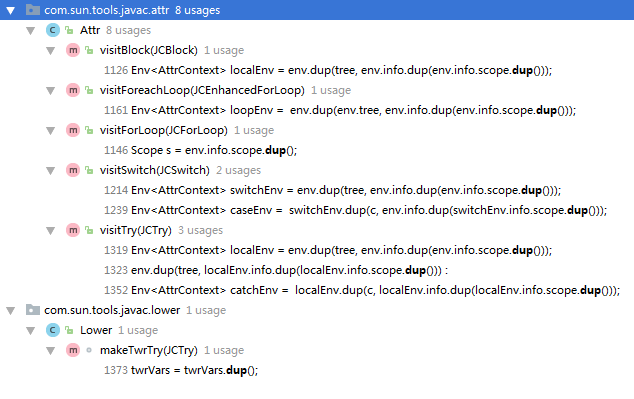
(3)调用dupUnshared()方法
/** Construct a fresh scope within this scope, with same ownerSymbol,
 *  with a new hash table, whose contents initially are those of
 *  the table of its outer scope.
 */
public Scope dupUnshared() {
    return new Scope(this, this.ownerSymbol, this.table.clone(), this.nelems);
}
与dup()方法比起来,克隆了this.table的值,举个例子如下:
public class Test1 {
    static class Entry{
        int a = 0;
        int[] arr = null;
        public Entry(int a,int[] arr){
            this.a = a;
            this.arr = arr;
        }
        @Override
        public String toString() {
            return "Entry [a=" + a + ", arr=" + Arrays.toString(arr) + "]";
        }
    }
    public static void main(String[] args) {

        Entry[] ens = new Entry[2];
        ens[0] = new Entry(2,new int[]{2,3});

        Entry[] ensC = ens.clone();
        ensC[0].arr[0] = 33;
        ensC[1] =  new Entry(3,new int[]{2,3});

        System.out.println(Arrays.toString(ens));
        System.out.println(Arrays.toString(ensC));

    }
}
运行结果如下:
result:
  [Entry [a=2, arr=[33, 3]], null]
  [Entry [a=2, arr=[33, 3]], Entry [a=3, arr=[2, 3]]]
可以看到,调用了clone()方法后,往table中加入新的Entry,不会影响到原来table中的值。这就是所说的不共享。
GJC中调用dupUnshared()方法的地方如下图所示。

其中有些重要的属性如下:
1、属性next
 /** Next enclosing scope (with whom this scope may share a hashtable)
     *
     */
    public Scope next;
从上面的例子可以清楚的看到next指向上一层作用域范围。作用域是通过块形成的,例如:
2、属性owner
 /** The scope's owner.
     */
    public Symbol owner;
表示的是这个作用域所属的符号。
3、属性table
 /** A hash table for the scope's entries.
     */
    Entry[] table;
这个属性比较重要,主要存储了这个Scope作用域内的符号,并且通过"open addressing"和"double hashing"来计算具体的某个Entry存储的位置。看一下Entry中除了存储符号Symbol还存储了哪些信息,定义如下:
/** A class for scope entries.
 *
 * shadowed指针指向桶中的下一个表项,shadowed意为隐蔽之义,sibling指针指向下一个填入哈希表中的表项,和符号的范围scope
 */
public class Entry {

    /** The referenced symbol. 被引用的符号
     *  sym == null   iff(if and only if 当且仅当)   this == sentinel
     */
    public Symbol sym;

    /** An entry with the same hash code, or sentinel.
     */
    public  Entry shadowed;

    /** Next entry in same scope.
     */
    public Entry sibling;

    /** The entry's scope.
     *  scope == null   iff   this == sentinel
     *  for an entry in an import scope, this is the scope where the entry came from (i.e. was imported from).
     */
    public Scope scope;
    ...
}
由于table属性可以共享,也就是被enclosing封闭的作用域可以和外层的作用域共享table,从上面举的例子中就可以看出。如果要共享,那么还需要保证被封闭的作用域的符号不能
被外层作用域取到,所以必须在Entry中指定这个Symbol到底是属于哪个作用域Scope的。通过如下截图就可以清楚的看到各个Symbol是在哪个作用域内定义的。

sibling属性将Entry连接为单向链表,如同一个作用域内定义了3个Symbol,有3个Entry,按倒序链接起来,也就是后加入的在前面。先加入的在后面。
public class C {

	public int a = 2;
	public void test(int b) {
		int c = 3;
		int d = 4;
	}
}
在方法内定义了两个变量c和d,通过如下截图可以清楚看到d的sibling指向c,因为c先定义的。
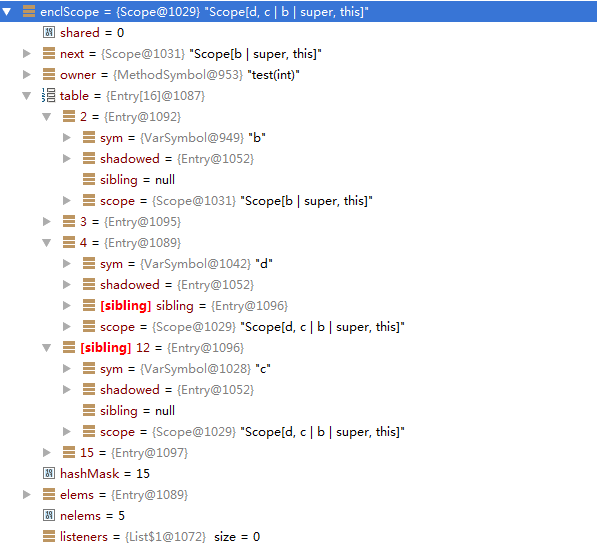
shadowed属性,举个例子,如下:
public class C {
	public int a = 2;
	public void test() {
		int a = 2;
		class a {}
	}
}
截图如下:

可以看到,对于类名为a和变量名为a的符号存储到了同一个hash桶中,通过shadowed形成了链。
再看个例子,如下:
public class C {

	public int a = 2;
	class a {

	}
	public void a() {
	}
}
截图如下:

关于作用域范围Scope的更多相关文章
- [译] 你该知道的javascript作用域 (javascript scope)(转)
javascript有一些对于初学者甚至是有经验的开发者都难以理解的概念. 这个部分是针对那些听到 : 作用域, 闭包, this, 命名空间, 函数作用域, 函数作用域, 全局作用域, 变量作用域( ...
- AngularJS 作用域(Scope)
AngularJS作用域(Scope) Scope作用域是应用在视图和控制器之间的纽带,Scope是一个对象包含可用的方法和属性,Scope可以应用在试图和控制器上. $scope是针对当前的cont ...
- JavaScript变量作用域(Variable Scope)和闭包(closure)的基础知识
在这篇文章中,我会试图讲解JavaScript变量的作用域和声明提升,以及许多隐隐藏的陷阱.为了确保我们不会碰到不可预见的问题,我们必须真正理解这些概念. 基本定义 作用范围是个“木桶”,里面装着变量 ...
- JavaScript 作用域(Scope)详解
先对需要用到的名词解释一下,再通过例子深入理解 一.什么是作用域(Scope) [[scope]]:每个javascript函数都是一个对象,对象中有些属性我们可以访问,但有些不可以,这些属性仅供ja ...
- 深入理解JavaScript系列(14):作用域链(Scope Chain)
前言 在第12章关于变量对象的描述中,我们已经知道一个执行上下文 的数据(变量.函数声明和函数的形参)作为属性存储在变量对象中. 同时我们也知道变量对象在每次进入上下文时创建,并填入初始值,值的更新出 ...
- JavaScript的作用域(Scope)和上下文(Context)
JavaScript对于作用域(Scope)和上下文(Context)的实现是这门语言的一个非常独到的地方,部分归功于其独特的灵活性. 函数可以接收不同的的上下文和作用域.这些概念为JavaScrip ...
- 依赖作用域之<scope>test</scope>
经常在代码中看到依赖的作用域为<scope>test</scope>,它的作用是,只能在test目录(通过右键->Make Directory as->Test S ...
- Spring中bean作用域属性scope
关键字: spring中属性scope的prototype是什么意思 默认情况下,从bean工厂所取得的实例为Singleton(bean的singleton属性) Singleton: Spri ...
- Mybatis笔记六:Mybatis中SqlSessionFactoryBuilder/SqlSessionFactory/SqlSession/映射器实例的作用域(Scope)和生命周期
SqlSessionFactoryBuilder 这个类可以被实例化.使用和丢弃,一旦创建了 SqlSessionFactory,就不再需要它了.因此 SqlSessionFactoryBuilder ...
随机推荐
- 动态链接库编程:非MFC DLL
设计一个DLL,内含一个函数计算a+b: DLL的组成 .h(头文件) 定义了DLL能够导出的函数.数据结构或类的声明,该文件的声明内容在.CPP文件中实现,而.CPP的源程序被封装到DLL文件中 . ...
- (网络流) Island Transport --Hdu -- 4280
链接: http://acm.hdu.edu.cn/showproblem.php?pid=4280 源点是West, 汇点是East, 用Dinic带入求就好了 代码:要用c++提交 #pragma ...
- CG图形学的工具
1. http://give.zju.edu.cn/cgcourse/new/frame/index.html 网页CG学习
- JProfiler 简要使用说明
1.简介 JProfiler是一个ALL-IN-ONE的JAVA剖析工具,可以方便地监控Java程序的CPU.内存使用状况,能够检查垃圾回收.分析性能瓶颈. 本说明文档基于JProfiler 9.2编 ...
- Android-fragment-ListView展示-v4支持包
昨天写的这几篇博客,Android-fragment简介-fragment的简单使用,Activity-fragment-ListView展示,Android-fragment生命周期,Android ...
- WinRT 中后台任务类的声明
要实现后台任务,需要实现IBackgroundTask接口 public sealed class SimpleTask : IBackgroundTask { public void Run(IBa ...
- NETSDK1061错误解决
NETSDK1061错误解决 在vs生成和运行都正常,发布的时候报错 .netcore控制台项目引用另一个类库 错误信息 NETSDK1061: 项目是使用 Microsoft.NETCore.App ...
- Net Core SignalR 测试,可以用于unity、Layair、白鹭引擎、大数据分析平台等高可用消息实时通信器。
SignalR介绍 SignalR介绍来源于微软文档,不过多解释.https://docs.microsoft.com/zh-cn/aspnet/core/signalr/introduction?v ...
- App.config使用方法(基础教程)
WPF程序中的App.config文件是应用程序中经常使用的一种配置文件,System.Configuration.dll文件中提供了大量的读写的配置,是一种很高效的程序配置方式. 1.首先在工程中配 ...
- JS 中的数据类型转换
转成字符串 String 1. 使用 toString方法 这种方法可以将 number, boolean, object,array,function 转化为字符串,但是无法转换 null, und ...