
如何用python的装饰器定义一个像C++一样的强类型函数
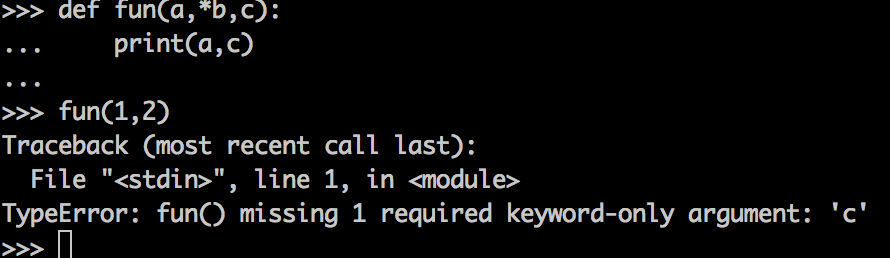
 def fun(a:int, b=1, *c, d, e=2, **f) -> str:

      pass
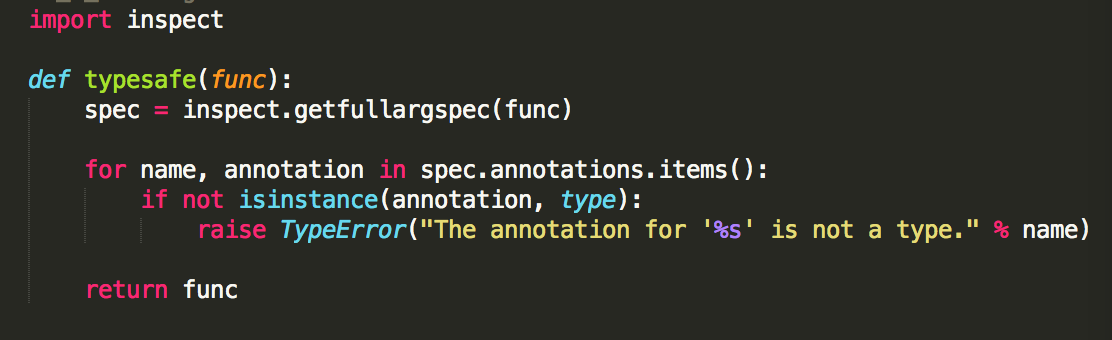
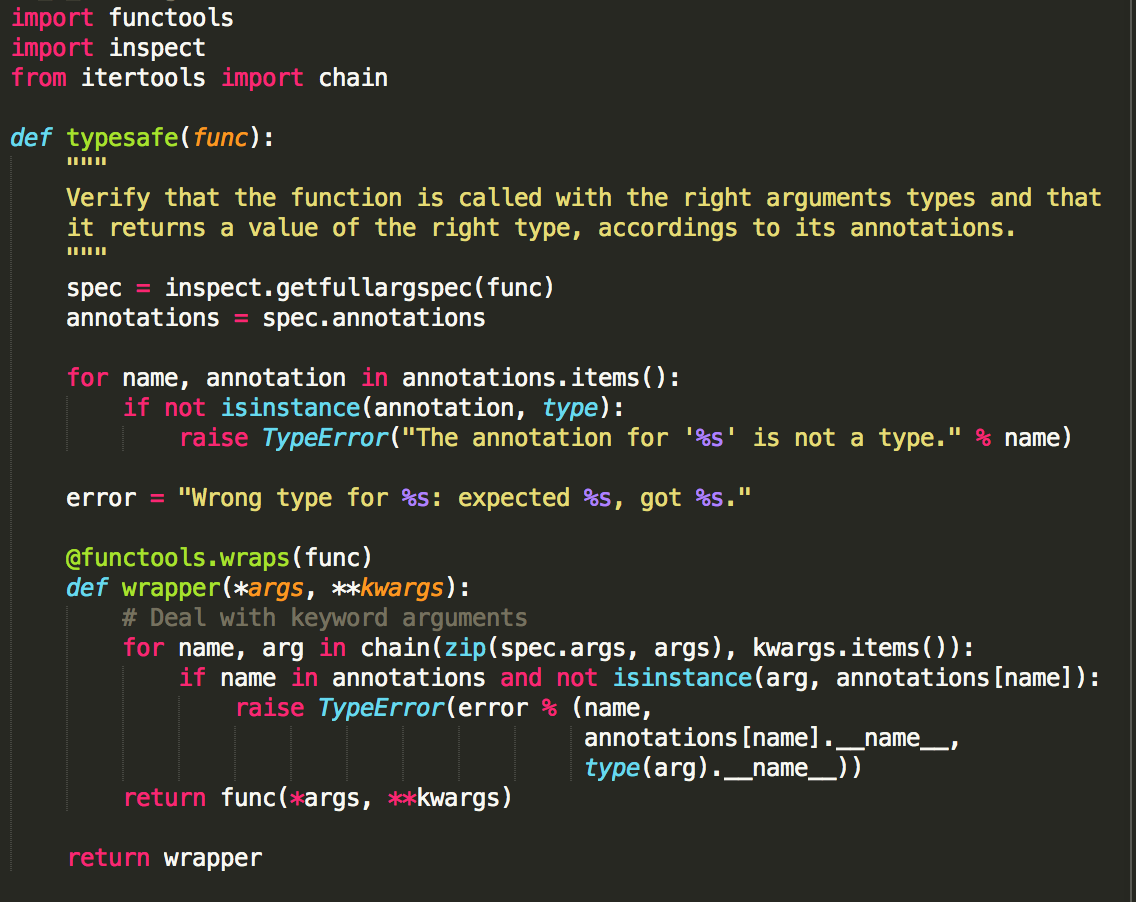
这里主要是说几点与python2中不同的点。


 # _*_ coding: utf-8

 import functools

 import inspect

 from itertools import chain

 def typesafe(func):

     """

     Verify that the function is called with the right arguments types and that

     it returns a value of the right type, accordings to its annotations.

     """

     spec = inspect.getfullargspec(func)

     annotations = spec.annotations

     for name, annotation in annotations.items():

         if not isinstance(annotation, type):

             raise TypeError("The annotation for '%s' is not a type." % name)

     error = "Wrong type for %s: expected %s, got %s."

     # Deal with default parameters

     defaults = spec.defaults or ()

     defaults_zip = zip(spec.args[-len(defaults):], defaults)

     kwonlydefaults = spec.kwonlydefaults or {}

     for name, value in chain(defaults_zip, kwonlydefaults.items()):

         if name in annotations and not isinstance(value, annotations[name]):

             raise TypeError(error % ('default value of %s' % name,

                                      annotations[name].__name__,

                                      type(value).__name__))

     @functools.wraps(func)

     def wrapper(*args, **kwargs):

         # Populate a dictionary of explicit arguments passed positionally

         explicit_args = dict(zip(spec.args, args))

         keyword_args = kwargs.copy()

         # Add all explicit arguments passed by keyword

         for name in chain(spec.args, spec.kwonlyargs):

             if name in kwargs:

                 explicit_args[name] = keyword_args.pop(name)

         # Deal with explict arguments

         for name, arg in explicit_args.items():

             if name in annotations and not isinstance(arg, annotations[name]):

                 raise TypeError(error % (name,

                                          annotations[name].__name__,

                                          type(arg).__name__))

         # Deal with variable positional arguments

         if spec.varargs and spec.varargs in annotations:

             annotation = annotations[spec.varargs]

             for i, arg in enumerate(args[len(spec.args):]):

                 if not isinstance(arg, annotation):

                     raise TypeError(error % ('variable argument %s' % (i+1),

                                     annotation.__name__,

                                     type(arg).__name__))

         # Deal with variable keyword argument

         if spec.varkw and spec.varkw in annotations:

             annotation = annotations[spec.varkw]

             for name, arg in keyword_args.items():

                 if not isinstance(arg, annotation):

                     raise TypeError(error % (name,

                                              annotation.__name__,

                                              type(arg).__name__))

         # Deal with return value

         r = func(*args, **kwargs)

         if 'return' in annotations and not isinstance(r, annotations['return']):

             raise TypeError(error % ('the return value',

                                      annotations['return'].__name__,

                                      type(r).__name__))

         return r

     return wrapper
对于上面的代码:
 # _*_ coding: utf-8

 import functools

 import inspect

 from itertools import chain

 def precessArg(value, annotation):

     try:

         return annotation(value)

     except ValueError as e:

         print('value:', value)

         raise TypeError('Expected: %s, got: %s' % (annotation.__name__,

                                                    type(value).__name__))

 def typesafe(func):

     """

     Verify that the function is called with the right arguments types and that

     it returns a value of the right type, accordings to its annotations.

     """

     spec = inspect.getfullargspec(func)

     annotations = spec.annotations

     for name, annotation in annotations.items():

         if not isinstance(annotation, type):

             raise TypeError("The annotation for '%s' is not a type." % name)

     error = "Wrong type for %s: expected %s, got %s."

     # Deal with default parameters

     defaults = spec.defaults and list(spec.defaults) or []

     defaults_zip = zip(spec.args[-len(defaults):], defaults)

     i = 0

     for name, value in defaults_zip:

         if name in annotations:

             defaults[i] = precessArg(value, annotations[name])

         i += 1

     func.__defaults__ = tuple(defaults)

     kwonlydefaults = spec.kwonlydefaults or {}

     for name, value in kwonlydefaults.items():

         if name in annotations:

             kwonlydefaults[name] = precessArg(value, annotations[name])

     func.__kwdefaults__ = kwonlydefaults

     @functools.wraps(func)

     def wrapper(*args, **kwargs):

         keyword_args = kwargs.copy()

         new_args = args and list(args) or []

         new_kwargs = kwargs.copy()

         # Deal with explicit argument passed positionally

         i = 0

         for name, arg in zip(spec.args, args):

             if name in annotations:

                 new_args[i] = precessArg(arg, annotations[name])

             i += 1

         # Add all explicit arguments passed by keyword

         for name in chain(spec.args, spec.kwonlyargs):

             poped_name = None

             if name in kwargs:

                 poped_name = keyword_args.pop(name)

             if poped_name is not None and name in annotations:

                 new_kwargs[name] = precessArg(poped_name, annotations[name])

         # Deal with variable positional arguments

         if spec.varargs and spec.varargs in annotations:

             annotation = annotations[spec.varargs]

             for i, arg in enumerate(args[len(spec.args):]):

                 new_args[i] = precessArg(arg, annotation)

         # Deal with variable keyword argument

         if spec.varkw and spec.varkw in annotations:

             annotation = annotations[spec.varkw]

             for name, arg in keyword_args.items():

                 new_kwargs[name] = precessArg(arg, annotation)

         # Deal with return value

         r = func(*new_args, **new_kwargs)

         if 'return' in annotations:

             r = precessArg(r, annotations['return'])

         return r

     return wrapper

 if __name__ == '__main__':

     print("Begin test.")

     print("Test case 1:")

     try:

         @typesafe

         def testfun1(a:'This is a para.'):

             print('called OK!')

     except TypeError as e:

         print("TypeError: %s" % e)

     print("Test case 2:")

     try:

         @typesafe

         def testfun2(a:int,b:str = 'defaule'):

             print('called OK!')

         testfun2('str',1)

     except TypeError as e:

         print("TypeError: %s" % e)

     print("test case 3:")

     try:

         @typesafe

         def testfun3(a:int, b:int = 'str'):

             print('called OK')

     except TypeError as e:

         print('TypeError: %s' % e)

     print("Test case 4:")

     try:

         @typesafe

         def testfun4(a:int = '', b:int = 1.2):

             print('called OK.')

             print(a, b)

         testfun4()

     except TypeError as e:

         print('TypeError: %s' % e)

     @typesafe

     def testfun5(a:int, b, c:int = 1, d = 2, *e:int, f:int, g, h:int = 3, i = 4, **j:int) -> str :

         print('called OK.')

         print(a, b, c, d, e, f, g, h, i, j)

         return 'OK'

     print("Test case 5:")

     try:

         testfun5(1.2, 'whatever', f = 2.3, g = 'whatever')

     except TypeError as e:

         print('TypeError: %s' % e)

     print("Test case 6:")

     try:

         testfun5(1.2, 'whatever', 2.2, 3.2, 'e1', f = '', g = 'whatever')

     except TypeError as e:

         print('TypeError: %s' % e)

     print("Test case 7:")

     try:

         testfun5(1.2, 'whatever', 2.2, 3.2, 12, f = '', g = 'whatever')

     except TypeError as e:

         print('TypeError: %s' % e)

     print("Test case 8:")

     try:

         testfun5(1.2, 'whatever', 2.2, 3.2, 12, f = '', g = 'whatever', key1 = 'key1')

     except TypeError as e:

         print('TypeError: %s' % e)

     print("Test case 9:")

     try:

         testfun5(1.2, 'whatever', 2.2, 3.2, 12, f = '', g = 'whatever', key1 = '')

     except TypeError as e:

         print('TypeError: %s' % e)

     print('Test case 10:')

     @typesafe

     def testfun10(a) -> int:

         print('called OK.')

         return 'OK'

     try:

         testfun10(1)

     except TypeError as e:

         print('TypeError: %s' % e)
如何用python的装饰器定义一个像C++一样的强类型函数的更多相关文章
- $python用装饰器实现一个计时器
直接上代码: import time from functools import wraps # 定义装饰器 def fn_timer(function): @wraps(function) def ...
- python基础—装饰器
python基础-装饰器 定义:一个函数,可以接受一个函数作为参数,对该函数进行一些包装,不改变函数的本身. def foo(): return 123 a=foo(); b=foo; print(a ...
- 【Python】装饰器理解
以下文章转载自:点这里 关于装饰器相关的帖子记录在这里: 廖雪峰, thy专栏, stackflow Python的函数是对象 简单的例子: def shout(word="yes" ...
- Python之装饰器、迭代器和生成器
在学习python的时候,三大“名器”对没有其他语言编程经验的人来说,应该算是一个小难点,本次博客就博主自己对装饰器.迭代器和生成器理解进行解释. 为什么要使用装饰器 什么是装饰器?“装饰”从字面意思 ...
- 关于python的装饰器(初解)
在python中,装饰器(decorator)是一个主要的函数,在工作中,有了装饰器简直如虎添翼,许多公司面试题也会考装饰器,而装饰器的意思又很难让人理解. python中,装饰器是一个帮函数动态增加 ...
- 如何写一个Python万能装饰器,既可以装饰有参数的方法,也可以装饰无参数方法,或者有无返回值都可以装饰
Python中的装饰器,可以有参数,可以有返回值,那么如何能让这个装饰器既可以装饰没有参数没有返回值的方法,又可以装饰有返回值或者有参数的方法呢?有一种万能装饰器,代码如下: def decorate ...
- 第7.27节 Python案例详解: @property装饰器定义属性访问方法getter、setter、deleter
上节详细介绍了利用@property装饰器定义属性的语法,本节通过具体案例来进一步说明. 一. 案例说明 本节的案例是定义Rectangle(长方形)类,为了说明问题,除构造函数外,其他方法都只 ...
- 第7.26节 Python中的@property装饰器定义属性访问方法getter、setter、deleter 详解
第7.26节 Python中的@property装饰器定义属性访问方法getter.setter.deleter 详解 一. 引言 Python中的装饰器在前面接触过,老猿还没有深入展开介绍装饰 ...
- Python使用property函数和使用@property装饰器定义属性访问方法的异同点分析
Python使用property函数和使用@property装饰器都能定义属性的get.set及delete的访问方法,他们的相同点主要如下三点: 1.定义这些方法后,代码中对相关属性的访问实际上都会 ...
随机推荐
- c++反汇编与逆向分析 小结
第一章 熟悉工作环境和相关工具 1.1 熟悉OllyDBG 操作技巧 1.2 反汇编静态分析工具 IDA(最专业的逆向工具) 快捷键 功能 Enter 跟进函数实现 ...
- JDBC操作数据库的批处理
在JDBC开发中,操作数据库需要与数据库建立连接,然后将要执行的SQL语句传送到数据库服务器,最后关闭数据库连接,都是按照这样一个流程进行操作的.如果按照该流程执行多条SQL语句,那么就需要建立多个数 ...
- 网页IE轻松调用VLC播放器实现监控(组件+方法大全)【转】
公司突发奇想,要把刚买回来的网络监控机用自己内部网站在线监控. 作为网站的开发员,我接下了这个任务. 网络上有很多资料参与,但是都不全都不尽人意,最后经过多次的不同关键字的查找和测试,总算让我成功了. ...
- Android Studio体验(一)--Window版本安装
如果说之前看见有人用Android Studio你还是不屑一顾的话,那么现在该改变态度了,正如我一样,之前一直习惯于Android内置ADT插件的捆绑Ecliple,现在Android Studio发 ...
- ComboxEdit 重要属性
DisplayMember="ComboItemName" ValueMember="ComboItemCode"IsTextEditable="Tr ...
- (转)[原创]在ios android设备上使用 Protobuf (使用源码方式)
自:http://game.ceeger.com/forum/read.php?tid=13479 如果你的工程只能以.Net 2.0而不能以.Net 2.0 subset运行,请看另外一个方法. 地 ...
- (转)深入浅出K-Means算法
原文地址:http://www.csdn.net/article/2012-07-03/2807073-k-means 摘要:在数据挖掘中,K-Means算法是一种 cluster analysis ...
- 6. Activity life cycle
An activity can exist in essentially three states: Resumed The activity is in the foreground of the ...
- 利用js_API 执行对html文档元素的属性的CRUD操作
转自:http://my.oschina.net/felay/blog/303470 <!DOCTYPE html> <html> <head> <meta ...
- 如何为Android上的产品设计一款合适的图标
如 果你已经完成了你的app,你一定会马上向其它人宣布这件事情.但是你需要注意一个很重要的问题,那就是app的图标.你的图标可能在项目启动之 前就已经设计好了,但我不喜欢这样,如果app没有完成实际上 ...