
Mybatis3源码笔记(二)SqlSession
1. 核心层次
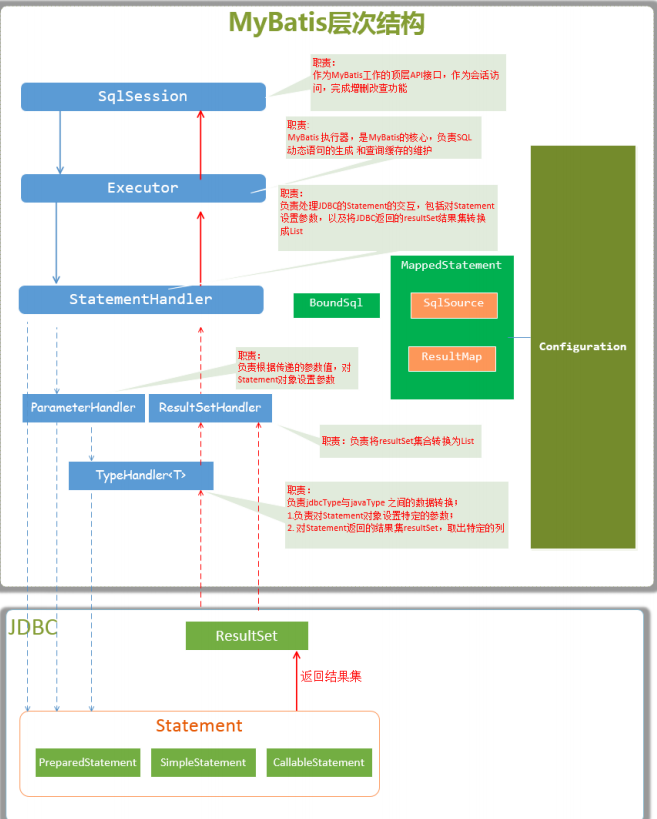
2. SqlSession
先从顶层的SqlSession接口开始说起。SqlSession是MyBatis提供的面向用户的API,表示和数据库的会话对象,用于完成对数据库的一系列CRUD操作以及获取mappers和管理事务等。
public interface SqlSession extends Closeable {

  /**

   * Retrieve a single row mapped from the statement key.

   * @param <T> the returned object type

   * @param statement

   *          the statement

   * @return Mapped object

   */

  <T> T selectOne(String statement);

  /**

   * Retrieve a single row mapped from the statement key and parameter.

   * @param <T> the returned object type

   * @param statement Unique identifier matching the statement to use.

   * @param parameter A parameter object to pass to the statement.

   * @return Mapped object

   */

  <T> T selectOne(String statement, Object parameter);

  /**

   * Retrieve a list of mapped objects from the statement key.

   * @param <E> the returned list element type

   * @param statement Unique identifier matching the statement to use.

   * @return List of mapped object

   */

  <E> List<E> selectList(String statement);

  /**

   * Retrieve a list of mapped objects from the statement key and parameter.

   * @param <E> the returned list element type

   * @param statement Unique identifier matching the statement to use.

   * @param parameter A parameter object to pass to the statement.

   * @return List of mapped object

   */

  <E> List<E> selectList(String statement, Object parameter);

  /**

   * Retrieve a list of mapped objects from the statement key and parameter,

   * within the specified row bounds.

   * @param <E> the returned list element type

   * @param statement Unique identifier matching the statement to use.

   * @param parameter A parameter object to pass to the statement.

   * @param rowBounds  Bounds to limit object retrieval

   * @return List of mapped object

   */

  <E> List<E> selectList(String statement, Object parameter, RowBounds rowBounds);

  /**

   * The selectMap is a special case in that it is designed to convert a list

   * of results into a Map based on one of the properties in the resulting

   * objects.

   * Eg. Return a of Map[Integer,Author] for selectMap("selectAuthors","id")

   * @param <K> the returned Map keys type

   * @param <V> the returned Map values type

   * @param statement Unique identifier matching the statement to use.

   * @param mapKey The property to use as key for each value in the list.

   * @return Map containing key pair data.

   */

  <K, V> Map<K, V> selectMap(String statement, String mapKey);

  /**

   * The selectMap is a special case in that it is designed to convert a list

   * of results into a Map based on one of the properties in the resulting

   * objects.

   * @param <K> the returned Map keys type

   * @param <V> the returned Map values type

   * @param statement Unique identifier matching the statement to use.

   * @param parameter A parameter object to pass to the statement.

   * @param mapKey The property to use as key for each value in the list.

   * @return Map containing key pair data.

   */

  <K, V> Map<K, V> selectMap(String statement, Object parameter, String mapKey);

  /**

   * The selectMap is a special case in that it is designed to convert a list

   * of results into a Map based on one of the properties in the resulting

   * objects.

   * @param <K> the returned Map keys type

   * @param <V> the returned Map values type

   * @param statement Unique identifier matching the statement to use.

   * @param parameter A parameter object to pass to the statement.

   * @param mapKey The property to use as key for each value in the list.

   * @param rowBounds  Bounds to limit object retrieval

   * @return Map containing key pair data.

   */

  <K, V> Map<K, V> selectMap(String statement, Object parameter, String mapKey, RowBounds rowBounds);

  /**

   * A Cursor offers the same results as a List, except it fetches data lazily using an Iterator.

   * @param <T> the returned cursor element type.

   * @param statement Unique identifier matching the statement to use.

   * @return Cursor of mapped objects

   */

  <T> Cursor<T> selectCursor(String statement);

  /**

   * A Cursor offers the same results as a List, except it fetches data lazily using an Iterator.

   * @param <T> the returned cursor element type.

   * @param statement Unique identifier matching the statement to use.

   * @param parameter A parameter object to pass to the statement.

   * @return Cursor of mapped objects

   */

  <T> Cursor<T> selectCursor(String statement, Object parameter);

  /**

   * A Cursor offers the same results as a List, except it fetches data lazily using an Iterator.

   * @param <T> the returned cursor element type.

   * @param statement Unique identifier matching the statement to use.

   * @param parameter A parameter object to pass to the statement.

   * @param rowBounds  Bounds to limit object retrieval

   * @return Cursor of mapped objects

   */

  <T> Cursor<T> selectCursor(String statement, Object parameter, RowBounds rowBounds);

  /**

   * Retrieve a single row mapped from the statement key and parameter

   * using a {@code ResultHandler}.

   * @param statement Unique identifier matching the statement to use.

   * @param parameter A parameter object to pass to the statement.

   * @param handler ResultHandler that will handle each retrieved row

   */

  void select(String statement, Object parameter, ResultHandler handler);

  /**

   * Retrieve a single row mapped from the statement

   * using a {@code ResultHandler}.

   * @param statement Unique identifier matching the statement to use.

   * @param handler ResultHandler that will handle each retrieved row

   */

  void select(String statement, ResultHandler handler);

  /**

   * Retrieve a single row mapped from the statement key and parameter using a {@code ResultHandler} and

   * {@code RowBounds}.

   *

   * @param statement

   *          Unique identifier matching the statement to use.

   * @param parameter

   *          the parameter

   * @param rowBounds

   *          RowBound instance to limit the query results

   * @param handler

   *          ResultHandler that will handle each retrieved row

   */

  void select(String statement, Object parameter, RowBounds rowBounds, ResultHandler handler);

  /**

   * Execute an insert statement.

   * @param statement Unique identifier matching the statement to execute.

   * @return int The number of rows affected by the insert.

   */

  int insert(String statement);

  /**

   * Execute an insert statement with the given parameter object. Any generated

   * autoincrement values or selectKey entries will modify the given parameter

   * object properties. Only the number of rows affected will be returned.

   * @param statement Unique identifier matching the statement to execute.

   * @param parameter A parameter object to pass to the statement.

   * @return int The number of rows affected by the insert.

   */

  int insert(String statement, Object parameter);

  /**

   * Execute an update statement. The number of rows affected will be returned.

   * @param statement Unique identifier matching the statement to execute.

   * @return int The number of rows affected by the update.

   */

  int update(String statement);

  /**

   * Execute an update statement. The number of rows affected will be returned.

   * @param statement Unique identifier matching the statement to execute.

   * @param parameter A parameter object to pass to the statement.

   * @return int The number of rows affected by the update.

   */

  int update(String statement, Object parameter);

  /**

   * Execute a delete statement. The number of rows affected will be returned.

   * @param statement Unique identifier matching the statement to execute.

   * @return int The number of rows affected by the delete.

   */

  int delete(String statement);

  /**

   * Execute a delete statement. The number of rows affected will be returned.

   * @param statement Unique identifier matching the statement to execute.

   * @param parameter A parameter object to pass to the statement.

   * @return int The number of rows affected by the delete.

   */

  int delete(String statement, Object parameter);

  /**

   * Flushes batch statements and commits database connection.

   * Note that database connection will not be committed if no updates/deletes/inserts were called.

   * To force the commit call {@link SqlSession#commit(boolean)}

   */

  void commit();

  /**

   * Flushes batch statements and commits database connection.

   * @param force forces connection commit

   */

  void commit(boolean force);

  /**

   * Discards pending batch statements and rolls database connection back.

   * Note that database connection will not be rolled back if no updates/deletes/inserts were called.

   * To force the rollback call {@link SqlSession#rollback(boolean)}

   */

  void rollback();

  /**

   * Discards pending batch statements and rolls database connection back.

   * Note that database connection will not be rolled back if no updates/deletes/inserts were called.

   * @param force forces connection rollback

   */

  void rollback(boolean force);

  /**

   * Flushes batch statements.

   * @return BatchResult list of updated records

   * @since 3.0.6

   */

  List<BatchResult> flushStatements();

  /**

   * Closes the session.

   */

  @Override

  void close();

  /**

   * Clears local session cache.

   */

  void clearCache();

  /**

   * Retrieves current configuration.

   * @return Configuration

   */

  Configuration getConfiguration();

  /**

   * Retrieves a mapper.

   * @param <T> the mapper type

   * @param type Mapper interface class

   * @return a mapper bound to this SqlSession

   */

  <T> T getMapper(Class<T> type);

  /**

   * Retrieves inner database connection.

   * @return Connection

   */

  Connection getConnection();

}
SqlSession接口一共有两个实现类,分线程不安全的DefaultSqlSession和线程安全的SqlSessionManager。

SqlSessionManager比较特殊,它不仅仅是实现SqlSession,还实现了SqlSessionFactory接口。他其实是相于把两者结合起来,用了一个ThreadLocal来保存每次的SqlSession来实现线程安全,运用JDK动态代理来控制每次会话的事务处理,从ThreadLocal中读取SqlSession用来复用,避免多次创建的资源浪费,享元模式?
这边只是先大概的讲一讲,其实SqlSessionManager就是一个组合模式罢了,走的还是默认操作这一套,只是做了套了一层壳子罢了,留在后面细讲。
2. DefaultSqlSession
DefaultSqlSession是SqlSession默认实现类。SqlSession通过工厂SqlSessionFactory创建。而SqlSessionFactory工厂的默认实现类是DefaultSqlSessionFactory。而DefaultSqlSessionFactory是从SqlSessionFactoryBuilder中生成的。
  public class SqlSessionFactoryBuilder {

  public SqlSessionFactory build(Reader reader) {

    return build(reader, null, null);

  }

  public SqlSessionFactory build(Reader reader, String environment) {

    return build(reader, environment, null);

  }

  public SqlSessionFactory build(Reader reader, Properties properties) {

    return build(reader, null, properties);

  }

  public SqlSessionFactory build(Reader reader, String environment, Properties properties) {

    try {

      XMLConfigBuilder parser = new XMLConfigBuilder(reader, environment, properties);

      return build(parser.parse());

    } catch (Exception e) {

      throw ExceptionFactory.wrapException("Error building SqlSession.", e);

    } finally {

      ErrorContext.instance().reset();

      try {

        reader.close();

      } catch (IOException e) {

        // Intentionally ignore. Prefer previous error.

      }

    }

  }

  public SqlSessionFactory build(InputStream inputStream) {

    return build(inputStream, null, null);

  }

  public SqlSessionFactory build(InputStream inputStream, String environment) {

    return build(inputStream, environment, null);

  }

  public SqlSessionFactory build(InputStream inputStream, Properties properties) {

    return build(inputStream, null, properties);

  }

  public SqlSessionFactory build(InputStream inputStream, String environment, Properties properties) {

    try {

      XMLConfigBuilder parser = new XMLConfigBuilder(inputStream, environment, properties);

      return build(parser.parse());

    } catch (Exception e) {

      throw ExceptionFactory.wrapException("Error building SqlSession.", e);

    } finally {

      ErrorContext.instance().reset();

      try {

        inputStream.close();

      } catch (IOException e) {

        // Intentionally ignore. Prefer previous error.

      }

    }

  }

  public SqlSessionFactory build(Configuration config) {

    return new DefaultSqlSessionFactory(config);

  }
这里用到工厂模式和建造者模式,这两个模式其实很容易搞混,他们都属于设计模式中的创建型模式。
区别在于:
1.工厂模式一般都是创建一个产品,注重的是把这个产品创建出来就行,只要创建出来,不关心这个产品的组成细节。
2.建造者模式也是创建一个产品,但是不仅要把这个产品创建出来,还要关系这个产品的组成细节。
SqlSessionFactoryBuilder就提供了许多不同的方法用来生成SqlSessionFactory。
SqlSessionFactory sqlSessionFactory = new SqlSessionFactoryBuilder().build(reader);

SqlSessionFactory sqlSessionFactory = new SqlSessionFactoryBuilder().build(reader, props);

SqlSessionFactory sqlSessionFactory = new SqlSessionFactoryBuilder().build(reader, "development-hsql")
Mybatis3源码笔记(二)SqlSession的更多相关文章
- Mybatis3源码笔记(六)SqlSession执行过程
前几篇大致分析了初始化的过程,今天打算走一个SqlSession具体执行过程. @Test void shouldSelectAllAuthors() { try (SqlSession sessio ...
- jQuery源码笔记(二):定义了一些变量和函数 jQuery = function(){}
笔记(二)也分为三部分: 一. 介绍: 注释说明:v2.0.3版本.Sizzle选择器.MIT软件许可注释中的#的信息索引.查询地址(英文版)匿名函数自执行:window参数及undefined参数意 ...
- Tomcat8源码笔记(二)Bootstrap启动
TOMCAT源码调试入口是Bootstrap类的main方法,我的启动参数VM: -Dcatalina.home=E:/Tomcat_Source_Code/apache-tomcat-8.0.53- ...
- Mybatis3源码笔记(一)环境搭建
1. 源码下载 地址:https://github.com/mybatis/mybatis-3.git. 国内访问有时确实有点慢,像我就直接先fork.然后从git上同步到国内的gitte上,然后在i ...
- Mybatis3源码笔记(八)小窥MyBatis-plus
前言 Mybatis-Plus是一个 MyBatis增强工具包,简化 CRUD 操作,在 MyBatis 的基础上只做增强不做改变,为简化开发.提高效率而生,号称无侵入,现在开发中比较常用,包括我自己 ...
- mybatis 源码学习(二)sqlsession
mybatis 中的sqlsession是一个非常重要的类.上篇我们分析了sessionfactory初始化配置文件,我们继续分析sessionfactory拿到会话进行的操作. 看这里.getMap ...
- Mybatis3源码笔记(七)Plugin
1.Mybatis3的插件其实主要是用到了责任链和动态代理两种模式相结合而生成的.下面我们看一个例子,在执行所有update操作时,执行一个小小的测试输出. @Intercepts({@Signatu ...
- Mybatis3源码笔记(四)Configuration(续)
1.pluginElement(root.evalNode("plugins")) 解析plugins节点(注册interceptorChain里记录对应的拦截器) private ...
- Mybatis3源码笔记(三)Configuration
1. XMLConfigBuilder 上一篇大致介绍了SqlSession的生成.在DefaultSqlSessionFactory的构造函数中就提到了Configuration这个对象.现在我们来 ...
随机推荐
- SpringBoot 项目初始化
工作之余,想要学习一下SpringBoot,通过网络大量教程最终成功运行SpringBoot项目. 第一步 首先,通过教程发现一套完整的快速搭建SpringBoot项目网站:https://star ...
- 小记一下递归通过id寻找一条链路的数据
Array.prototype.remove = function(val) { var index = this.indexOf(val); if (index > -1) { this.sp ...
- Golang 实现 Redis(9): 使用GeoHash 搜索附近的人
本文是使用 golang 实现 redis 系列的第九篇,主要介绍如何使用 GeoHash 实现搜索附近的人. 搜索附近的POI是一个非常常见的功能,它的技术难点在于地理位置是二维的(经纬度)而我们常 ...
- oracle之用户
命令都是在命令行窗口执行 创建用户 1)登陆管理员用户 sqlplus system/密码 sqlplus system/briup 注意不要以分号结尾 2)创建用户 create user 用户名 ...
- 痞子衡嵌入式:盘点国内RISC-V内核MCU厂商
大家好,我是痞子衡,是正经搞技术的痞子.今天痞子衡给大家介绍的是国内RISC-V内核MCU厂商. 虽然RISC-V风潮已经吹了好几年,但2019年才是其真正进入主流市场的元年,最近国内大量芯片公司崛起 ...
- Snort + Barbyard2 + Snorby环境搭建
1.环境 ubuntu-14.04.5 daq-2.0.7 Snort-2.9.15.1 Barbyard2 snorby Mysql Docker 2.架构 3.安装步骤 Ubuntu配置 如果是刚 ...
- FutureTask源码分析(JDK7)
总览 A cancellable asynchronous computation. This class provides a base implementation of {@link Futur ...
- Hi3559AV100的VI细节处理说明
因为项目后期涉及到MPP平台下的VI接口,现把有关视频输入VI模块的实现细节总结,也方便大家进一步了解. 1.整体概述 视频输入(VI)模块实现的功能:通过 MIPI Rx(含 MIPI 接口.LVD ...
- 微信小程序和H5之间相互跳转
1.微信小程序跳转小程序 wx.navigateToMiniProgram <script src='https://res.wx.qq.com/open/js/jweixin-1.3.0.js ...
- Codeforces 1167c(ccpc wannafly camp day1) News Distribution 并查集模板
题目: In some social network, there are nn users communicating with each other in mm groups of friends ...