
5. First-Class Functions
Function in python are first-class objects (runtime / element / argument / return)
1. Treating a Function Like an Object
def test(n):

    """ return n*2 """

    return n * 2

print test(5)  # 10

# '__doc__' is used to generate the help text of an object

# 'help(test)' do like this in Python Interactive Console

print test.__doc__  # ' return n*2 '

# Function object is an instance of the function class.

print type(test)  # <type 'function'>

# assign it, call it, use it as an argument

tmp = test

print tmp(5)  # 10

print list(map(tmp, range(5)))  # [0, 2, 4, 6, 8]
2. Higher-Order Functions
- A function that takes a function as argument or returns a function
fruits = ['fig', 'apple', 'cherry']

print sorted(fruits, key=len)  # ['fig', 'apple', 'cherry']

# Any one-argument function can be used as the key.

print sorted(fruits, key=lambda word: word[::-1])  # ['apple', 'fig', 'cherry']
2.1 Modern Replacements for map, filter, and reduce
def test(n):

    return n * 2

print list(map(test, range(5)))  # [0, 2, 4, 6, 8]

print [test(n) for n in range(5)]  # [0, 2, 4, 6, 8]

print list(map(test, filter(lambda n: n % 2, range(5))))  # [2, 6]

print [test(n) for n in range(5) if n % 2]  # [2, 6]

print reduce(lambda x,y: x+y, range(100))  # 4950

print sum(range(100))  # 4950
3. The Seven Flavors of Callable Objects
- User-defined functions: def or lambda.
- Built-in functions: like len or time.strftime.
- Built-in methods: like dict.get.
- Methods: functions in class.
- Classes: a class runs its __new__ method to create an instance, then __init__ to initialize it, and finally the instance is returned to the caller.
- Class instances: if a class defines a __call__ method, then its instances may be invoked as functions.
- Generator functions: functions or methods that use the yield keyword.
[notes]: To determine whether an object is callable, use the callable() built-in function.
4. User-Defined Callable Types
- Python objects may also be made to behave like functions
class Test:

    def __init__(self, items):

        self._items = list(items)

    def pick(self):

        return self._items.pop()

    def __call__(self):

        return self.pick()

t = Test(range(5))

print t.pick()  # 4

print t()  # 3

print callable(t)  # True
5. Keyword-Only Parameters
- Can only be given as a keyword argument.
- Python 3 only.
def tag(name, *content, cls=None, **attrs):  # cls: Keyword-Only

    """ Generate one or more HTML tags """

    if cls is not None:

        attrs['class'] = cls

    if attrs:

        attr_str = ''.join(' %s="%s"' % (attr, value) for attr, value in sorted(attrs.items()))

    else:

        attr_str = ''

    if content:

        return '\n'.join('<%s%s>%s</%s>' % (name, attr_str, c, name) for c in content)

    else:

        return '<%s%s />' % (name, attr_str)

print(tag('br'))  # <br />

print(tag('a', 'hello', 'world', href='#'))  # <a href="#">hello</a>\n<a href="#">world</a>

print(tag('div', 'im div~', cls='f-left'))  # <div class="f-left">im div~</div>

print(tag(**{'name': 'img', 'id': 'my_img'}))  # <img id="my_img" />

def f(a, *, b):  # b: Keyword-Only

    return a, b

print(f(1, b=2))  # (1, 2)
6. Function Introspection
def test(n):

     return n * 2

test.name = 'double it!'

# a function uses the __dict__ attribute to store user attributes assigned to it

print test.__dict__  # {'name': 'double it!'}
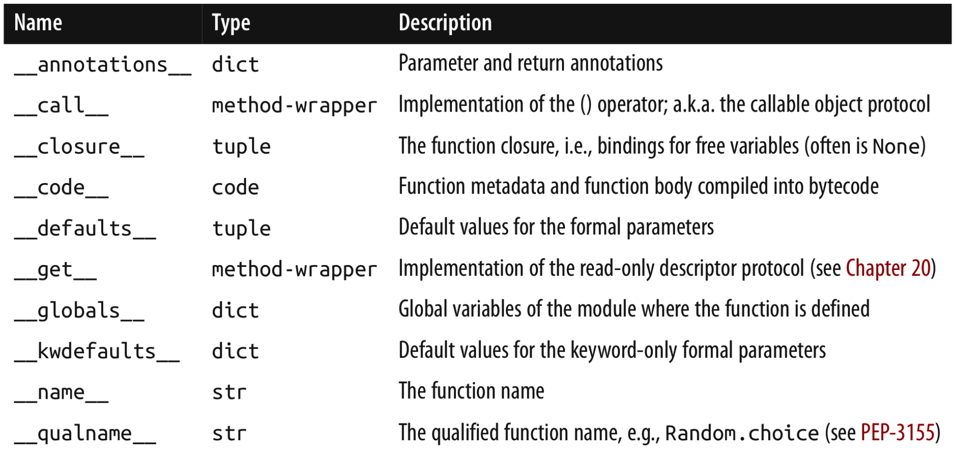
- Attributes of functions that don’t exist in plain instances
7. Retrieving Information About Parameters
def test(a, b=2, c=3, **x):

    d = a * b * c

    return d

print test.__defaults__  # (2, 3)

# defaults for keyword-only arguments

# print(test.__kwdefaults__)  # {'e': 3}

print test.__code__  # <code object test at 0x...>

# does't include any variable arguments prefixed with * or **

print test.__code__.co_varnames  # ('a', 'b', 'c', 'd')

print test.__code__.co_argcount  # 3
def test(a, b=2, c=3, **x):

    d = a * b * c

    return d

from inspect import signature  # python 3

tmp = signature(test)

print(str(tmp))  # (a, b=2, c=3, **x)

for name, param in tmp.parameters.items():

	# 'kind' can also be: VAR_POSITIONAL / VAR_KEYWORD / KEYWORD_ONLY / POSITIONAL_ONLY

    print(param.kind)  # POSITIONAL_OR_KEYWORD

    print(name)  # a

    print(param.default)  # <class 'inspect._empty'>

bind_tmp = tmp.bind(**{'a': 11, 'b': 22})

for name, value in bind_tmp.arguments.items():

    print(name, '=', value)  # a = 11 \n b = 22
8. Function Annotations
- Just annotation, noting else!
- Python 3 only.
def test(a:str, b:'in>0'=1) -> str:

    return a

print(test('qqq', 2))  # qqq

print(test.__annotations__)   # {'a': <class 'str'>, 'b': 'in>0', 'return': <class 'str'>}

from inspect import signature  # python 3

tmp = signature(test)

for name, param in tmp.parameters.items():

    print(param.annotation)  # <class 'str'>

    print(param.name)  # a

    print(param.default)  # <class 'inspect._empty'>
9. Packages for Functional Programming
9.1 operator
from operator import mul

print mul(4, 5)  # 20

from operator import itemgetter  # pick items from sequences

test_data = [('b', 2), ('a', 1), ('c', 3)]

for item in sorted(test_data, key=itemgetter(1)):  # lambda i: i[1]

    print item  # ('a', 1)

func = itemgetter(1, 0)  # lambda i: (i[1], i[0])

for item in test_data:

    print func(item)  # (2, 'b')

from operator import attrgetter  # read attributes from objects

class A:

    tmp = 1

class B:

    a = A()

class C:

    b = B()

    tmp = 2

c = C()

func = attrgetter('b.a.tmp', 'tmp')

print func(c)  # (1, 2)

from operator import methodcaller

s = 'The time has come'

my_upper = methodcaller('upper')

print my_upper(s)  # s.upper()

my_replace = methodcaller('replace', ' ', '-')

print my_replace(s)  # s.replace(' ', '-')

#['abs', 'add', 'and_', 'attrgetter', 'concat', 'contains', 'countOf',

# 'delitem', 'eq', 'floordiv', 'ge', 'getitem', 'gt', 'iadd', 'iand',

# 'iconcat', 'ifloordiv', 'ilshift', 'imod', 'imul', 'index', 'indexOf',

# 'inv', 'invert', 'ior', 'ipow', 'irshift', 'is_', 'is_not', 'isub',

# 'itemgetter', 'itruediv', 'ixor', 'le', 'length_hint', 'lshift',

# 'lt', 'methodcaller', 'mod', 'mul', 'ne', 'neg', 'not_', 'or_', 'pos',

# 'pow', 'rshift', 'setitem', 'sub', 'truediv', 'truth', 'xor']
9.2 functools
def test(a, b, c):

    return a * b * c

from functools import partial

tmp = partial(test, 1, c=2)  # can't 'b=2' because 'c'

print list(map(tmp, range(5)))  # [0, 2, 4, 6, 8]

print test      # <function test at 0x10dca0e60>

print tmp.func  # <function test at 0x10dca0e60>

print tmp.args  # (1,)

print tmp.keywords  # {'c': 2}
5. First-Class Functions的更多相关文章
- asp.net MVC helper 和自定义函数@functions小结
asp.net Razor 视图具有.cshtml后缀,可以轻松的实现c#代码和html标签的切换,大大提升了我们的开发效率.但是Razor语法还是有一些棉花糖值得我们了解一下,可以更加强劲的提升我们 ...
- 【跟着子迟品 underscore】Array Functions 相关源码拾遗 & 小结
Why underscore 最近开始看 underscore.js 源码,并将 underscore.js 源码解读 放在了我的 2016 计划中. 阅读一些著名框架类库的源码,就好像和一个个大师对 ...
- 【跟着子迟品 underscore】Object Functions 相关源码拾遗 & 小结
Why underscore 最近开始看 underscore.js 源码,并将 underscore.js 源码解读 放在了我的 2016 计划中. 阅读一些著名框架类库的源码,就好像和一个个大师对 ...
- ajax的使用:(ajaxReturn[ajax的返回方法]),(eval返回字符串);分页;第三方类(page.class.php)如何载入;自动加载函数库(functions);session如何防止跳过登录访问(构造函数说明)
一.ajax例子:ajaxReturn("ok","eval")->thinkphp中ajax的返回值的方法,返回参数为ok,返回类型为eval(字符串) ...
- QM模块包含主数据(Master data)和功能(functions)
QM模块包含主数据(Master data)和功能(functions) QM主数据 QM主数据 1 Material Master MM01/MM02/MM50待测 物料主数据 2 Sa ...
- jQuery String Functions
In today's post, I have put together all jQuery String Functions. Well, I should say that these are ...
- 2-4. Using auto with Functions
在C++14中允许使用type deduction用于函数参数和函数返回值 Return Type Deduction in C++11 #include <iostream> using ...
- [Python] Pitfalls: About Default Parameter Values in Functions
Today an interesting bug (pitfall) is found when I was trying debug someone's code. There is a funct ...
- Kernel Functions for Machine Learning Applications
In recent years, Kernel methods have received major attention, particularly due to the increased pop ...
- Execution Order of Event Functions
In Unity scripting, there are a number of event functions that get executed in a predetermined order ...
随机推荐
- iOS-MMDrawerController的使用【抽屉视图+(SUNSlideSwitchView)进度条手势滑动】转
下载网站:https://github.com/mutualmobile/MMDrawerController 首先,到下载网址下载MMDrawerController,将文件导入工程,里面有: MM ...
- 深入理解Android消息机制
在日常的开发中,Android 的消息机制作为系统运行的根本机制之一,显得十分的重要. 从 Handler 发送消息开始 查看源码,Handler的post.send方法最终都会走到 public f ...
- 用于Python文件转换.exe文件的pyinstaller工具安装
安装方法: 注:python环境一定要配置好. 1.第一步:下载 官方网站:http://www.pyinstaller.org/downloads.html 此处下载版本为稳定版. 2.第二步:下载 ...
- 【ABAP系列】SAP ABAP BAPI_REQUISITION_CREATE创建采购申请
公众号:SAP Technical 本文作者:matinal 原文出处:http://www.cnblogs.com/SAPmatinal/ 原文链接:[ABAP系列]SAP ABAP BAPI_RE ...
- Unity学习笔记_控制人物移动+摄像机跟随
我想做的移动操作方式类似[流星蝴蝶剑].[龙之谷].[我的世界第三人称]的第三人称操作方式. 操作说明:W键会朝当前镜头方向前进,鼠标控制镜头旋转. 做前需知(先去稍微了解一下比较好): ①unity ...
- python之pandas学习笔记-初识pandas
初识pandas python最擅长的就是数据处理,而pandas则是python用于数据分析的最常用工具之一,所以学python一定要学pandas库的使用. pandas为python提供了高性能 ...
- Python学习笔记——文件系统
文件系统 import os # 打印当前目录 print(os.getcwd()) # 列出当前目录的所有文件 print(os.listdir()) F:\codes\python\python\ ...
- 在图中寻找最短路径-----深度优先算法C++实现
求从图中的任意一点(起点)到另一点(终点)的最短路径,最短距离: 图中有数字的点表示为图中的不同海拔的高地,不能通过:没有数字的点表示海拔为0,为平地可以通过: 这个是典型的求图中两点的最短路径:本例 ...
- Kafka 1.1.0 服务端源码阅读笔记
网络层 01: 服务器的启动 02: Acceptor和Processor 03: RequestChannel API层 04: Handler和Apis 06: Produce请求(1): 写入本 ...
- 【转】GMM与K-means聚类效果实战
原地址: GMM与K-means聚类效果实战 备注 分析软件:python 数据已经分享在百度云:客户年消费数据 密码:lehv 该份数据中包含客户id和客户6种商品的年消费额,共有440个样本 正文 ...