
java并发之ReentrantLock学习理解
简介
java多线程中可以使用synchronized关键字来实现线程间同步互斥,但在jdk1.5中新增加了ReentrantLock类也能实现同样的效果,并且在扩展功能上也更加强大,比如具有嗅探锁定、多路通知分支等功能,并且使用上比synchronized更加灵活。
如何使用ReentrantLock
主要是lock.lock()和lock.unlock()两个方法
 public class MyService implements Runnable {

     protected ReentrantLock lock;

     public MyService(ReentrantLock lock){

         this.lock = lock;

     }

     public void run() {

         lock.lock();

         for (int i = 0; i < 5; i++) {

             System.out.println(Thread.currentThread().getName()+" "+i);

             try {

                 Thread.sleep(1000);

             } catch (InterruptedException e) {

                 e.printStackTrace();

             }

         }

         lock.unlock();

     }

 }
 /**

  * 测试类

  * @author ko

  *

  */

 public class Test {

     public static void main(String[] args) {

         ReentrantLock lock = new ReentrantLock();

         for (int i = 0; i < 4; i++) {

             new Thread(new MyService(lock)).start();

         }

     }

 }
Thread-0 0

Thread-0 1

Thread-0 2

Thread-0 3

Thread-0 4

Thread-1 0

Thread-1 1

Thread-1 2

Thread-1 3

Thread-1 4

Thread-2 0

Thread-2 1

Thread-2 2

Thread-2 3

Thread-2 4

Thread-3 0

Thread-3 1

Thread-3 2

Thread-3 3

Thread-3 4
使用Condition类实现wait、notify的功能
Condition类也是jdk1.5里出来的,它能实现synchronized和wait、notify搭配的功能,另外比后者更灵活,Condition可以实现多路通知功能,也就是在一个Lock对象里可以创建多个Condition(即对象监视器)实例,线程对象可以注册在指定的Condition中,从而可以有选择的进行线程通知,在调度线程上更加灵活。
而synchronized就相当于整个Lock对象中只有一个单一的Condition对象,所有的线程都注册在这个对象上。线程开始notifyAll时,需要通知所有的WAITING线程,没有选择权,会有相当大的效率问题。
使用Condition为什么会报java.lang.IllegalMonitorStateException异常
还是刚才的代码,稍作改动
 public class MyService implements Runnable {

     protected ReentrantLock lock;

     protected Condition condition;

     public MyService(ReentrantLock lock,Condition condition){

         this.lock = lock;

         this.condition = condition;

     }

     public void run() {

 //        lock.lock();

         try {

             condition.await();

         } catch (InterruptedException e1) {

             // TODO Auto-generated catch block

             e1.printStackTrace();

         }

         for (int i = 0; i < 5; i++) {

             System.out.println(Thread.currentThread().getName()+" "+i);

             try {

                 Thread.sleep(1000);

             } catch (InterruptedException e) {

                 e.printStackTrace();

             }

         }

 //        lock.unlock();

     }

 }
 /**

  * 测试类

  * @author ko

  *

  */

 public class Test {

     public static void main(String[] args) {

         ReentrantLock lock = new ReentrantLock();

         Condition condition = lock.newCondition();

         for (int i = 0; i < 4; i++) {

             new Thread(new MyService(lock,condition)).start();

         }

     }

 }
Exception in thread "Thread-0" Exception in thread "Thread-1" Exception in thread "Thread-2" Exception in thread "Thread-3" java.lang.IllegalMonitorStateException

	at java.util.concurrent.locks.ReentrantLock$Sync.tryRelease(Unknown Source)

	at java.util.concurrent.locks.AbstractQueuedSynchronizer.release(Unknown Source)

	at java.util.concurrent.locks.AbstractQueuedSynchronizer.fullyRelease(Unknown Source)

	at java.util.concurrent.locks.AbstractQueuedSynchronizer$ConditionObject.await(Unknown Source)

	at ww.MyService.run(MyService.java:26)

	at java.lang.Thread.run(Unknown Source)
报错的异常信息是监视器出错,原因是在调用condition.await()之前是要先调用lock.lock()来获得同步监视器。
正确使用Condition类
 public class MyService implements Runnable {

     protected ReentrantLock lock;

     protected Condition condition;

     public MyService(ReentrantLock lock,Condition condition){

         this.lock = lock;

         this.condition = condition;

     }

     public void await(){

         try {

             lock.lock();

             System.out.println("await time is "+System.currentTimeMillis());

             condition.await();

             System.out.println("after await info...");

         } catch (InterruptedException e1) {

             e1.printStackTrace();

         } finally {

             lock.unlock();

         }

     }

     public void signal(){

         try {

             lock.lock();

             System.out.println("signal time is "+System.currentTimeMillis());

             condition.signal();

         } finally {

             lock.unlock();

         }

     }

     public void run() {

         await();

     }

 }
 /**

  * 测试类

  * @author ko

  *

  */

 public class Test {

     public static void main(String[] args) {

         ReentrantLock lock = new ReentrantLock();

         Condition condition = lock.newCondition();

         MyService service = new MyService(lock,condition);

         new Thread(service).start();

         try {

             Thread.sleep(3000);

         } catch (InterruptedException e) {

             e.printStackTrace();

         }

         service.signal();

     }

 }
await time is 1501142954379

signal time is 1501142957381

after await info...
成功实现等待通知模式,整理一下,下表的方法功能是对应的
|
Object类 |
Condition类 |
|
Wait() |
Await() |
|
Wait(long timeout) |
Await(long time,TimeUnit unit) |
|
Notify() |
Signal() |
|
notifyAll() |
signalAll() |
使用多个Condition实现通知部分线程
 public class MyService implements Runnable {

     protected ReentrantLock lock;

     protected Condition conditionA;

     protected Condition conditionB;

     public MyService(ReentrantLock lock,Condition conditionA,Condition conditionB){

         this.lock = lock;

         this.conditionA = conditionA;

         this.conditionB = conditionB;

     }

     public void await_A(){

         try {

             lock.lock();

             System.out.println(Thread.currentThread().getName()+" await_A time is "+System.currentTimeMillis());

             conditionA.await();

             System.out.println(Thread.currentThread().getName()+" after await_A info...");

         } catch (InterruptedException e1) {

             e1.printStackTrace();

         } finally {

             lock.unlock();

         }

     }

     public void await_B(){

         try {

             lock.lock();

             System.out.println(Thread.currentThread().getName()+" await_B time is "+System.currentTimeMillis());

             conditionB.await();

             System.out.println(Thread.currentThread().getName()+" after_B await info...");

         } catch (InterruptedException e1) {

             e1.printStackTrace();

         } finally {

             lock.unlock();

         }

     }

     public void signal_A(){

         try {

             lock.lock();

             System.out.println(Thread.currentThread().getName()+" signal_A time is "+System.currentTimeMillis());

             conditionA.signal();

         } finally {

             lock.unlock();

         }

     }

     public void signal_B(){

         try {

             lock.lock();

             System.out.println(Thread.currentThread().getName()+" signal_B time is "+System.currentTimeMillis());

             conditionB.signal();

         } finally {

             lock.unlock();

         }

     }

     public void run() {

         String tname = Thread.currentThread().getName();

         if (tname.equals("A")) {

             await_A();

         } else if (tname.equals("B")) {

             await_B();

         }

     }

 }
 /**

  * 测试类

  * @author ko

  *

  */

 public class Test {

     public static void main(String[] args) {

         ReentrantLock lock = new ReentrantLock();

         Condition conditionA = lock.newCondition();

         Condition conditionB = lock.newCondition();

         MyService service = new MyService(lock,conditionA,conditionB);

         Thread tA = new Thread(service);

         tA.setName("A");

         tA.start();

         Thread tB = new Thread(service);

         tB.setName("B");

         tB.start();

         try {

             Thread.sleep(3000);

         } catch (InterruptedException e) {

             e.printStackTrace();

         }

         service.signal_A();

     }

 }
A await_A time is 1501482321344

B await_B time is 1501482321346

main signal_A time is 1501482324344

A after await_A info...
可以看到只唤醒了A线程。。。
一对一的生产者消费者
 /**

  * 生产者和消费者一对一

  * @author ko

  *

  */

 public class MyService {

     protected ReentrantLock lock = new ReentrantLock();

     protected Condition condition = lock.newCondition();

     protected boolean hasValue = false;

     public void set(){

         try {

             lock.lock();

             while (hasValue == true) {

                 condition.await();

             }

             System.out.println("★");

             hasValue = true;

             condition.signal();

         } catch (InterruptedException e) {

             // TODO Auto-generated catch block

             e.printStackTrace();

         } finally {

             lock.unlock();

         }

     }

     public void get(){

         try {

             lock.lock();

             while (hasValue == false) {

                 condition.await();

             }

             System.out.println("☆");

             hasValue = false;

             condition.signal();

         } catch (InterruptedException e) {

             // TODO Auto-generated catch block

             e.printStackTrace();

         } finally {

             lock.unlock();

         }

     }

 }
 /**

  * 生产者

  * @author ko

  *

  */

 public class Producer implements Runnable {

     protected MyService myService;

     public Producer(MyService myService) {

         super();

         this.myService = myService;

     }

     public void run() {

         for (int i = 0; i < Integer.MAX_VALUE; i++) {

             myService.set();

         }

     }

 }
 /**

  * 消费者

  * @author ko

  *

  */

 public class Customer implements Runnable {

     protected MyService myService;

     public Customer(MyService myService) {

         super();

         this.myService = myService;

     }

     public void run() {

         for (int i = 0; i < Integer.MAX_VALUE; i++) {

             myService.get();

         }

     }

 }
 /**

  * 测试类

  * @author ko

  *

  */

 public class Test {

     public static void main(String[] args) {

         MyService myService = new MyService();

         Producer p = new Producer(myService);

         Customer c = new Customer(myService);

         new Thread(p).start();

         new Thread(c).start();

     }

 }
打印结果

多对多的生产者消费者
 /**

  * 测试类

  * @author ko

  *

  */

 public class Test {

     public static void main(String[] args) {

         MyService myService = new MyService();

         for (int i = 0; i < 10; i++) {

             new Thread(new Producer(myService)).start();

             new Thread(new Customer(myService)).start();

         }

     }

 }
 /**

  * 生产者和消费者多对多

  * @author ko

  *

  */

 public class MyService {

     protected ReentrantLock lock = new ReentrantLock();

     protected Condition condition = lock.newCondition();

     protected boolean hasValue = false;

     public void set(){

         try {

             lock.lock();

             while (hasValue == true) {

                 System.out.println("有可能★连续打印");

                 condition.await();

             }

             System.out.println("★");

             hasValue = true;

             condition.signalAll();

         } catch (InterruptedException e) {

             // TODO Auto-generated catch block

             e.printStackTrace();

         } finally {

             lock.unlock();

         }

     }

     public void get(){

         try {

             lock.lock();

             while (hasValue == false) {

                 System.out.println("有可能☆连续打印");

                 condition.await();

             }

             System.out.println("☆");

             hasValue = false;

             condition.signalAll();

         } catch (InterruptedException e) {

             // TODO Auto-generated catch block

             e.printStackTrace();

         } finally {

             lock.unlock();

         }

     }

 }
要注意的是由于现在是多个生产者消费者,所以condition.signal()要改为condition.signalAll(),其它代码不变。

查看打印结果,发现★和☆总是间隔打印,但是 有可能★连续打印 和 有可能☆连续打印 却有可能连续打印,这是因为改为signalAll后唤醒的是所有线程,有可能再次把自己唤醒,所以会出现这种情况。
公平锁与非公平锁
公平锁表示线程获取锁的顺序是按照线程加锁的顺序来分配的,而非公平锁是一种抢占机制,随机的。
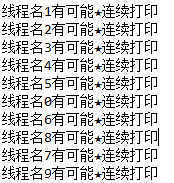
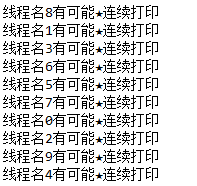
还是上面的代码,给ReentrantLock换个有isFair参数的构造方法,new ReentrantLock(isFair) true就是公平锁,false就是非公平锁。再给打印的语句加上线程名,当为true时,线程是按顺序打印,为false时随机打印。
方法getHoldCount()的使用
getHoldCount()表示当前线程获取锁的个数
 public class MyService {

     protected ReentrantLock lock = new ReentrantLock(true);

     public void method1(){

         try {

             lock.lock();

             System.out.println(Thread.currentThread().getName()+"线程保持lock锁的个数:"+lock.getHoldCount()+" method1");

             method2();

         } catch (Exception e) {

             e.printStackTrace();

         } finally {

             lock.unlock();

         }

     }

     public void method2(){

         try {

             lock.lock();

             System.out.println(Thread.currentThread().getName()+"线程保持lock锁的个数:"+lock.getHoldCount()+" method2");

         } catch (Exception e) {

             e.printStackTrace();

         } finally {

             lock.unlock();

         }

     }

 }
 public class ThreadA extends Thread {

     protected MyService myService;

     public ThreadA(MyService myService) {

         super();

         this.myService = myService;

     }

     public void run() {

         myService.method1();

     }

 }
 public class Test {

     public static void main(String[] args) {

         MyService myService = new MyService();

         new ThreadA(myService).start();

     }

 }

getQueueLength()方法使用
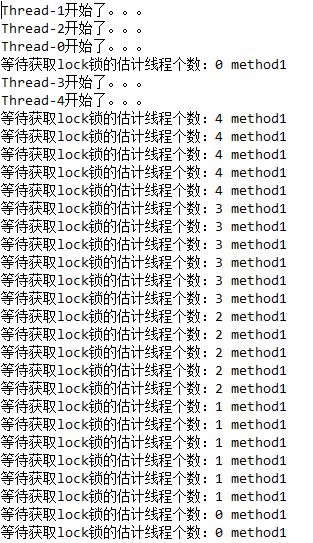
getQueueLength()表示等待获取lock锁的估计线程个数。
 public class MyService {

     protected ReentrantLock lock = new ReentrantLock();

     public void getql(){

         System.out.println("等待获取lock锁的估计线程个数:"+lock.getQueueLength()+" method1");

     }

     public void synmethod(){

         System.out.println(Thread.currentThread().getName()+"开始了。。。");

         lock.lock();

         try {

             Thread.sleep(5000);

         } catch (InterruptedException e) {

             e.printStackTrace();

         }

         lock.unlock();

     }

 }
 public class ThreadA extends Thread {

     protected MyService myService;

     public ThreadA(MyService myService) {

         super();

         this.myService = myService;

     }

     public void run() {

         myService.synmethod();

     }

 }
 public class Test {

     public static void main(String[] args) {

         MyService myService = new MyService();

         new ThreadA(myService).start();

         new ThreadA(myService).start();

         new ThreadA(myService).start();

         new ThreadA(myService).start();

         new ThreadA(myService).start();

         while (true) {

             myService.getql();

             try {

                 Thread.sleep(900);

             } catch (InterruptedException e) {

                 e.printStackTrace();

             }

         }

     }

 }
getWaitQueueLength(condition)的用法
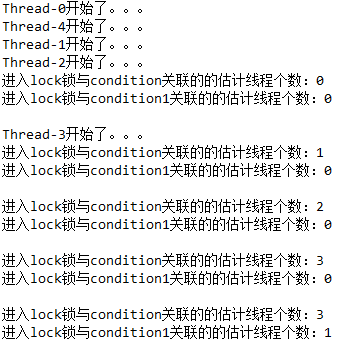
getWaitQueueLength(condition) 表示返回等待与此锁相关的给定条件condition的线程估计数。比如有3个线程都执行了同一个condition的await方法,那么调用getWaitQueueLength(condition)返回的就是3.
 public class MyService {

     protected ReentrantLock lock = new ReentrantLock();

     protected Condition condition = lock.newCondition();

     protected Condition condition1 = lock.newCondition();

     public void synmethod(){

         System.out.println(Thread.currentThread().getName()+"开始了。。。");

         lock.lock();

         System.out.println("进入lock锁与condition关联的的估计线程个数:"+lock.getWaitQueueLength(condition));

         System.out.println("进入lock锁与condition1关联的的估计线程个数:"+lock.getWaitQueueLength(condition1));

         System.out.println("");

         try {

             if (!Thread.currentThread().getName().contains("2")) {

                 condition.await();

             }else{

                 condition1.await();

             }

         } catch (InterruptedException e) {

             e.printStackTrace();

         }

         lock.unlock();

     }

 }
 public class Test {

     public static void main(String[] args) {

         MyService myService = new MyService();

         new ThreadA(myService).start();

         new ThreadA(myService).start();

         new ThreadA(myService).start();

         new ThreadA(myService).start();

         new ThreadA(myService).start();

     }

 }
hasQueuedThread(thread)和hasQueuedThreads()的使用
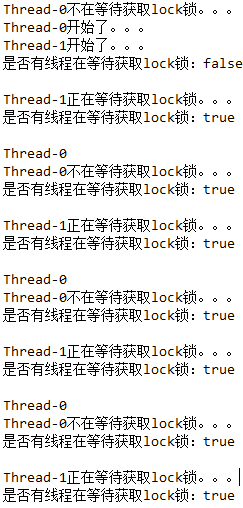
hasQueuedThread(thread)返回的是线程thread是否在等待获取lock锁
hasQueuedThreads()返回的是是否有线程正在等待获取lock锁
 public class MyService {

     protected ReentrantLock lock = new ReentrantLock();

     protected Condition condition = lock.newCondition();

     public void hasa(Thread thread){

         if (lock.hasQueuedThread(thread)) {

             System.out.println(thread.getName()+"正在等待获取lock锁。。。");

         }else{

             System.out.println(thread.getName()+"不在等待获取lock锁。。。");

         }

         System.out.println("是否有线程在等待获取lock锁:"+lock.hasQueuedThreads());

         System.out.println("");

     }

     public void synmethod(){

         System.out.println(Thread.currentThread().getName()+"开始了。。。");

         lock.lock();

         if (Thread.currentThread().getName().contains("1")) {

             try {

                 condition.await();

             } catch (InterruptedException e) {

                 e.printStackTrace();

             }

         }

         try {

             Thread.sleep(15000);

         } catch (InterruptedException e) {

             // TODO Auto-generated catch block

             e.printStackTrace();

         }

         lock.unlock();

     }

 }
 public class Test {

     public static void main(String[] args) {

         MyService myService = new MyService();

         ThreadA ta = new ThreadA(myService);

         ta.start();

         ThreadA tb = new ThreadA(myService);

         tb.start();

         while (true) {

             myService.hasa(ta);

             myService.hasa(tb);

             System.out.println(""+ta.getName());

             try {

                 Thread.sleep(1000);

             } catch (InterruptedException e) {

                 e.printStackTrace();

             }

         }

     }

 }
hasWaiters(condition)的用法
hasWaiters(condition)表示是否有线程进入了lock锁与condition相关联的等待中。
 public class MyService {

     protected ReentrantLock lock = new ReentrantLock();

     protected Condition condition = lock.newCondition();

     public void synmethod(){

         System.out.println(Thread.currentThread().getName()+"开始了。。。");

         lock.lock();

         System.out.println("是否有线程进入了lock锁与condition相关联的等待中:"+lock.hasWaiters(condition));

         if (Thread.currentThread().getName().contains("0")) {

             try {

                 condition.await();

             } catch (InterruptedException e) {

                 e.printStackTrace();

             }

         }

         try {

             Thread.sleep(3000);

         } catch (InterruptedException e) {

             e.printStackTrace();

         }

         lock.unlock();

     }

 }
 public class Test {

     public static void main(String[] args) {

         MyService myService = new MyService();

         ThreadA ta = new ThreadA(myService);

         ta.start();

         try {

             Thread.sleep(3500);

         } catch (InterruptedException e) {

             e.printStackTrace();

         }

         ThreadA tb = new ThreadA(myService);

         tb.start();

     }

 }

方法isFair()、isHeldByCurrentThread()、isLocked()的使用
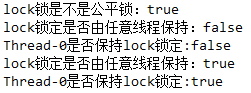
isFair()判断线程锁是不是公平锁
isHeldByCurrentThread()查询当前线程是否保持此锁定
isLocked()查询此锁定是否由任意线程保持
 public class MyService {

     protected ReentrantLock lock = new ReentrantLock(true);

     protected Condition condition = lock.newCondition();

     public void synmethod(){

         System.out.println("lock锁是不是公平锁:"+lock.isFair());

         System.out.println("lock锁定是否由任意线程保持:"+lock.isLocked());

         System.out.println(Thread.currentThread().getName()+"是否保持lock锁定:"+lock.isHeldByCurrentThread());

         lock.lock();

         System.out.println("lock锁定是否由任意线程保持:"+lock.isLocked());

         System.out.println(Thread.currentThread().getName()+"是否保持lock锁定:"+lock.isHeldByCurrentThread());

         lock.unlock();

     }

 }
 public class Test {

     public static void main(String[] args) {

         MyService myService = new MyService();

         ThreadA ta = new ThreadA(myService);

         ta.start();

     }

 }
lockInterruptibly()方法的使用
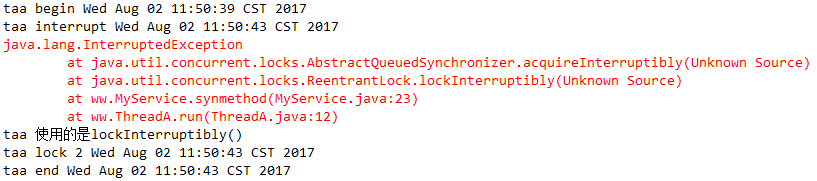
lockInterruptibly()比lock()获取锁之前多了个判断,如果当前线程未被中断,则获取锁定,如果已被中断,则抛出java.lang.InterruptedException异常。
 public class MyService {

     protected ReentrantLock lock = new ReentrantLock(true);

     protected Condition condition = lock.newCondition();

     public void synmethod(){

         try {

             System.out.println(Thread.currentThread().getName()+" begin "+new Date().toString());

             for (int i = 0; i < Integer.MAX_VALUE/20; i++) {// 大概会延长7 8s,这里不用sleep延长线程时间,而是这样写,是因为调用线程的interrupt()方法时,如果线程在sleep会报异常

                 Math.random();

             }

             if(new Random().nextInt(5)%2==0){// 随机

                 System.out.println(Thread.currentThread().getName()+" 使用的是lock() ");

                 lock.lock();

             }else{

                 System.out.println(Thread.currentThread().getName()+" 使用的是lockInterruptibly() ");

                 lock.lockInterruptibly();

             }

             System.out.println(Thread.currentThread().getName()+" lock 1 "+new Date().toString());

             for (int i = 0; i < Integer.MAX_VALUE/20; i++) {// 同上

                 Math.random();

             }

         } catch (InterruptedException e) {

             // TODO Auto-generated catch block

             e.printStackTrace();

         } finally {

             System.out.println(Thread.currentThread().getName()+" lock 2 "+new Date().toString());

             if (lock.isHeldByCurrentThread()) {

                 lock.unlock();

             }

             System.out.println(Thread.currentThread().getName()+" end "+new Date().toString());

         }

     }

 }
 /**

  * 测试类

  * @author ko

  *

  */

 public class Test {

     public static void main(String[] args) {

         MyService myService = new MyService();

         ThreadA taa = new ThreadA(myService);

         taa.setName("taa");

         taa.start();

         try {

             Thread.sleep(1500);// 等前面的线程都启动好

         } catch (InterruptedException e) {

             e.printStackTrace();

         }

         System.out.println("taa interrupt "+new Date().toString());

         taa.interrupt();// 打标记  这个时候taa还没有进入lock锁里

     }

 }
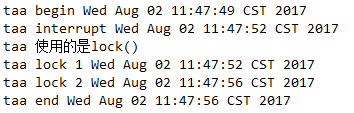
代码里采用了随机的处理,有的时候使用的是lock(),有的时候使用的是lockInterruptibly(),多运行几遍就能得到两种结果。
lock.tryLock()、lock.tryLock(timeout, unit)方法使用
lock.tryLock()) 立即返回,获得锁返回true,没获得锁返回false
lock.tryLock(3, TimeUnit.SECONDS) 等待3s,3s后,获得锁返回true,没获得锁返回false
 public class MyService {

     protected ReentrantLock lock = new ReentrantLock(true);

     protected Condition condition = lock.newCondition();

     public void synmethod(){

         try {

             System.out.println(Thread.currentThread().getName()+"进入方法"+new Date().toString());

             if (lock.tryLock()) {// 立即返回,获得锁返回true,没获得锁返回false

                 System.out.println(Thread.currentThread().getName()+"获得锁");

             } else {

                 System.out.println(Thread.currentThread().getName()+"没有获得锁");

             }

 //            if (lock.tryLock(3, TimeUnit.SECONDS)) {// 等待3s,3s后,获得锁返回true,没获得锁返回false

 //                System.out.println(Thread.currentThread().getName()+"获得锁的时间"+new Date().toString());

 //                Thread.sleep(10000);

 //            } else {

 //                System.out.println(Thread.currentThread().getName()+"没有获得锁");

 //            }

             System.out.println(Thread.currentThread().getName()+"方法结束"+new Date().toString());

         } catch (Exception e) {

             e.printStackTrace();

         }

     }

 }
 /**

  * 测试类

  * @author ko

  *

  */

 public class Test {

     public static void main(String[] args) {

         MyService myService = new MyService();

         ThreadA ta = new ThreadA(myService);

         ta.setName("ta");

         ta.start();

         ThreadA taa = new ThreadA(myService);

         taa.setName("taa");

         taa.start();

     }

 }
awaitUninterruptibly()方法使用
当在线程等待的时候,如果外部要中断该线程,不会报InterruptedException异常,而await()会报异常
 public class MyService {

     protected ReentrantLock lock = new ReentrantLock(true);

     protected Condition condition = lock.newCondition();

     public void synmethod(){

         try {

             System.out.println(Thread.currentThread().getName()+"进入方法"+new Date().toString());

             lock.lock();

             if (new Random().nextInt(5)%2 == 0) {

                 System.out.println(Thread.currentThread().getName()+"走的是await()");

                 condition.await();

             } else {

                 System.out.println(Thread.currentThread().getName()+"走的是awaitUninterruptibly()");

                 condition.awaitUninterruptibly();

             }

         } catch (Exception e) {

             e.printStackTrace();

         } finally {

             System.out.println(Thread.currentThread().getName()+"方法结束"+new Date().toString());

             lock.unlock();

         }

     }

 }
 /**

  * 测试类

  * @author ko

  *

  */

 public class Test {

     public static void main(String[] args) {

         MyService myService = new MyService();

         ThreadA taa = new ThreadA(myService);

         taa.setName("taa");

         taa.start();

         try {

             Thread.sleep(1000);

         } catch (InterruptedException e) {

             e.printStackTrace();

         }

         taa.interrupt();// 打标记

     }

 }


awaitUntil(Time time)方法使用
awaitUntil(Time time)和await()一样会使当前线程进入等待状态,不过它有个截止时间,到了time这个时间,自动唤醒。
 public class MyService {

     protected ReentrantLock lock = new ReentrantLock(true);

     protected Condition condition = lock.newCondition();

     public void synmethod(){

         try {

             System.out.println(Thread.currentThread().getName()+"进入方法"+new Date().toString());

             lock.lock();

             Calendar calendar = Calendar.getInstance();

             calendar.add(Calendar.SECOND, 10);

             System.out.println("begin awaitUntil "+new Date().toString());

             condition.awaitUntil(calendar.getTime());//

             System.out.println("after awaitUntil "+new Date().toString());

         } catch (Exception e) {

             e.printStackTrace();

         } finally {

             System.out.println(Thread.currentThread().getName()+"方法结束"+new Date().toString());

             lock.unlock();

         }

     }

 }
 /**

  * 测试类

  * @author ko

  *

  */

 public class Test {

     public static void main(String[] args) {

         MyService myService = new MyService();

         ThreadA taa = new ThreadA(myService);

         taa.setName("taa");

         taa.start();

     }

 }

使用Condition实现顺序执行
 /**

  * 利用condition实现顺序执行

  * @author ko

  *

  */

 public class MyService implements Runnable{

     protected ReentrantLock lock;

     protected Condition signalCondition;// 在某个线程里负责等待

     protected Condition awaitCondition;// 在某个线程里负责唤醒

     public MyService(ReentrantLock lock, Condition signalCondition, Condition awaitCondition) {

         super();

         this.lock = lock;

         this.signalCondition = signalCondition;

         this.awaitCondition = awaitCondition;

     }

     public void print(Condition signalCondition, Condition awaitCondition) throws InterruptedException{

         lock.lock();

         for (int j = 0; j < 10; j++) {

             for (int i = 1; i < 4; i++) {

                 System.out.println(Thread.currentThread().getName()+" "+i);

             }

             System.out.println("");

             signalCondition.signal();

             awaitCondition.await();

         }

         lock.unlock();

     }

     public void run() {

         try {

             print(signalCondition, awaitCondition);

         } catch (InterruptedException e) {

             e.printStackTrace();

         }

     }

 }
myservice
 /**

  * 测试类

  * @author ko

  *

  */

 public class Test {

     public static void main(String[] args) {

         ReentrantLock lock = new ReentrantLock();

         Condition conditionA = lock.newCondition();

         Condition conditionB = lock.newCondition();

         Condition conditionC = lock.newCondition();

         MyService myService = new MyService(lock, conditionB, conditionA);

         new Thread(new MyService(lock, conditionB, conditionA),"thread a").start();

         new Thread(new MyService(lock, conditionC, conditionB),"thread b").start();

         new Thread(new MyService(lock, conditionA, conditionC),"thread c").start();

     }

 }
test
thread a 1

thread a 2

thread a 3

thread b 1

thread b 2

thread b 3

thread c 1

thread c 2

thread c 3

thread a 1

thread a 2

thread a 3

thread b 1

thread b 2

thread b 3

thread c 1

thread c 2

thread c 3

thread a 1

thread a 2

thread a 3

thread b 1

thread b 2

thread b 3

thread c 1

thread c 2

thread c 3

thread a 1

thread a 2

thread a 3

thread b 1

thread b 2

thread b 3

thread c 1

thread c 2

thread c 3

thread a 1

thread a 2

thread a 3

thread b 1

thread b 2

thread b 3

thread c 1

thread c 2

thread c 3

thread a 1

thread a 2

thread a 3

thread b 1

thread b 2

thread b 3

thread c 1

thread c 2

thread c 3

thread a 1

thread a 2

thread a 3

thread b 1

thread b 2

thread b 3

thread c 1

thread c 2

thread c 3

thread a 1

thread a 2

thread a 3

thread b 1

thread b 2

thread b 3

thread c 1

thread c 2

thread c 3

thread a 1

thread a 2

thread a 3

thread b 1

thread b 2

thread b 3

thread c 1

thread c 2

thread c 3

thread a 1

thread a 2

thread a 3

thread b 1

thread b 2

thread b 3

thread c 1

thread c 2

thread c 3
打印结果
java并发之ReentrantLock学习理解的更多相关文章
- Java并发之ReentrantLock源码解析(四)
Condition 在上一章中,我们大概了解了Condition的使用,下面我们来看看Condition再juc的实现.juc下Condition本质上是一个接口,它只定义了这个接口的使用方式,具体的 ...
- Java并发之ReentrantLock
一.ReentrantLock简介 ReentrantLock字面意义上理解为可重入锁.那么怎么理解可重入这个概念呢?或者说和我们经常用的synchronized又什么区别呢? ReentrantLo ...
- Java并发之ReentrantLock详解
一.入题 ReentrantLock是Java并发包中互斥锁,它有公平锁和非公平锁两种实现方式,以lock()为例,其使用方式为: ReentrantLock takeLock = new Reent ...
- Java并发之ReentrantLock源码解析(一)
ReentrantLock ReentrantLock是一种可重入的互斥锁,它的行为和作用与关键字synchronized有些类似,在并发场景下可以让多个线程按照一定的顺序访问同一资源.相比synch ...
- Java并发之ReentrantLock源码解析(三)
ReentrantLock和BlockingQueue 首先,看到这个标题,不要怀疑自己进错文章,也不要怀疑笔者写错,哈哈.本章笔者会从BlockingQueue(阻塞队列)的角度,看看juc包下的阻 ...
- java高并发----个人学习理解汇总记录
1.首先,需要理解几个概念 1.同步(Synchronous):同步方法调用一旦开始,调用者必须等到前面的方法调用返回后,才能继续后续的行为,依次直到完成所有. 2.异步(Asynchronous): ...
- Java并发之ReentrantLock源码解析(二)
在了解如何加锁时候,我们再来了解如何解锁.可重入互斥锁ReentrantLock的解锁方法unlock()并不区分是公平锁还是非公平锁,Sync类并没有实现release(int arg)方法,这里会 ...
- 深入理解Java并发之synchronized实现原理
深入理解Java类型信息(Class对象)与反射机制 深入理解Java枚举类型(enum) 深入理解Java注解类型(@Annotation) 深入理解Java类加载器(ClassLoader) 深入 ...
- Java 8 Lambda表达式学习和理解
Java 8 Lambda表达式和理解 说明:部分资料来源于网络 时间:20190704 Lambda 表达式,也可称为闭包,它是推动 Java 8 发布的最重要新特性.Lambda 允许把函数作为一 ...
随机推荐
- 菜鸟玩云计算之二十:saltstack入门初步
菜鸟玩云计算之二十 SaltStack 入门初步 0. saltstack 是什么 参考下面的文章: http://docs.saltstack.com/en/latest/topics/tutori ...
- 大型服装集团BI决策系统的分析主题模块
一般BI商业智能解决方案都包含财务.销售.客户等分析模块,本文分享的是某大型服装集团通过帆软FineBI建设的BI决策系统.该决策系统主要针对财务.资金.采购.生产.库存.物流.销售.渠道.产品.客户 ...
- how tomcat works 读书笔记(二)----------一个简单的servlet容器
app1 (建议读者在看本章之前,先看how tomcat works 读书笔记(一)----------一个简单的web服务器 http://blog.csdn.net/dlf123321/arti ...
- 【63】关系数据库常用的sql语句总结
创建表 语法 CREATE TABLE <表名>(<列名> <数据类型>[列级完整性约束条件] [,<列名> <数据类型>[列级完整性约束条 ...
- AngularJS进阶(一)深入理解ANGULARUI路由_UI-ROUTER
深入理解ANGULARUI路由_UI-ROUTER 最近在用 ionic写个webapp 看到几个demo中路由有好几种,搞的有点晕,查下资料研究下,做个笔记,其中大部分为摘抄别人的,做个说明免得被人 ...
- GDI+ 读取jpg图片每个像素的值
// 读取jpg图像像素rgb值.cpp : 定义控制台应用程序的入口点. // #include "stdafx.h" #include <iostream> #in ...
- iOS中NSBundle的介绍
bundle是一个目录,其中包含了程序会使用到的资源.这些资源包含了如图像,声音,编译好的代码,nib文件(用户也会把bundle称为plug-in).对应bundle,cocoa提供了类NSBund ...
- Android特效专辑(十)——点击水波纹效果实现,逻辑清晰实现简单
Android特效专辑(十)--点击水波纹效果实现,逻辑清晰实现简单 这次做的东西呢,和上篇有点类似,就是用比较简单的逻辑思路去实现一些比较好玩的特效,最近也是比较忙,所以博客更新的速度还得看时间去推 ...
- HBase快照
CDH是Cloudera的完全开源分布式Apache Hadoop及相关项目(包括Apache HBase).CDH的当前版本(4.2)引入的一个HBase新特性最近加入到了主干中,允许用户对指定表进 ...
- 初识MySQL数据库的各种CMD命令窗口下的指令
今天我们就来看一下数据库的各种命令,以下命令全部是从CMD命令窗口下的命令行输入指令,首先如果如果输入mysql,系统提示"mysql不是内部命令或外部命令.那么这其实是环境变量没有设置好的 ...