
Numerical Analysis
PART1 <求解方程>
1,二分法
def bisect(f,a,b,TOL=0.000004):

    u_a = a

    u_b = b

    while(u_b-u_a)/2.0 > TOL:

        c = (u_a+u_b)/2.0

        if f(c) == :

            break

        if f(u_a)*f(c) < :

            u_b = c

        else:

            u_a = c

    u_c = (u_a + u_b) / 2.0

    return u_c

f = lambda x: x*x*x + x -

ret = bisect(f,-1.0,1.0)

print(ret)

print(f(ret))
2,不动点迭代法求解方程(FPI)
例如求cosx - x = 0 方程 事实上可以化成x = cosx
x^3 + x - 1 = 0 也可以化成 x=1 - x^3
等式左边是x 右边设为f(x)
即是:x = f(x)
过程如下:
x1 = f(x0)

x2 = f(x1)

x3 = f(x2)

........
例如求cosx = x 即(cosx - x = 0)的解: 他的不动点是0.7390851332
def fpi(f,x0,k):

    xvalues = []

    xvalues.append(x0)

    for i in range(k):

        xvalues.append(f(xvalues[i]))

    print(xvalues)

    return xvalues[-1]  # return last

import math

f = lambda x:math.cos(x)

v = fpi(f,0,10)

print(v)
上述代码迭代十次 可以看到生成的数值为:
[0, 1.0, 0.5403023058681398, 0.8575532158463933, 0.6542897904977792, 0.7934803587425655, 0.7013687736227566,
0.7639596829006542, 0.7221024250267077, 0.7504177617637605, 0.7314040424225098, 0.7442373549005569,
0.7356047404363473, 0.7414250866101093, 0.7375068905132428, 0.7401473355678757, 0.7383692041223232,
0.739567202212256, 0.7387603198742114, 0.7393038923969057, 0.7389377567153446]
20次基本达到了与精确解
PART2 <求解方程组>
3,雅克比(jacobi)和高斯-赛德尔(Gauss-Seidel) 解方程组
结论:高斯-赛德尔的收敛速度比雅克比快的多。Gauss-Seidel20次迭代达到精确解,jacobi 20次还没得到
还有个高斯-赛德尔SOR 实现起来比较简单。
D代表对角阵,除了对角元素其他都为0
L,除了对角元素往下的元素,其他都为0
U,除了对角元素往上的元素,其他都为0
注意这里的LU和 LU分解是有本质的区别。
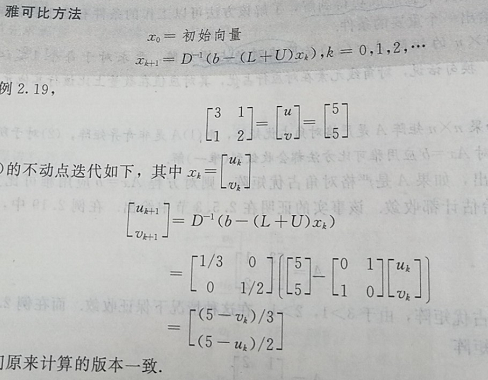
高斯赛的尔 用的我蓝色标识的字:
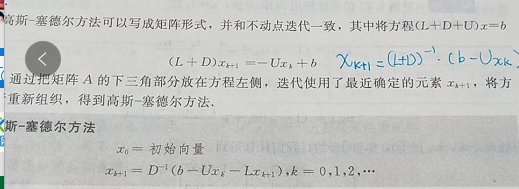
import numpy as np

class GMatrix:

    @staticmethod

    def Invert(matrix):

        nm = np.linalg.inv(matrix.mmatrix)

        gm = GMatrix()

        gm.assignNumPyMatrix(nm)

        return gm

    def __init__(self, nx=0, ny=0):

        self.rows = nx

        self.columns = ny

        self.mmatrix = np.matrix(np.zeros((nx, ny)))

    def assignNumPyMatrix(self, matrix):

        self.mmatrix = matrix

    def changeShape(self, nx, ny):

        self.mmatrix = np.matrix(np.zeros((nx, ny)))

    def debug(self):

        print("{\n", ">>SHAPE:", (self.mmatrix.shape))

        print(self.mmatrix)

        print('}\n')

    def numPyMatrix(self):

        return self.mmatrix

    def set(self, i, j, var):

        self.mmatrix[i - 1, j - 1] = var

    def get(self, i, j):

        return self.mmatrix[i - 1, j - 1]

    def L(self):

        n = self.rows

        m = GMatrix(n, n)

        for j in range(1, n, 1):

            for i in range(j + 1, n + 1):

                # print(i, j)

                m.set(i, j, self.get(i, j))

        return m

    def U(self):

        n = self.rows

        m = GMatrix(n, n)

        for i in range(1, n + 1, 1):

            for j in range(i + 1, n + 1):

                m.set(i, j, self.get(i, j))

        return m

    def D(self):

        """

        this matrix diagonal values

        1,make a empty matrix

        2,copy diagonal value to this empty matrix

        """

        n = self.rows

        m = GMatrix(n, n)

        for i in range(self.rows):

            index = i + 1

            m.set(index, index, self.get(index, index))

        return m

    def DInvert(self):

        """

        invert diagonal matrix !

        :return:

        """

        n = self.rows

        m = GMatrix(n, n)

        for i in range(n):

            index = i + 1

            m.set(index, index, 1 / self.get(index, index))

        return m

    def __mul__(self, other):

        nm = self.mmatrix * other.mmatrix  # USE NumPy matrix * matrix

        m = GMatrix()

        m.assignNumPyMatrix(nm)

        return m

    def __add__(self, other):

        nm = self.mmatrix + other.mmatrix  # USE NumPy matrix + matrix

        m = GMatrix()

        m.assignNumPyMatrix(nm)

        return m

    def __sub__(self, other):

        nm = self.mmatrix - other.mmatrix  # USE NumPy matrix - matrix

        m = GMatrix()

        m.assignNumPyMatrix(nm)

        return m

def Jacobi_Solver(x0, L, U, invertD, b,iter =20):

    """

    x0   = INIT_VECTOR_VALUE

    xk+1 = Inv(D)*[ b-(L+U)xk ]  ,k = 0,1,2,......

    :return:

    """

    nextX = x0

    for x in range(iter):

        nextX = invertD * (b - (L + U) * nextX)

    return nextX

def Gauss_Seidel_Solver(x0, L, U, D, b,iter =10):

    """

    xk+1 = inv(L+D) * (b- U*xk)

    """

    nextX = x0

    for x in range(iter):

        nextX = GMatrix.Invert(L+D) * (b - U * nextX)

    return nextX

def unit_test_matrix():

    m = GMatrix(2, 2)

    m.set(1, 1, 3)

    m.set(1, 2, 1)

    m.set(2, 1, 1)

    m.set(2, 2, 2)

    # and also can this

    # m.numPyMatrix()[0, 0] = 3

    # m.numPyMatrix()[0, 1] = 1

    # m.numPyMatrix()[1, 0] = 1

    # m.numPyMatrix()[1, 1] = 2

    m.debug()

    m.D().debug()

    m.L().debug()

    m.U().debug()

    m.DInvert().debug()

def unit_test_jacobi():

    """

    |  3 1  |   |u|      |5|

    |       |   | |   =  | |

    |  1 2  |   |v|      |5|

    --------

    AX = b

    --------

    :return:

    """

    # CONSTRUCT THE A MATRIX

    A = GMatrix(2, 2)

    A.set(1, 1, 3)  # A11 = 3

    A.set(1, 2, 1)  # A12 = 1

    A.set(2, 1, 1)  # A21 = 1

    A.set(2, 2, 2)  # A22 = 2

    #A.debug()

    # CONSTRUCT THE b vector

    b = GMatrix(2, 1)

    b.set(1, 1, 5)

    b.set(2, 1, 5)

    # INIT zero vector to iter

    x0 = GMatrix(2,1) # [0,0]T vector initialize

    invert_D = A.DInvert()

    L = A.L()

    U = A.U()

    print("get the jacobi result ")

    Jacobi_Solver(x0,L,U,invert_D,b).debug()

def unit_test_Gauss_Seidel():

    """

        |  3 1  |   |u|      |5|

        |       |   | |   =  | |

        |  1 2  |   |v|      |5|

        --------

        AX = b

        --------

        :return:

        """

    # CONSTRUCT THE A MATRIX

    A = GMatrix(2, 2)

    A.set(1, 1, 3)  # A11 = 3

    A.set(1, 2, 1)  # A12 = 1

    A.set(2, 1, 1)  # A21 = 1

    A.set(2, 2, 2)  # A22 = 2

    # CONSTRUCT THE b vector

    b = GMatrix(2, 1)

    b.set(1, 1, 5)

    b.set(2, 1, 5)

    # INIT zero vector to iter

    x0 = GMatrix(2, 1)  # [0,0]T vector initialize

    D = A.D()

    L = A.L()

    U = A.U()

    print("get the Gauss_Seidel result ")

    Gauss_Seidel_Solver(x0, L, U, D, b).debug()

unit_test_jacobi()

unit_test_Gauss_Seidel()
4,楚列斯基分解choleskyDecomposition
这类情况只适合于正定矩阵。
楚列斯基分解的目的就是将正定矩阵分解成A = transpose(R) * R .
求解方程组直接使用回代法即可求出向量解,

这类方法不是迭代法,最重要的是分解矩阵.
所以是要求出来这个上三角矩阵R,比如分解如下矩阵:
[[  4.  -2.   2.]

 [ -2.   2.  -4.]

 [  2.  -4.  11.]]
import numpy as np

import math

class GMatrix:

    def __init__(self, shape):

        self.nn = shape

        self.Mat = np.zeros((shape, shape))

    def setRawData(self, *args):

        if len(args) != self.nn * self.nn:

            raise ValueError

        deserialize = []

        for i in range(self.nn):

            rhtmp = []

            for j in range(self.nn):

                rhtmp.append(args[i * self.nn + j])

            deserialize.append(rhtmp)

        self.tupleToMatrix(deserialize)

    def tupleToMatrix(self, tupleObj):

        """

        :param tupleObj: ([1,2],[3,4])

        will set matrix above tuple obj

        """

        for i in range(self.nn):

            # get row data of args

            row_data = tupleObj[i]

            for j in range(self.nn):

                self.Mat[i, j] = row_data[j]

    def setRowsData(self, *args):

        if len(args) != self.nn:

            raise ValueError

        self.tupleToMatrix(args)

    def __str__(self):

        return str(self.Mat)

    def divideConstant(self, var):

        self.Mat[:, :] = self.Mat[:, :] / var

    def __add__(self, other):

        self.Mat[:, :] = self.Mat[:, :] + other.mat[:, :]

    def __sub__(self, other):

        self.Mat[:, :] = self.Mat[:, :] - other.mat[:, :]

    def nextLayer(self):

        array = self.Mat[1:, 1:]

        m = GMatrix(a.Mat.shape[0])

        m.Mat = array

        return m

    def getupu(self):

        self.Mat = np.triu(self.Mat)

        return self

def choleskyDecomposition(op=GMatrix(2)):

    """ DEFINE MATRIX:

    R11 R12 ... R1n

    R21 R22 ... R2n

     .   .       .

     .   .       .

    Rn1 Rn2 ... Rnn

    """

    if len(op.Mat.flatten()) == 1:

        op.Mat[op.nn - 1:, op.nn - 1:] = np.sqrt(op.Mat[op.nn - 1:, op.nn - 1:])

        return

    # First make the matrix A11 to sqrt(A11)

    op.Mat[0, 0] = math.sqrt(op.Mat[0, 0])  # R11

    op.Mat[0, 1:] = op.Mat[0, 1:] / op.Mat[0,0]  # (R12 R13 .... R1n) = (R12 R13 ...R1n) / R11

    # cal u.transpose(u)

    u   = np.matrix(op.Mat[0,1:])      # it's a row vector

    ut  = np.transpose(u)              # it's a column vector

    uut = ut*u

    # extract_layer - uut

    op.Mat[1:,1:] = op.Mat[1:,1:] - uut

    choleskyDecomposition(op.nextLayer())

a = GMatrix(3)

a.setRawData(4, -2, 2, -2, 2, -4, 2, -4, 11)

print(a)

choleskyDecomposition(a)

print(a.getupu())
分解结果R:
[[ 2. -1.  1.]

 [ 0.  1. -3.]

 [ 0.  0.  1.]]
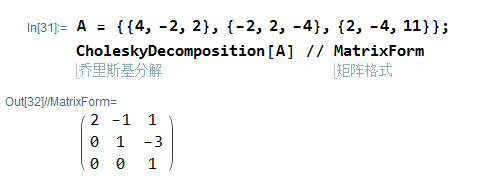
Mathematica 检查结果:
5,共轭梯度法:
6,预条件共轭梯度法:
BVP:
差分法比较简单略.
排列法求解BVP问题:
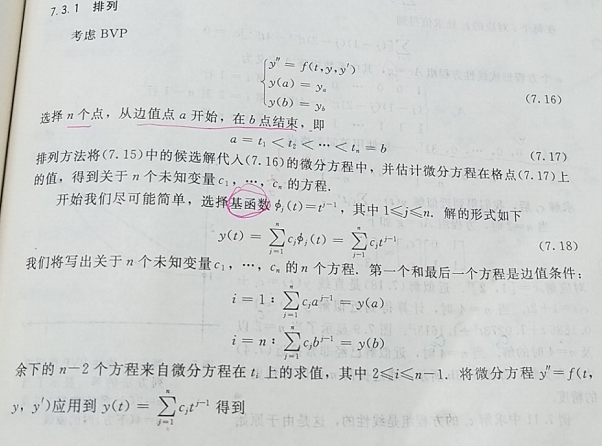
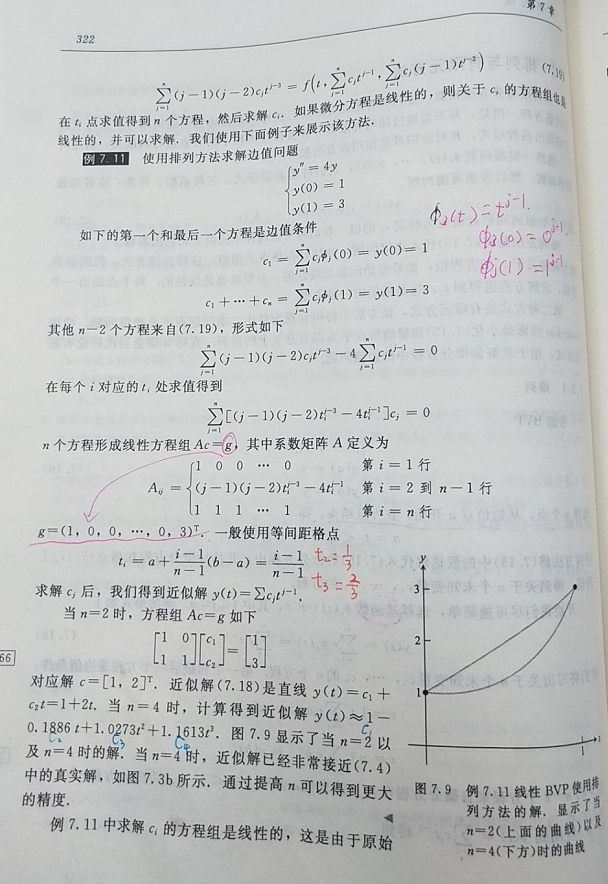
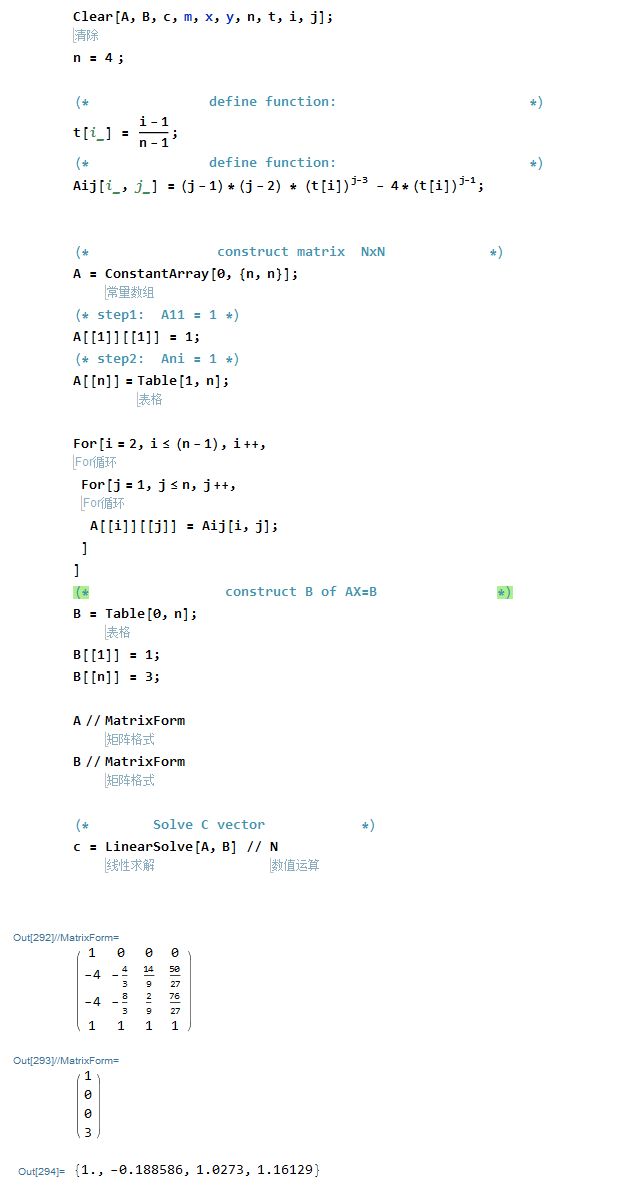
如下例,n=2书中已经给答案,n=4的矩阵未给出,顺便自己解下矩阵n=4的情况。
算出c1,c2,c3,c4:
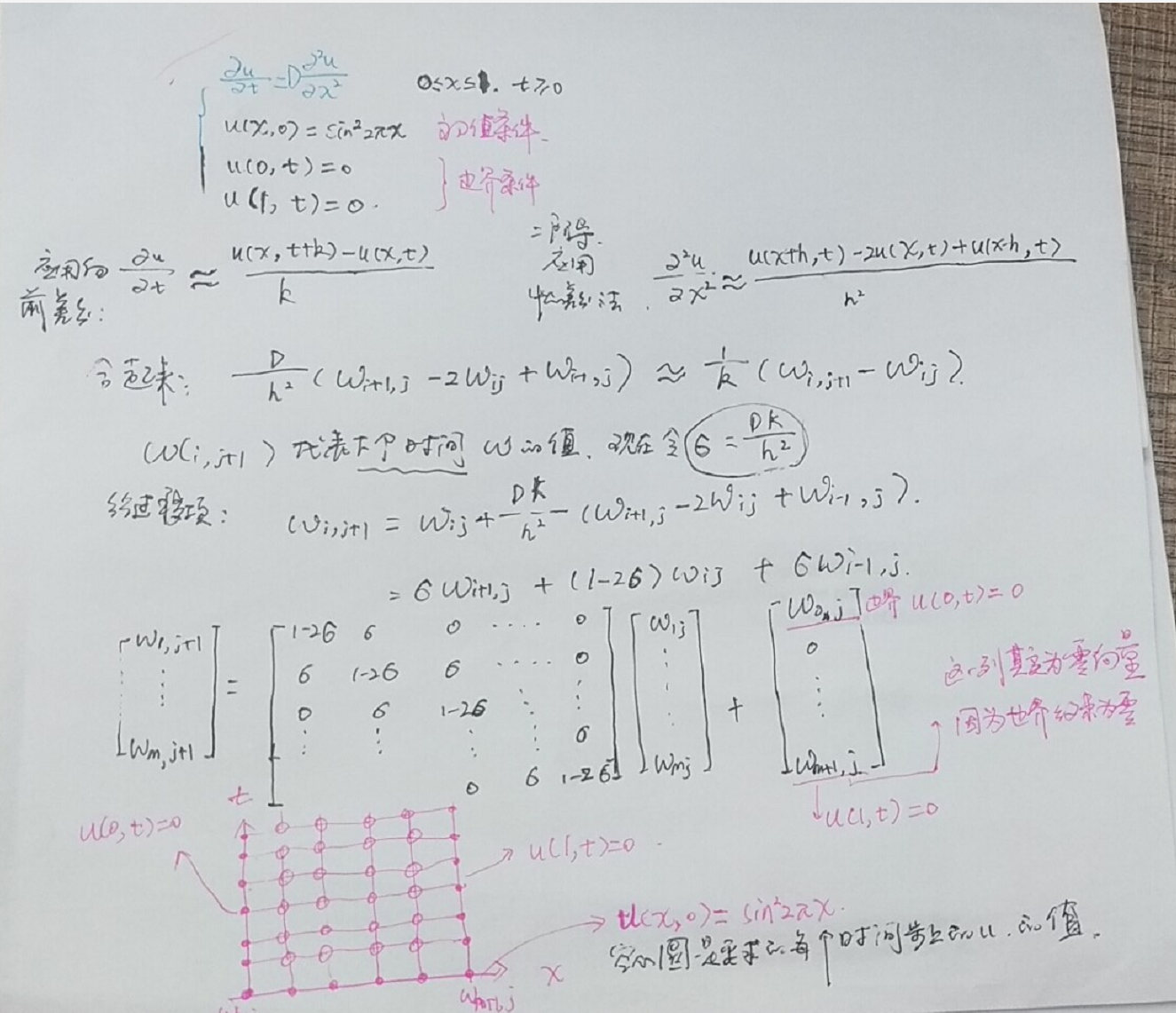
PDE 解热方程:
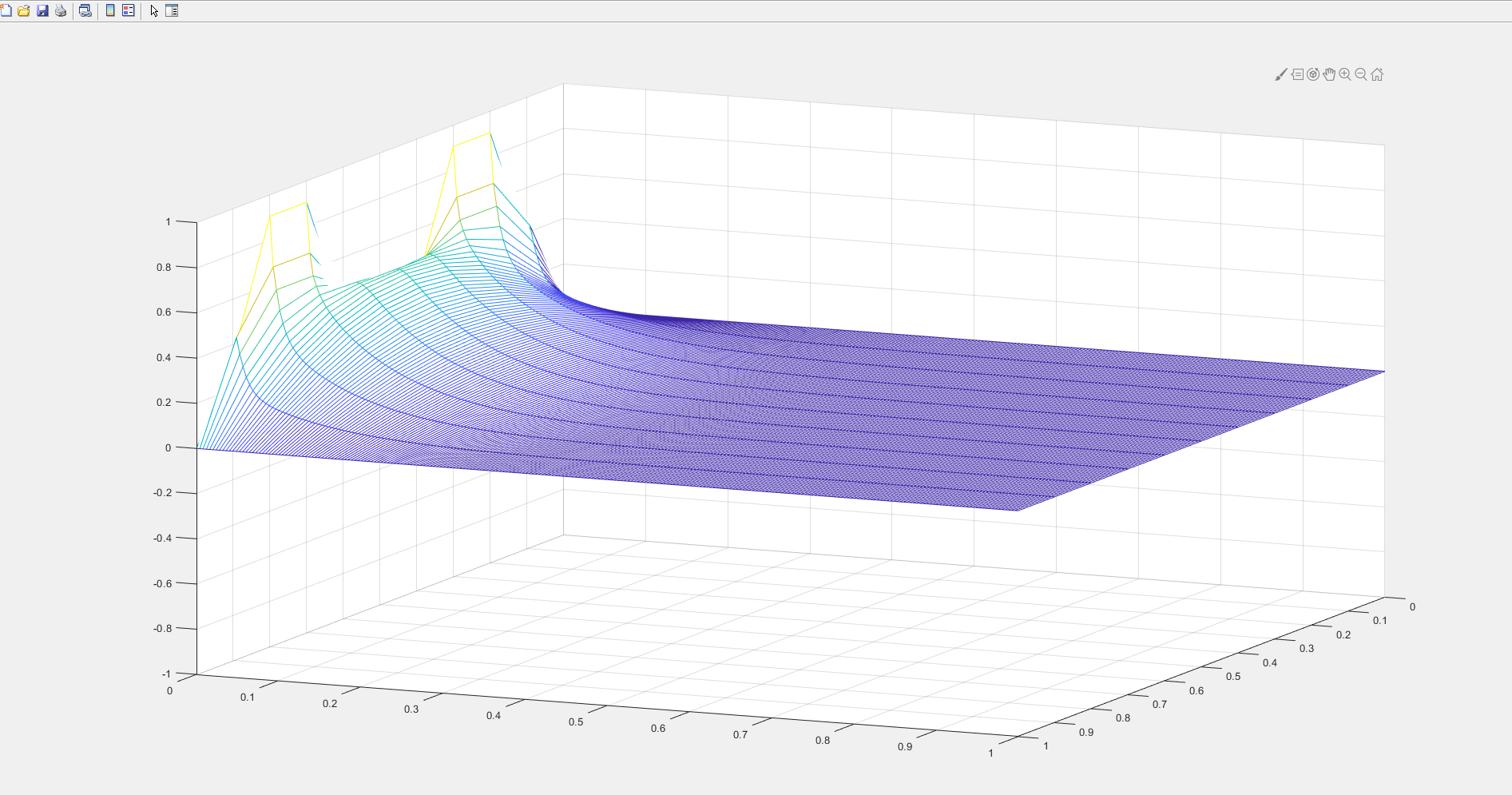
这次将时间方向放入坐标轴,可以用三维图像直接看到 在时间步上,热方程是如何传递的.
clc;

clear w a b c d M N f l r m sigma ;

xl = 0;

xr = 1;

yb = 0;

yt = 1;

M = 10;

N = 250;

f = @(x) sin(2*pi*x).^2;

l = @(t) 0*t;

r = @(t) 0*t;

D =1;

h = (xr-xl) / M

k = (yt-yb) / N

m = M -1;

n=N;

sigma = D*k/(h*h);

lside = l(yb+(0:n)*k);

rside = r(yb+(0:n)*k);

% 定义矩阵a

a = diag(1-2*sigma*ones(m,1));

a = a + diag(sigma*ones(m-1,1),1);  %自身加上  往右offset 1列 sigma倍数

a = a + diag(sigma*ones(m-1,1),-1); %自身加上  往左偏移 1列sigma倍数

a

% 设置w第一列 ,初值条件,注意 要转置,因为 设置 w的第一列向量

w(:,1) = f(xl + (1:m) * h)'

disp('START FOR LOOP')

% 给w 在时间250 迭代成列向量,则w是251列向量

for j = 1:n

    rhs = w(:,1)';

    w(:,j+1) = a*w(:,j) ;

end

disp('END FOR LOOP')

w = [lside;w;rside];

x = (0:m+1)*h; t= (0:n)*k;

mesh(x,t,w')

view(60,30);

axis([xl xr yb yt -1 1]);
Numerical Analysis的更多相关文章
- 为什么要学习Numerical Analysis
前几日我发了一个帖子,预告自己要研究一下 Numerical Analysis 非常多人问我为啥,我统一回答为AI-----人工智能 我在和教授聊天的时候,忽然到了语言发展上 我说:老S啊(和我关系 ...
- <<Numerical Analysis>>笔记
2ed, by Timothy Sauer DEFINITION 1.3A solution is correct within p decimal places if the error is l ...
- <Numerical Analysis>(by Timothy Sauer) Notes
2ed, by Timothy Sauer DEFINITION 1.3A solution is correct within p decimal places if the error is l ...
- Residual (numerical analysis)
In many cases, the smallness of the residual means that the approximation is close to the solution, ...
- List of numerical libraries,Top Numerical Libraries For C#
Top Numerical Libraries For C# AlgLib (http://alglib.net) ALGLIB is a numerical analysis and data pr ...
- dir命令只显示文件名
dir /b 就是ls -f的效果 1057 -- FILE MAPPING_web_archive.7z 2007 多校模拟 - Google Search_web_archive.7z 2083 ...
- OpenCASCADE Gauss Integration
OpenCASCADE Gauss Integration eryar@163.com Abstract. Numerical integration is the approximate compu ...
- 【原创】开源Math.NET基础数学类库使用(06)直接求解线性方程组
本博客所有文章分类的总目录:[总目录]本博客博文总目录-实时更新 开源Math.NET基础数学类库使用总目录:[目录]开源Math.NET基础数学类库使用总目录 前言 ...
- RapidJSON 代码剖析(四):优化 Grisu
我曾经在知乎的一个答案里谈及到 V8 引擎里实现了 Grisu 算法,我先引用该文的内容简单介绍 Grisu.然后,再谈及 RapidJSON 对它做了的几个底层优化. (配图中的<Grisù& ...
随机推荐
- Spring缓存注解@Cacheable、@CacheEvict、@CachePut使用(转)
原文地址:https://www.cnblogs.com/fashflying/p/6908028.html 从3.1开始,Spring引入了对Cache的支持.其使用方法和原理都类似于Spring对 ...
- Python操作Excel 之 openpyxl
一.基础 安装openpyxl 模块 pip install openpyxl 或者通过轮子安装 font(字体类):字号.字体颜色.下划线等 fill(填充类):颜色等 border(边框类):设置 ...
- DAY25、面向对象总复习
面向对象总复习:面向过程编程思想: 核心是 过程 二字, 过程指的是解决问题的步骤是,即先干什么再干什么. 基于该编程思想编写程序,相当于一条流水线,一种机械式的思维方式. 面向对象编程思想: 核心是 ...
- Manjaro折腾简单记录
0.Manjaro启动U盘的制作 推荐使用4-16G容量的U盘,避免兼容性问题(U盘太大可能会无法启动). 用rufus就可以,注意选用DD模式才能成功制作. 如果在linux环境里,先用sudo f ...
- Oracle篇 之 数据操作
一.DML 数据操作语言(Data Manipulation Language) 1.insert insert into student values(1,'briup1',20,'Male'); ...
- (简单)华为Nova青春 WAS-AL00的USB调试模式在哪里开启的流程
就在我们使用Pc接通安卓手机的时候,如果手机没有开启usb开发者调试模式,Pc则无办法成功检测到我们的手机,在一些情况下,我们使用的一些功能较强的app好比之前我们使用的一个app引号精灵,老版本就需 ...
- 【CSA72G】【XSY3316】rectangle 线段树 最小生成树
题目大意 有一个 \(n\times n\) 的矩阵 \(A\).最开始 \(A\) 中每个元素的值都为 \(0\). 有 \(m\) 次操作,每次给你 \(x_1,x_2,y_1,y_2,w\),对 ...
- emwin之创建窗口与窗口回调函数的句柄是一致的
@2019-04-28 [小记] 由函数GUI_CreateDialogBox 创建的窗口所返回的句柄与回调函数形参中的窗口句柄参数是一样的
- MySQL逻辑备份into outfile
MySQL 备份之 into outfile 逻辑数据导出(备份) 用法: select xxx into outfile '/path/file' from table_name; mysql> ...
- Flexbox(弹性盒模型)完全指南
Flexbox(弹性盒模型)布局完全指南 Github:sueRimn 来源:A guide to Flexbox 这个指南讲诉了flexbox的所有内容,重点介绍了父元素(flex容器)和子元素(f ...