
一次Spring Transactional嵌套事务使用不同的rollbackFor的分析
起因:
项目期间由于一次异常回滚问题,发现自己在事务知识方面知识的遗漏,趁着这次机会,做了几次rollbackFor的测试。
测试:
现在有两个事务,事务oute包含事务Inner。事务A回滚规则是当事务抛出TestException,其中TestException继承RunTimeException。事务B的回滚规则是事务抛RuntimeException。事务的传播方式都是使用的默认,即 Propagation.REQUIRED。如以下代码:
     @Override

     @Transactional(rollbackFor = TestException.class)

     public void transOuter() {

         productMapper.updateOrderQuantityPessimistic(product_code1);

         ((ProductService) AopContext.currentProxy()).transInner();

     }

     @Transactional(rollbackFor = Exception.class)

     public void transInner() {

         productMapper.updateOrderQuantityPessimistic(product_code);

         if (true) {

             throw new RuntimeException();

         }

     }
以下为TestException的代码。
 public class TestException extends RuntimeException {

     public TestException(String message) {

         super(message);

     }

 }
一开始按照自己对事务的理解, 默认的传播属性之下。事务B启动的时候,会默认使用事务A的rollbackFor来进行回滚,所以该代码运行时候。程序不会回滚。
然而测试,测试完之后发现事务A、B都进行了回滚。
看着测试结果产生了疑问。难道是以innner的rollBack为准?接着进行测试。
     @Override

     @Transactional(rollbackFor = Exception.class)

     public void transOuter() {

         productMapper.updateOrderQuantityPessimistic(product_code1);

         ((ProductService) AopContext.currentProxy()).transInner();

     }

     @Transactional(rollbackFor = TestException.class)

     public void transInner() {

         productMapper.updateOrderQuantityPessimistic(product_code);

         if (true) {

             throw new RuntimeException();

         }

     }
再次测试,测试完之后发现事务A、B依然进行了回滚。
感觉自己对事务的理解还是太浅薄了,是时候debug一波源码。
分析源码:
查看 org.springframework.transaction.interceptor.TransactionAspectSupport 类的 invokeWithinTransaction方法。该方法是事务执行的主要方法,这里我们主要看第20行的事务捕捉那一块。completeTransactionAfterThrowing的方法。
     protected Object invokeWithinTransaction(Method method, Class<?> targetClass, final InvocationCallback invocation)

             throws Throwable {

         // If the transaction attribute is null, the method is non-transactional.

         final TransactionAttribute txAttr = getTransactionAttributeSource().getTransactionAttribute(method, targetClass);

         final PlatformTransactionManager tm = determineTransactionManager(txAttr);

         final String joinpointIdentification = methodIdentification(method, targetClass);

         if (txAttr == null || !(tm instanceof CallbackPreferringPlatformTransactionManager)) {

             // Standard transaction demarcation with getTransaction and commit/rollback calls.

             TransactionInfo txInfo = createTransactionIfNecessary(tm, txAttr, joinpointIdentification);

             Object retVal = null;

             try {

                 // This is an around advice: Invoke the next interceptor in the chain.

                 // This will normally result in a target object being invoked.

                 retVal = invocation.proceedWithInvocation();

             }

             catch (Throwable ex) {

                 // 事务异常捕捉主要在这边获取

                 completeTransactionAfterThrowing(txInfo, ex);

                 throw ex;

             }

             finally {

                 cleanupTransactionInfo(txInfo);

             }

             commitTransactionAfterReturning(txInfo);

             return retVal;

         }

         else {

             // It's a CallbackPreferringPlatformTransactionManager: pass a TransactionCallback in.

             try {

                 Object result = ((CallbackPreferringPlatformTransactionManager) tm).execute(txAttr,

                         new TransactionCallback<Object>() {

                             @Override

                             public Object doInTransaction(TransactionStatus status) {

                                 TransactionInfo txInfo = prepareTransactionInfo(tm, txAttr, joinpointIdentification, status);

                                 try {

                                     return invocation.proceedWithInvocation();

                                 }

                                 catch (Throwable ex) {

                                     if (txAttr.rollbackOn(ex)) {

                                         // A RuntimeException: will lead to a rollback.

                                         if (ex instanceof RuntimeException) {

                                             throw (RuntimeException) ex;

                                         }

                                         else {

                                             throw new ThrowableHolderException(ex);

                                         }

                                     }

                                     else {

                                         // A normal return value: will lead to a commit.

                                         return new ThrowableHolder(ex);

                                     }

                                 }

                                 finally {

                                     cleanupTransactionInfo(txInfo);

                                 }

                             }

                         });

                 // Check result: It might indicate a Throwable to rethrow.

                 if (result instanceof ThrowableHolder) {

                     throw ((ThrowableHolder) result).getThrowable();

                 }

                 else {

                     return result;

                 }

             }

             catch (ThrowableHolderException ex) {

                 throw ex.getCause();

             }

         }

     }
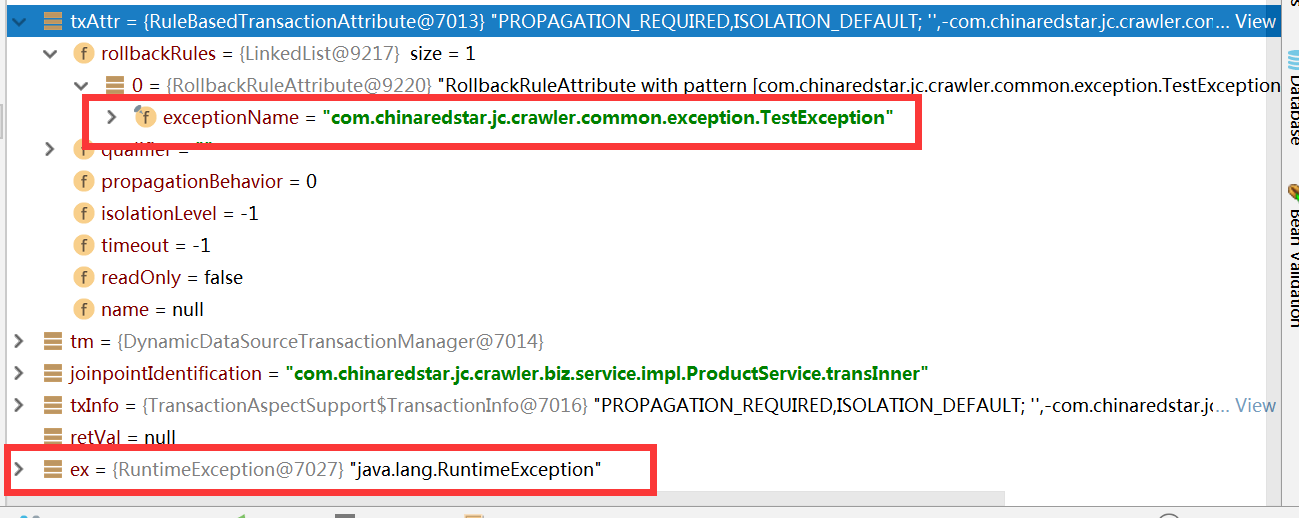
这边显示当事务的rollbackFor为TestException,而抛出的异常为RunTimeException时候。跟我们的transInner一致。接着往下看 completeTransactionAfterThrowing 方法。主要看第8行,第8行对事务进行判断,是否对该抛出的异常进行回滚。
 protected void completeTransactionAfterThrowing(TransactionAspectSupport.TransactionInfo txInfo, Throwable ex) {

         if (txInfo != null && txInfo.hasTransaction()) {

             if (logger.isTraceEnabled()) {

                 logger.trace("Completing transaction for [" + txInfo.getJoinpointIdentification() +

                         "] after exception: " + ex);

             }

             //这里主要判断事务捕获了异常以后,是否进行回滚

             if (txInfo.transactionAttribute.rollbackOn(ex)) {

                 try {

                     txInfo.getTransactionManager().rollback(txInfo.getTransactionStatus());

                 }

                 catch (TransactionSystemException ex2) {

                     logger.error("Application exception overridden by rollback exception", ex);

                     ex2.initApplicationException(ex);

                     throw ex2;

                 }

                 catch (RuntimeException ex2) {

                     logger.error("Application exception overridden by rollback exception", ex);

                     throw ex2;

                 }

                 catch (Error err) {

                     logger.error("Application exception overridden by rollback error", ex);

                     throw err;

                 }

             }

             else {

                 // We don't roll back on this exception.

                 // Will still roll back if TransactionStatus.isRollbackOnly() is true.

                 try {

                     txInfo.getTransactionManager().commit(txInfo.getTransactionStatus());

                 }

                 catch (TransactionSystemException ex2) {

                     logger.error("Application exception overridden by commit exception", ex);

                     ex2.initApplicationException(ex);

                     throw ex2;

                 }

                 catch (RuntimeException ex2) {

                     logger.error("Application exception overridden by commit exception", ex);

                     throw ex2;

                 }

                 catch (Error err) {

                     logger.error("Application exception overridden by commit error", ex);

                     throw err;

                 }

             }

         }

     }
再深入点进去看,看到第11行,这边获取该异常的深度。跳转到片段二进行代码查看。
     public boolean rollbackOn(Throwable ex) {

         if (logger.isTraceEnabled()) {

             logger.trace("Applying rules to determine whether transaction should rollback on " + ex);

         }

         RollbackRuleAttribute winner = null;

         int deepest = Integer.MAX_VALUE;

         if (this.rollbackRules != null) {

             for (RollbackRuleAttribute rule : this.rollbackRules) {

                 //获取异常的深度?

                 int depth = rule.getDepth(ex);

                 if (depth >= 0 && depth < deepest) {

                     deepest = depth;

                     winner = rule;

                 }

             }

         }

         if (logger.isTraceEnabled()) {

             logger.trace("Winning rollback rule is: " + winner);

         }

         // User superclass behavior (rollback on unchecked) if no rule matches.

         if (winner == null) {

             logger.trace("No relevant rollback rule found: applying default rules");

             //如果depth为-1之后,父类的回滚方式

             return super.rollbackOn(ex);

         }

         return !(winner instanceof NoRollbackRuleAttribute);

     }
根据深度代码查看,rollbackFor和抛出异常ex不一致,返回-1。再回去看上面的代码片段,当返回-1之后,代码走到第28行。进行父类的回滚方法。
     private int getDepth(Class<?> exceptionClass, int depth) {

         if (exceptionClass.getName().contains(this.exceptionName)) {

             // Found it!

             return depth;

         }

         // If we've gone as far as we can go and haven't found it...

         //此处RuntimeException 跟TestException不一致,返回-1

         if (exceptionClass == Throwable.class) {

             return -1;

         }

         return getDepth(exceptionClass.getSuperclass(), depth + 1);

     }
以下是父类的代码是否回滚判断方法,有没有很眼熟,只要抛出的异常的是RunTimeExcpetion或者Error则进行回滚。
     public boolean rollbackOn(Throwable ex) {

         return (ex instanceof RuntimeException || ex instanceof Error);

     }
总结
根据上面的代码,我们可以推断出以下几个结论:
1、当我们抛出的异常为RunTime及其子类或者Error和其子类的时候。不论rollbackFor的异常是啥,都会进行事务的回滚。
2、当我们抛出的异常不是RunTime及其子类或者Error和其子类的时候,必须根据rollbackfor进行回滚。比如rollbackfor=RuntimeException,而抛出IOException时候,事务是不进行回滚的。
3、当我们抛出的异常不是RunTime及其子类或者Error和其子类的时候,如果嵌套事务中,只要有一个rollbackfor允许回滚,则整个事务回滚。
经过测试,上述的结论也没发现什么问题。
一次Spring Transactional嵌套事务使用不同的rollbackFor的分析的更多相关文章
- 数据库事务中的隔离级别和锁+spring Transactional注解
数据库事务中的隔离级别和锁 数据库事务在后端开发中占非常重要的地位,如何确保数据读取的正确性.安全性也是我们需要研究的问题.ACID首先总结一下数据库事务正确执行的四个要素(ACID): 原子性(At ...
- How does Spring @Transactional Really Work?--转
原文地址:http://blog.jhades.org/how-does-spring-transactional-really-work/ In this post we will do a dee ...
- Spring @Transactional使用的示例
Spring @Transactional使用的示例: 参考: http://blog.csdn.net/seng3018/article/details/6690527 http://blog.si ...
- Spring @Transactional 使用
Spring @Transactional是Spring提供的一个声明式事务,对代码的侵入性比较小,只需考虑业务逻辑,不需要把事务和业务搞混在一起. @Transactional 可以注解在inter ...
- Java:Spring @Transactional工作原理
本文将深入研究Spring的事务管理.主要介绍@Transactional在底层是如何工作的.之后的文章将介绍: propagation(事务传播)和isolation(隔离性)等属性的使用 事务使用 ...
- spring @Transactional 事务注解
@Transactional(propagation = Propagation.REQUIRED, isolation = Isolation.SERIALIZABLE, rollbackFor = ...
- Spring @Transactional (一)
Spring @Transactional (一) 博客分类: JAVA SpringJPAJDBCUPSQL Spring事务的传播行为 在service类前加上@Transactional,声明 ...
- [转]数据库事务中的隔离级别和锁+spring Transactional注解
数据库事务中的隔离级别和锁 数据库事务在后端开发中占非常重要的地位,如何确保数据读取的正确性.安全性也是我们需要研究的问题.ACID首先总结一下数据库事务正确执行的四个要素(ACID): 原子性(At ...
- 25.Spring @Transactional工作原理
转自:http://www.importnew.com/12300.html 本文将深入研究Spring的事务管理.主要介绍@Transactional在底层是如何工作的.之后的文章将介绍: prop ...
随机推荐
- Hive SQL之分区表与分桶表
Hive sql是Hive 用户使用Hive的主要工具.Hive SQL是类似于ANSI SQL标准的SQL语言,但是两者有不完全相同.Hive SQL和Mysql的SQL方言最为接近,但是两者之间也 ...
- 70. SequenceInputStream(文件合并)
缓冲输入字节流:----------------------| InputStream 输入字节流的基类----------------| FileInputStream 读取文件的输入字节流--- ...
- Dart编程实例 - HelloWorld
Dart编程实例 - HelloWorld void main() { print('hello world'); } 本文转自:http://codingdict.com/article/23399
- bzoj 2561
传送门:http://www.lydsy.com/JudgeOnline/problem.php?id=2561 考虑做mst的时候,什么时候这条边不在这棵mst上呢? 就是比他小的权值的边讲这条边的 ...
- python内置模块-random
print(random.randint(1,10)) 生成随机整数,下限必须小于上限print(random.randrange(1,10)) 生成随机整数,参数为([start],stop,[st ...
- PHP fpassthru() 函数
定义和用法 fpassthru() 函数输出文件指针处的所有剩余数据. 该函数将给定的文件指针从当前的位置读取到 EOF,并把结果写到输出缓冲区. 语法 fpassthru(file) 参数 描述 f ...
- f-li.cn
package org.rx.service.command.impl; import lombok.Getter; import lombok.Setter; import org.rx.core. ...
- Openstack组件部署 — Nova overview
目录 目录 前文列表 前言 Compute service overview Nova 的组件 nova-api service nova-api-metadata service nova-comp ...
- 浅谈HP-Socket在物联网的应用
原文链接:https://my.oschina.net/chrisforbt/blog/1669746 一.应用背景 去年公司成立了个项目——<智慧用电安全隐患监管服务平台>,计划是开发一 ...
- 18、Page Object 设计模式
Page Object 设计模式的优点如下: 减少代码的重复. 提高测试用例的可读性. 提高测试用例的可维护性, 特别是针对 UI 频繁变化的项目. 当你针对网页编写测试时,你需要引用该网页中的元素, ...