
Scala与Mongodb实践3-----运算环境的搭建
目的:使的在IDEA中编辑代码,令代码实现mongodb运算,且转换较为便捷
- 由实验2可知,运算环境的搭建亦需要对数据进行存储和计算,故需要实现类型转换,所以在实验2的基础上搭建环境。
- 由菜鸟教程可得到mongodb命令的具体格式等,如:新建集合
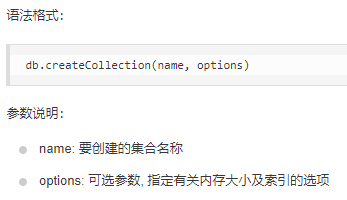
==》可以新建:
case class CreateCollection(name:String,options:Options[Any]=None) //其他的mongodb命令也是照着这样建立的
由org.mongodb.scala.model.Filters可知Filters内的相关方法的返回类型都是Bson。例子如下:
 /**

   * Creates a filter that matches all documents where the value of the given field is greater than the specified value.

   *

   * @param fieldName the field name

   * @param value the value

   * @tparam TItem the value type

   * @return the filter

   * @see [[http://docs.mongodb.org/manual/reference/operator/query/gt \$gt]]

   */

  def gt[TItem](fieldName: String, value: TItem): Bson = JFilters.gt(fieldName, value)

  /**

   * Creates a filter that matches all documents where the value of the given field is less than the specified value.

   *

   * @param fieldName the field name

   * @param value the value

   * @tparam TItem the value type

   * @return the filter

   * @see [[http://docs.mongodb.org/manual/reference/operator/query/lt \$lt]]

   */

  def lt[TItem](fieldName: String, value: TItem): Bson = JFilters.lt(fieldName, value)
根据相关语法格式,可新建
case class Count(filter: Option[Bson], options: Option[Any])
- 执行相关命令需要引入数据库和集合,新建MGOContext.scala
case class MGOContext(

                       dbName:String,

                       collName:String,

                       action:MGOCommands=null

                     ){ctx=>

  def setDbName(name:String):MGOContext=ctx.copy(dbName=name)

  def setCollName(name:String):MGOContext=ctx.copy(collName=name)

  def setCommand(cmd:MGOCommands):MGOContext=ctx.copy(action=cmd)

}

object MGOContext {

  def apply(db:String,coll:String) = new MGOContext(db,coll)

  def apply(

             db: String,

             coll: String,

             action: MGOCommands = null

           ): MGOContext = new MGOContext(db, coll, action)

}
- 分别新建相关的数据库操作,新建MGOCommands.scala和MGOAdmins.scala
//MGOAdmins.scala

import org.bson.conversions.Bson

object MGOAdmins {

  case class DropCollection(collName: String) extends MGOCommands

  case class CreateCollection(collName: String, options: Option[Any] = None) extends MGOCommands

  case class ListCollection(dbName: String) extends MGOCommands

  case class CreateView(viewName: String, viewOn: String, pipeline: Seq[Bson], options: Option[Any] = None) extends MGOCommands

  case class CreateIndex(key: Bson, options: Option[Any] = None) extends MGOCommands

  case class DropIndexByName(indexName: String, options: Option[Any] = None) extends MGOCommands

  case class DropIndexByKey(key: Bson, options: Option[Any] = None) extends MGOCommands

  case class DropAllIndexes(options: Option[Any] = None) extends MGOCommands

}

//MGOCommands.scala

import org.mongodb.scala.{Document, FindObservable}

import org.mongodb.scala.bson.conversions.Bson

import org.mongodb.scala.model.WriteModel

trait MGOCommands

object MGOCommands {

   case class Count(filter: Option[Bson], options: Option[Any]) extends MGOCommands

  case class Distict(fieldName: String, filter: Option[Bson]) extends MGOCommands

  case class Find[M](filter: Option[Bson] = None,

                     andThen: Option[FindObservable[Document] => FindObservable[Document]]= None,

                     converter: Option[Document => M] = None,

                     firstOnly: Boolean = false) extends MGOCommands

  case class Aggregate(pipeLine: Seq[Bson]) extends MGOCommands

  case class MapReduce(mapFunction: String, reduceFunction: String) extends MGOCommands

  case class Insert(newdocs: Seq[Document], options: Option[Any] = None) extends MGOCommands

  case class Delete(filter: Bson, options: Option[Any] = None, onlyOne: Boolean = false) extends MGOCommands

  case class Replace(filter: Bson, replacement: Document, options: Option[Any] = None) extends MGOCommands

  case class Update(filter: Bson, update: Bson, options: Option[Any] = None, onlyOne: Boolean = false) extends MGOCommands

  case class BulkWrite(commands: List[WriteModel[Document]], options: Option[Any] = None) extends MGOCommands

}
- 综上所述,具体实现相关的操作
import org.mongodb.scala.{Document, MongoClient}

import org.mongodb.scala.model.{BulkWriteOptions, CountOptions, CreateCollectionOptions, CreateViewOptions, DeleteOptions, DropIndexOptions, IndexOptions, InsertManyOptions, InsertOneOptions, UpdateOptions}

import scala.concurrent.Future

object MGOEngine{

  import MGOAdmins._

  import MGOCommands._

  def DAO[T](ctx: MGOContext)(implicit client: MongoClient): Future[T] = {

    val db = client.getDatabase(ctx.dbName)

    val coll = db.getCollection(ctx.collName)

    ctx.action match {

      case Count(Some(filter), Some(opt)) =>

        coll.count(filter, opt.asInstanceOf[CountOptions])

          .toFuture().asInstanceOf[Future[T]]

      case Count(Some(filter), None) =>

        coll.count(filter).toFuture()

          .asInstanceOf[Future[T]]

      case Count(None, None) =>

        coll.count().toFuture()

          .asInstanceOf[Future[T]]

      /* distinct */

      case Distict(field, Some(filter)) =>

        coll.distinct(field, filter).toFuture()

          .asInstanceOf[Future[T]]

      case Distict(field, None) =>

        coll.distinct((field)).toFuture()

          .asInstanceOf[Future[T]]

      /* find */

      case Find(None, None, optConv, false) =>

        if (optConv == None) coll.find().toFuture().asInstanceOf[Future[T]]

        else coll.find().map(optConv.get).toFuture().asInstanceOf[Future[T]]

      case Find(None, None, optConv, true) =>

        if (optConv == None) coll.find().first().head().asInstanceOf[Future[T]]

        else coll.find().first().map(optConv.get).head().asInstanceOf[Future[T]]

      case Find(Some(filter), None, optConv, false) =>

        if (optConv == None) coll.find(filter).toFuture().asInstanceOf[Future[T]]

        else coll.find(filter).map(optConv.get).toFuture().asInstanceOf[Future[T]]

      case Find(Some(filter), None, optConv, true) =>

        if (optConv == None) coll.find(filter).first().head().asInstanceOf[Future[T]]

        else coll.find(filter).first().map(optConv.get).head().asInstanceOf[Future[T]]

      case Find(None, Some(next), optConv, _) =>

        if (optConv == None) next(coll.find[Document]()).toFuture().asInstanceOf[Future[T]]

        else next(coll.find[Document]()).map(optConv.get).toFuture().asInstanceOf[Future[T]]

      case Find(Some(filter), Some(next), optConv, _) =>

        if (optConv == None) next(coll.find[Document](filter)).toFuture().asInstanceOf[Future[T]]

        else next(coll.find[Document](filter)).map(optConv.get).toFuture().asInstanceOf[Future[T]]

      /* aggregate */

      case Aggregate(pline) => coll.aggregate(pline).toFuture().asInstanceOf[Future[T]]

      /* mapReduce */

      case MapReduce(mf, rf) => coll.mapReduce(mf, rf).toFuture().asInstanceOf[Future[T]]

      /* insert */

      case Insert(docs, Some(opt)) =>

        if (docs.size > 1) coll.insertMany(docs, opt.asInstanceOf[InsertManyOptions]).toFuture()

          .asInstanceOf[Future[T]]

        else coll.insertOne(docs.head, opt.asInstanceOf[InsertOneOptions]).toFuture()

          .asInstanceOf[Future[T]]

      case Insert(docs, None) =>

        if (docs.size > 1) coll.insertMany(docs).toFuture().asInstanceOf[Future[T]]

        else coll.insertOne(docs.head).toFuture().asInstanceOf[Future[T]]

      /* delete */

      case Delete(filter, None, onlyOne) =>

        if (onlyOne) coll.deleteOne(filter).toFuture().asInstanceOf[Future[T]]

        else coll.deleteMany(filter).toFuture().asInstanceOf[Future[T]]

      case Delete(filter, Some(opt), onlyOne) =>

        if (onlyOne) coll.deleteOne(filter, opt.asInstanceOf[DeleteOptions]).toFuture().asInstanceOf[Future[T]]

        else coll.deleteMany(filter, opt.asInstanceOf[DeleteOptions]).toFuture().asInstanceOf[Future[T]]

      /* replace */

      case Replace(filter, replacement, None) =>

        coll.replaceOne(filter, replacement).toFuture().asInstanceOf[Future[T]]

      case Replace(filter, replacement, Some(opt)) =>

        coll.replaceOne(filter, replacement, opt.asInstanceOf[UpdateOptions]).toFuture().asInstanceOf[Future[T]]

      /* update */

      case Update(filter, update, None, onlyOne) =>

        if (onlyOne) coll.updateOne(filter, update).toFuture().asInstanceOf[Future[T]]

        else coll.updateMany(filter, update).toFuture().asInstanceOf[Future[T]]

      case Update(filter, update, Some(opt), onlyOne) =>

        if (onlyOne) coll.updateOne(filter, update, opt.asInstanceOf[UpdateOptions]).toFuture().asInstanceOf[Future[T]]

        else coll.updateMany(filter, update, opt.asInstanceOf[UpdateOptions]).toFuture().asInstanceOf[Future[T]]

      /* bulkWrite */

      case BulkWrite(commands, None) =>

        coll.bulkWrite(commands).toFuture().asInstanceOf[Future[T]]

      case BulkWrite(commands, Some(opt)) =>

        coll.bulkWrite(commands, opt.asInstanceOf[BulkWriteOptions]).toFuture().asInstanceOf[Future[T]]

      /* drop collection */

      case DropCollection(collName) =>

        val coll = db.getCollection(collName)

        coll.drop().toFuture().asInstanceOf[Future[T]]

      /* create collection */

      case CreateCollection(collName, None) =>

        db.createCollection(collName).toFuture().asInstanceOf[Future[T]]

      case CreateCollection(collName, Some(opt)) =>

        db.createCollection(collName, opt.asInstanceOf[CreateCollectionOptions]).toFuture().asInstanceOf[Future[T]]

      /* list collection */

      case ListCollection(dbName) =>

        client.getDatabase(dbName).listCollections().toFuture().asInstanceOf[Future[T]]

      /* create view */

      case CreateView(viewName, viewOn, pline, None) =>

        db.createView(viewName, viewOn, pline).toFuture().asInstanceOf[Future[T]]

      case CreateView(viewName, viewOn, pline, Some(opt)) =>

        db.createView(viewName, viewOn, pline, opt.asInstanceOf[CreateViewOptions]).toFuture().asInstanceOf[Future[T]]

      /* create index */

      case CreateIndex(key, None) =>

        coll.createIndex(key).toFuture().asInstanceOf[Future[T]]

      case CreateIndex(key, Some(opt)) =>

        coll.createIndex(key, opt.asInstanceOf[IndexOptions]).toFuture().asInstanceOf[Future[T]]

      /* drop index */

      case DropIndexByName(indexName, None) =>

        coll.dropIndex(indexName).toFuture().asInstanceOf[Future[T]]

      case DropIndexByName(indexName, Some(opt)) =>

        coll.dropIndex(indexName, opt.asInstanceOf[DropIndexOptions]).toFuture().asInstanceOf[Future[T]]

      case DropIndexByKey(key, None) =>

        coll.dropIndex(key).toFuture().asInstanceOf[Future[T]]

      case DropIndexByKey(key, Some(opt)) =>

        coll.dropIndex(key, opt.asInstanceOf[DropIndexOptions]).toFuture().asInstanceOf[Future[T]]

      case DropAllIndexes(None) =>

        coll.dropIndexes().toFuture().asInstanceOf[Future[T]]

      case DropAllIndexes(Some(opt)) =>

        coll.dropIndexes(opt.asInstanceOf[DropIndexOptions]).toFuture().asInstanceOf[Future[T]]

    }

  }}
Scala与Mongodb实践3-----运算环境的搭建的更多相关文章
- Scala与Mongodb实践4-----数据库操具体应用
目的:在实践3中搭建了运算环境,这里学会如何使用该环境进行具体的运算和相关的排序组合等. 由数据库mongodb操作如find,aggregate等可知它们的返回类型是FindObservable.A ...
- Scala与Mongodb实践2-----图片、日期的存储读取
目的:在IDEA中实现图片.日期等相关的类型在mongodb存储读取 主要是Scala和mongodb里面的类型的转换.Scala里面的数据编码类型和mongodb里面的存储的数据类型各个不同.存在类 ...
- 转】[1.0.2] 详解基于maven管理-scala开发的spark项目开发环境的搭建与测试
场景 好的,假设项目数据调研与需求分析已接近尾声,马上进入Coding阶段了,辣么在Coding之前需要干马呢?是的,“统一开发工具.开发环境的搭建与本地测试.测试环境的搭建与测试” - 本文详细记录 ...
- Scala与Mongodb实践1-----mongodbCRUD
目的:如何使用MongoDB之前提供有关Scala驱动程序及其异步API. 1.现有条件 IDEA中的:Scala+sbt+SDK mongodb-scala-driver的网址:http://mon ...
- 使用Scala操作Mongodb
介绍 Scala是一种功能性面向对象语言.它融汇了很多前所未有的特性.而同一时候又执行于JVM之上.随着开发人员对Scala的兴趣日增,以及越来越多的工具支持,无疑Scala语言将成为你手上一件不可缺 ...
- SDP(6):分布式数据库运算环境- Cassandra-Engine
现代信息系统应该是避不开大数据处理的.作为一个通用的系统集成工具也必须具备大数据存储和读取能力.cassandra是一种分布式的数据库,具备了分布式数据库高可用性(high-availability) ...
- Scala对MongoDB的增删改查操作
=========================================== 原文链接: Scala对MongoDB的增删改查操作 转载请注明出处! ==================== ...
- Windows 7上安装配置TensorFlow-GPU运算环境
Windows 7上安装配置TensorFlow-GPU运算环境 1. 概述 在深度学习实践中,对于简单的模型和相对较小的数据集,我们可以使用CPU完成建模过程.例如在MNIST数据集上进行手写数字识 ...
- 实验 2 Scala 编程初级实践
实验 2 Scala 编程初级实践 一.实验目的 1.掌握 Scala 语言的基本语法.数据结构和控制结构: 2.掌握面向对象编程的基础知识,能够编写自定义类和特质: 3.掌握函数式编程的基础知识,能 ...
随机推荐
- ThinkPHP3.2版本安全更新
近日我们收到了一个关于3.2版本的漏洞提醒,官方已经第一时间进行处理和更新.由于3.2版本已经过了官方的维护和安全更新周期,而且大量的开发者也进行了二次开发,因此不再发布新版,官方仅进行安全公告和修复 ...
- linux初始化中的错误处理
你必须记住一件事, 在注册内核设施时, 注册可能失败. 即便最简单的动作常常需要内存 分配, 分配的内存可能不可用. 因此模块代码必须一直检查返回值, 并且确认要求的操作 实际上已经成功. 如果在你注 ...
- 使用vuex来管理数据
最近一直工作比较忙,博客已经鸽了好久了,趁着今天是周末,写点东西吧 使用vuex来管理数据 最近一直在用vue做项目,但是却从来没真正去用过vuex,因为一直感觉很复杂,其实真正去研究一下啊,就会发现 ...
- jQuery 工具类函数-检测对象是否为原始对象
调用名为$.isPlainObject的工具函数,能检测对象是否为通过{}或new Object()关键字创建的原始对象,如果是,返回true,否则,返回false值,调用格式为: $.isPlain ...
- 洛谷——P1540机器翻译(队列操作)
#include<bits/stdc++.h> using namespace std; int main(){ queue<int> num;//存放的内存 ]; int m ...
- Docker Desktop for Windows Experience
Docker Desktop for Windows Experience: https://github.com/poazy/boazy-learn/blob/master/doc/Docker%2 ...
- 运行APP脚本的步骤
1.打开ride(可运行命令:ride.py) 2.启动Appium 3.启动android-sdk\tools\uiantomatorviewer.bat(目的是为了抓取设备元素ID)
- 0013 CSS复合选择器:后代、子代、交集、并集、超链接伪类
重点: 复合选择器 后代选择器 并集选择器 标签显示模式 CSS背景 背景位置 CSS三大特性 优先级 1. CSS复合选择器 目标 理解 理解css复合选择器分别的应用场景 应用 使用后代选择器给元 ...
- c# T4模板生成实体类(sqlserver)
1.用vs新建tt文件. 2.tt文件保存就自动运行 3.tt文件代码如下,设置生成cs文件的命名空间和生成地址 <#@ template language="C#" hos ...
- 深入CAS的底层实现机制,以及对应的使用风险
概述 CAS(Compare-and-Swap),即比较并替换,是一种实现并发算法时常用到的技术,Java并发包中的很多类都使用了CAS技术.CAS也是现在面试经常问的问题,本文将深入的介绍CAS的原 ...