
用两个栈实现队列(C++ 和 Python 实现)
(说明:本博客中的题目、题目详细说明及参考代码均摘自 “何海涛《剑指Offer:名企面试官精讲典型编程题》2012年”)
题目
用两个栈实现一个队列。队列的声明如下,请实现它的两个函数 appendTail 和 deleteHead,分别完成在队列尾部插入结点和在队列头部删除结点功能。
template <typename T> class CQueue

{

public:

    CQueue(void);

    ~CQueue(void);

    void appendTail(const T& node);

    T deleteHead();

};
进一步详细说明:
在上述队列的声明中可以看出,一个队列包含两个栈 stack1 和 stack2,因此这道题的意图是要求我们操作这两个 “先进后出” 的栈实现一个 “先进先出” 的队列 CQueue。
算法设计思想
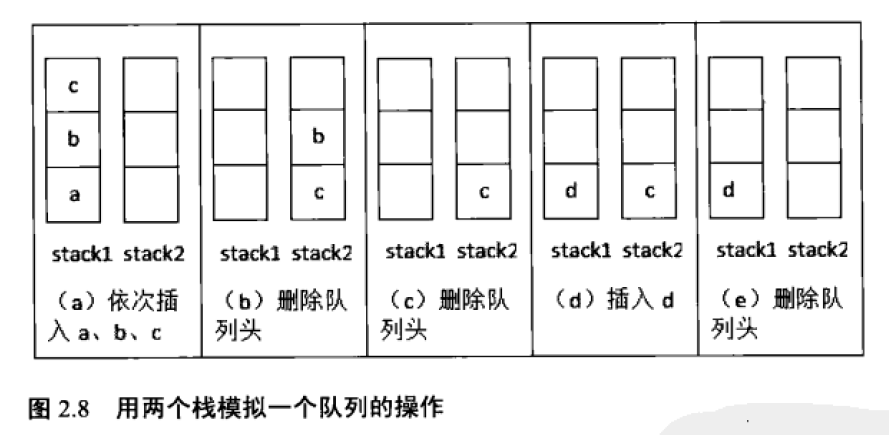
因为栈是后进先出的数据结构,当将数据依次压入第一个栈后,再依次从这个栈弹出,压入第二个栈,如果此时从第二个栈中获取数据,表现正好像一个 “先进先出” 的队列数据结构。
具体来说,使用两个栈实现一个队列,可以考虑用第一个栈(stack1)存放输入的元素(队尾元素),从第二个栈(stack2)获取队头元素。当第一栈(stack1)为空时,将第二个栈(stack2)中的全部元素依次弹出,再依次压入第一个栈中。其过程如图 2.8 所示,
C++ 实现
#include <iostream>

#include <stack>

#include <exception>

template <typename T> class CQueue

{

public:

    CQueue(void);

    ~CQueue(void);

    void appendTail(const T& node);

    T deleteHead();

private:

    std::stack<T> stack1;

    std::stack<T> stack2;

};

// Declare queue empty exception when try to pop when the queue is empty.

class QEmptyException: public std::exception {

    virtual const char* what() const throw()

    {

        return "Error: Queue is empty!";

    }

} popException;

// stack1 as input stack, stack2 as output stack

template <typename T>

void CQueue<T>::appendTail(const T& node)

{

    stack1.push(node);

}

template <class T>

T CQueue<T>::deleteHead()

{

    // Check if there are elements in stack2

    if (stack2.empty())

    {

        // Pop all the elements from stack1, then push them onto stack2

        if (stack1.size() > )

        {

            while (!stack1.empty())

            {

                T elem = stack1.top();

                stack1.pop();

                stack2.push(elem);

            }

        }

        else

            throw popException;

    }

    // Get the top element from stack2, then delete it from stack2

    T elem = stack2.top();

    stack2.pop();

    return elem;

}

template <typename T>

CQueue<T>::CQueue(void)

{

}

template <typename T>

CQueue<T>::~CQueue(void)

{

}

void unitest()

{

    CQueue<int> que;

    std::cout << "Push 1, 2, 3 successively into CQueue." << std::endl;

    que.appendTail();

    que.appendTail();

    que.appendTail();

    std::cout << "Pop the head of the queue: " << que.deleteHead() << std::endl;

    std::cout << "Pop the head of the queue: " << que.deleteHead() << std::endl;

    std::cout << "Push 4, 5, 6 successively into CQueue." << std::endl;

    que.appendTail();

    que.appendTail();

    que.appendTail();

    // Pop the rest elements in the queue, until the queue empty exception happens

    for (int i = ; i < ; ++i)

    {

        std::cout << "Pop the head of the queue: " << que.deleteHead() << std::endl;

    }

}

int main()

{

    unitest();

    return ;

}
Python 实现
#!/usr/bin/python

# -*- coding: utf8 -*-

class CQueue:

    def __init__(self):

        self.stack1 = []

        self.stack2 = []

    def append_tail(self, elem):

        self.stack1.append(elem)

    def delete_head(self):

        if not self.stack2:

            if self.stack1:

                while self.stack1:

                    elem = self.stack1.pop()

                    self.stack2.append(elem)

            else:

                raise Exception("Queue is empty.")

        elem = self.stack2.pop()

        return elem

def unitest():

    # Create an instance of class CQueue

    que = CQueue()

    print "Push 1, 2, 3 successively into CQueue."

    for i in range(1, 4):

        que.append_tail(i)

    print "Pop the head of the queue:", que.delete_head()

    print "Pop the head of the queue:", que.delete_head()

    print "Push 4, 5, 6 successively into CQueue."

    for i in range(4, 7):

        que.append_tail(i)

    # Pop the rest elements in the queue

    for i in range(4):

        print "Pop the head of the queue:", que.delete_head()

if __name__ == '__main__':

    unitest()
参考代码
1. targetver.h
#pragma once

// The following macros define the minimum required platform.  The minimum required platform

// is the earliest version of Windows, Internet Explorer etc. that has the necessary features to run

// your application.  The macros work by enabling all features available on platform versions up to and

// including the version specified.

// Modify the following defines if you have to target a platform prior to the ones specified below.

// Refer to MSDN for the latest info on corresponding values for different platforms.

#ifndef _WIN32_WINNT            // Specifies that the minimum required platform is Windows Vista.

#define _WIN32_WINNT 0x0600     // Change this to the appropriate value to target other versions of Windows.

#endif
2. stdafx.h
// stdafx.h : include file for standard system include files,

// or project specific include files that are used frequently, but

// are changed infrequently

//

#pragma once

#include "targetver.h"

#include <stdio.h>

#include <tchar.h>

// TODO: reference additional headers your program requires here
3. stdafx.cpp
// stdafx.cpp : source file that includes just the standard includes

// QueueWithTwoStacks.pch will be the pre-compiled header

// stdafx.obj will contain the pre-compiled type information

#include "stdafx.h"

// TODO: reference any additional headers you need in STDAFX.H

// and not in this file
4. Queue.h
#pragma once

#include <stack>

#include <exception>

using namespace std;

template <typename T> class CQueue

{

public:

    CQueue(void);

    ~CQueue(void);

    // 在队列末尾添加一个结点

    void appendTail(const T& node);

    // 删除队列的头结点

    T deleteHead();

private:

    stack<T> stack1;

    stack<T> stack2;

};

template <typename T> CQueue<T>::CQueue(void)

{

}

template <typename T> CQueue<T>::~CQueue(void)

{

}

template<typename T> void CQueue<T>::appendTail(const T& element)

{

    stack1.push(element);

}

template<typename T> T CQueue<T>::deleteHead()

{

    if(stack2.size()<= )

    {

        while(stack1.size()>)

        {

            T& data = stack1.top();

            stack1.pop();

            stack2.push(data);

        }

    }

    if(stack2.size() == )

        throw new exception("queue is empty");

    T head = stack2.top();

    stack2.pop();

    return head;

}
5. Queue.cpp
#include "StdAfx.h"

#include "Queue.h"

#include <queue>
6. QueueWithTwoStacks.cpp
// QueueWithTwoStacks.cpp : Defines the entry point for the console application.

//

// 《剑指Offer——名企面试官精讲典型编程题》代码

// 著作权所有者:何海涛

#include "stdafx.h"

#include "Queue.h"

void Test(char actual, char expected)

{

    if(actual == expected)

        printf("Test passed.\n");

    else

        printf("Test failed.\n");

}

int _tmain(int argc, _TCHAR* argv[])

{

    CQueue<char> queue;

    queue.appendTail('a');

    queue.appendTail('b');

    queue.appendTail('c');

    char head = queue.deleteHead();

    Test(head, 'a');

    head = queue.deleteHead();

    Test(head, 'b');

    queue.appendTail('d');

    head = queue.deleteHead();

    Test(head, 'c');

    queue.appendTail('e');

    head = queue.deleteHead();

    Test(head, 'd');

    head = queue.deleteHead();

    Test(head, 'e');

    return ;

}
7. 参考代码下载
项目 07_QueueWithTwoStacks 下载: 百度网盘
何海涛《剑指Offer:名企面试官精讲典型编程题》 所有参考代码下载:百度网盘
参考资料
[1] 何海涛. 剑指 Offer:名企面试官精讲典型编程题 [M]. 北京:电子工业出版社,2012. 58-62.
用两个栈实现队列(C++ 和 Python 实现)的更多相关文章
- 剑指Offer面试题:6.用两个栈实现队列
一.题目:用两个栈实现队列 题目:用两个栈实现一个队列.队列的声明如下,请实现它的两个函数appendTail和deleteHead,分别完成在队列尾部插入结点和在队列头部删除结点的功能. 原文是使用 ...
- 剑指OFFER之用两个栈实现队列(九度OJ1512)
题目描述: 用两个栈来实现一个队列,完成队列的Push和Pop操作.队列中的元素为int类型. 输入: 每个输入文件包含一个测试样例.对于每个测试样例,第一行输入一个n(1<=n<=100 ...
- 九度OJ 1512 用两个栈实现队列 【数据结构】
题目地址:http://ac.jobdu.com/problem.php?pid=1512 题目描述: 用两个栈来实现一个队列,完成队列的Push和Pop操作. 队列中的元素为int类型. 输入: 每 ...
- 两个栈实现队列+两个队列实现栈----java
两个栈实现队列+两个队列实现栈----java 一.两个栈实现一个队列 思路:所有元素进stack1,然后所有出s ...
- Algorithm --> 两个栈实现队列和两个队列实现栈
两个栈实现队列和两个队列实现栈 队列(queue)先进先出的线性表:栈(stack)先进后出的线性表. 两个栈实现队列 法一思路: s1是入栈的,s2是出栈的. 入队列:直接压入s1即可: 出队列:如 ...
- 二、 编写一个类,用两个栈实现队列,支持队列的基本操作(add,poll,peek)
请指教交流! package com.it.hxs.c01; import java.util.Stack; /* 编写一个类,用两个栈实现队列,支持队列的基本操作(add,poll,peek) */ ...
- 两个队列实现栈&两个栈实现队列(JAVA)
1,两个栈实现队列 题目描述 用两个栈来实现一个队列,完成队列的Push和Pop操作. 队列中的元素为int类型. 思路:栈的特点时先进后出,队列的特点是先进先出. 若此时有两个队列stack1,st ...
- 剑指offer【05】- 用两个栈实现队列(java)
题目:用两个栈实现队列 考点:栈和队列 题目描述:用两个栈来实现一个队列,完成队列的Push和Pop操作. 队列中的元素为int类型. 解题思路:每次psuh是时先将stack2清空放入stck1(保 ...
- C++版 - 剑指offer 面试题7:用两个栈实现队列 题解
用两个栈实现队列 提交网址: http://www.nowcoder.com/practice/54275ddae22f475981afa2244dd448c6?tpId=13&tqId=1 ...
- 《剑指offer》用两个栈实现队列
本题来自<剑指offer> 用两个栈实现队列 题目: 用两个栈来实现一个队列,完成队列的Push和Pop操作. 队列中的元素为int类型. 思路: 队列定义:先进先出 栈定义:先进后出 要 ...
随机推荐
- git获取代码,拉取最新代码,更新代码等
有句话说的很好:git是弓,我们的代码是箭,github就是靶子.我们需要把自己的代码存放到github的仓库上. 下图为截取的阮一峰博客的关于git常用命令总结的一张图片: 1.一开始从零获取代码 ...
- 阿里实人认证 .net 准备工作
1.H5+服务端接入 认证方案 https://help.aliyun.com/document_detail/61362.html?spm=a2c4g.11186623.2.37.35247556k ...
- 食品生鲜调料代理分销拼团商城微信小程序
食品生鲜调料代理分销拼团商城微信小程序 现在小程序越来越火爆了,一种新的分销拼团模式出现了.一起来分享一下吧 调料商城是一家是专业从事各种调料生产和网上调料商品销售平台,是藤椒油.花椒油.香油.火锅油 ...
- range() 和 np.arange()区别
range() 和 np.arange()区别 range(start,stop,step) 三个参数都必须是整数 np.arange()没有此类约束
- Linux 系统下安装 mysql5.7.25(glibc版)
前言:经过一天半的折腾,终于把 mysql 5.7.25 版本安装上了 Amazon Linux AMI release 2017.09 系统上,把能参考的博客几乎都看了一遍,终于发现这些细节问题,然 ...
- for、while、do while 3种循环异同点
for (; ; ){ 循环体} while(循环条件){ 循环体} do{ 循环体}while(循环条件); 执行顺序不同: for循环和while循环:先判断条件为true时,然后再执行 do w ...
- 用PL/sql连接oracle 弹窗出现 could not resolve the connect identifier specified 这个错误
1 错误如下图: 图1 2.可能原因: 配置oracle客户端中tnsnames.ora文件时,把数据库名弄错,如下图: 图2 箭头所指位置出错.箭头处应该为我们安装时的数据库名(通常是orcl).而 ...
- docker升级
使用系统自带的docker源安装docker,安装的版本都是偏低的,因此需要进行版本升级 升级步骤如下: 1. 查找现主机上关于docker的已安装包, 若列出为空,跳过第2步 rpm -qa|gre ...
- 一个数字键盘引发的血案——移动端H5输入框、光标、数字键盘全假套件实现
https://juejin.im/post/5a44c5eef265da432d2868f6 为啥要写假键盘? 还是输入框.光标全假的假键盘? 手机自带的不用非得写个假的,吃饱没事干吧? 装逼?炫技 ...
- db2 monitor event
1.创建事件监控器至少需要哪些权限? DBADM authority SQLADM authority 2.事件监控器的种类有哪些? 3. db2 flush event monitor eventm ...