
Mayor's posters POJ - 2528(线段树 + 离散化)
| Time Limit: 1000MS | Memory Limit: 65536K | |
| Total Submissions: 74745 | Accepted: 21574 |
Description
- Every candidate can place exactly one poster on the wall.
- All posters are of the same height equal to the height of the wall; the width of a poster can be any integer number of bytes (byte is the unit of length in Bytetown).
- The wall is divided into segments and the width of each segment is one byte.
- Each poster must completely cover a contiguous number of wall segments.
They have built a wall 10000000 bytes long (such that there is enough place for all candidates). When the electoral campaign was restarted, the candidates were placing their posters on the wall and their posters differed widely in width. Moreover, the candidates started placing their posters on wall segments already occupied by other posters. Everyone in Bytetown was curious whose posters will be visible (entirely or in part) on the last day before elections.
Your task is to find the number of visible posters when all the posters are placed given the information about posters' size, their place and order of placement on the electoral wall.
Input
Output
The picture below illustrates the case of the sample input. 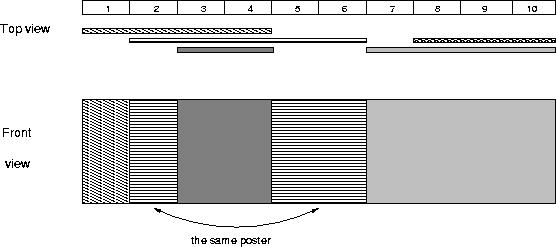
Sample Input
1

5

1 4

2 6

8 10

3 4

7 10
Sample Output
4

解析:
题目大意:给你一个无限长的板子,然后依次往上面贴n张等高的海报,问你最后能看到多少张海报。
思路分析:线段树区间更新问题,但是要注意,给的长度的可能非常大,有1e9,不加处理直接维护一个线段树肯定会
MLE,TLE,但是我们注意到一共最多只有2e4个点,因此我们可以用离散化的思想先对区间进行预处理,所谓的离散化,
在我理解看来就是将一个很大的区间映射为一个很小的区间,而不改变原有的大小覆盖关系,但是注意简单的离散化可能
会出现错误,给出下面两个简单的例子应该能体现普通离散化的缺陷:
例子一:1-10 1-4 5-10
例子二:1-10 1-4 6-10
普通离散化后都变成了[1,4][1,2][3,4]
线段2覆盖了[1,2],线段3覆盖了[3,4],那么线段1是否被完全覆盖掉了呢?
例子一是完全被覆盖掉了,而例子二没有被覆盖
解决的办法则是对于距离大于1的两相邻点,中间再插入一个点,本题还用到了Lazy标记的思想
直接更新区间进行标记而先不对子节点进行处理,如果需要往下更新再将标记下传一层。
#include <iostream>

#include <cstdio>

#include <cstring>

#include <queue>

#include <algorithm>

#include <cmath>

#define mem(a, b) memset(a, b, sizeof(a))

using namespace std;

const int maxn = , INF = 0x7fffffff;

int t[maxn], a1[maxn], a2[maxn], vis[maxn];

int a, b, x, y, ans;

 struct node{

    int l, r, w, f;

 }Node[maxn*];

 void build(int k, int ll, int rr)

 {

     Node[k].l = ll, Node[k].r = rr;

     Node[k].w = ;

     if(Node[k].l == Node[k].r) return;

     int m = (ll + rr) / ;

     build(k*, ll, m);

     build(k*+, m+, rr);

 }

 void down(int k)

 {

     Node[k*].f = Node[k].f;

     Node[k*+].f = Node[k].f;

     Node[k*].w = Node[k].f;

     Node[k*+].w = Node[k].f;

     Node[k].f = ;

 }

void chinter(int k)

{

    if(Node[k].l >= a && Node[k].r <= b)

    {

        Node[k].w =  y;

        Node[k].f = y;

        return;

    }

    if(Node[k].f) down(k);

    int m = (Node[k].l + Node[k].r) / ;

    if(a <= m) chinter(k*);

    if(b > m) chinter(k*+);

 //   Node[k].w = Node[k*2].w + Node[k*2+1].w;

}

void qp(int k)

{

    if(Node[k].l == Node[k].r)

    {

        ans = Node[k].w;

        return;

    }

    if(Node[k].f) down(k);

    int m = (Node[k].l + Node[k].r) / ;

    if(a <= m) qp(k*);

    else qp(k*+);

}

int main()

{

    int T;

    scanf("%d",&T);

    while(T--)

    {

        mem(vis, );

        int n, cnt = , ret = ;

        scanf("%d",&n);

        for(int i=; i<=n; i++)

        {

            scanf("%d%d",&a1[i],&a2[i]);

            t[cnt++] = a1[i];

            t[cnt++] = a2[i];

        }

        sort(t+, t+cnt);

        int m = unique(t+, t+cnt) - (t+);

        int len = m;

        for(int i=; i<len; i++)

            if(t[i+] - t[i] > ) t[++m] = t[i] + ;

        sort(t+, t+m+);

        build(, , m);

        for(int i=; i<=n; i++)

        {

            a = lower_bound(t+, t+m+, a1[i]) - t;

            b = lower_bound(t+, t+m+, a2[i]) - t;

            y = i;

            chinter();

        }

        for(int i=; i<=m; i++)

        {

            a = i;

            qp();

        //    cout<< ans;

            if(!vis[ans] && ans != )

            {

                vis[ans] = ;

                ret++;

            }

        }

    //    cout<< endl;

        printf("%d\n",ret);

    }

    return ;

}
Mayor's posters POJ - 2528(线段树 + 离散化)的更多相关文章
- Mayor's posters POJ - 2528 线段树(离散化处理大数?)
题意:输入t组数据,输入n代表有n块广告牌,按照顺序贴上去,输入左边和右边到达的地方,问贴完以后还有多少块广告牌可以看到(因为有的被完全覆盖了). 思路:很明显就是线段树更改区间,不过这个区间的跨度有 ...
- Mayor's posters POJ - 2528 线段树区间覆盖
//线段树区间覆盖 #include<cstdio> #include<cstring> #include<iostream> #include<algori ...
- POJ 2528 (线段树 离散化) Mayor's posters
离散化其实就是把所有端点放在一起,然后排序去个重就好了. 比如说去重以后的端点个数为m,那这m个点就构成m-1个小区间.然后给这m-1个小区间编号1~m-1,再用线段树来做就行了. 具体思路是,从最后 ...
- poj 2528(线段树+离散化) 市长的海报
http://poj.org/problem?id=2528 题目大意是市长竞选要贴海报,给出墙的长度和依次张贴的海报的长度区间(参考题目给的图),问最后你能看见的海报有几张 就是有的先贴的海报可能会 ...
- poj 2528 线段树+离散化
题意:在墙上贴一堆海报(只看横坐标,可以抽象成一线段),新海报可以覆盖旧海报.求最后能看到多少张海报 sol:线段树成段更新.铺第i张海报的时候更新sg[i].x~sg[i].y这一段为i. 然而坐标 ...
- poj 2528 线段树 离散化的小技巧
题意:在墙上贴海报,海报可以互相覆盖,问最后可以看见几张海报思路:直接搞超时+超内存,需要离散化.离散化简单的来说就是只取我们需要的值来 用,比如说区间[1000,2000],[1990,2012] ...
- poj 2528 线段树区间修改+离散化
Mayor's posters POJ 2528 传送门 线段树区间修改加离散化 #include <cstdio> #include <iostream> #include ...
- POJ 2528 Mayor's posters 贴海报 线段树 区间更新
注意离散化!!!线段树的叶子结点代表的是一段!!! 给出下面两个简单的例子应该能体现普通离散化的缺陷: 1-10 1-4 5-10 1-10 1-4 6-10 普通离散化算出来的结果都会是2,但是第二 ...
- Picture POJ - 1177 线段树+离散化+扫描线 求交叉图像周长
参考 https://www.cnblogs.com/null00/archive/2012/04/22/2464876.html #include <stdio.h> #include ...
随机推荐
- 开放的dae模型
从网上看到了这段代码,就Copy过来了. 其实面对dae这种开放的模型格式,我们可以做很多事情,就像通常的XML文件一样. //------------------------------------ ...
- [01] Collection和Map
0.写在前面的话 集合是Java的API中非常重要的概念,用来存储多个数据,并实现了不同的数据结构. Java集合框架中常见的有三大接口: Collection Map Iterator 1.Co ...
- Nowcoder186C 失衡天平 背包
题目传送门 题意:给你$N$个数,你可以将其划分为若干对集合(这里所说的集合允许数字重复)(即集合是两个集合两个集合出现),每对集合中两个集合所有元素的和的差的绝对值不超过$M$,可以有数字不在集合内 ...
- NoSql的三大基石:CAP理论&BASE&最终一致性
关系型数据库的局限 NoSql出现在关系型数据库之后,主要是为了解决关系型数据库的短板,我们先来看看随着软件行业的发展,关系型数据库面临了哪些挑战: 1.高并发 一个最典型的就是电商网站,例如双11, ...
- CF1146 Forethought Future Cup Elimination Round Tutorial
CF1146 Forethought Future Cup Elimination Round Tutorial 叮,守夜冠军卡 https://codeforces.com/blog/entry/6 ...
- C# 爬虫 正则、NSoup、HtmlAgilityPack、Jumony四种方式抓取小说
心血来潮,想爬点小说.通过百度选择了个小说网站,随便找了一本小说http://www.23us.so/files/article/html/13/13655/index.html. 1.分析html规 ...
- Zabbix监控系统部署:基本功能测试
1. 概述2. 登陆2.1 登陆账号密码2.1 设置中文语言环境3. 创建用户3.1 用户创建入口3.2 添加用户信息3.3 用户报警媒介3.4 用户权限4. 创建监控主机4.1 添加一台监控主机4. ...
- 如何新增一个ssh-key文件
前言 由于在公司有一个sshkey 在用,用于绑定公司的git code 仓库.那么在家要连上git hub 仓库,就也需要一个 ssh key .为了避免公司信息外露,所以还是新增一个ssh key ...
- getUserMedia API及HTML5 调用摄像头和麦克风
getUserMedia API简介 HTML5的getUserMedia API为用户提供访问硬件设备媒体(摄像头.视频.音频.地理位置等)的接口,基于该接口,开发者可以在不依赖任何浏览器插件的条件 ...
- Ajax写成绩批量录入
1.jsp,ajax的循环调用,必须要递归,否则会出错. <%@ page language="java" import="java.util.*" pa ...