
Java中的异常Exception
涉及到异常类相关的文章:
(1)异常类不能是泛型的 http://www.cnblogs.com/extjs4/p/8888085.html
(2)Finally block may not complete normally的问题,参考文章:https://www.cnblogs.com/extjs4/p/9375400.html
(3)JLS https://docs.oracle.com/javase/specs/jls/se7/html/jls-11.html#jls-11.2
(4)关于动态代理的异常 http://www.importnew.com/28664.html
try{ }catch(Exception e){ }
上面的例子不会报错,虽然try块中不会抛出异常,所以catch中Exception或者Exception的父类时不要求try块中一定要抛出相应异常。
Throwable为顶层父类,派生出Error类和Exception类,如下图:
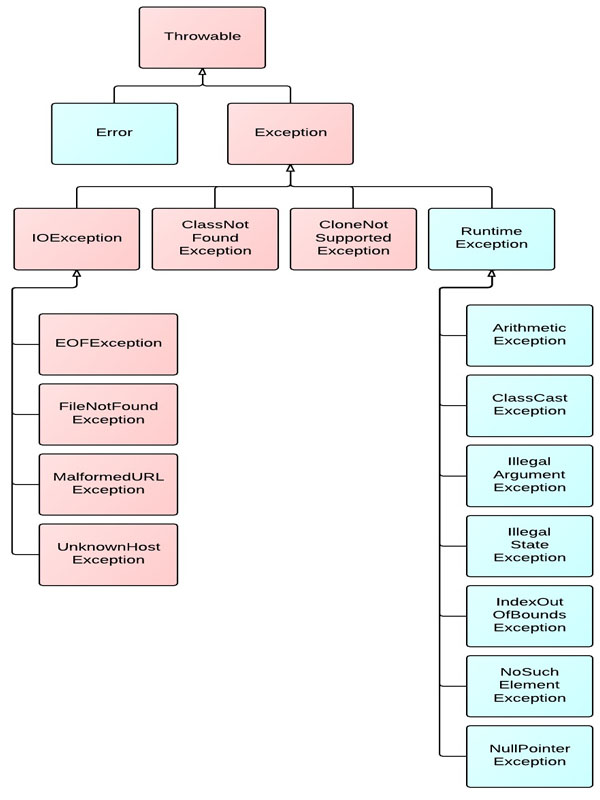
错误:Error类以及他的子类的实例,代表了JVM本身的错误。错误不能被程序员通过代码处理,Error很少出现。因此,程序员应该关注Exception为父类的分支下的各种异常类。
关于断言的java.lang.AssertionError也是无法处理的,如果出现错误,程序将终止。开启断言可在Eclipse中的VM arguments中传入参数:-ea 进行开启
异常:Exception以及他的子类,代表程序运行时发送的各种不期望发生的事件。可以被Java异常处理机制使用,是异常处理的核心。而且如果这些异常没有被处理,会导致线程退出。异常又分为非检查异常(unckecked exception)与检查异常(checked exception)。
由上图可以看出,继承
例1:
class SubThread extends Thread  {
	@Override
	public void run() throws ArithmeticException{
		int i = 0;
		int x = i / i; // 抛出java.lang.ArithmeticException
		System.out.println("SubThread end...");
	}

}
运行时异常如果不处理最终还是会导致线程终止。
例2:
class SubThread extends Thread  {
	@Override
	public void run() throws ArithmeticException{
		int i = 0;
		try {
			int x = i / i;
		} catch (Exception e) {
                    throw e;
		}
		System.out.println("SubThread end...");
	}
}
抛出异常时没有具体进行处理,同样会导致线程终止。如果注释掉throw e语句后,则线程就可正常结束打印出SubThread end...
11.2.1. Exception Analysis of Expressions
A class instance creation expression (§15.9) can throw an exception class E iff either:
The expression is a qualified class instance creation expression and the qualifying expression can throw E; or
Some expression of the argument list can throw E; or
E is determined to be an exception class of the
throwsclause of the constructor that is invoked (§15.12.2.6); orThe class instance creation expression includes a ClassBody, and some instance initializer block or instance variable initializer expression in the ClassBody can throw E.
A method invocation expression (§15.12) can throw an exception class E iff either:
The method to be invoked is of the form Primary.Identifierand the Primary expression can throw E; or
Some expression of the argument list can throw E; or
E is determined to be an exception class of the
throwsclause of the method that is invoked (§15.12.2.6).
For every other kind of expression, the expression can throw an exception class E iff one of its immediate subexpressions can throw E.
eg1:
class FirstException extends Exception {  }

class AA{
	public AA() throws FirstException{}
}
// 方法上必须有FirstException,否则下面抛出FirstException都将报错
public void dd() throws FirstException {

	AA a = new AA(){}; // // throw FirstException

	Object b = new Object(){
		// instance variable initializer
		AA a = new AA(); // throw FirstException
		// instance initializer block
		{
			AA a = new AA(); // // throw FirstException
		}
	};

}
11.2.2. Exception Analysis of Statements
A throw statement (§14.18) whose thrown expression has static type E and is not a final or effectively final exception parameter can throw E or any exception class that the thrown expression can throw.
For example, the statement throw new java.io.FileNotFoundException(); can throw java.io.FileNotFoundException only. Formally, it is not the case that it "can throw" a subclass or superclass of java.io.FileNotFoundException.
A throw statement whose thrown expression is a final or effectively final exception parameter of a catch clause C can throw an exception class E iff:
E is an exception class that the
tryblock of thetrystatement which declares C can throw; andE is assignment compatible with any of C's catchable exception classes; and
E is not assignment compatible with any of the catchable exception classes of the
catchclauses declared to the left of C in the sametrystatement.
A try statement (§14.20) can throw an exception class E iff either:
The
tryblock can throw E, or an expression used to initialize a resource (in atry-with-resources statement) can throw E, or the automatic invocation of theclose()method of a resource (in atry-with-resources statement) can throw E, and E is not assignment compatible with any catchable exception class of anycatchclause of thetrystatement, and either nofinallyblock is present or thefinallyblock can complete normally; orSome
catchblock of thetrystatement can throw E and either nofinallyblock is present or thefinallyblock can complete normally; orA
finallyblock is present and can throw E.
An explicit constructor invocation statement (§8.8.7.1) can throw an exception class E iff either:
Some expression of the constructor invocation's parameter list can throw E; or
E is determined to be an exception class of the
throwsclause of the constructor that is invoked (§15.12.2.6).
Any other statement S can throw an exception class E iff an expression or statement immediately contained in S can throw E.
关于异常的一些注意点:
(1)If a catch block handles more than one exception type, then the catch parameter is implicitly final.
(2)Rethrowing Exceptions with More Inclusive Type Checking(更具包容性的类型检查)
static class FirstException extends Exception {	}

static class SecondException extends Exception { }

// Java7之前对异常的处理
public void rethrowExceptionPriorSE7(String exceptionName)
		throws Exception {
	try {
		if (exceptionName.equals("First")) {
			throw new FirstException();
		} else {
			throw new SecondException();
		}
	} catch (Exception e) {
		throw e;
	}
}
// Java7新增对异常的处理语法
public void rethrowExceptionSE7(String exceptionName)
		throws FirstException, SecondException {
	try {
		if (exceptionName.equals("First")) {
			throw new FirstException();
		} else {
			throw new SecondException();
		}
	} catch (Exception e) {
		throw e;
	}
}
In detail, in Java SE 7 and later, when you declare one or more exception types in a catch clause, and rethrow the exception handled by this catch block, the compiler verifies that the type of the rethrown exception meets the following conditions:
- The
tryblock is able to throw it. - There are no other preceding
catchblocks that can handle it. - It is a subtype or supertype of one of the
catchclause's exception parameters.
如上的三条对Java7及后面的版本来说都需要进行检查,如下:
static class FirstException extends Exception {	}

static class SecondException extends FirstException { }

// Java7新增对异常的处理语法
public void rethrowExceptionSE7(String exceptionName)
		throws FirstException, SecondException {
	try {
		throw new FirstException();
	} catch (SecondException e) {
		throw e;
	}
}
在try块中抛出父类异常,在catch中捕获子类异常,这是允许的。
参考:
(1)http://www.importnew.com/26613.html
(2)https://docs.oracle.com/javase/specs/jls/se7/html/jls-11.html
(3)https://docs.oracle.com/javase/8/docs/technotes/guides/language/catch-multiple.html
Java中的异常Exception的更多相关文章
- java中的异常(Exception)
基本概念 将程序执行中发生的不正常的情况称为"异常".开发中的语法错误和逻辑错误不是异常 执行过程中的异常事件可分为两大类 错误(Error):Java虚拟机无法解决的严重问题.例 ...
- Java中的Checked Exception——美丽世界中潜藏的恶魔?
在使用Java编写应用的时候,我们常常需要通过第三方类库来帮助我们完成所需要的功能.有时候这些类库所提供的很多API都通过throws声明了它们所可能抛出的异常.但是在查看这些API的文档时,我们却没 ...
- 【Java心得总结二】浅谈Java中的异常
作为一个面向对象编程的程序员对于 下面的一句一定非常熟悉: try { // 代码块 } catch(Exception e) { // 异常处理 } finally { // 清理工作 } 就是面向 ...
- Java中的异常-Throwable-Error-Exception-RuntimeExcetpion-throw-throws-try catch
今天在做一个将String转换为Integer的功能时,发现Integer.parseInte()会抛出异常NumberFormatException. 函数Integer.parseInt(Stri ...
- Java中的异常详解
一.异常定义 阻止当前方法或作用域继续执行的问题,称为异常 二.异常分析 所有不正常类都继承Throwable类,这个类主要有两个子类Error类和Exception类.Error指系统错误 ...
- Java中的异常和处理详解
简介 程序运行时,发生的不被期望的事件,它阻止了程序按照程序员的预期正常执行,这就是异常.异常发生时,是任程序自生自灭,立刻退出终止,还是输出错误给用户?或者用C语言风格:用函数返回值作为执行状态?. ...
- Java中的异常简介
Java中异常的分类 Java中的异常机制是针对正常运行程序的一个必要补充,一般来说没有加入异常机制,程序也能正常运营,但是,由于入参.程序逻辑的严谨度,总会有期望之外的结果生成,因此加入异常机制的补 ...
- java中的异常类
Java中的异常: 1. Throwable是所有异常的根,java.lang.Throwable Throwable包含了错误(Error)和异常(Exception),Exception又包含了运 ...
- Java 中的异常
前段时间集合的整理真的是给我搞得心力交瘁啊,现在可以整理一些稍微简单一点的,搭配学习 ~ 突然想到一个问题,这些东西我之前就整理过,现在再次整理有什么区别嘛?我就自问自答一下,可能我再次整理会看到不一 ...
随机推荐
- HDU1879 继续畅通工程 2017-04-12 19:12 50人阅读 评论(0) 收藏
继续畅通工程 Time Limit : 2000/1000ms (Java/Other) Memory Limit : 32768/32768K (Java/Other) Total Submis ...
- Metasploit学习指南—基础篇
Metasploit是一款强大的渗透测试平台,其中包括了很多渗透测试利器,本文简单介绍一下Metasploit的配置和基础的使用方法,主要包括以下几个方面: Metasploit的核心 基础的配置 M ...
- mysql查看数据库性能常用命令
mysql> show global status; 可以列出MySQL服务器运行各种状态值,另外,查询MySQL服务器配置信息语句: mysql> show variables; 一.慢 ...
- C# winform无边框窗体移动
public partial class MessageHints : Form { //窗体移动API [DllImport("user32.dll")] public stat ...
- Wpf Page间跳转传参数 And Window To Page
这段时间用到Wpf,页面间的跳转网上有不少的示例,但是有些已经不能用了,尤其是页面间的传参问题更是一大堆,但正确的解决方案却没有几个,或者说写的不清楚,让人走了很多弯路,查看官方文档后发现了正确的姿势 ...
- .net core 自制错误日志
前言 之前.net framework用的ErrorLog帮助类,对于监控错误形成日志,内容非常清晰,想在.net core2.2中继续用,但是有很多不一样的地方,所以想总结一下. 首先需要HttpC ...
- 在 Cef 中实现 C++ 与 JavaScript 交互场景分析
此文已由作者邓佳佳授权网易云社区发布. 欢迎访问网易云社区,了解更多网易技术产品运营经验 本文主要介绍 CEF 场景中 C++ 和 JavaScript 交互(以下简称 JS Bridge)中的一些重 ...
- HBase - 数据写入流程解析
本文由 网易云发布. 作者:范欣欣 本篇文章仅限内部分享,如需转载,请联系网易获取授权. 众所周知,HBase默认适用于写多读少的应用,正是依赖于它相当出色的写入性能:一个100台RS的集群可以轻松 ...
- C# winform中listview排序
本文解决方案是采用下面链接中的解决方案.十分感谢这篇文章的作者bright:http://blog.163.com/shensc@126/blog/static/1312896522010614103 ...
- sqlite3简单操作
最近在操作公司视频设备的tutk转发服务器的时候,用到的数据库是sqlite,在此复习一下 目录 1 建立数据库档案 2 在sqlite3提示列下操作 3 SQL的指令格式 4 建立资料表 5 建立索 ...