
netty解决粘包半包问题
前言:开发者用到TCP/IP交互时,偶尔会遇到粘包或者半包的数据,这种情况有时会对我们的程序造成严重的影响,netty框架为解决这种问题提供了若干框架
1. LineBasedFrameDecoder:通过在包尾添加回车换行符 \r\n 来区分整包消息。
说明:LineBasedFrameDecoder 是从 ByteBuf 的可读字节中找到 \n 或者 \r\n,找到之后就以此为结束,然后将当前读取到的数据组成一行。
使用方法:ch.pipline().addLast(new LineBasedFrameDecoder(1024));//1024是设置每一行的最大长度,如果读到最大长度还没有结束符,会抛出异常,结束当前读取到的数据
2. DelimiterBasedFrameDecoder:通过特殊字符作为分隔符来区分整包消息
说明:客户端和服务端协议中有一致的特殊字符,来代表每一包的结束
如:客户端发送3条消息:"你好你好你好$_"
"hellohellohello$_"
"赞赞$_"
服务端为了防止分包粘包,使用方法如下:
ByteBuf delimiter = Unpooled.copiedBuffer("$_".getBytes());
ch.pipline().addLast(new DelimiterBasedFrameDecoder(1024, delimiter));//1024设置每一行的最大长度ch.pipline().addLast(new FixedLengthFrameDecoder(1024));那就介绍一种科一解决不定长协议的分包粘包方法:LengthFieldBasedFrameDecoder
先看一下LengthFieldBasedFrameDecoder源码中一个构造函数:
 public LengthFieldBasedFrameDecoder(

            int maxFrameLength,

            int lengthFieldOffset, int lengthFieldLength,

            int lengthAdjustment, int initialBytesToStrip) {

        this(

                maxFrameLength,

                lengthFieldOffset, lengthFieldLength, lengthAdjustment,

                initialBytesToStrip, true);

    }
其中有5个参数的定义我用一个协议数据举例

maxFrameLength:单个包的最大长度,根据实际环境定义
lengthFieldOffset:表示数据长度字段开始的偏移量,上图中,表示数据长度的字段前边还有协议头、版本号、日期等字段,一共占了12字节,所以按照这个协议,这个参数填写12

lengthFieldOffset:数据长度字段所占的字节数,上图中协议长度占用2个字节,这个参数写2
lengthAdjustment:lengthAdjustment +数据长度取值 = 数据长度字段之后剩下包的字节数,上图中,除了协议长度和数据内容,后边还有协议尾和CRC认证,占用6个字节,这个参数写6
initialBytesToStrip:从整个包开始,向后忽略的字节数(我写成0)

按照以上协议,我的使用方法就是:ch.pipeline().addLast(new LengthFieldBasedFrameDecoder(1024,12,2,6,0));

这句代码加在自定义Hander的前边,否则无效。这样就解决了粘包和分包的问题

但是我现在遇见的问题是:我的协议数据长度字段和数据内容实际长度可能是不对应的
我的协议是如果长度字段不是8的倍数,要在数据后补0 ,例如:
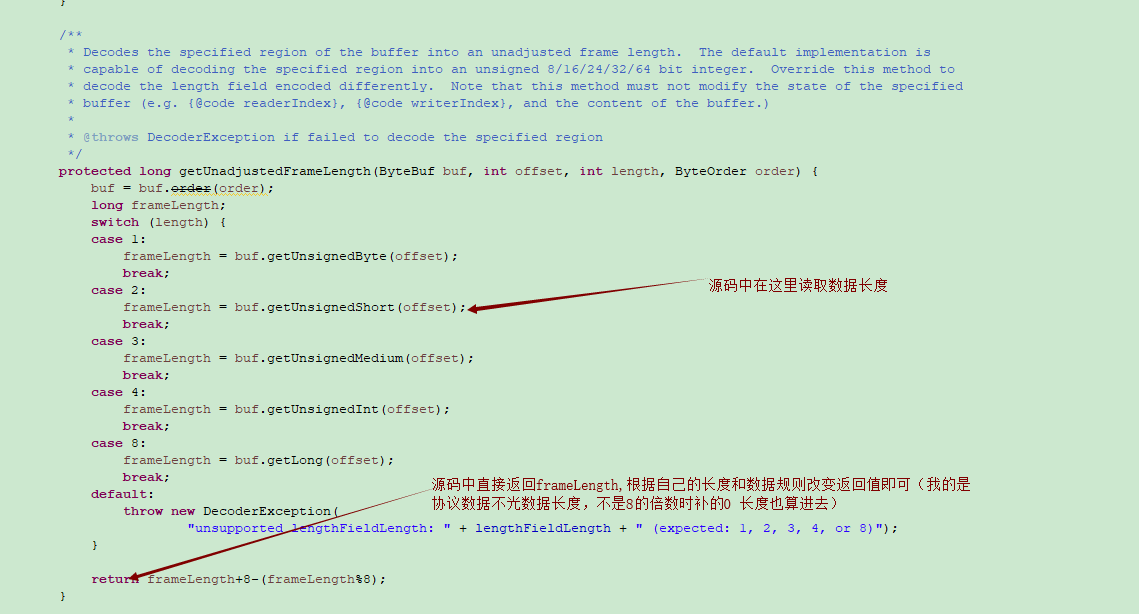
协议长度字段是0046 46不是8的倍数 要补两个0 所以导致以上所有方法都不适合我,因为我不知道长度究竟会是几,究竟会补几个0,于是我自定义LengthFieldBasedFrameDecoder解决这个问题
源码中LengthFieldBasedFrameDecoder继承的是ByteToMessageDecoder(以上所有方法都是继承这个类)
解决方案:自己创建一个类,继承ByteToMessageDecoder,将LengthFieldBasedFrameDecoder
public class SelfDefineEncodeHandler extends ByteToMessageDecoder {

	  private final ByteOrder byteOrder;

	    private final int maxFrameLength;

	    private final int lengthFieldOffset;

	    private final int lengthFieldLength;

	    private final int lengthFieldEndOffset;

	    private final int lengthAdjustment;

	    private final int initialBytesToStrip;

	    private final boolean failFast;

	    private boolean discardingTooLongFrame;

	    private long tooLongFrameLength;

	    private long bytesToDiscard;

	    /**

	     * Creates a new instance.

	     *

	     * @param maxFrameLength

	     *        the maximum length of the frame.  If the length of the frame is

	     *        greater than this value, {@link TooLongFrameException} will be

	     *        thrown.

	     * @param lengthFieldOffset

	     *        the offset of the length field

	     * @param lengthFieldLength

	     *        the length of the length field

	     */

	    public SelfDefineEncodeHandler(

	            int maxFrameLength,

	            int lengthFieldOffset, int lengthFieldLength) {

	        this(maxFrameLength, lengthFieldOffset, lengthFieldLength, 0, 0);

	    }

	    /**

	     * Creates a new instance.

	     *

	     * @param maxFrameLength

	     *        the maximum length of the frame.  If the length of the frame is

	     *        greater than this value, {@link TooLongFrameException} will be

	     *        thrown.

	     * @param lengthFieldOffset

	     *        the offset of the length field

	     * @param lengthFieldLength

	     *        the length of the length field

	     * @param lengthAdjustment

	     *        the compensation value to add to the value of the length field

	     * @param initialBytesToStrip

	     *        the number of first bytes to strip out from the decoded frame

	     */

	    public SelfDefineEncodeHandler(

	            int maxFrameLength,

	            int lengthFieldOffset, int lengthFieldLength,

	            int lengthAdjustment, int initialBytesToStrip) {

	        this(

	                maxFrameLength,

	                lengthFieldOffset, lengthFieldLength, lengthAdjustment,

	                initialBytesToStrip, true);

	    }

	    /**

	     * Creates a new instance.

	     *

	     * @param maxFrameLength

	     *        the maximum length of the frame.  If the length of the frame is

	     *        greater than this value, {@link TooLongFrameException} will be

	     *        thrown.

	     * @param lengthFieldOffset

	     *        the offset of the length field

	     * @param lengthFieldLength

	     *        the length of the length field

	     * @param lengthAdjustment

	     *        the compensation value to add to the value of the length field

	     * @param initialBytesToStrip

	     *        the number of first bytes to strip out from the decoded frame

	     * @param failFast

	     *        If <tt>true</tt>, a {@link TooLongFrameException} is thrown as

	     *        soon as the decoder notices the length of the frame will exceed

	     *        <tt>maxFrameLength</tt> regardless of whether the entire frame

	     *        has been read.  If <tt>false</tt>, a {@link TooLongFrameException}

	     *        is thrown after the entire frame that exceeds <tt>maxFrameLength</tt>

	     *        has been read.

	     */

	    public SelfDefineEncodeHandler(

	            int maxFrameLength, int lengthFieldOffset, int lengthFieldLength,

	            int lengthAdjustment, int initialBytesToStrip, boolean failFast) {

	        this(

	                ByteOrder.BIG_ENDIAN, maxFrameLength, lengthFieldOffset, lengthFieldLength,

	                lengthAdjustment, initialBytesToStrip, failFast);

	    }

	    /**

	     * Creates a new instance.

	     *

	     * @param byteOrder

	     *        the {@link ByteOrder} of the length field

	     * @param maxFrameLength

	     *        the maximum length of the frame.  If the length of the frame is

	     *        greater than this value, {@link TooLongFrameException} will be

	     *        thrown.

	     * @param lengthFieldOffset

	     *        the offset of the length field

	     * @param lengthFieldLength

	     *        the length of the length field

	     * @param lengthAdjustment

	     *        the compensation value to add to the value of the length field

	     * @param initialBytesToStrip

	     *        the number of first bytes to strip out from the decoded frame

	     * @param failFast

	     *        If <tt>true</tt>, a {@link TooLongFrameException} is thrown as

	     *        soon as the decoder notices the length of the frame will exceed

	     *        <tt>maxFrameLength</tt> regardless of whether the entire frame

	     *        has been read.  If <tt>false</tt>, a {@link TooLongFrameException}

	     *        is thrown after the entire frame that exceeds <tt>maxFrameLength</tt>

	     *        has been read.

	     */

	    public SelfDefineEncodeHandler(

	            ByteOrder byteOrder, int maxFrameLength, int lengthFieldOffset, int lengthFieldLength,

	            int lengthAdjustment, int initialBytesToStrip, boolean failFast) {

	        if (byteOrder == null) {

	            throw new NullPointerException("byteOrder");

	        }

	        if (maxFrameLength <= 0) {

	            throw new IllegalArgumentException(

	                    "maxFrameLength must be a positive integer: " +

	                    maxFrameLength);

	        }

	        if (lengthFieldOffset < 0) {

	            throw new IllegalArgumentException(

	                    "lengthFieldOffset must be a non-negative integer: " +

	                    lengthFieldOffset);

	        }

	        if (initialBytesToStrip < 0) {

	            throw new IllegalArgumentException(

	                    "initialBytesToStrip must be a non-negative integer: " +

	                    initialBytesToStrip);

	        }

	        if (lengthFieldOffset > maxFrameLength - lengthFieldLength) {

	            throw new IllegalArgumentException(

	                    "maxFrameLength (" + maxFrameLength + ") " +

	                    "must be equal to or greater than " +

	                    "lengthFieldOffset (" + lengthFieldOffset + ") + " +

	                    "lengthFieldLength (" + lengthFieldLength + ").");

	        }

	        this.byteOrder = byteOrder;

	        this.maxFrameLength = maxFrameLength;

	        this.lengthFieldOffset = lengthFieldOffset;

	        this.lengthFieldLength = lengthFieldLength;

	        this.lengthAdjustment = lengthAdjustment;

	        lengthFieldEndOffset = lengthFieldOffset + lengthFieldLength;

	        this.initialBytesToStrip = initialBytesToStrip;

	        this.failFast = failFast;

	    }

	    @Override

	    protected final void decode(ChannelHandlerContext ctx, ByteBuf in, List<Object> out) throws Exception {

	        Object decoded = decode(ctx, in);

	        if (decoded != null) {

	            out.add(decoded);

	        }

	    }

	    /**

	     * Create a frame out of the {@link ByteBuf} and return it.

	     *

	     * @param   ctx             the {@link ChannelHandlerContext} which this {@link ByteToMessageDecoder} belongs to

	     * @param   in              the {@link ByteBuf} from which to read data

	     * @return  frame           the {@link ByteBuf} which represent the frame or {@code null} if no frame could

	     *                          be created.

	     */

	    protected Object decode(ChannelHandlerContext ctx, ByteBuf in) throws Exception {

	        if (discardingTooLongFrame) {

	            long bytesToDiscard = this.bytesToDiscard;

	            int localBytesToDiscard = (int) Math.min(bytesToDiscard, in.readableBytes());

	            in.skipBytes(localBytesToDiscard);

	            bytesToDiscard -= localBytesToDiscard;

	            this.bytesToDiscard = bytesToDiscard;

	            failIfNecessary(false);

	        }

	        if (in.readableBytes() < lengthFieldEndOffset) {

	            return null;

	        }

	        int actualLengthFieldOffset = in.readerIndex() + lengthFieldOffset;

	        long frameLength = getUnadjustedFrameLength(in, actualLengthFieldOffset, lengthFieldLength, byteOrder);

	        System.out.println("---------------"+frameLength);

	        if (frameLength < 0) {

	            in.skipBytes(lengthFieldEndOffset);

	            throw new CorruptedFrameException(

	                    "negative pre-adjustment length field: " + frameLength);

	        }

	        frameLength += lengthAdjustment + lengthFieldEndOffset;

	        if (frameLength < lengthFieldEndOffset) {

	            in.skipBytes(lengthFieldEndOffset);

	            throw new CorruptedFrameException(

	                    "Adjusted frame length (" + frameLength + ") is less " +

	                    "than lengthFieldEndOffset: " + lengthFieldEndOffset);

	        }

	        if (frameLength > maxFrameLength) {

	            long discard = frameLength - in.readableBytes();

	            tooLongFrameLength = frameLength;

	            if (discard < 0) {

	                // buffer contains more bytes then the frameLength so we can discard all now

	                in.skipBytes((int) frameLength);

	            } else {

	                // Enter the discard mode and discard everything received so far.

	                discardingTooLongFrame = true;

	                bytesToDiscard = discard;

	                in.skipBytes(in.readableBytes());

	            }

	            failIfNecessary(true);

	            return null;

	        }

	        // never overflows because it's less than maxFrameLength

	        int frameLengthInt = (int) frameLength;

	        if (in.readableBytes() < frameLengthInt) {

	            return null;

	        }

	        if (initialBytesToStrip > frameLengthInt) {

	            in.skipBytes(frameLengthInt);

	            throw new CorruptedFrameException(

	                    "Adjusted frame length (" + frameLength + ") is less " +

	                    "than initialBytesToStrip: " + initialBytesToStrip);

	        }

	        in.skipBytes(initialBytesToStrip);

	        // extract frame

	        int readerIndex = in.readerIndex();

	        int actualFrameLength = frameLengthInt - initialBytesToStrip;

	        ByteBuf frame = extractFrame(ctx, in, readerIndex, actualFrameLength);

	        in.readerIndex(readerIndex + actualFrameLength);

	        return frame;

	    }

	    /**

	     * Decodes the specified region of the buffer into an unadjusted frame length.  The default implementation is

	     * capable of decoding the specified region into an unsigned 8/16/24/32/64 bit integer.  Override this method to

	     * decode the length field encoded differently.  Note that this method must not modify the state of the specified

	     * buffer (e.g. {@code readerIndex}, {@code writerIndex}, and the content of the buffer.)

	     *

	     * @throws DecoderException if failed to decode the specified region

	     */

	    protected long getUnadjustedFrameLength(ByteBuf buf, int offset, int length, ByteOrder order) {

	        buf = buf.order(order);

	        long frameLength;

	        switch (length) {

	        case 1:

	            frameLength = buf.getUnsignedByte(offset);

	            break;

	        case 2:

	            frameLength = buf.getUnsignedShort(offset);

	            break;

	        case 3:

	            frameLength = buf.getUnsignedMedium(offset);

	            break;

	        case 4:

	            frameLength = buf.getUnsignedInt(offset);

	            break;

	        case 8:

	            frameLength = buf.getLong(offset);

	            break;

	        default:

	            throw new DecoderException(

	                    "unsupported lengthFieldLength: " + lengthFieldLength + " (expected: 1, 2, 3, 4, or 8)");

	        }

	        return frameLength+8-(frameLength%8);

	    }

	    private void failIfNecessary(boolean firstDetectionOfTooLongFrame) {

	        if (bytesToDiscard == 0) {

	            // Reset to the initial state and tell the handlers that

	            // the frame was too large.

	            long tooLongFrameLength = this.tooLongFrameLength;

	            this.tooLongFrameLength = 0;

	            discardingTooLongFrame = false;

	            if (!failFast ||

	                failFast && firstDetectionOfTooLongFrame) {

	                fail(tooLongFrameLength);

	            }

	        } else {

	            // Keep discarding and notify handlers if necessary.

	            if (failFast && firstDetectionOfTooLongFrame) {

	                fail(tooLongFrameLength);

	            }

	        }

	    }

	    /**

	     * Extract the sub-region of the specified buffer.

	     * <p>

	     * If you are sure that the frame and its content are not accessed after

	     * the current {@link #decode(ChannelHandlerContext, ByteBuf)}

	     * call returns, you can even avoid memory copy by returning the sliced

	     * sub-region (i.e. <tt>return buffer.slice(index, length)</tt>).

	     * It's often useful when you convert the extracted frame into an object.

	     * Refer to the source code of {@link ObjectDecoder} to see how this method

	     * is overridden to avoid memory copy.

	     */

	    protected ByteBuf extractFrame(ChannelHandlerContext ctx, ByteBuf buffer, int index, int length) {

	        return buffer.retainedSlice(index, length);

	    }

	    private void fail(long frameLength) {

	        if (frameLength > 0) {

	            throw new TooLongFrameException(

	                            "Adjusted frame length exceeds " + maxFrameLength +

	                            ": " + frameLength + " - discarded");

	        } else {

	            throw new TooLongFrameException(

	                            "Adjusted frame length exceeds " + maxFrameLength +

	                            " - discarding");

	        }

	    }

}
备忘,参考文章:http://linkedkeeper.com/detail/blog.action?bid=105 里面介绍了更多netty解决粘包分包的方法
netty解决粘包半包问题的更多相关文章
- Netty 粘包/半包原理与拆包实战
Java NIO 粘包 拆包 (实战) - 史上最全解读 - 疯狂创客圈 - 博客园 https://www.cnblogs.com/crazymakercircle/p/9941658.html 本 ...
- Netty入门系列(2) --使用Netty解决粘包和拆包问题
前言 上一篇我们介绍了如果使用Netty来开发一个简单的服务端和客户端,接下来我们来讨论如何使用解码器来解决TCP的粘包和拆包问题 TCP为什么会粘包/拆包 我们知道,TCP是以一种流的方式来进行网络 ...
- Http 调用netty 服务,服务调用客户端,伪同步响应.ProtoBuf 解决粘包,半包问题.
实际情况是: 公司需要开发一个接口给新产品使用,需求如下 1.有一款硬件设备,客户用usb接上电脑就可以,但是此设备功能比较单一,所以开发一个服务器程序,辅助此设备业务功能 2.解决方案,使用Sock ...
- Netty解决粘包和拆包问题的四种方案
在RPC框架中,粘包和拆包问题是必须解决一个问题,因为RPC框架中,各个微服务相互之间都是维系了一个TCP长连接,比如dubbo就是一个全双工的长连接.由于微服务往对方发送信息的时候,所有的请求都是使 ...
- netty 解决粘包拆包问题
netty server TimeServer package com.zhaowb.netty.ch4_3; import io.netty.bootstrap.ServerBootstrap; i ...
- netty: 解决粘包拆包: 分隔符DelimiterBasedFrameDecoder,定长消息FixedLengthFrameDecoder
DelimiterBasedFrameDecoder 自定义分隔符 给Server发送多条信息,但是server会讲多条信息合并为一条.这时候我们需要对发生的消息指定分割,让client和server ...
- socket编程 TCP 粘包和半包 的问题及解决办法
一般在socket处理大数据量传输的时候会产生粘包和半包问题,有的时候tcp为了提高效率会缓冲N个包后再一起发出去,这个与缓存和网络有关系. 粘包 为x.5个包 半包 为0.5个包 由于网络原因 一次 ...
- Netty - 粘包和半包(上)
在网络传输中,粘包和半包应该是最常出现的问题,作为 Java 中最常使用的 NIO 网络框架 Netty,它又是如何解决的呢?今天就让我们来看看. 定义 TCP 传输中,客户端发送数据,实际是把数据写 ...
- c# socket 解决粘包,半包
处理原理: 半包:即一条消息底层分几次发送,先有个头包读取整条消息的长度,当不满足长度时,将消息临时缓存起来,直到满足长度再解码 粘包:两条完整/不完整消息粘在一起,一般是解码完上一条消息,然后再判断 ...
随机推荐
- componentWillMount VS componentDidMount
前言 这与React组件的生命周期有关,组件挂载时有关的生命周期有以下几个: constructor(){} componentWillMount(){} render(){} componentDi ...
- Mybatis_resultMap的关联方式实现多表查询(一对多)
a)在 ClazzMapper.xml 中定义多表连接查询 SQL 语句, 一次性查到需要的所有数据, 包括对应学生的信息. b)通过<resultMap>定义映射关系, 并通过<c ...
- 最全的linux系统安装教程和排错方法
第4章 linux信息和系统安装与连接 260 4.1 linux的发展历史 260 4.2 GPL协议,FSF协议 261 4.3 linux系统的安装 261 4.3.1 ...
- vue中使用this遇到的坑
在两个页面中创建函数,并且调用一个函数中能够获取到代表vue实例的this,而另一个却获取不到 页面1: <button id="login" v-text="$t ...
- LInux内核配置过程
内核版本 linux 2.6.32.2 配置内核的过程 配置内核可以通过执行 make menuconfig 来进行,下面分析该命令的执行流程 执行该目标 %config: scripts_basic ...
- 【NodeJS】跨域
[NodeJS]跨域 转载:https://www.cnblogs.com/yangchongxing/p/10635480.html var express = require('express') ...
- 如果你不了解Java的JVM,那真的很难进BAT一线大厂!
前言 对于开发人员来说,如果不了解Java的JVM,那真的是很难写得一手好代码,很难查得一手好bug.同时,JVM也是面试环节的中重灾区.我们不能为了面试而面试,但是学习会这些核心知识你必定会成为面试 ...
- CentOS7添加自定义脚本服务
一.CentOS7添加自定义脚本服务说明 在CentOS7下,已经不再使用chkconfig命令管理系统开机自启动服务和条件自定义脚本服务了,而是使用管理unit的方式来控制开机自启动服务和添加自定义 ...
- Java堆的结构是什么样子的?什么是堆中的永久代(Perm Gen space)?
JVM的堆是运行时数据区,所有类的实例和数组都是在堆上分配内存.它在JVM启动的时候被创建.对象所占的堆内存是由自动内存管理系统也就是垃圾收集器回收. 堆内存是由存活和死亡的对象组成的.存活的对象是应 ...
- poj 1741 Tree (树的分治)
Tree Time Limit: 1000MS Memory Limit: 30000K Total Submissions: 30928 Accepted: 10351 Descriptio ...