
机器学习算法 --- Decision Trees Algorithms
一、Decision Trees Agorithms的简介
决策树算法(Decision Trees Agorithms),是如今最流行的机器学习算法之一,它即能做分类又做回归(不像之前介绍的其他学习算法),在本文中,将介绍如何用它来对数据做分类。
本文参照了Madhu Sanjeevi ( Mady )的Decision Trees Algorithms,有能力的读者可去阅读原文。
说明:本文有几处直接引用了原文,并不是不想做翻译,而是感觉翻译过来总感觉不够清晰,而原文却讲的很明白清晰。(个人观点:任何语言的翻译都会损失一定量的信息,所以尽量支持原版)
二、Why Decision trees?
在已经有了很多种学习算法的情况下,为什么还要创造出回归树这种学习算法呢?它相比于其他算法有和优点?
至于为什么,原因有很多,这里主要讲两点,这两点也是在我看来相比于其他算法最大的优点。
其一,决策树的算法思想与人类做决定时的思考方式很相似,它相比于其他算法,无需计算很多很多的各种参数,它能像人类一样综合各种考虑,做出很好的选择(不一定是最好啊ㄟ(▔,▔)ㄏ)。
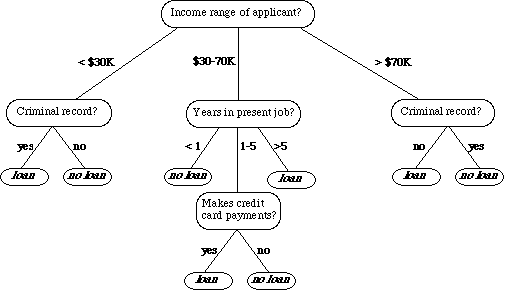
其二,它能将它做出决策的逻辑过程可视化(不同于SVM, NN, 或是神经网络等,对于用户而言是一个黑盒), 例如下图,就是一个银行是否给客户发放贷款使用决策树决策的一个过程。
三、What is the decision tree??
A decision tree is a tree where each node represents a feature(attribute), each link(branch) represents a decision(rule) and each leaf represents an outcome(categorical or continues value).
类似于下图中左边的数据,对于数据的分类我们使用右边的方式对其分类:
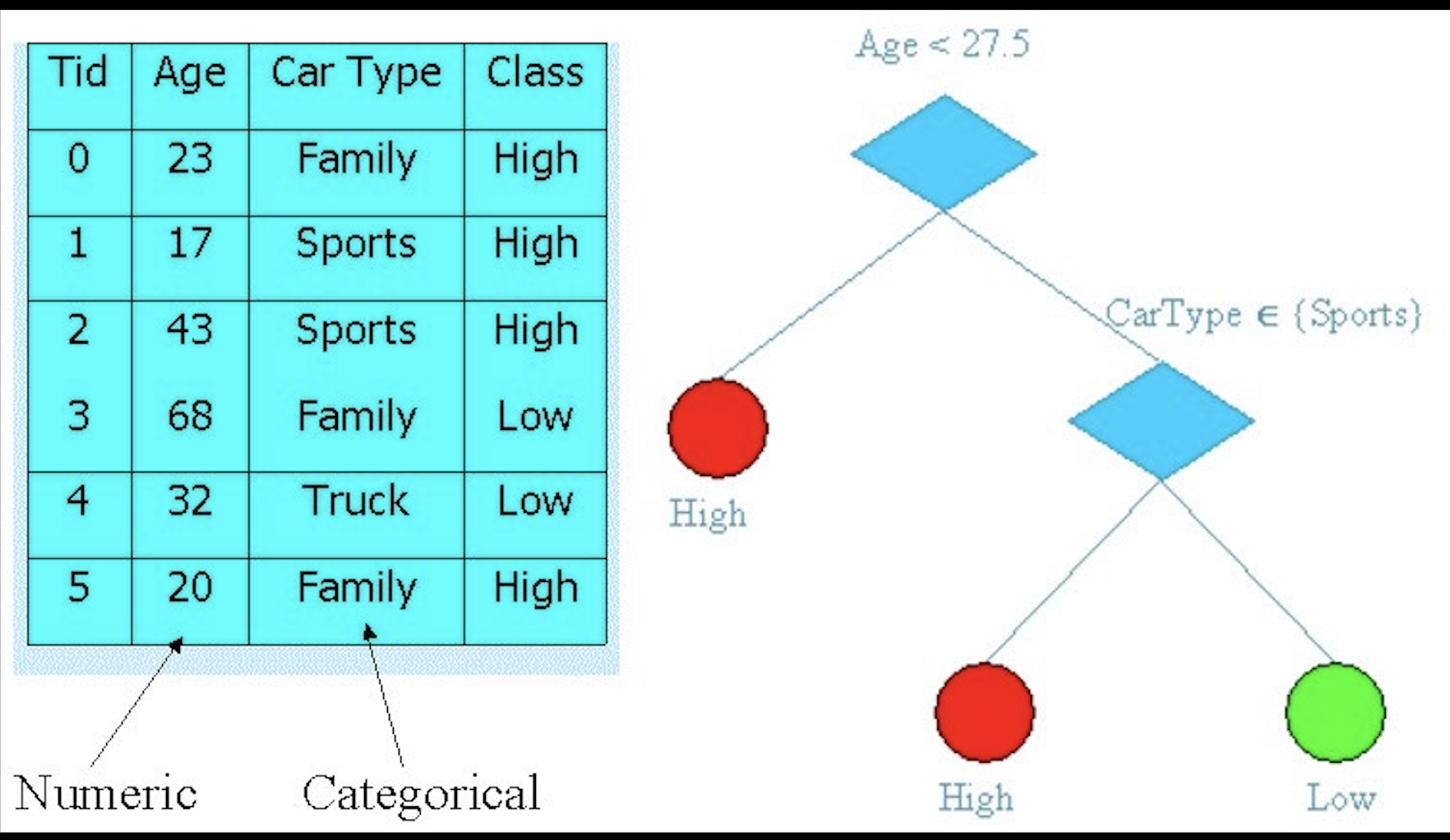
step 1:判断Age,Age<27.5,则Class=High;否则,执行step 2。
step 2: 判断CarType,CarType∈Sports,则Class=High;否则Class=Low。
对于一组数据,只需按照决策树的分支一步步的走下去,便可得到最终的结果,有点儿类似于程序设计中的多分支选择结构。
四、How to build this??
学习新知识,最主要的三个问题就是why,what,how。前两个问题已经在上面的介绍中解决了,接下来就是how,即如何建立一颗决策树?
建立决策树,有很多种算法,本文主要讲解一下两种:
- ID3 (Iterative Dichotomiser 3) → uses Entropy function and Information gain as metrics.
- CART (Classification and Regression Trees) → uses Gini Index(Classification) as metric.
————————————————————————————————————————————————————————————————————————————————————————————————————— 首先,我们使用第一种算法来对一个经典的分类问题建立决策树:
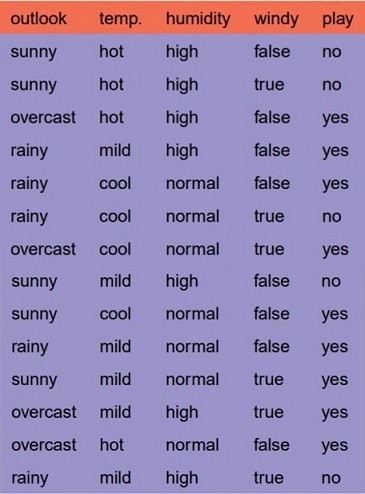
Let’s just take a famous dataset in the machine learning world which is whether dataset(playing game Y or N based on whether condition).
We have four X values (outlook,temp,humidity and windy) being categorical and one y value (play Y or N) also being categorical.
So we need to learn the mapping (what machine learning always does) between X and y.
This is a binary classification problem, lets build the tree using the ID3 algorithm.
首先,决策树,也是一棵树,在计算机科学中,树是一种数据结构,它有根节点(root node),分枝(branch),和叶子节点(leaf node)。
而对于一颗决策树,each node represents a feature(attribute),so first, we need to choose the root node from (outlook, temp, humidity, windy). 那么改如何选择呢?
Answer: Determine the attribute that best classifies the training data; use this attribute at the root of the tree. Repeat this process at for each branch.
这也就意味着,我们要对决策树的空间进行自顶向下的贪婪搜索。
所以问题又来了,how do we choose the best attribute?
Answer: use the attribute with the highest information gain in ID3.
In order to define information gain precisely, we begin by defining a measure commonly used in information theory, called entropy(熵) that characterizes the impurity of an arbitrary collection of examples.”
So what's the entropy? (下图是wikipedia给出的定义)
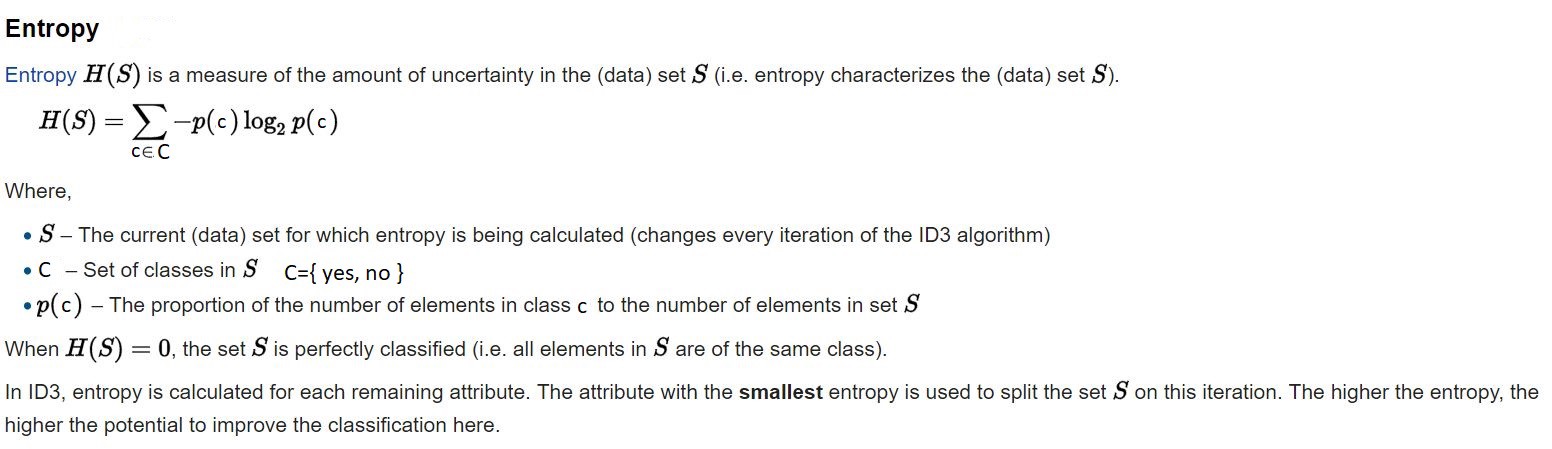
从上面的公式中我们可以得到,对于一个二分类问题,如果entropy=0,则要么全为正样本,要么全为负样本(即理论上样本应该属于两个,实际上所有的样本全属于一类)。如果entropy=1,则正负样本各占一半。
有了Entropy的概念,便可以定义Information gain:
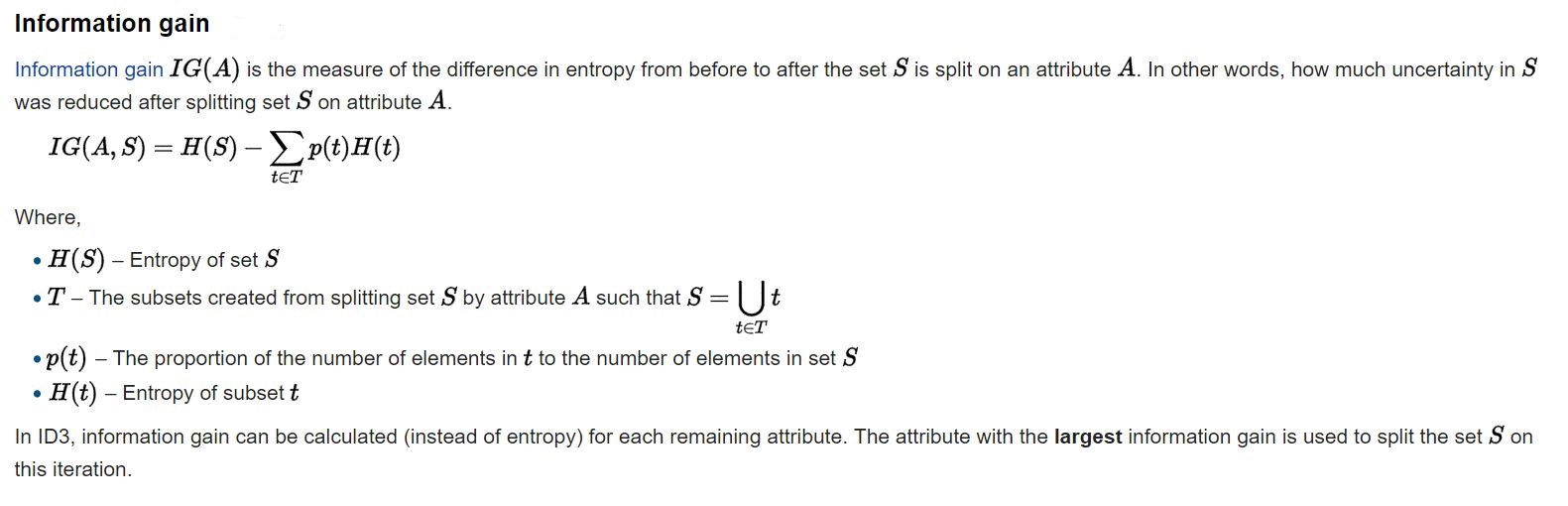
有了上述两个概念,便可建立决策树了,步骤如下:
.compute the entropy for data-set

.for every attribute/feature:

       .calculate entropy for all categorical values

       .take average information entropy for the current attribute

       .calculate gain for the current attribute

. pick the highest gain attribute.

. Repeat until we get the tree we desired.
对于这个实例,我们来具体使用一下它:
step1(计算数据集整体的entropy):
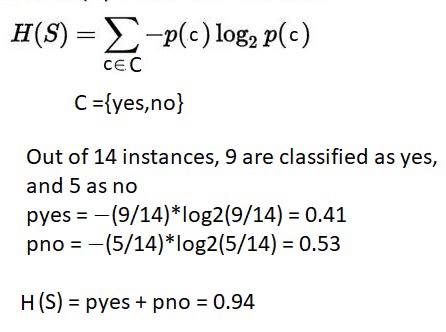
step2(计算每一项feature的entropy and information gain):

这里只计算了两项,其他两项的计算方法类似。
step3 (选择Info gain最高的属性):
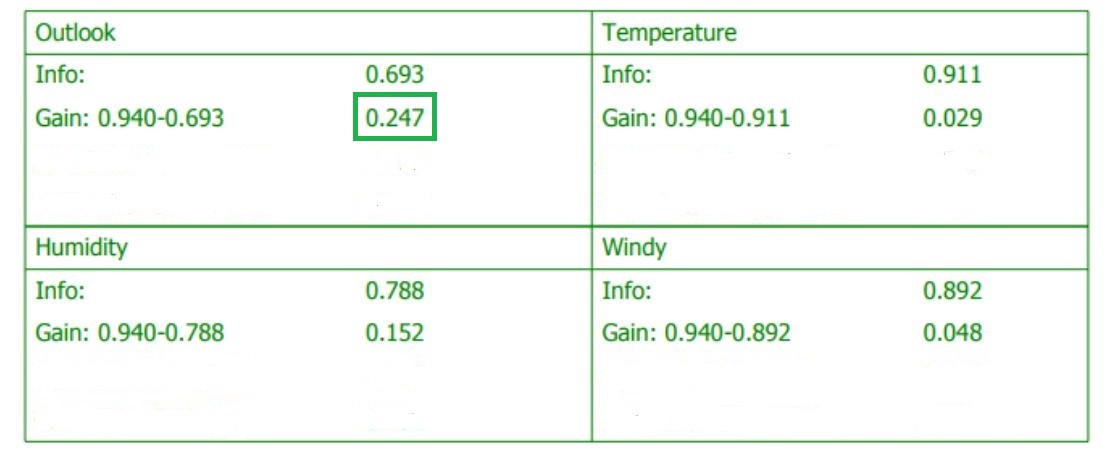
上表列出了每一项feature的entropy and information gain,我们可以发现Outlook便是我们要找的那个attribute。
So our root node is Outlook:
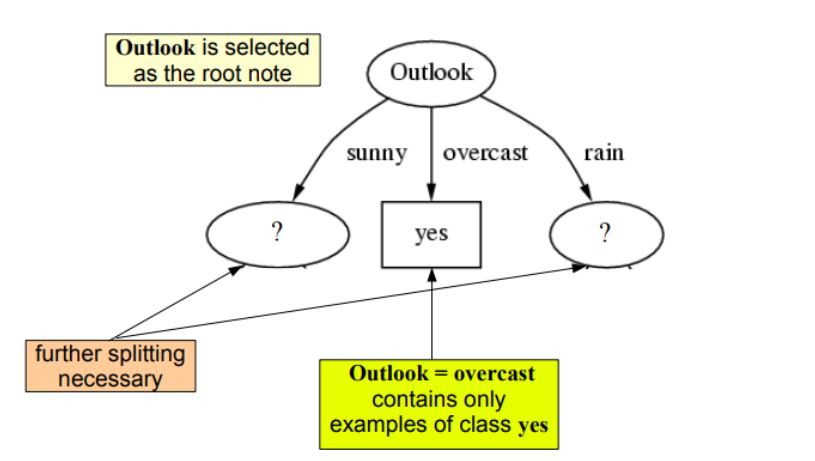
接着对于图中左边的未知节点,我们将由sunny得来的数据当做数据集,然后从这些数据中按照上述的步骤选择其他三个属性的一种作为此节点,对于右边的节点做类似操作即可:
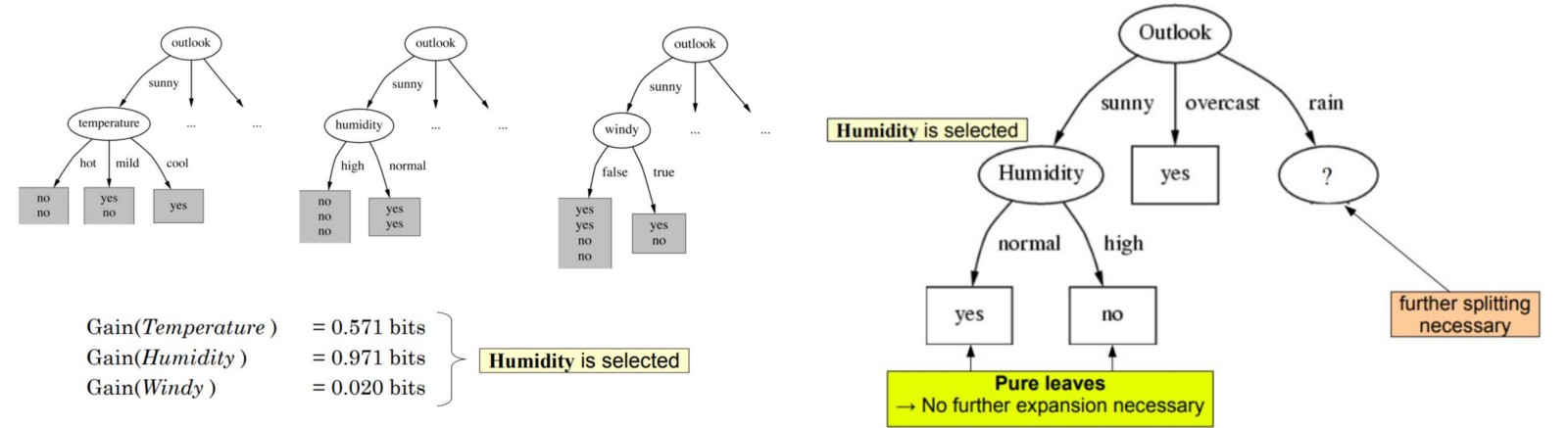
最终,建立的决策树如下:
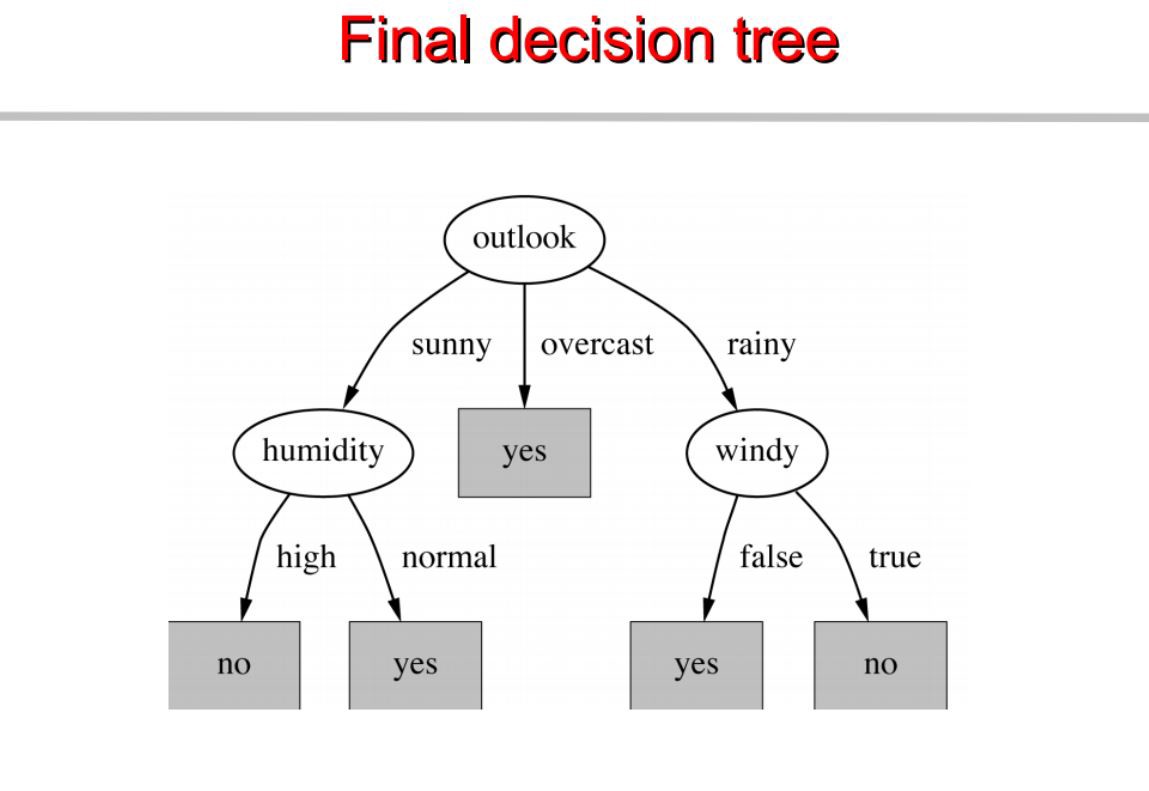
————————————————————————————————————————————————————————————————————————————————————————————————————— 接着,我们使用第二种算法来建立决策树(Classification with using the CART algorithm):
CART算法其实与ID3非常相像,只是每次选择时的指标不同,在ID3中我们使用entropy来计算Informaition gain,而在CART中,我们使用Gini index来计算Gini gain。
同样的,对于一个二分类问题而言(Yes or No),有四种组合:1 0 , 0 1 , 1 0 , 0 0,则存在
P(Target=).P(Target=) + P(Target=).P(Target=) + P(Target=).P(Target=) + P(Target=).P(Target=) = 1
P(Target=1).P(Target=0) + P(Target=0).P(Target=1) = 1 — P^2(Target=0) — P^2(Target=1)
那么,对于二分类问题的Gini index定义如下:

A Gini score gives an idea of how good a split is by how mixed the classes are in the two groups created by the split. A perfect separation results in a Gini score of 0, whereas the worst case split that results in 50/50 classes.
所以,对于一个二分类问题,最大的Gini index:
= 1 — (1/2)^2 — (1/2)^2
= 1–2*(1/2)^2
= 1- 2*(1/4)
= 1–0.5
= 0.5
和二分类类似,我们可以定义出多分类时Gini index的计算公式:
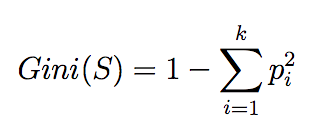
Maximum value of Gini Index could be when all target values are equally distributed.
同样的,当取最大的Gini index时,可以写为(一共有k类且每一类数量相等时): = 1–1/k
当所有样本属于同一类别时,Gini index为0。
此时我们就可以根据Gini gani来选择所需的node,Gini gani的计算公式(类似于information gain的计算)如下:

那么便可以使用类似于ID3的算法的思想建立decision tree,步骤如下:
.compute the gini index for data-set

.for every attribute/feature:

       .calculate gini index for all categorical values

       .take average information entropy(这里指GiniGain(A,S)的右半部分,跟ID3中的不同) for the current attribute
.calculate the gini gain

. pick the best gini gain attribute.

. Repeat until we get the tree we desired.
最终,形成的decision tree如下:
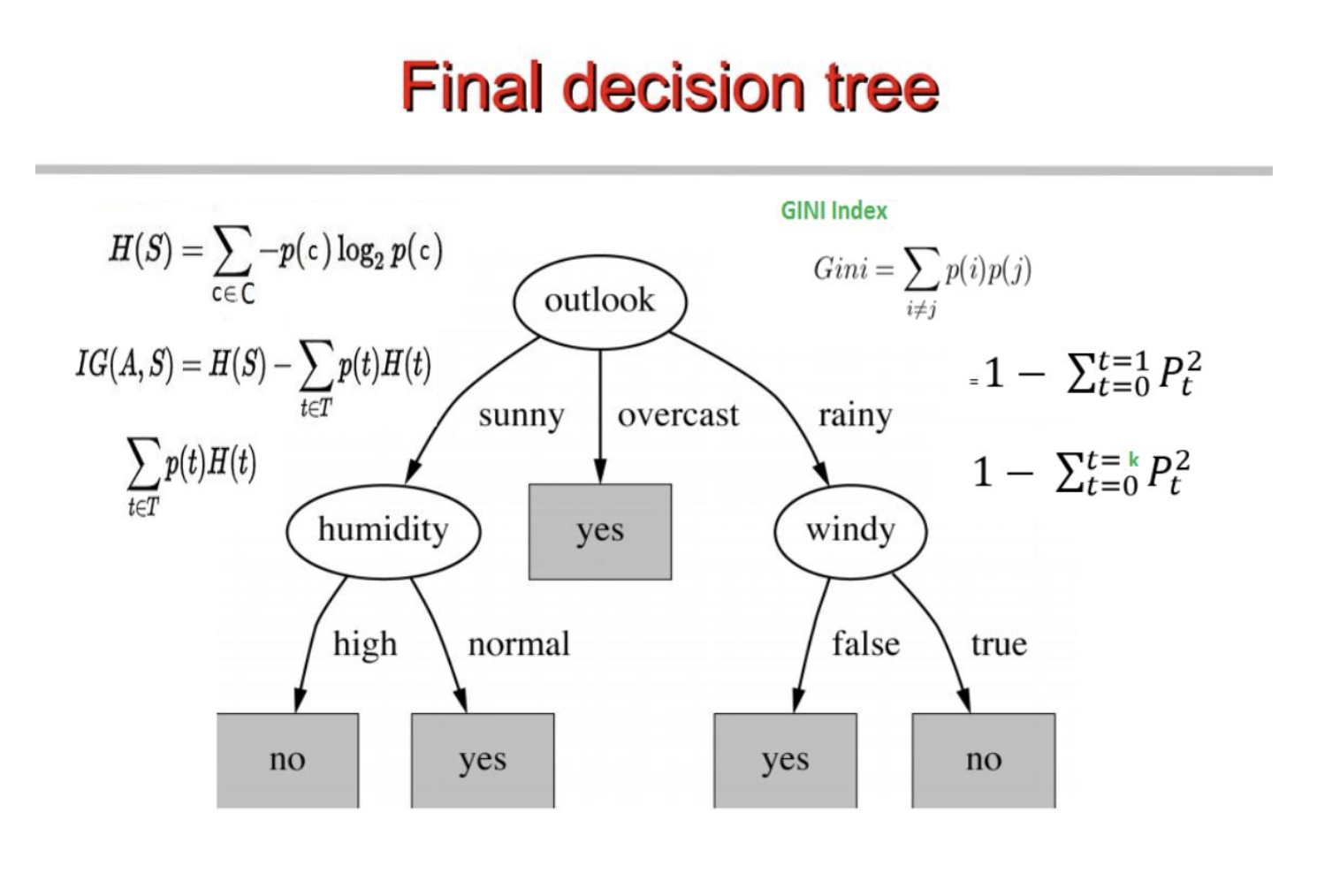
其实这两种算法本质没有任何区别,只是选择node时所用的指标(表达式)不同而已。
机器学习算法 --- Decision Trees Algorithms的更多相关文章
- paper 19 :机器学习算法(简介)
本来看了一天的分类器方面的代码,乱乱的,索性再把最基础的概念拿过来,现总结一下机器学习的算法吧! 1.机器学习算法简述 按照不同的分类标准,可以把机器学习的算法做不同的分类. 1.1 从机器学习问题角 ...
- 机器学习算法 --- Pruning (decision trees) & Random Forest Algorithm
一.Table for Content 在之前的文章中我们介绍了Decision Trees Agorithms,然而这个学习算法有一个很大的弊端,就是很容易出现Overfitting,为了解决此问题 ...
- 机器学习算法之旅A Tour of Machine Learning Algorithms
In this post we take a tour of the most popular machine learning algorithms. It is useful to tour th ...
- 【机器学习算法-python实现】决策树-Decision tree(1) 信息熵划分数据集
(转载请注明出处:http://blog.csdn.net/buptgshengod) 1.背景 决策书算法是一种逼近离散数值的分类算法,思路比較简单,并且准确率较高.国际权威的学术组织,数据挖掘国际 ...
- Logistic Regression vs Decision Trees vs SVM: Part II
This is the 2nd part of the series. Read the first part here: Logistic Regression Vs Decision Trees ...
- Logistic Regression Vs Decision Trees Vs SVM: Part I
Classification is one of the major problems that we solve while working on standard business problem ...
- 在opencv3中的机器学习算法
在opencv3.0中,提供了一个ml.cpp的文件,这里面全是机器学习的算法,共提供了这么几种: 1.正态贝叶斯:normal Bayessian classifier 我已在另外一篇博文中介 ...
- <转>机器学习系列(9)_机器学习算法一览(附Python和R代码)
转自http://blog.csdn.net/han_xiaoyang/article/details/51191386 – 谷歌的无人车和机器人得到了很多关注,但我们真正的未来却在于能够使电脑变得更 ...
- LightGBM详细用法--机器学习算法--周振洋
LightGBM算法总结 2018年08月21日 18:39:47 Ghost_Hzp 阅读数:2360 版权声明:本文为博主原创文章,未经博主允许不得转载. https://blog.csdn.ne ...
随机推荐
- Vue2+Webpack创建vue项目
相比较AngularJS和ReactJS,VueJS一直以轻量级,易上手称道.MVVM的开发模式也使前端从原先的DOM中解放出来,我们在不需要在维护视图和数据的统一上花大量时间,只需要关注于data的 ...
- Codeforces 1106 E. Lunar New Year and Red Envelopes 优先队列+dp
题意大致是Bob新年拿红包,每个红包可以在s-t时间内取,但是取了之后得在d+1时间开始才能继续取红包. 同时他女儿能在m个时间点阻止他取红包,求女儿阻止后Bob取得的w总和最小值. Bob取红包的策 ...
- Linux无法识别Broadcom 802.11abgn无线网卡
折腾了好久,都无法解决 索性后来直接使用的usb外置网卡,勉强能用(使用极其不便) 最后使尽浑身解数,冲着萤火般的希望,好在没有放弃 正解就是下面这 完成重启即可 sudo cp /sys/fir ...
- boost的初步了解
本章介绍了 Boost C++ 库 Asio,它是异步输入输出的核心. 名字本身就说明了一切:Asio 意即异步输入/输出. 该库可以让 C++ 异步地处理数据,且平台独立. 异步数据处理就是指,任务 ...
- 简单说说Vue
Vue.js是这次我们公司迭代项目使用的前端框架之一.我们前端使用的是一个叫Metronic的.Metronic的可以说是bootstrap系列的集合. 当然也用到一个叫layui的,layui的话就 ...
- break,continue,return和exit的区别
1.break break语句的使用场合主要是switch语句和循环结构. 在循环结构中使用break语句,就退出循环,接着执行循环结构下面的第一条语句. 如果在多重嵌套循环中使用break语句,当执 ...
- Verilog HDL与C语言的比较
Verilog HDL与C语言的比较 Verilog HDL是在C语言的基础上发展起来的,因而它保留了C语言所独有的结构特点. 为便于对Verilog HDL有个大致的认识,在这里将它与C语言的异 ...
- [教程] 【【【【odex教程之jar】】】】/system/framework里面的jar做odex g13
dexopt-wrapper core.jar core.odex dexopt-wrapper ext.jar ext.odex dexopt-wrapper framework.jar frame ...
- 【Unix 网络编程】TCP 客户/服务器简单 Socket 程序
建立一个 TCP 连接时会发生下述情形: 1. 服务器必须准备好接受外来的连接.这通常通过调用 socket.bind 和 listen 这三个函数来完成,我们称之为被动打开. 2. 客户通过调用 c ...
- CSS3 Gradient渐变效果
最近看到一遍关于渐变的文章,感觉很好,只是收藏感觉太可惜了,就转载了,好好学习! CSS3 Gradient分为linear-gradient(线性渐变)和radial-gradient(径向渐变). ...