
第26题:LeetCode572:Subtree of Another Tree另一个树的子树
题目描述
给定两个非空二叉树 s 和 t,检验 s 中是否包含和 t 具有相同结构和节点值的子树。s 的一个子树包括 s 的一个节点和这个节点的所有子孙。s 也可以看做它自身的一棵子树。
示例 1:
给定的树 s:
     3

    / \

   4   5

  / \

 1   2
给定的树 t:
   4

  / \

 1   2
返回 true,因为 t 与 s 的一个子树拥有相同的结构和节点值。
示例 2:
给定的树 s:
     3

    / \

   4   5

  / \

 1   2

    /

   0
给定的树 t:
   4

  / \

 1   2
返回 false。
测试用例
// 树中结点含有分叉,树B是树A的子结构

//                  8                8

//              /       \           / \

//             8         7         9   2

//           /   \

//          9     2

//               / \

//              4   7

void Test1()

{

    BinaryTreeNode* pNodeA1 = CreateBinaryTreeNode(8);

    BinaryTreeNode* pNodeA2 = CreateBinaryTreeNode(8);

    BinaryTreeNode* pNodeA3 = CreateBinaryTreeNode(7);

    BinaryTreeNode* pNodeA4 = CreateBinaryTreeNode(9);

    BinaryTreeNode* pNodeA5 = CreateBinaryTreeNode(2);

    BinaryTreeNode* pNodeA6 = CreateBinaryTreeNode(4);

    BinaryTreeNode* pNodeA7 = CreateBinaryTreeNode(7);

    ConnectTreeNodes(pNodeA1, pNodeA2, pNodeA3);

    ConnectTreeNodes(pNodeA2, pNodeA4, pNodeA5);

    ConnectTreeNodes(pNodeA5, pNodeA6, pNodeA7);

    BinaryTreeNode* pNodeB1 = CreateBinaryTreeNode(8);

    BinaryTreeNode* pNodeB2 = CreateBinaryTreeNode(9);

    BinaryTreeNode* pNodeB3 = CreateBinaryTreeNode(2);

    ConnectTreeNodes(pNodeB1, pNodeB2, pNodeB3);

    Test("Test1", pNodeA1, pNodeB1, true);

    DestroyTree(pNodeA1);

    DestroyTree(pNodeB1);

}

// 树中结点含有分叉,树B不是树A的子结构

//                  8                8

//              /       \           / \

//             8         7         9   2

//           /   \

//          9     3

//               / \

//              4   7

void Test2()

{

    BinaryTreeNode* pNodeA1 = CreateBinaryTreeNode(8);

    BinaryTreeNode* pNodeA2 = CreateBinaryTreeNode(8);

    BinaryTreeNode* pNodeA3 = CreateBinaryTreeNode(7);

    BinaryTreeNode* pNodeA4 = CreateBinaryTreeNode(9);

    BinaryTreeNode* pNodeA5 = CreateBinaryTreeNode(3);

    BinaryTreeNode* pNodeA6 = CreateBinaryTreeNode(4);

    BinaryTreeNode* pNodeA7 = CreateBinaryTreeNode(7);

    ConnectTreeNodes(pNodeA1, pNodeA2, pNodeA3);

    ConnectTreeNodes(pNodeA2, pNodeA4, pNodeA5);

    ConnectTreeNodes(pNodeA5, pNodeA6, pNodeA7);

    BinaryTreeNode* pNodeB1 = CreateBinaryTreeNode(8);

    BinaryTreeNode* pNodeB2 = CreateBinaryTreeNode(9);

    BinaryTreeNode* pNodeB3 = CreateBinaryTreeNode(2);

    ConnectTreeNodes(pNodeB1, pNodeB2, pNodeB3);

    Test("Test2", pNodeA1, pNodeB1, false);

    DestroyTree(pNodeA1);

    DestroyTree(pNodeB1);

}

// 树中结点只有左子结点,树B是树A的子结构

//                8                  8

//              /                   /

//             8                   9

//           /                    /

//          9                    2

//         /

//        2

//       /

//      5

void Test3()

{

    BinaryTreeNode* pNodeA1 = CreateBinaryTreeNode(8);

    BinaryTreeNode* pNodeA2 = CreateBinaryTreeNode(8);

    BinaryTreeNode* pNodeA3 = CreateBinaryTreeNode(9);

    BinaryTreeNode* pNodeA4 = CreateBinaryTreeNode(2);

    BinaryTreeNode* pNodeA5 = CreateBinaryTreeNode(5);

    ConnectTreeNodes(pNodeA1, pNodeA2, nullptr);

    ConnectTreeNodes(pNodeA2, pNodeA3, nullptr);

    ConnectTreeNodes(pNodeA3, pNodeA4, nullptr);

    ConnectTreeNodes(pNodeA4, pNodeA5, nullptr);

    BinaryTreeNode* pNodeB1 = CreateBinaryTreeNode(8);

    BinaryTreeNode* pNodeB2 = CreateBinaryTreeNode(9);

    BinaryTreeNode* pNodeB3 = CreateBinaryTreeNode(2);

    ConnectTreeNodes(pNodeB1, pNodeB2, nullptr);

    ConnectTreeNodes(pNodeB2, pNodeB3, nullptr);

    Test("Test3", pNodeA1, pNodeB1, true);

    DestroyTree(pNodeA1);

    DestroyTree(pNodeB1);

}

// 树中结点只有左子结点,树B不是树A的子结构

//                8                  8

//              /                   /

//             8                   9

//           /                    /

//          9                    3

//         /

//        2

//       /

//      5

void Test4()

{

    BinaryTreeNode* pNodeA1 = CreateBinaryTreeNode(8);

    BinaryTreeNode* pNodeA2 = CreateBinaryTreeNode(8);

    BinaryTreeNode* pNodeA3 = CreateBinaryTreeNode(9);

    BinaryTreeNode* pNodeA4 = CreateBinaryTreeNode(2);

    BinaryTreeNode* pNodeA5 = CreateBinaryTreeNode(5);

    ConnectTreeNodes(pNodeA1, pNodeA2, nullptr);

    ConnectTreeNodes(pNodeA2, pNodeA3, nullptr);

    ConnectTreeNodes(pNodeA3, pNodeA4, nullptr);

    ConnectTreeNodes(pNodeA4, pNodeA5, nullptr);

    BinaryTreeNode* pNodeB1 = CreateBinaryTreeNode(8);

    BinaryTreeNode* pNodeB2 = CreateBinaryTreeNode(9);

    BinaryTreeNode* pNodeB3 = CreateBinaryTreeNode(3);

    ConnectTreeNodes(pNodeB1, pNodeB2, nullptr);

    ConnectTreeNodes(pNodeB2, pNodeB3, nullptr);

    Test("Test4", pNodeA1, pNodeB1, false);

    DestroyTree(pNodeA1);

    DestroyTree(pNodeB1);

}

// 树中结点只有右子结点,树B是树A的子结构

//       8                   8

//        \                   \

//         8                   9

//          \                   \

//           9                   2

//            \

//             2

//              \

//               5

void Test5()

{

    BinaryTreeNode* pNodeA1 = CreateBinaryTreeNode(8);

    BinaryTreeNode* pNodeA2 = CreateBinaryTreeNode(8);

    BinaryTreeNode* pNodeA3 = CreateBinaryTreeNode(9);

    BinaryTreeNode* pNodeA4 = CreateBinaryTreeNode(2);

    BinaryTreeNode* pNodeA5 = CreateBinaryTreeNode(5);

    ConnectTreeNodes(pNodeA1, nullptr, pNodeA2);

    ConnectTreeNodes(pNodeA2, nullptr, pNodeA3);

    ConnectTreeNodes(pNodeA3, nullptr, pNodeA4);

    ConnectTreeNodes(pNodeA4, nullptr, pNodeA5);

    BinaryTreeNode* pNodeB1 = CreateBinaryTreeNode(8);

    BinaryTreeNode* pNodeB2 = CreateBinaryTreeNode(9);

    BinaryTreeNode* pNodeB3 = CreateBinaryTreeNode(2);

    ConnectTreeNodes(pNodeB1, nullptr, pNodeB2);

    ConnectTreeNodes(pNodeB2, nullptr, pNodeB3);

    Test("Test5", pNodeA1, pNodeB1, true);

    DestroyTree(pNodeA1);

    DestroyTree(pNodeB1);

}

// 树A中结点只有右子结点,树B不是树A的子结构

//       8                   8

//        \                   \

//         8                   9

//          \                 / \

//           9               3   2

//            \

//             2

//              \

//               5

void Test6()

{

    BinaryTreeNode* pNodeA1 = CreateBinaryTreeNode(8);

    BinaryTreeNode* pNodeA2 = CreateBinaryTreeNode(8);

    BinaryTreeNode* pNodeA3 = CreateBinaryTreeNode(9);

    BinaryTreeNode* pNodeA4 = CreateBinaryTreeNode(2);

    BinaryTreeNode* pNodeA5 = CreateBinaryTreeNode(5);

    ConnectTreeNodes(pNodeA1, nullptr, pNodeA2);

    ConnectTreeNodes(pNodeA2, nullptr, pNodeA3);

    ConnectTreeNodes(pNodeA3, nullptr, pNodeA4);

    ConnectTreeNodes(pNodeA4, nullptr, pNodeA5);

    BinaryTreeNode* pNodeB1 = CreateBinaryTreeNode(8);

    BinaryTreeNode* pNodeB2 = CreateBinaryTreeNode(9);

    BinaryTreeNode* pNodeB3 = CreateBinaryTreeNode(3);

    BinaryTreeNode* pNodeB4 = CreateBinaryTreeNode(2);

    ConnectTreeNodes(pNodeB1, nullptr, pNodeB2);

    ConnectTreeNodes(pNodeB2, pNodeB3, pNodeB4);

    Test("Test6", pNodeA1, pNodeB1, false);

    DestroyTree(pNodeA1);

    DestroyTree(pNodeB1);

}

// 树A为空树

void Test7()

{

    BinaryTreeNode* pNodeB1 = CreateBinaryTreeNode(8);

    BinaryTreeNode* pNodeB2 = CreateBinaryTreeNode(9);

    BinaryTreeNode* pNodeB3 = CreateBinaryTreeNode(3);

    BinaryTreeNode* pNodeB4 = CreateBinaryTreeNode(2);

    ConnectTreeNodes(pNodeB1, nullptr, pNodeB2);

    ConnectTreeNodes(pNodeB2, pNodeB3, pNodeB4);

    Test("Test7", nullptr, pNodeB1, false);

    DestroyTree(pNodeB1);

}

// 树B为空树

void Test8()

{

    BinaryTreeNode* pNodeA1 = CreateBinaryTreeNode(8);

    BinaryTreeNode* pNodeA2 = CreateBinaryTreeNode(9);

    BinaryTreeNode* pNodeA3 = CreateBinaryTreeNode(3);

    BinaryTreeNode* pNodeA4 = CreateBinaryTreeNode(2);

    ConnectTreeNodes(pNodeA1, nullptr, pNodeA2);

    ConnectTreeNodes(pNodeA2, pNodeA3, pNodeA4);

    Test("Test8", pNodeA1, nullptr, false);

    DestroyTree(pNodeA1);

}

// 树A和树B都为空

void Test9()

{

    Test("Test9", nullptr, nullptr, false);

}
考点
1.二叉树遍历
2.递归
3.鲁棒性:每次访问指针要检查是否为nullptr,防御性编程
4.用几个测试用例进行单元测试。
思路
辅助测试代码
BinaryTreeNode* CreateBinaryTreeNode(double dbValue)

{

    BinaryTreeNode* pNode = new BinaryTreeNode();

    pNode->m_dbValue = dbValue;

    pNode->m_pLeft = nullptr;

    pNode->m_pRight = nullptr;

    return pNode;

}

void ConnectTreeNodes(BinaryTreeNode* pParent, BinaryTreeNode* pLeft, BinaryTreeNode* pRight)

{

    if(pParent != nullptr)

    {

        pParent->m_pLeft = pLeft;

        pParent->m_pRight = pRight;

    }

}

void DestroyTree(BinaryTreeNode* pRoot)

{

    if(pRoot != nullptr)

    {

        BinaryTreeNode* pLeft = pRoot->m_pLeft;

        BinaryTreeNode* pRight = pRoot->m_pRight;

        delete pRoot;

        pRoot = nullptr;

        DestroyTree(pLeft);

        DestroyTree(pRight);

    }

}
第一遍
//对于float和double型的小数,无法直接比较大小,判断这两个数相等的做法是:两数之差的绝对值在一个很小的范围内,0.0000001

bool Equal(double num1, double num2)

{

	return ((num1 - num2) > -0.000000001 && (num1 - num2) < 0.00000001) ? true : false;

}

//递归检查根节点下的子树是否结构一样

bool DoesTree1HaveTree2(BinaryTreeNode* pRoot1, BinaryTreeNode* pRoot2)

{

	//技巧2:递归结束条件:大树为空,说明已经遍历完了,说明存在;子树为空,就返回假

	//1.如果B子树为空,返回真,说明已经遍历完子树了

	if (!pRoot2)

		return true;

	//2.如果A子树为空,返回假,说明不匹配

	if (!pRoot1)

		return false;

	//3.如果两个节点不相同,返回假,说明不匹配

	if (!Equal(pRoot1->m_dbValue, pRoot2->m_dbValue))

		return false;

	//4.返回递归调用,各自的左节点和各自的右节点递归

	return DoesTree1HaveTree2(pRoot1->m_pLeft, pRoot2->m_pLeft) && DoesTree1HaveTree2(pRoot1->m_pRight, pRoot2->m_pRight);

}

//是否为子树

bool HasSubtree(BinaryTreeNode* pRoot1, BinaryTreeNode* pRoot2)

{

	//1.如果有空树,返回假

	if (!pRoot1 || !pRoot2)

		return false;

	//2.默认返回结果为假

	bool result = false;

	//3.如果两个根节点相同就判断第二步

	if (Equal( pRoot1->m_dbValue,pRoot2->m_dbValue))//技巧1:小数用定义的函数判断,不用==判断相等。

		result = DoesTree1HaveTree2(pRoot1, pRoot2);

	if (!result)

		//如果不相同,就往左遍历,直到找到第一个相同的根节点

		result = HasSubtree(pRoot1->m_pLeft, pRoot2);

	if (!result)//如果不相同,就往右遍历,直到找到第一个相同的根节点

		result = HasSubtree(pRoot1->m_pRight, pRoot2);

	//4.返回结果

	return result;

}
第二遍(newcoder)
/*

struct TreeNode {

	int val;

	struct TreeNode *left;

	struct TreeNode *right;

	TreeNode(int x) :

			val(x), left(NULL), right(NULL) {

	}

};*/

class Solution {

public:

    bool HasSubtree(TreeNode* pRoot1, TreeNode* pRoot2)

    {

        //1.如果有空树,直接返回

        if(!pRoot1||!pRoot2)

            return false;

        //2.bool 记录结果

        bool result=false;

        //3.如果根节点不相等,result=false

        if(!numCompare(pRoot1,pRoot2))

           result=false;

        else//3.1如果相等,就进行第二步

            result= HasSubtree2( pRoot1,  pRoot2);

        //4.如果result=false,遍历左子树的根节点是否与B树根节点相等

        if(!result)

            result=HasSubtree(pRoot1->left,pRoot2);

        //5.如果result=false,遍历右子树的根节点是否与B树根节点相等

        if(!result)

            result=HasSubtree(pRoot1->right,pRoot2);

        //6.返回result

        return result;

    }

    //递归

    bool HasSubtree2(TreeNode* pRoot1, TreeNode* pRoot2)

    {

        //1.递归结束条件:B树为空,返回真

        if(!pRoot2)

            return true;

        //2.递归结束条件2:A树为空,返回假

        if(!pRoot1)

            return false;

        //3.如果这两个节点相等,分别继续判断左子树和右子树

        if(numCompare(pRoot1,pRoot2))

            return HasSubtree2(pRoot1->left,pRoot2->left)&&HasSubtree2(pRoot1->right,pRoot2->right);

        else

            //如果不相等 返回假

            return false;

    }

    bool numCompare(TreeNode* pRoot1, TreeNode* pRoot2)

    {

        return (pRoot1->val-pRoot2->val)<0.0000001&&(pRoot1->val-pRoot2->val)>-0.0000001?true:false;

    }

};
第三遍(leetcode572)
错误解答:
/**

 * Definition for a binary tree node.

 * struct TreeNode {

 *     int val;

 *     TreeNode *left;

 *     TreeNode *right;

 *     TreeNode(int x) : val(x), left(NULL), right(NULL) {}

 * };

 */

class Solution {

public:

    bool isSubtree(TreeNode* s, TreeNode* t) {

        //1.如果有一个为空,返回假

        if(!s||!t)

            return false;

        //2.记录结果

        bool result=false;

        //3.如果根节点相同

        if(compare(s,t))

            //进入第二步

            result=HasSubtree(s,t);

        //4.如果根节点不同,result=false,遍历左节点

        if(!result)

            result=isSubtree(s->left,t);

        //5.如果S的左树都没有相同的根节点,遍历右树

        if(!result)

            result=isSubtree(s->right,t);

        //6.返回result

        return result;

    }

    //第二步,递归函数,

    bool HasSubtree(TreeNode* s, TreeNode* t)

    {

        //1.如果子树遍历完,返回真

        if(!t)

            return true;

        //2.如果大树遍历完,返回假

        if(!s)

            return false;

        //3.比较根节点大小

        if(compare(s,t))

            //根节点相同,分别遍历左右子树,返回fun(left)&&fun(right)的结果

            return HasSubtree(s->left,t->left)&&HasSubtree(s->right,t->right);

        else

            //否则返回假

            return false;

    }

    //比较小数大小

    bool compare(TreeNode* s,TreeNode* t)

    {

        return (s->val-t->val)<0.0000001&&(s->val-t->val)>-0.0000001?true:false;

}

};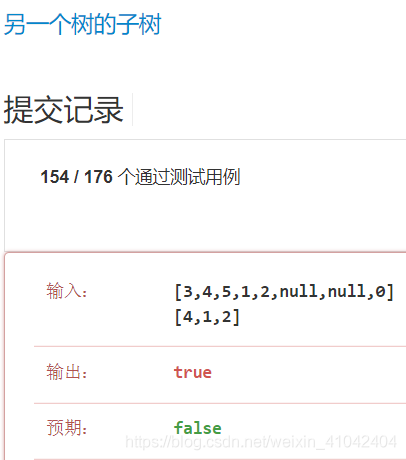
//[3, 4, 5, 1, 2, null, null, 0]
//[4, 1, 2]
// 3
// / \
// 4 5
// / \
// 1 2
// /
// 0[4,1,2]少了一个左孩子0 ,所以不是子树
Q:
为什么输入是
[1,2,3]
[1,2]
预期结果是:false呢?A:
因为【1,2】不是【1,2,3】的子树啊,【1,2,3】的子树是它自身和【2】,【3】
正解:
/**

 * Definition for a binary tree node.

 * struct TreeNode {

 *     int val;

 *     TreeNode *left;

 *     TreeNode *right;

 *     TreeNode(int x) : val(x), left(NULL), right(NULL) {}

 * };

 */

class Solution {

public:

    bool isSameTree(TreeNode*s, TreeNode* t){

    if (!s) return !t;

    if (!t) return false;

    if (s->val != t->val) return false;

    return isSameTree(s->left, t->left) & isSameTree(s->right, t->right);

}

bool isSubtree(TreeNode* s, TreeNode* t) {

    if (!s) return !t;

    if (s->val == t->val && isSameTree(s, t))

        return true;

    return isSubtree(s->left, t) | isSubtree(s->right, t);

}

};
最优解
/**

 * Definition for a binary tree node.

 * struct TreeNode {

 *     int val;

 *     TreeNode *left;

 *     TreeNode *right;

 *     TreeNode(int x) : val(x), left(NULL), right(NULL) {}

 * };

 */

class Solution {

public:

    bool isSameTree(TreeNode* s, TreeNode* t,bool check)

    {

        //1.都为空,返回真

        if(!s&&!t)

            return true;

        //2.只有一个为空,返回假

        if(!s || !t)

            return false;

        //3.如果第一步相同,第二步不同,返回假

         if(check&&s->val!=t->val)

             return false;

        bool ret=false;

        //4.如果根的值相同,&&分别递归遍历左右子树

        if(s->val==t->val)

           ret=isSameTree(s->left,t->left,true)&&isSameTree(s->right,t->right,true);

        //5.ret=ret或左子树或右子树,||

        ret=ret||isSameTree(s->left,t,false)||isSameTree(s->right,t,false);

        //6.返回ret

        return ret;

    }

    bool isSubtree(TreeNode* s, TreeNode* t ) {

        return isSameTree(s,t,false);

    }

};
这道题还可以用序列化二叉树,然后用KMP方法做,树M,子树N,M>=N,时间复杂度O(M)。
后面再贴KMP的做法。
第26题:LeetCode572:Subtree of Another Tree另一个树的子树的更多相关文章
- Leetcode572.Subtree of Another Tree另一个树的子树
给定两个非空二叉树 s 和 t,检验 s 中是否包含和 t 具有相同结构和节点值的子树.s 的一个子树包括 s 的一个节点和这个节点的所有子孙.s 也可以看做它自身的一棵子树. 示例 1: 给定的树 ...
- [LeetCode] Subtree of Another Tree 另一个树的子树
Given two non-empty binary trees s and t, check whether tree t has exactly the same structure and no ...
- LeetCode 572. 另一个树的子树(Subtree of Another Tree) 40
572. 另一个树的子树 572. Subtree of Another Tree 题目描述 给定两个非空二叉树 s 和 t,检验 s 中是否包含和 t 具有相同结构和节点值的子树.s 的一个子树包括 ...
- 【LeetCode】572. 另一个树的子树 Subtree of Another Tree(Python & Java)
作者: 负雪明烛 id: fuxuemingzhu 个人博客: http://fuxuemingzhu.cn/ 目录 题目描述 题目大意 解题方法 方法一:先序遍历 方法二:DFS + DFS 方法三 ...
- [Swift]LeetCode572. 另一个树的子树 | Subtree of Another Tree
Given two non-empty binary trees s and t, check whether tree t has exactly the same structure and no ...
- Leetcode--572. Subtree of Another Tree(easy)
Given two non-empty binary trees s and t, check whether tree t has exactly the same structure and no ...
- LeetCode 572. Subtree of Another Tree (是否是另一个树的子树)
Given two non-empty binary trees s and t, check whether tree t has exactly the same structure and no ...
- LeetCode572. 另一个树的子树
题目 本题目一开始想要通过二叉树遍历KMP匹配,但看来实现比较复杂 不如直接暴力匹配,本题和LeetCode100.相同的树有共通之处 1 class Solution { 2 public: 3 b ...
- 572. Subtree of Another Tree(easy)
Given two non-empty binary trees s and t, check whether tree t has exactly the same structure and no ...
随机推荐
- Observer模式(观察者设计模式)
Observer 设计模式? 在Observer模式中,当观察对象的状态发生变化时,会通知给观察者.Observer模式适用于根据对象状态进行相应处理的场景. Observer 并非主动观察,而是被动 ...
- JavaScript刷新页面,不重复提交
location.replace(location.href);//刷新页面,不重复提交
- 从sql中获取表名
<dependency> <groupId>com.github.jsqlparser</groupId> <artifactId>jsqlparser ...
- DB2的常用数据类型
今天在db2中查询数据时出现错误: Overflow occurred during numeric data type conversion:SQLCODE=-413, SQLSTATE=22003 ...
- C A Simple Job
题目3 : A Simple Job时间限制:1000ms单点时限:1000ms内存限制:256MB描述Institute of Computational Linguistics (ICL), Pe ...
- JavaScript函数体系
第4章 JavaScript函数 1. 函数基本介绍 ① 为什么需要函数 函数最大的好处就是将零散的代码封装到了一起,当我们要再次使用该功能的时候,不需要再重新书写代码,只需要调用封装好的函数就可以 ...
- HAProxy负载均衡安装配置
1.下载HAProxy http://haproxy.1wt.eu/download/1.4/src/haproxy-1.4.22.tar.gz 2. 安装haproxy #tar z ...
- LitePal——安卓数据库library
简介:一个让开发者使用SQLite数据库更加容易的库文件 LitePal for Android,项目地址:点击打开 LitePal是一个开源的android库,它让开发者使用SQLite数据变得容易 ...
- shiro web环境初始化过程
在web工程中使用shiro的时候需要配置一个shiro的listenser(EnvironmentLoaderListener)和一个shiro的filter(ShiroFilter). liste ...
- Magento 中一个订单的“生命历程”
当我们在网上愉快的买买买的时候, 你知道在这些屏幕“背后”正在进行着什么吗? 1. 当一个产品被加入到购物车后, 实际上发生了什么? 当第一个产品被加入到购物车, 系统首先会生成一个 quote (q ...