
RNN 入门教程 Part 1 – RNN 简介
转载 - Recurrent Neural Networks Tutorial, Part 1 – Introduction to RNNs
Recurrent Neural Networks (RNN) 是当前比较流行的模型,在自然语言处理中有很重要的应用。但是现在对RNN的详细结构模型以及如何实现RNN算法的博客很少,故本文目的是翻译该外文资料,帮助理解大家理解。同时,英文文章写的很有深度,而且翻译错误之处可能会很多,有兴趣的可以参阅英文原文。本教程主要分为以下四个部分:
As part of the tutorial we will implement a recurrent neural network based language model. The applications of language models are two-fold: First, it allows us to score arbitrary sentences based on how likely they are to occur in the real world. This gives us a measure of grammatical and semantic correctness. Such models are typically used as part of Machine Translation systems. Secondly, a language model allows us to generate new text (I think that’s the much cooler application). Training a language model on Shakespeare allows us to generate Shakespeare-like text. This fun post by Andrej Karpathy demonstrates what character-level language models based on RNNs are capable of.
I’m assuming that you are somewhat familiar with basic Neural Networks. If you’re not, you may want to head over to Implementing A Neural Network From Scratch, which guides you through the ideas and implementation behind non-recurrent networks.
什么是RNN模型?
The idea behind RNNs is to make use of sequential information. In a traditional neural network we assume that all inputs (and outputs) are independent of each other. But for many tasks that’s a very bad idea. If you want to predict the next word in a sentence you better know which words came before it. RNNs are called recurrent because they perform the same task for every element of a sequence, with the output being depended on the previous computations. Another way to think about RNNs is that they have a “memory” which captures information about what has been calculated so far. In theory RNNs can make use of information in arbitrarily long sequences, but in practice they are limited to looking back only a few steps (more on this later). Here is what a typical RNN looks like:
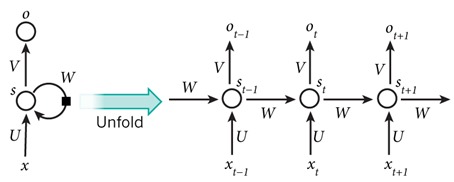
图1.将一个循环神经网络模型RNN按时间序列展开
The above diagram shows a RNN being unrolled (or unfolded) into a full network. By unrolling we simply mean that we write out the network for the complete sequence. For example, if the sequence we care about is a sentence of 5 words, the network would be unrolled into a 5-layer neural network, one layer for each word. The formulas that govern the computation happening in a RNN are as follows:
- $x_t$ 是在时间 $t$ 的输入值. For example, $x_1$ could be a one-hot vector corresponding to the second word of a sentence.
- $s_t$ 是时间$t$ 隐藏层的值. It’s the “memory” of the network. is calculated based on the previous hidden state and the input at the current step: \[s_t=f(Ux_t+Ws_{t-1})\]The function $f$ usually is a nonlinearity such as tanh or ReLU. $s_{-1}$, which is required to calculate the first hidden state, is typically initialized to all zeroes.
- $o_t$ 在时间$t$ 的输出值. For example, if we wanted to predict the next word in a sentence.\[o_t=softmax(Vs_t)\] It would be a vector of probabilities across our vocabulary.

需要注意以下几点:
- 你可以将 hidden state 当作模型 memory. 但是他不能保存较长时间的信息。
- 与传统的神经网络模型不同(每层使用不同的参数),RNN在每次迭代的时候都共享同一组参数($U,V,W$). 这表明,每次计算我们只是输入不同的 $X_t$,其他的参数都是一样的,这种设计方案极大减少了需要学习的参数。
- 每一次迭代(step),都会有一个输出,但我们并不必须使用它.例如,当我们预测一个句子的情感的时候我们可以使用RNN的最后的输出来做预测,而不是输入每一个单词所输出的值做预测(尽管这样也可以) 。这个模型的主要特点就是sequence的所有信息都保存在RNN的hidden state里面。
RNN模型的应用?
RNNs have shown great success in many NLP tasks. At this point I should mention that the most commonly used type of RNNs are LSTMs, which are much better at capturing long-term dependencies than vanilla RNNs are. But don’t worry, LSTMs are essentially the same thing as the RNN we will develop in this tutorial, they just have a different way of computing the hidden state. We’ll cover LSTMs in more detail in a later post. Here are some example applications of RNNs in NLP (by non means an exhaustive list).
语言、文本建模
Given a sequence of words we want to predict the probability of each word given the previous words. Language Models allow us to measure how likely a sentence is, which is an important input for Machine Translation (since high-probability sentences are typically correct). A side-effect of being able to predict the next word is that we get a generative model, which allows us to generate new text by sampling from the output probabilities. And depending on what our training data is we can generate all kinds of stuff. In Language Modeling our input is typically a sequence of words (encoded as one-hot vectors for example), and our output is the sequence of predicted words. When training the network we set $o_t=x_{t+1}$ since we want the output at step to be the actual next word.
相关的语言建模和文本自动生成的论文:
- Recurrent neural network based language model
- Extensions of Recurrent neural network based language model
- Generating Text with Recurrent Neural Networks
机器翻译
Machine Translation is similar to language modeling in that our input is a sequence of words in our source language (e.g. German). We want to output a sequence of words in our target language (e.g. English). A key difference is that our output only starts after we have seen the complete input, because the first word of our translated sentences may require information captured from the complete input sequence.
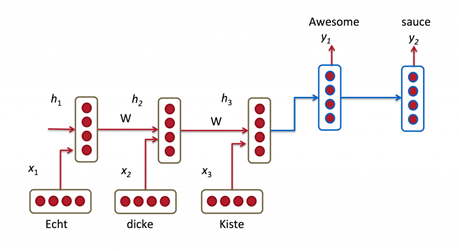
图2. RNN 机器翻译模型
机器翻译的相关论文:
- A Recursive Recurrent Neural Network for Statistical Machine Translation
- Sequence to Sequence Learning with Neural Networks
- Joint Language and Translation Modeling with Recurrent Neural Networks
语音识别
Given an input sequence of acoustic signals from a sound wave, we can predict a sequence of phonetic segments together with their probabilities.
语音识别的相关论文:
Generating Image Descriptions
Together with convolutional Neural Networks, RNNs have been used as part of a model to generate descriptions for unlabeled images. It’s quite amazing how well this seems to work. The combined model even aligns the generated words with features found in the images.
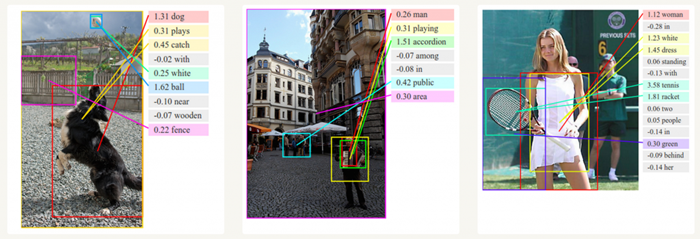
图3. Deep Visual-Semantic Alignments for Generating Image Descriptions.
训练RNN
训练RNN模型和训练传统的Neural Network 十分相似,都是采用 backpropagation算法,只不过在这里稍微一点不同而已。因为整个模型在每个steps都共享参数parameters,计算gradient的时候不只需要计算当前step的值,还要包含前面所有step的gradient的值. For example, in order to calculate the gradient at $t=4$ we would need to backpropagate 3 steps and sum up the gradients. This is called Backpropagation Through Time (BPTT). If this doesn’t make a whole lot of sense yet, don’t worry, we’ll have a whole post on the gory details. For now, just be aware of the fact that vanilla RNNs trained with BPTThave difficulties learning long-term dependencies (e.g. dependencies between steps that are far apart) due to what is called the vanishing/exploding gradient problem. There exists some machinery to deal with these problems, and certain types of RNNs (like LSTMs) were specifically designed to get around them.
RNN 扩展模型
Over the years researchers have developed more sophisticated types of RNNs to deal with some of the shortcomings of the vanilla RNN model. We will cover them in more detail in a later post, but I want this section to serve as a brief overview so that you are familiar with the taxonomy of models.
- 双向RNNs模型: are based on the idea that the output at time may not only depend on the previous elements in the sequence, but also future elements. For example, to predict a missing word in a sequence you want to look at both the left and the right context. Bidirectional RNNs are quite simple. They are just two RNNs stacked on top of each other. The output is then computed based on the hidden state of both RNNs.
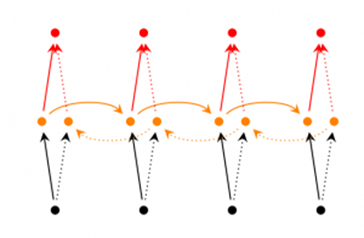
- 堆叠双向RNN模型: are similar to Bidirectional RNNs, only that we now have multiple layers per time step. In practice this gives us a higher learning capacity (but we also need a lot of training data).
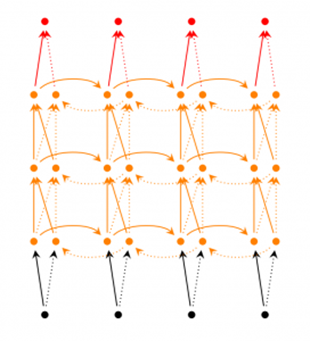
- LSTM 模型: are quite popular these days and we briefly talked about them above. LSTMs don’t have a fundamentally different architecture from RNNs, but they use a different function to compute the hidden state. The memory in LSTMs are called cells and you can think of them as black boxes that take as input the previous state $h_{t-1}$ and current input . Internally these cells decide what to keep in (and what to erase from) memory. They then combine the previous state, the current memory, and the input. In turns out that these types of units are very efficient at capturing long-term dependencies. LSTMs can be quite confusing in the beginning but if you’re interested in learning more this post has an excellent explanation.
结论
到目前为止,我们介绍了基本的RNN模型架构和它的应用领域,在下一篇文章中,我们将将介绍如何使用Python的 numpy 和Theano 分别建立一个RNN算法模型。
如有什么问题,请留言。
RNN 入门教程 Part 1 – RNN 简介的更多相关文章
- RNN 入门教程 Part 3 – 介绍 BPTT 算法和梯度消失问题
转载 - Recurrent Neural Networks Tutorial, Part 3 – Backpropagation Through Time and Vanishing Gradien ...
- WCF入门教程(一)简介
WCF入门教程(一)简介 1.WCF是什么? WCF( Windows Communication Foundation), 是Microsoft为构建面向服务的应用提供的分布式通信编程框架,是.NE ...
- .NetCore微服务Surging新手傻瓜式 入门教程 学习日志---结构简介(二)
原文:.NetCore微服务Surging新手傻瓜式 入门教程 学习日志---结构简介(二) 先上项目解决方案图: 以上可以看出项目结构可以划分为4大块,1是surging的核心底层,2,3,4都可以 ...
- 2018-06-20 中文代码示例视频演示Python入门教程第三章 简介Python
知乎原链 Python 3.6.5官方入门教程中示例代码汉化后演示 对应在线文档: 3. An Informal Introduction to Python 不知如何合集, 请指教. 中文代码示例P ...
- RNN 入门教程 Part 2 – 使用 numpy 和 theano 分别实现RNN模型
转载 - Recurrent Neural Networks Tutorial, Part 2 – Implementing a RNN with Python, Numpy and Theano 本 ...
- RNN 入门教程 Part 4 – 实现 RNN-LSTM 和 GRU 模型
转载 - Recurrent Neural Network Tutorial, Part 4 – Implementing a GRU/LSTM RNN with Python and Theano ...
- TensorFlow 实现 RNN 入门教程
转子:https://www.leiphone.com/news/201705/zW49Eo8YfYu9K03J.html 最近在看RNN模型,为简单起见,本篇就以简单的二进制序列作为训练数据,而不实 ...
- PyTorch快速入门教程七(RNN做自然语言处理)
以下内容均来自: https://ptorch.com/news/11.html word embedding也叫做word2vec简单来说就是语料中每一个单词对应的其相应的词向量,目前训练词向量的方 ...
- (转)WCF入门教程(一)简介
原文系列来自http://www.cnblogs.com/yank/p/3653160.html 1.WCF是什么? WCF( Windows Communication Foundation), 是 ...
随机推荐
- 处理 EF 并发其实就这么简单
最近项目有点闲,终于可以了解点自己想了解的了,以前听同事讲面试的经历总会被问到“如何处理高并发大数据” 乍一听感觉这东西好像很有学问的样子,于是并发这个词在脑海里留深刻印像,而且在自己心中的技术地位也 ...
- 综合使用spring cloud技术实现微服务应用
在之前的章节,我们已经实现了配置服务器.注册服务器.微服务服务端,实现了服务注册与发现.这一章将实现微服务的客户端,以及联调.实现整个spring cloud框架核心应用. 本文属于<7天学会s ...
- C# 序列化与反序列化
我们先说说什么是序列化.所谓的序列化就是把要保存的内容以特定的格式存入某种介质中.比如我们要保存一些数据在下次程序启动的时候再读入.我们一般就是把这个数据写在一个本地的文本中.然后程序启动的时候去读入 ...
- js中各种宽度高度总结
offsetWidth 是对象的可见宽度,包滚动条等边线,会随窗口的显示大小改变 IE6.0.FF1.06+:offsetWidth = width + padding + borderoffsetH ...
- 开发错误12:gradle编译错误:Conflict with dependency com.android.support:support-annotations
在build.gradle中的configurations.all {}下添加:resolutionStrategy.force 'com.android.support:support-annota ...
- ubuntu静态IP配置
1. 修改配置文件/etc/network/interfacesroot@ubuntu:~# sudo gedit /etc/network/interfaces 添加以下内容:auto eth0 ...
- 升級 Centos 6.5 的 php 版本
升級 Centos 6.5 的 php 版本 待會再看 Centos 6.5 的 php 預設是用 5.3.3 這個版本號 最近想要改用 Laravel 4.1 發現需要 5.3.7 才能用,所以 ...
- 类似掌盟的Tab页 Android 开源框架ViewPageIndicator 和 ViewPager 仿网易新闻客户端Tab标签 (转)
原博客地址 :http://blog.csdn.net/xiaanming/article/details/10766053 本文转载,记录学习用,如有需要,请到原作者网站查看(上面这个网址) 之前 ...
- ActiveMQ_监听器(四)
一.本文章包含的内容 1.列举了ActiveMQ中监听器的使用 2.spring+activemq方式 1 2 3 <!-- 消息监听容器(Queue),配置连接工厂,监听的队列是queue3, ...
- 【BZOJ 4516】【SDOI 2016】生成魔咒
http://www.lydsy.com/JudgeOnline/problem.php?id=4516 后缀自动机直接做...省选时cena评测竟然没有卡掉map 每次加一个字符,增加的子串数目为n ...