
Weekly Contest 113
949. Largest Time for Given Digits (string::compare)
Given an array of 4 digits, return the largest 24 hour time that can be made.
The smallest 24 hour time is 00:00, and the largest is 23:59. Starting from 00:00, a time is larger if more time has elapsed since midnight.
Return the answer as a string of length 5. If no valid time can be made, return an empty string.
Example 1:
Input: [1,2,3,4]

Output: "23:41"
Example 2:
Input: [5,5,5,5]

Output: ""
Note:
A.length == 40 <= A[i] <= 9
class Solution {

public:

    string largestTimeFromDigits(vector<int>& A) {

        check(A[0], A[1], A[2], A[3]);

        check(A[0], A[2], A[1], A[3]);

        check(A[0], A[3], A[1], A[2]);

        check(A[1], A[2], A[0], A[3]);

        check(A[1], A[3], A[0], A[2]);

        check(A[2], A[3], A[0], A[1]);

        return ans;

    }

    void check(int h1, int h2, int m1, int m2) {

        string hour = best(h1, h2, 24);

        string minute = best(m1, m2, 60);

        if (hour == "" || minute == "") return ;

        string cand = hour + ":" + minute;

        if (ans.compare(cand) < 0) ans = cand;

    }

    string best(int d1, int d2, int limit) {

        int ans = max(d1*10 + d2 < limit ? d1*10 + d2 : -1,

                      d2*10 + d1 < limit ? d2*10 + d1 : -1);

        string res = "";

        if (ans < 0) return res;

        else {

            if (ans < 10) {

                res += "0";

                res += to_string(ans);

            } else {

                res += to_string(ans);

            }

        }

        return res;

    }

private:

    string ans = "";

};
In this problem, we can use difference functions to solve the sub questions, At the first time I try to use if statement to solve difference case, finally, I failed. It's too complicate to deal with all cases.
And In C we can use strcmp to compare two string (char* str[]), but in C++ we have to use string::compare. if str1.compare(str2) < 0, it represent str1 isn't match with str2, and lower in the compare string.
951. Flip Equivalent Binary Trees
For a binary tree T, we can define a flip operation as follows: choose any node, and swap the left and right child subtrees.
A binary tree X is flip equivalent to a binary tree Y if and only if we can make X equal to Y after some number of flip operations.
Write a function that determines whether two binary trees are flip equivalent. The trees are given by root nodes root1 and root2.
Example 1:
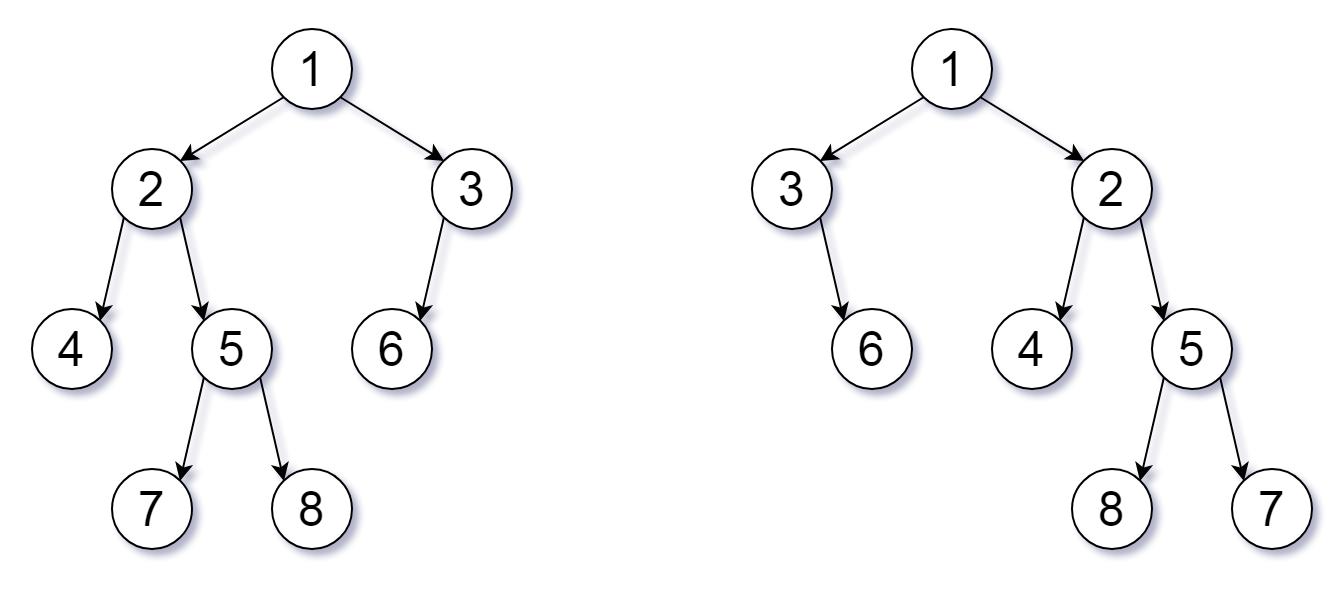
Input: root1 = [1,2,3,4,5,6,null,null,null,7,8], root2 = [1,3,2,null,6,4,5,null,null,null,null,8,7]

Output: true

Explanation: We flipped at nodes with values 1, 3, and 5.
Note:
- Each tree will have at most
100nodes. - Each value in each tree will be a unique integer in the range
[0, 99].
/**

 * Definition for a binary tree node.

 * struct TreeNode {

 *     int val;

 *     TreeNode *left;

 *     TreeNode *right;

 *     TreeNode(int x) : val(x), left(NULL), right(NULL) {}

 * };

 */

class Solution {

public:

    bool flipEquiv(TreeNode* root1, TreeNode* root2) {

        if (root1 == root2)

            return true;

        if (root1 == nullptr || root2 == nullptr || root1->val != root2->val)

            return false;

        return (flipEquiv(root1->left, root2->left) && flipEquiv(root1->right, root2->right) ||

                flipEquiv(root1->left, root2->right) && flipEquiv(root1->right, root2->left));

    }

};
950. Reveal Cards In Increasing Order
In a deck of cards, every card has a unique integer. You can order the deck in any order you want.
Initially, all the cards start face down (unrevealed) in one deck.
Now, you do the following steps repeatedly, until all cards are revealed:
- Take the top card of the deck, reveal it, and take it out of the deck.
- If there are still cards in the deck, put the next top card of the deck at the bottom of the deck.
- If there are still unrevealed cards, go back to step 1. Otherwise, stop.
Return an ordering of the deck that would reveal the cards in increasing order.
The first entry in the answer is considered to be the top of the deck.
Example 1:
Input: [17,13,11,2,3,5,7]

Output: [2,13,3,11,5,17,7]

Explanation:

We get the deck in the order [17,13,11,2,3,5,7] (this order doesn't matter), and reorder it.

After reordering, the deck starts as [2,13,3,11,5,17,7], where 2 is the top of the deck.

We reveal 2, and move 13 to the bottom.  The deck is now [3,11,5,17,7,13].

We reveal 3, and move 11 to the bottom.  The deck is now [5,17,7,13,11].

We reveal 5, and move 17 to the bottom.  The deck is now [7,13,11,17].

We reveal 7, and move 13 to the bottom.  The deck is now [11,17,13].

We reveal 11, and move 17 to the bottom.  The deck is now [13,17].

We reveal 13, and move 17 to the bottom.  The deck is now [17].

We reveal 17.

Since all the cards revealed are in increasing order, the answer is correct.
Note:
1 <= A.length <= 10001 <= A[i] <= 10^6A[i] != A[j]for alli != j
class Solution {

public:

    vector<int> deckRevealedIncreasing(vector<int>& deck) {

        int N = deck.size();

        queue<int> q;

        for (int i = 0; i < N; ++i) {

            q.push(i);

        }

        vector<int> ans(N);

        sort(deck.begin(), deck.end());

        for (int card : deck) {

            ans[q.front()] = card;

            if (!q.empty()) {

                q.pop();

                q.push(q.front());

                q.pop();

            }

        }

        return ans;

    }

};
It's very clever to use a queue to simulation the process.
952. Largest Component Size by Common Factor
Given a non-empty array of unique positive integers A, consider the following graph:
- There are
A.lengthnodes, labelledA[0]toA[A.length - 1]; - There is an edge between
A[i]andA[j]if and only ifA[i]andA[j]share a common factor greater than 1.
Return the size of the largest connected component in the graph.
Example 1:
Input: [4,6,15,35]

Output: 4

Example 2:
Input: [20,50,9,63]

Output: 2

Example 3:
Input: [2,3,6,7,4,12,21,39]

Output: 8

Note:
1 <= A.length <= 200001 <= A[i] <= 100000
class Solution {

    public int largestComponentSize(int[] A) {

        int N = A.length;

        ArrayList<Integer>[] factored = new ArrayList[N];

        for (int i = 0; i < N; ++i) {

            factored[i] = new ArrayList<Integer>();

            int d = 2, x = A[i];

            while (d * d <= x) {

                if (x % d == 0) {

                    while (x % d == 0)

                        x /= d;

                    factored[i].add(d);

                }

                d++;

            }

            if (x > 1 || factored[i].isEmpty())

                factored[i].add(x);

        }

        Set<Integer> primes = new HashSet();

        for (List<Integer> facs : factored)

            for (int x : facs)

                primes.add(x);

        int[] primesL = new int[primes.size()];

        int t = 0;

        for (int x : primes)

            primesL[t++] = x;

        Map<Integer, Integer> primeToIndex = new HashMap();

        for (int i = 0; i < primesL.length; ++i) {

            primeToIndex.put(primesL[i], i);

        }

        DSU dsu = new DSU(primesL.length);

        for (List<Integer> facs : factored)

            for (int x : facs)

                dsu.union(primeToIndex.get(facs.get(0)), primeToIndex.get(x));

        int[] count = new int[primesL.length];

        for (List<Integer> facs : factored)

            count[dsu.find(primeToIndex.get(facs.get(0)))]++;

        int ans = 0;

        for (int x : count)

            if (x > ans)

                ans = x;

        return ans;

    }

}

class DSU {

    int[] parent;

    public DSU(int N) {

        parent = new int[N];

        for (int i = 0; i < N; ++i) {

            parent[i] = i;

        }

    }

    public int find(int x) {

        if (parent[x] != x)

            parent[x] = find(parent[x]);

        return parent[x];

    }

    public void union(int x, int y) {

        parent[find(x)] = find(y);

    }

}
To be honset, I can't understand it.
Weekly Contest 113的更多相关文章
- LeetCode Weekly Contest 8
LeetCode Weekly Contest 8 415. Add Strings User Accepted: 765 User Tried: 822 Total Accepted: 789 To ...
- Leetcode Weekly Contest 86
Weekly Contest 86 A:840. 矩阵中的幻方 3 x 3 的幻方是一个填充有从 1 到 9 的不同数字的 3 x 3 矩阵,其中每行,每列以及两条对角线上的各数之和都相等. 给定一个 ...
- leetcode weekly contest 43
leetcode weekly contest 43 leetcode649. Dota2 Senate leetcode649.Dota2 Senate 思路: 模拟规则round by round ...
- LeetCode Weekly Contest 23
LeetCode Weekly Contest 23 1. Reverse String II Given a string and an integer k, you need to reverse ...
- LeetCode之Weekly Contest 91
第一题:柠檬水找零 问题: 在柠檬水摊上,每一杯柠檬水的售价为 5 美元. 顾客排队购买你的产品,(按账单 bills 支付的顺序)一次购买一杯. 每位顾客只买一杯柠檬水,然后向你付 5 美元.10 ...
- LeetCode Weekly Contest
链接:https://leetcode.com/contest/leetcode-weekly-contest-33/ A.Longest Harmonious Subsequence 思路:hash ...
- LeetCode Weekly Contest 47
闲着无聊参加了这个比赛,我刚加入战场的时候时间已经过了三分多钟,这个时候已经有20多个大佬做出了4分题,我一脸懵逼地打开第一道题 665. Non-decreasing Array My Submis ...
- 75th LeetCode Weekly Contest Champagne Tower
We stack glasses in a pyramid, where the first row has 1 glass, the second row has 2 glasses, and so ...
- LeetCode之Weekly Contest 102
第一题:905. 按奇偶校验排序数组 问题: 给定一个非负整数数组 A,返回一个由 A 的所有偶数元素组成的数组,后面跟 A 的所有奇数元素. 你可以返回满足此条件的任何数组作为答案. 示例: 输入: ...
随机推荐
- http://blog.csdn.net/wh211212/article/details/53005321
http://blog.csdn.net/wh211212/article/details/53005321
- gitPermission denied (publickey).
$ git clone git@github.com:DavidWanderer/test1.git Cloning into 'test1'... Warning: Permanently adde ...
- PAT 甲级 1041. Be Unique (20) 【STL】
题目链接 https://www.patest.cn/contests/pat-a-practise/1041 思路 可以用 map 标记 每个数字的出现次数 然后最后再 遍历一遍 找到那个 第一个 ...
- 计算机行业工作者-->面试的总结博文(【*持续补充】)
1.博文题目:找实习/工作经验心得分享-偏IT技术向 http://blog.csdn.net/koudaidai/article/details/8063288 2.博文题目:百度,阿里 笔试面试 ...
- TopCoder SRM420 Div1 RedIsGood —— 期望
题目链接:https://vjudge.net/problem/TopCoder-9915 (论文上的题) 题解: 更正:, i>0, j>0 代码如下: #include <ios ...
- Contiki进程间的交互
之前都是从各个模块开始看起,从底层开始看起.应该改变一下思路,从高往下看,站得高看得远. 一.Main函数 源码:contiki-release-2-7\platform\stm32test\cont ...
- python循环次数的使用
a=[str(i) for i in range(88888,88912)] b=[str(i) for i in range(77777,77785)] def f(a,b,k=0,m=0): n= ...
- python读取文件后切片
from itertools import islice with open(“1.txt") as f: for a in islice(f,0,2): print(a)
- 简洁多用途SuperSlide插件—tab标签样式
简洁多用途SuperSlide插件—tab标签切换代码样式,由huiyi8素材网提供. 源码:http://www.huiyi8.com/tab/
- Facebook的实时流处理技术——Scuba是Facebook的一个非常快速、分布式的内存数据库,用于实时分析和查询
Scuba,Facebook的一个非常快速.分布式的内存数据库,用于实时分析和查询.是Facebook的回归分析代码.错误报告监控.广告收入监控和性能调试的背后主力. Facebook的实时流处理技术 ...