
[POJ 1204]Word Puzzles(Trie树暴搜&AC自己主动机)
Description
perception of any possible delay in bringing them their order.
Even though word puzzles may be entertaining to solve by hand, they may become boring when they get very large. Computers do not yet get bored in solving tasks, therefore we thought you could devise a program to speedup (hopefully!) solution finding in such
puzzles.
The following figure illustrates the PizzaHut puzzle. The names of the pizzas to be found in the puzzle are: MARGARITA, ALEMA, BARBECUE, TROPICAL, SUPREMA, LOUISIANA, CHEESEHAM, EUROPA, HAVAIANA, CAMPONESA.
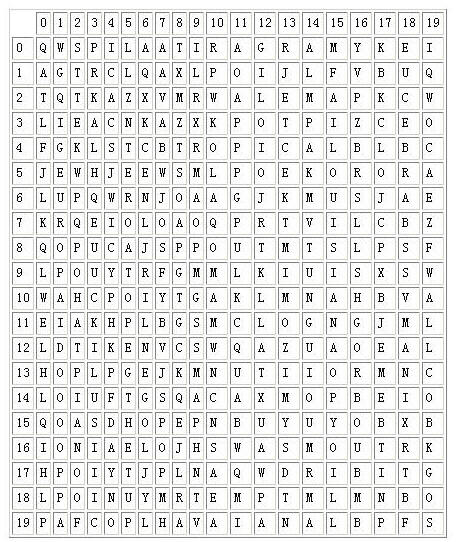
Your task is to produce a program that given the word puzzle and words to be found in the puzzle, determines, for each word, the position of the first letter and its orientation in the puzzle.
You can assume that the left upper corner of the puzzle is the origin, (0,0). Furthemore, the orientation of the word is marked clockwise starting with letter A for north (note: there are 8 possible directions in total).
Input
size C characters, contain the word puzzle. Then at last the W words are input one per line.
Output
of the word according to the rules define above. Each value in the triplet must be separated by one space only.
Sample Input
20 20 10

QWSPILAATIRAGRAMYKEI

AGTRCLQAXLPOIJLFVBUQ

TQTKAZXVMRWALEMAPKCW

LIEACNKAZXKPOTPIZCEO

FGKLSTCBTROPICALBLBC

JEWHJEEWSMLPOEKORORA

LUPQWRNJOAAGJKMUSJAE

KRQEIOLOAOQPRTVILCBZ

QOPUCAJSPPOUTMTSLPSF

LPOUYTRFGMMLKIUISXSW

WAHCPOIYTGAKLMNAHBVA

EIAKHPLBGSMCLOGNGJML

LDTIKENVCSWQAZUAOEAL

HOPLPGEJKMNUTIIORMNC

LOIUFTGSQACAXMOPBEIO

QOASDHOPEPNBUYUYOBXB

IONIAELOJHSWASMOUTRK

HPOIYTJPLNAQWDRIBITG

LPOINUYMRTEMPTMLMNBO

PAFCOPLHAVAIANALBPFS

MARGARITA

ALEMA

BARBECUE

TROPICAL

SUPREMA

LOUISIANA

CHEESEHAM

EUROPA

HAVAIANA

CAMPONESA
Sample Output
0 15 G

2 11 C

7 18 A

4 8 C

16 13 B

4 15 E

10 3 D

5 1 E

19 7 C

11 11 H
Source
1、Trie树暴搜,能够说是Trie模板题,将单词插入Trie树后,以地图上每一个点作为起点。8个方向搜索单词就可以,WA了6发,总算AC了,须要注意的就是当眼下的单词已经搜到尽头(终止节点),不要停止搜索!
#include <stdio.h>

#include <iostream>

#include <string>

#include <string.h>

#define WORD 26

#define MAXN 1050

using namespace std;

struct trie

{

	trie *child[WORD]; //儿子节点指针

	int id; //若该节点为某单词的终止节点,id=该单词编号

	trie(){

		memset(child,0,sizeof(child)); //儿子节点初始化为空

		id=-1;

	}

}; //root=根节点

trie *root=new trie();

int dx[]={-1,-1,0,1,1,1,0,-1};

int dy[]={0,1,1,1,0,-1,-1,-1}; //搜索方向,暴力枚举每一个点八个方向

int ans[MAXN][3],visit[MAXN],L,C,W; //第i个单词的位置=(ans[i][1],ans[i][2]),方向为ans[i][0]

string c[MAXN],word; //保存全部字符串的矩阵

void build(string s,int num) //将编号为num的字符串s插入trie树中

{

	int i;

	trie *p=root; //初始时p指向根节点

	for(i=0;i<s.size();i++)

	{

		if(p->child[s[i]-'A']==NULL) //无现成的字符串相应位置儿子节点

			p->child[s[i]-'A']=new trie();

		p=p->child[s[i]-'A']; //将指针移向当前节点以下的相应儿子节点

	}

	p->id=num; //记下终止节点的相应单词编号

}

void search(int sx,int sy,int dir) //搜索trie树,单词起点(sx,sy),延伸方向为dir

{

	int xx=sx,yy=sy; //当前单词字母的坐标(xx,yy)

	trie *point=root; //point指向当前trie树的节点

	while(xx>=0&&xx<L&&yy>=0&&yy<C) //坐标未越界

	{

		if(!point->child[c[xx][yy]-'A']) //到达了终止节点,但单词还没结束

			break;

		else

			point=point->child[c[xx][yy]-'A']; //指针向该节点下方移动

		if(point->id!=-1) //该节点为终止节点

		{

			if(visit[point->id]==0)

			{

				visit[point->id]=1;

				ans[point->id][0]=dir; //记录下该单词的開始坐标、方向

				ans[point->id][1]=sx;

				ans[point->id][2]=sy;

			}

		}

		xx+=dx[dir]; //移动坐标

		yy+=dy[dir];

	}

}

int main()

{

	int i,j,k;

	scanf("%d%d%d",&L,&C,&W);

	for(i=0;i<L;i++)

	{

		cin>>c[i];

	}

	for(i=0;i<W;i++)

	{

		cin>>word;

		build(word,i); //将单词插入trie树

	}

	for(i=0;i<L;i++) //枚举起点(i,j)

		for(j=0;j<C;j++)

			for(k=0;k<8;k++) //暴力枚举单词存在的方向

				search(i,j,k);

	for(i=0;i<W;i++)

		printf("%d %d %c\n",ans[i][1],ans[i][2],ans[i][0]+'A');

	return 0;

}
2、AC自己主动机。Trie树暴力的方法由于是从地图上每一个点開始搜。并且Trie树失配后就必须回到根节点又一次来过。所以复杂度太高,能够直接用AC自己主动机。利用AC自己主动机能够将字符串的后缀和模式串匹配的特点。从地图的四个边上的点作为起点,向八个方向匹配就可以,加之匹配过程中失配后能够沿着失败指针向上走,不必直接到根节点重头来,因此复杂度比第一种方法低不少,可是代码也太长太复杂(140行)
#include <stdio.h>

#include <iostream>

#include <queue>

#include <string>

#include <string.h>

#define WORD 26

#define MAXN 1050

using namespace std;

struct trie

{

	trie *child[WORD]; //儿子节点指针

	trie *fail; //失败指针(前缀指针)

	int id; //若该节点为某单词的终止节点,id=该单词编号

	trie()

	{

		memset(child,0,sizeof(child)); //儿子节点初始化为空

		fail=NULL;

		id=-1;

	}

}tree[MAXN*100]; //root=根节点

int dx[]={-1,-1,0,1,1,1,0,-1};

int dy[]={0,1,1,1,0,-1,-1,-1}; //搜索方向,暴力枚举每一个点八个方向

int ans[MAXN][3],len[MAXN],L,C,W,nNodesCount=0; //第i个单词的位置=(ans[i][1],ans[i][2]),方向为ans[i][0],nNodeCounts=节点个数

string c[MAXN],word; //保存全部字符串的矩阵

void build(trie *pRoot,string s,int num) //将编号为num的字符串s插入树根为pRoot的trie树中

{

	int i;

	len[num]=s.size();

	for(i=0;s[i];i++)

	{

		if(pRoot->child[s[i]-'A']==NULL) //无现成的字符串相应位置儿子节点

		{

			pRoot->child[s[i]-'A']=tree+nNodesCount;

			nNodesCount++; //节点个数+1

		}

		pRoot=pRoot->child[s[i]-'A']; //将指针移向当前节点以下的相应儿子节点

	}

	pRoot->id=num; //记下终止节点的相应单词编号

}

void acAutomation() //搭建前缀指针,构造AC自己主动机

{

	int i;

	for(i=0;i<WORD;i++)

		tree[0].child[i]=tree+1; //让第0个节点的全部儿子节点都指向第一个节点,即不论什么单词都能从根节点匹配下去

	tree[0].fail=NULL; //根节点的失败指针指向空

	tree[1].fail=tree; //第一个节点的失败指针指向根节点

	trie *pRoot,*point;

	queue<trie*>q;

	q.push(tree+1); //将第一个节点入队

	while(!q.empty()) //队列不为空

	{

		pRoot=q.front();

		q.pop(); //队首出队

		for(i=0;i<WORD;i++) //遍历该节点的儿子

		{

			point=pRoot->child[i]; //point=单词当前字母相应的儿子

			if(point)

			{

				trie *pPrev=pRoot->fail; //失败指针指向的节点

				while(pPrev) //当指向的节点不为空,不断向上爬

				{

					if(pPrev->child[i]) //指向的节点能匹配

					{

						point->fail=pPrev->child[i]; //将该节点的失败指针指向失败指针指向的节点的能够匹配的儿子节点

						break;

					}

					else

						pPrev=pPrev->fail; //无法匹配,向该失败指针指向的节点的失败指针往上爬

				}

				q.push(point); //该节点入队

			}

		}

	}

}

void ACsearch(int sx,int sy,int dir) //搜索,单词起点(sx,sy),延伸方向为dir

{

	int i,xx=sx,yy=sy;

	trie *point=tree+1;

	while(xx>=0&&xx<L&&yy>=0&&yy<C)

	{

		while(1)

		{

			if(point->child[c[xx][yy]-'A']) //该节点的儿子节点能够匹配

			{

				point=point->child[c[xx][yy]-'A']; //指针向儿子移动

				if(point->id!=-1) //指针相应节点为危急节点,则匹配成功,记录答案

				{

					ans[point->id][0]=dir; //记录下该单词的開始坐标、方向

					ans[point->id][1]=xx-(len[point->id]-1)*dx[dir];

					ans[point->id][2]=yy-(len[point->id]-1)*dy[dir];

				}

				break;

			}

			else

				point=point->fail; //否则。无法匹配,向失败指针移动

		}

		xx+=dx[dir];

		yy+=dy[dir];

	}

}

int main()

{

	int i,j,k;

	nNodesCount=2;

	scanf("%d%d%d",&L,&C,&W);

	for(i=0;i<L;i++) cin>>c[i];

	for(i=0;i<W;i++)

	{

		cin>>word;

		build(tree+1,word,i); //将单词插入trie树

	}

	acAutomation(); //插入失败指针,构造AC自己主动机

	for(i=0;i<L;i++)

		for(j=0;j<8;j++)

			ACsearch(i,0,j);

	for(i=0;i<L;i++)

		for(j=0;j<8;j++)

			ACsearch(i,C-1,j);

	for(i=0;i<C;i++)

		for(j=0;j<8;j++)

			ACsearch(0,i,j);

	for(i=0;i<C;i++)

		for(j=0;j<8;j++)

			ACsearch(L-1,i,j);

	for(i=0;i<W;i++)

		printf("%d %d %c\n",ans[i][1],ans[i][2],ans[i][0]+'A');

	return 0;

}
[POJ 1204]Word Puzzles(Trie树暴搜&AC自己主动机)的更多相关文章
- poj 1204 Word Puzzles(字典树)
题目链接:http://poj.org/problem?id=1204 思路分析:由于题目数据较弱,使用暴力搜索:对于所有查找的单词建立一棵字典树,在图中的每个坐标,往8个方向搜索查找即可: 需要注意 ...
- 【 POJ - 1204 Word Puzzles】(Trie+爆搜|AC自动机)
Word Puzzles Time Limit: 5000MS Memory Limit: 65536K Total Submissions: 10782 Accepted: 4076 Special ...
- POJ 1204 Word Puzzles(AC自动机)
这题的数据卡在,如下: 5 5 3 ABCDE FGHIJ KLMNO PQRST UVWXY PQR RS RST puzzle中间的行中可以包含要查询的多个单词.这个问题很好解决,SearchDf ...
- [poj] 1204 Word Puzzles || AC自动机
原题 给个X*Y的字符串矩阵,W个询问,对每个询问输出这个串出现的位置及方向,共有8个方向,顺时针开始分别用A~H表示 AC自动机的板子题. 对于待匹配串建一个自动机,然后从矩阵的四周分别沿八个方向跑 ...
- POJ 1204 Word Puzzles | AC 自动鸡
题目: 给一个字母矩阵和几个模式串,矩阵中的字符串可以有8个方向 输出每个模式串开头在矩阵中出现的坐标和这个串的方向 题解: 我们可以把模式串搞成AC自动机,然后枚举矩阵最外围一层的每个字母,向八个方 ...
- PKU 1204 Word Puzzles(AC自动机)
题目大意:原题链接 给定一个字符串矩阵和待查找的单词,可以朝8个不同的方向查找,输出待查找单词第一个字母在矩阵中出现的位置和该单词被查到的方向. A~H代表8个不同的方向,A代表正北方向,其他依次以4 ...
- poj 2778 AC自己主动机 + 矩阵高速幂
// poj 2778 AC自己主动机 + 矩阵高速幂 // // 题目链接: // // http://poj.org/problem?id=2778 // // 解题思路: // // 建立AC自 ...
- BZOJ 1212 HNOI2004 L语言 AC自己主动机(Trie树)+动态规划
标题效果:给定词的列表,并m串 每个字符串q个最长前缀,这个前缀可满足拆分成一些字符串 这些字符串中存在的词汇太 再也不怕错误的数据范围--有一个很明显Trie树能解决的问题竟然被我写的AC自己主动机 ...
- BZOJ 3172 [Tjoi2013]单词 AC自己主动机(fail树)
题意:链接 方法:AC自己主动机与fail树性质 解析:复习AC自己主动机的第一道题?(真正的第一题明明是又一次写了遍hdu2222! ) 这题说实话第一眼看上去就是个sb题,仅仅要建出来自己主动机. ...
随机推荐
- Node.js(二)----安装Cnpm
---恢复内容开始--- 1.安装CNPM 因为天草的 Great Wall 导致下载速度龟速....所以安装Cnpm淘宝镜像 2.命令 2.1 如果版本合适 设置镜像地址 npm config se ...
- mysql 常用函数,基本使用
1:选中排除表1 连接表2 表3 获取选中表1中部分选中表3 的部分 并且设置选中状态select t1.*,if(t2中t3id=t1.id,1,0)as checked from t1 lefet ...
- 数据分析处理库Pandas——时间
时间戳 向后推的时间戳 备注:五天后的时间. 指定日期和时间 时间的Series结构 按要求显示时间(开始时间,时间间隔,时间个数) 转换为时间格式,并设置时间列为索引列 方法一 方法二 筛选显示 方 ...
- python基础,导入模块,if语句,while语句
python基础 python代码 变为字节码 变为机器码 最后执行执行‘文件名.py’文件时出现的‘文件名.pyc’文件为字节码 缓存机制 使用pycharm的时候在文件最开始添加下面这两行代码,中 ...
- 网站mysql防止sql注入攻击 3种方法总结
mysql数据库一直以来都遭受到sql注入攻击的影响,很多网站,包括目前的PC端以及手机端都在使用php+mysql数据库这种架构,大多数网站受到的攻击都是与sql注入攻击有关,那么mysql数据库如 ...
- Kubernetes-Envoy(一种全新的Ingress实现方式)
Ingress 在讲Envoy之前,先介绍一下Kubernetes中Service的表现形式为IP:Port,及工作在Ingress:TCP/IP层.而对于基于HTTP的服务来说,不同的URL地址经常 ...
- SIMD数据并行(三)——图形处理单元(GPU)
在计算机体系中,数据并行有两种实现路径:MIMD(Multiple Instruction Multiple Data,多指令流多数据流)和SIMD(Single Instruction Multip ...
- Oozie Coordinator job 之定时任务
使用 Coordinator job 可以执行定时任务和时间触发执行 需要注意的是 Oozie 默认使用的时区与中国时区不是一致的,需要进行一点修改 1.关于时区 a.修改 core-site.xml ...
- xss挑战赛小记 0x01(xsstest)
0x00 今天在先知社区看到了一个xss挑战赛 结果发现比赛已经结束 服务器也关了 百度找了个xss挑战赛来玩一下 正好印证下xss的学习--- 地址 http://test.xss.tv/ ...
- nginx proxy_cache缓存详解
目录 1. 关于缓冲区指令 1.1 proxy_buffer_size 1.2 proxy_buffering 1.3 proxy_buffers 1.4 proxy_busy_buffers_siz ...