
Weekly Contest 117
965. Univalued Binary Tree
A binary tree is univalued if every node in the tree has the same value.
Return true if and only if the given tree is univalued.
Example 1:
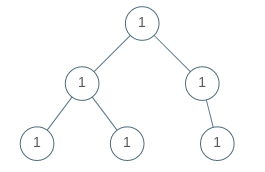
Input: [1,1,1,1,1,null,1]

Output: true
Example 2:
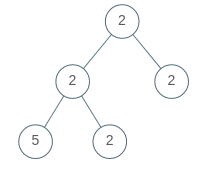
Input: [2,2,2,5,2]

Output: false
Note:
- The number of nodes in the given tree will be in the range
[1, 100]. - Each node's value will be an integer in the range
[0, 99].
Code:
/**

 * Definition for a binary tree node.

 * struct TreeNode {

 *     int val;

 *     TreeNode *left;

 *     TreeNode *right;

 *     TreeNode(int x) : val(x), left(NULL), right(NULL) {}

 * };

 */

class Solution {

public:

    bool isUnivalTree(TreeNode* root) {

        solve(root, root->val);

        return ans;

    }

    void solve(TreeNode* root, int num) {

        if (root->val != num) ans = false;

        if (root->left != NULL) solve(root->left, num);

        if (root->right != NULL) solve(root->right, num);

    }

private:

    bool ans = true;

};
967. Numbers With Same Consecutive Differences
Return all non-negative integers of length N such that the absolute difference between every two consecutive digits is K.
Note that every number in the answer must not have leading zeros except for the number 0 itself. For example, 01 has one leading zero and is invalid, but 0 is valid.
You may return the answer in any order.
Example 1:
Input: N = 3, K = 7

Output: [181,292,707,818,929]

Explanation: Note that 070 is not a valid number, because it has leading zeroes.
Example 2:
Input: N = 2, K = 1

Output: [10,12,21,23,32,34,43,45,54,56,65,67,76,78,87,89,98]
Code:
class Solution {

public:

    vector<int> numsSameConsecDiff(int N, int K) {

        vector<int> ans;

        if (N == 1) {

            for (int i = 0; i < 10; ++i)

                ans.push_back(i);

            return ans;

        }

        for (int i = 1; i < 10; ++i) {

            string s = to_string(i);

            dfs(s, N, K, ans);

        }

        return ans;

    }

    void dfs(string s, const int N, const int K, vector<int>& ans) {

        if (s.length() == N) {

            ans.push_back(stoi(s));

            return ;

        }

        int lastNum = s[s.length()-1] - '0';

        int temp = lastNum + K;

        string dummy = s;

        if (temp >= 0 && temp < 10) {

            dummy += to_string(temp);

            dfs(dummy, N, K, ans);

        }

        if (K != 0) {

            int temp = lastNum - K;

            if (temp >= 0 && temp < 10) {

                s += to_string(temp);

                dfs(s, N, K, ans);

            }

        }

    }

};
966. Vowel Spellchecker
Given a wordlist, we want to implement a spellchecker that converts a query word into a correct word.
For a given query word, the spell checker handles two categories of spelling mistakes:
- Capitalization: If the query matches a word in the wordlist (case-insensitive), then the query word is returned with the same case as the case in the wordlist.
- Example:
wordlist = ["yellow"],query = "YellOw":correct = "yellow" - Example:
wordlist = ["Yellow"],query = "yellow":correct = "Yellow" - Example:
wordlist = ["yellow"],query = "yellow":correct = "yellow"
- Example:
- Vowel Errors: If after replacing the vowels ('a', 'e', 'i', 'o', 'u') of the query word with any vowel individually, it matches a word in the wordlist (case-insensitive), then the query word is returned with the same case as the match in the wordlist.
- Example:
wordlist = ["YellOw"],query = "yollow":correct = "YellOw" - Example:
wordlist = ["YellOw"],query = "yeellow":correct = ""(no match) - Example:
wordlist = ["YellOw"],query = "yllw":correct = ""(no match)
- Example:
In addition, the spell checker operates under the following precedence rules:
- When the query exactly matches a word in the wordlist (case-sensitive), you should return the same word back.
- When the query matches a word up to capitlization, you should return the first such match in the wordlist.
- When the query matches a word up to vowel errors, you should return the first such match in the wordlist.
- If the query has no matches in the wordlist, you should return the empty string.
Given some queries, return a list of words answer, where answer[i] is the correct word for query = queries[i].
Example 1:
Input: wordlist = ["KiTe","kite","hare","Hare"], queries = ["kite","Kite","KiTe","Hare","HARE","Hear","hear","keti","keet","keto"]

Output: ["kite","KiTe","KiTe","Hare","hare","","","KiTe","","KiTe"]
Note:
1 <= wordlist.length <= 50001 <= queries.length <= 50001 <= wordlist[i].length <= 71 <= queries[i].length <= 7- All strings in
wordlistandqueriesconsist only of english letters.
Code:
class Solution {

public:

    vector<string> spellchecker(vector<string>& wordlist, vector<string>& queries) {

        unordered_map<string, vector<string>> seen, tran;

        unordered_set<string> matches;

        for (int i = 0; i < wordlist.size(); ++i) {

            string temp_tolower = _tolower(wordlist[i]);

            string temp_todev = _todev(wordlist[i]);

            seen[temp_tolower].push_back(wordlist[i]);

            tran[temp_todev].push_back(wordlist[i]);

            matches.insert(wordlist[i]);

        }

        vector<string> ans;

        for (int i = 0; i < queries.size(); ++i) {

            // match

            if (matches.count(queries[i])) {

                ans.push_back(queries[i]);

                continue;

            }

            string temp = _tolower(queries[i]);

            // capitalization

            if (seen.count(temp)) {

                ans.push_back(seen[temp][0]);

                continue;

            }

            // vowel errors

            string ant = _todev(queries[i]);

            if (tran.count(ant)) {

                ans.push_back(tran[ant][0]);

            } else {

                ans.push_back("");

            }

        }

        return ans;

    }

    string _tolower(string s) {

        for (auto& c : s)

            c = tolower(c);

        return s;

    }

    string _todev(string s) {

        s = _tolower(s);

        for (auto& c : s)

            if (c == 'a' || c == 'e' || c == 'i' || c == 'o' || c == 'u')

                c = '#';

        return s;

    }

};
In this question I reference the function of _todev with @lee215.
968. Binary Tree Cameras
Given a binary tree, we install cameras on the nodes of the tree.
Each camera at a node can monitor its parent, itself, and its immediate children.
Calculate the minimum number of cameras needed to monitor all nodes of the tree.
Example 1:

Input: [0,0,null,0,0]

Output: 1

Explanation: One camera is enough to monitor all nodes if placed as shown.
Example 2:

Input: [0,0,null,0,null,0,null,null,0]

Output: 2

Explanation: At least two cameras are needed to monitor all nodes of the tree. The above image shows one of the valid configurations of camera placement.
Note:
- The number of nodes in the given tree will be in the range
[1, 1000]. - Every node has value 0.
Code:
/**

 * Definition for a binary tree node.

 * struct TreeNode {

 *     int val;

 *     TreeNode *left;

 *     TreeNode *right;

 *     TreeNode(int x) : val(x), left(NULL), right(NULL) {}

 * };

 */

class Solution {

public:

    int minCameraCover(TreeNode* root) {

        int state = dfs(root);

        return res + (state < 1 ? 1 : 0);

    }

    int dfs(TreeNode* root) {

        int needCamera = 0;

        int covered = 0;

        if (root->left == NULL && root->right == NULL)

            return 0;

        if (root->left != NULL) {

            int state = dfs(root->left);

            if (state == 0) {

                needCamera = 1;

                covered = 1;

            } else if (state == 1) {

                covered = 1;

            }

        }

        if (root->right != NULL) {

            int state = dfs(root->right);

            if (state == 0) {

                needCamera = 1;

                covered = 1;

            } else if (state == 1) {

                covered = 1;

            }

        }

        if (needCamera > 0) {

            res++;

            return 1;

        }

        if (covered > 0) {

            return 2;

        }

        return 0;

    }

private:

    int res = 0;

};
Analysis:
https://leetcode.com/problems/binary-tree-cameras/discuss/211180/JavaC%2B%2BPython-Greedy-DFS
Weekly Contest 117的更多相关文章
- LeetCode Weekly Contest 117
已经正式在实习了,好久都没有刷题了(应该有半年了吧),感觉还是不能把思维锻炼落下,所以决定每周末刷一次LeetCode. 这是第一周(菜的真实,只做了两题,还有半小时不想看了,冷~). 第一题: 96 ...
- LeetCode Weekly Contest 8
LeetCode Weekly Contest 8 415. Add Strings User Accepted: 765 User Tried: 822 Total Accepted: 789 To ...
- Leetcode Weekly Contest 86
Weekly Contest 86 A:840. 矩阵中的幻方 3 x 3 的幻方是一个填充有从 1 到 9 的不同数字的 3 x 3 矩阵,其中每行,每列以及两条对角线上的各数之和都相等. 给定一个 ...
- leetcode weekly contest 43
leetcode weekly contest 43 leetcode649. Dota2 Senate leetcode649.Dota2 Senate 思路: 模拟规则round by round ...
- LeetCode Weekly Contest 23
LeetCode Weekly Contest 23 1. Reverse String II Given a string and an integer k, you need to reverse ...
- LeetCode之Weekly Contest 91
第一题:柠檬水找零 问题: 在柠檬水摊上,每一杯柠檬水的售价为 5 美元. 顾客排队购买你的产品,(按账单 bills 支付的顺序)一次购买一杯. 每位顾客只买一杯柠檬水,然后向你付 5 美元.10 ...
- LeetCode Weekly Contest
链接:https://leetcode.com/contest/leetcode-weekly-contest-33/ A.Longest Harmonious Subsequence 思路:hash ...
- LeetCode Weekly Contest 47
闲着无聊参加了这个比赛,我刚加入战场的时候时间已经过了三分多钟,这个时候已经有20多个大佬做出了4分题,我一脸懵逼地打开第一道题 665. Non-decreasing Array My Submis ...
- 75th LeetCode Weekly Contest Champagne Tower
We stack glasses in a pyramid, where the first row has 1 glass, the second row has 2 glasses, and so ...
随机推荐
- nios pio interrupt 的使能
关于nios 中的中断,因为要16c550中需要nios的中断环境去测试,所以就用到了中断. 硬件:在nios中添加硬件PIO,但是要使能中断功能.如下图所示: 系统列化,PIO的连接就不说了.但是要 ...
- SQL Server 2008怎么自动备份数据库
在SQL Server 2008数据库中.为了防止数据的丢失我们就需要按时的来备份数据库了.要是每天都要备份的话,人工备份会很麻烦的,自动备份的话就不需要那么麻烦了,只 要设置好了,数据库就会自动在你 ...
- python's thirteenth day for me 迭代器 生成器
迭代器: for 循环可以循环的就是可迭代对象. 可迭代对象:str, list, tuple, dict, set, range. 迭代器:f1文件句柄. 可迭代协议: 可以被迭代要满足的要求就叫做 ...
- python写一个能生成三种一句话木马的脚本
代码: import time import os from threading import Thread import optparse def aspyijuhua(): try: juy=op ...
- 优化深度神经网络(一) dropout 初始化
Coursera吴恩达<优化深度神经网络>课程笔记(1)-- 深度学习的实用层面 1. Train/Dev/Test sets 训练集(Training sets).验证集(Develo ...
- pandas索引操作
Pandas的索引操作 索引对象Index 1. Series和DataFrame中的索引都是Index对象 示例代码: print(type(ser_obj.index)) print(type(d ...
- 音频AAC编码浅析
/* * unsigned long nSampleRate, // 采样率,单位是bps * unsigned long nChannels, // 声道,1为单声道,2为双声道 * unsigne ...
- EasyGui
EasyGui 在IDLE上运行EasyGui可能存在冲突 EasyGui是运行在Tkinter上并哟拥有自身的事件循环,而IDLE也是Tkinter写的一个应用程序并页拥有自身的事件循环.两者同时运 ...
- mysql之数据类型以及操作数据表
数据类型: 数据类型是指列.存储过程的参数.表达式和局部变量的数据特征,它决定了数据的存储格式,代表了不同的信息类型. ———————————————————————————————————————— ...
- Linux 常用命令(转)
转自:https://www.cnblogs.com/gaojun/p/3359355.html 1.ls命令 就是list的缩写,通过ls 命令不仅可以查看linux文件夹包含的文件,而且可以查看文 ...