
Oracle SQL 注入攻击
All about Security - SQL Injection
I recently did a web seminar on Oracle Database Security (you can see a
replay of it here
). We had over 1,300 live attendees (glad I couldn't see you all - that would be scary) and the feedback was pretty good.
我们也接到了一些问题,好吧,事实上,很多问题。我打算在这里一点一点处理他们。我将以我最感兴趣的问题--”SQL注入“开始。我将主要在本文介绍SQL注入的核心概念,让后对ORACLE 数据库防火墙(对于检测和阻止SQL注入很有用的工具)做一番介绍。
陈述中,我讨论了SQL注入式何等的阴险和难于侦测。事实上,我之前写过一篇文章。。。
During the presentation - I talked about how insidious SQL Injection is - and how hard it can be to detect. In fact, I've written about this before,
in this article
. The interesting thing about that article on injecting is the very last part of it, the section on "selective system grants". If you read that small section you'll see a comment
"Note: Revised content—to prevent SQL injection— for this procedure submitted by Roy Jorgensen."
. What that means is - the original article I submitted had a SQL Injection bug in it - right after I just spent pages going over SQL Injection! That wasn't too embarrassing was it (it was). But it does point out how easy it is for a SQL Injection bug to sneak into code - even when the coder knows full well what SQL Injection is and how it happens!
总之,研讨会中我讲了关于我使用的幻灯片--一个存储过程,里面含有SQL注入BUG。我问观众,许多开发员和DBA们都告诉我该段代码如何被SQL注入。。。我告诉他们正确
Anyway, during the web seminar I talked about a slide I use - with a full stored procedure on it - that contains a SQL Injection bug. I ask the audience, usually full of developers and DBAs to tell me how the code can be SQL Injected.. I tell them right out - this code can be injected and if I were to put it in my schema and grant you execute on it - you could use this to read pretty much any table I own.
此刻,我通常听蟋蟀,没有手,没有志愿者(啥意思?)。下面是幻灯片:
I usually hear crickets at this point in time, no hands, no volunteers. Here is the slide:
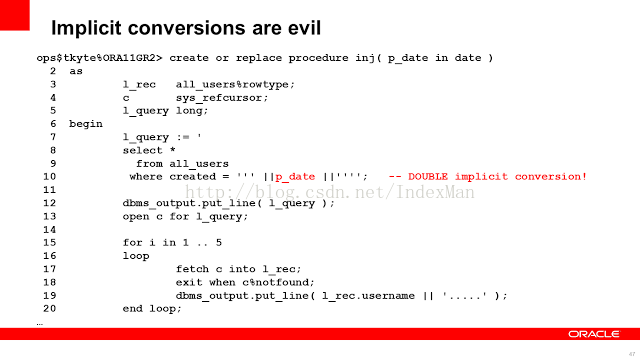
create or replace procedure inj(p_date in date)

as

	l_rec	all_users%rowtype;

	c	sys_refcursor;

	l_query	long;

begin

	l_query := '

	select *

	from all_users

        where created = ''' ||p_date ||''''; --2次隐式转换

	dbms_output.put_line(l_query);

	open c for l_query;

	for i in 1 .. 5

        loop

		fetch c into l_rec;

		exit when c%notfound;

		dbms_output.put_line(l_rec.username || '.....');

        end loop;

end;

/Before we get there - let's talk about the bit of code that will be problematic - that is line 10. As noted there is a double implicit conversion going on there. That line of code is really:
Where created = to_date( to_char( p_date ) );
Also consider that I said "by default". By default the NLS_DATE_FORMAT is DD-MON-RR (currrently, it has been different in the past!). What happens to this code when someone decides to change it? Your application might well start querying up entirely different data!
until, until someone who has read the documentation comes along. They might run your code like this:
you can do - isn't it? I've had people look at that example and scoff at it - saying "so what, they were allowed to see that table". Ok, take it a step further, I'd like to know what tables you own - so I can start querying them. I'll just do this:
serious code reviews of any code that uses string concatenation to build their SQL statements - any code that takes a parameter as input and concatenates it to a SQL query must be read and reviewed by many people - many people who will be super critical of the code. In this case, the resulting code would have to be:
- You shall never use implicit conversions ever, as in never.
- You shall always use an explicit date mask with dates, as in every single time, you will not rely on defaults (because defaults can inject you and because defaults can radically modify your logic unintentionally!)
cannot be SQL Injected - this is true for PL/SQL, for Java, for any and all languages. If you use bind variables you
cannot be SQL Injected - period. It is that simple, really and truly. If the code was:
where can I find an illustration of SQL injection?
can u share the sql injection demo code
Can you share that SQL injection slide?
Can you show a code example of the SQL injection bug that nobody noticed during your presentations?
Can you show us or point us to the site of the example of SQL injection bug?
Is SQL injection all about binding, or is there more?
should application layer deal with the SQL injection attacks prevention as that layer understands what the proper data access patterns look like rather than database?
always use a bind variable unless you have an excellent technical reason not to - and then you must submit your code for review to at least five people who do not like you - they must be motivated to rip your code apart, critically review it, make fun of it - so they find the bugs.
What is the dbms_assert PL/SQL package? How does it help prevent SQL injection? Should my organization be using it?
find that paper here.
Oracle SQL 注入攻击的更多相关文章
- SQL注入攻击技巧总结
0×01 你要知道目前有哪些数据库 微软公司旗下的: Microsoft SQL server 简称 MS-SQL 或者 SQL SERVER (大型数据库操作,功能和性能异常强大)(一般也是ASP或 ...
- SQL注入攻击
SQL注入攻击是黑客对数据库进行攻击的常用手段之一.随着B/S模式应用开发的发展,使用这种模式编写应用程序的程序员也越来越多.但是由于程序员的水平及经验也参差不齐,相当大一部分程序员在编写代码的时候, ...
- 【渗透攻防WEB篇】SQL注入攻击初级
前言不管用什么语言编写的Web应用,它们都用一个共同点,具有交互性并且多数是数据库驱动.在网络中,数据库驱动的Web应用随处可见,由此而存在的SQL注入是影响企业运营且最具破坏性的漏洞之一,这里我想问 ...
- 【web渗透技术】渗透攻防Web篇-SQL注入攻击初级
[web渗透技术]渗透攻防Web篇-SQL注入攻击初级 前言不管用什么语言编写的Web应用,它们都用一个共同点,具有交互性并且多数是数据库驱动.在网络中,数据库驱动的Web应用随处可见,由此而存在的S ...
- 使用SQLMAP对网站和数据库进行SQL注入攻击
from:http://www.blackmoreops.com/2014/05/07/use-sqlmap-sql-injection-hack-website-database/ 0x00 背景介 ...
- 2017-2018-2 20179205《网络攻防技术与实践》第十一周作业 SQL注入攻击与实践
<网络攻防技术与实践>第十一周作业 SQL注入攻击与实践 1.研究缓冲区溢出的原理,至少针对两种数据库进行差异化研究 缓冲区溢出原理 在计算机内部,输入数据通常被存放在一个临时空间内, ...
- 网站如何防止sql注入攻击的解决办法
首先我们来了解下什么是SQL注入,SQL注入简单来讲就是将一些非法参数插入到网站数据库中去,执行一些sql命令,比如查询数据库的账号密码,数据库的版本,数据库服务器的IP等等的一些操作,sql注入是目 ...
- 2017-2018-2 20179204《网络攻防实践》第十一周学习总结 SQL注入攻击与实践
第1节 研究缓冲区溢出的原理,至少针对两种数据库进行差异化研究 1.1 原理 在计算机内部,输入数据通常被存放在一个临时空间内,这个临时存放的空间就被称为缓冲区,缓冲区的长度事先已经被程序或者操作系统 ...
- 【spring】(填坑)sql注入攻击 - 持久层参数化
结果 填坑失败,并没有看懂是如何检测sql攻击的. 只能说的是: 建议都使用参数化传递sql语句参数.(所以,用hibernate.mybatis等框架的真不用太担心sql攻击问题.) 前言 本文 ...
- JDBC基础:JDBC快速入门,JDBC工具类,SQL注入攻击,JDBC管理事务
JDBC基础 重难点梳理 一.JDBC快速入门 1.jdbc的概念 JDBC(Java DataBase Connectivity:java数据库连接)是一种用于执行SQL语句的Java API,可以 ...
随机推荐
- Laravel - 使用 DB facade 实现CURD
<?php namespace App\Http\Controllers; use Illuminate\Http\Request; use Illuminate\Support\Facades ...
- Go-数组-切片
- [转帖]TLS 1.2 浏览器兼容性
https://support-splashtopbusiness.splashtop.com/hc/zh-cn/articles/4414002633883-TLS-1-2-%E6%B5%8F%E8 ...
- [转帖]SQL Server索引的维护 - 索引碎片、填充因子
https://www.cnblogs.com/kissdodog/archive/2013/06/14/3135412.html 这两个问题都和页密度有关,虽然两者的表现形式在本质上有所区别,但是故 ...
- [转帖]如何使用coredump
一.coredump 当用户态进程出现异常后,在该进程的执行目录下生成对应的coredump文件,如果我们想将coredump生成的位置做改变,就需要如下设置. echo "/home/co ...
- [转帖]技术分享 | 国产麒麟 arm 上编译安装 xtrabackup8
原创 发布于 2022-07-19 13:29:29 3220 举报 作者:王向 爱可生 DBA 团队成员,负责公司 DMP 产品的运维和客户 MySQL 问题的处理.擅长数据库故障处理.对数据库技术 ...
- [转帖]Kubernetes-18:Dashboard安装及使用
https://www.cnblogs.com/v-fan/p/13950268.html Helm安装Dashboard 简介 Dashboard 是 kubernetes 的图形化管理工具,可直观 ...
- [转帖]【Python】计算程序运行时间的方法总结
一.第一种方法 利用time包: import time def test(): start_time = time.time() # 记录程序开始运行时间 s = 0 for i in range( ...
- 【转帖】训练中文LLaMA大规模语言模型
https://zhuanlan.zhihu.com/p/612752963?utm_id=0 https://github.com/CVI-SZU/Linlygithub.com/CVI-SZU/ ...
- WebAssembly入门笔记[1]:与JavaScript的交互
前一阵子利用Balazor开发了一个NuGet站点,对WebAssembly进行了初步的了解,觉得挺有意思.在接下来的一系列文章中,我们将通过实例演示的方式介绍WebAssembly的一些基本概念和编 ...