
Akka源码分析-Router
akak中还有一个比较重要的概念,那就是Router(路由)。路由的概念,相信大家都不陌生,在akka中,它就是其他actors的一个代理,会把消息按照路由规则,分发给指定的actor。我一般喜欢把Router用作负载均衡。
其实如果不看官方的源码或不使用官方Router,我们自己实现一个router也还是很简单的,因为一共有三个重要的概念:路由、路由策略、路由对象。路由负责接收消息,按照路由策略把消息传递给路由对象。在akka中,路由和路由对象都是一个普通的actor,只不过路由策略需要我们涉及的通用些,能够支持各种路由算法就好了。不过既然官方实现了Router,就研读一下喽。
老规矩,还是从官方demo入手,分析Router的相关源码。
    import akka.routing.{ ActorRefRoutee, RoundRobinRoutingLogic, Router }

    class Master extends Actor {

      var router = {

        val routees = Vector.fill(5) {

          val r = context.actorOf(Props[Worker])

          context watch r

          ActorRefRoutee(r)

        }

        Router(RoundRobinRoutingLogic(), routees)

      }

      def receive = {

        case w: Work ⇒

          router.route(w, sender())

        case Terminated(a) ⇒

          router = router.removeRoutee(a)

          val r = context.actorOf(Props[Worker])

          context watch r

          router = router.addRoutee(r)

      }

    }
很简单,上面master启动的时候,通过actorOf创建了5个Worker,然后收到Work消息时,调用routee分发消息。当然了在收到worker的Terminated消息后,又重新创建了一个worker。这只是router的一个用法,我个人是不喜欢的,因为它定死了worker的个数。
/**

 * For each message that is sent through the router via the [[#route]] method the

 * [[RoutingLogic]] decides to which [[Routee]] to send the message. The [[Routee]] itself

 * knows how to perform the actual sending. Normally the [[RoutingLogic]] picks one of the

 * contained `routees`, but that is up to the implementation of the [[RoutingLogic]].

 *

 * A `Router` is immutable and the [[RoutingLogic]] must be thread safe.

 */

final case class Router(val logic: RoutingLogic, val routees: immutable.IndexedSeq[Routee] = Vector.empty)
上面是Router的定义,这居然是一个case class,有两个变量:路由逻辑(RoutingLogic)、路由对象(IndexedSeq[Routee])。
/**

 * The interface of the routing logic that is used in a [[Router]] to select

 * destination routed messages.

 *

 * The implementation must be thread safe.

 */

trait RoutingLogic extends NoSerializationVerificationNeeded {

  /**

   * Pick the destination for a given message. Normally it picks one of the

   * passed `routees`, but in the end it is up to the implementation to

   * return whatever [[Routee]] to use for sending a specific message.

   *

   * When implemented from Java it can be good to know that

   * `routees.apply(index)` can be used to get an element

   * from the `IndexedSeq`.

   */

  def select(message: Any, routees: immutable.IndexedSeq[Routee]): Routee

}
上面是RoutingLogic的定义,要不要这么简单呢?就只有一个select函数,它根据message和路由对象集合返回了一个路由目标。
/**

 * Abstraction of a destination for messages routed via a [[Router]].

 */

trait Routee {

  def send(message: Any, sender: ActorRef): Unit

}
路由对象是啥呢?就是一个只包含send方法的trait,也非常简单。其实吧,路由对象只要能发送消息就行了,不管他是ActorRef还是ActorSelection。
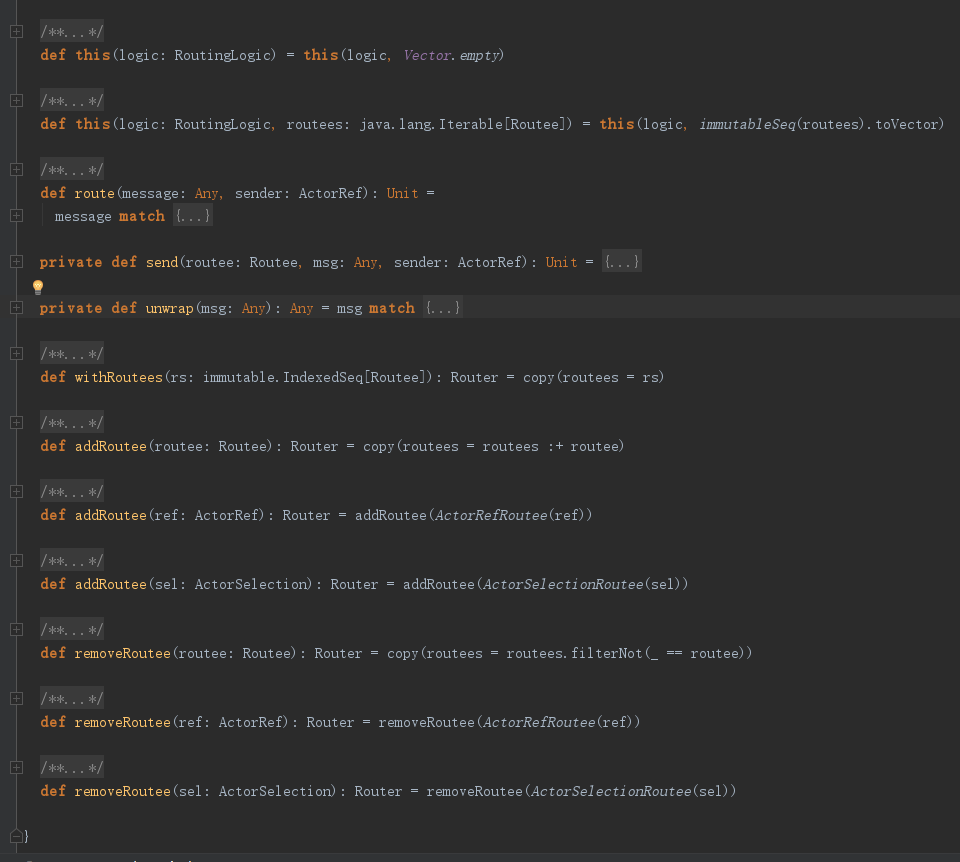
上面是Router的完整源码,一共分四部分功能:路由消息、给指定路由对象发送消息、路由对象操作、消息解包。
 /**

   * Send the message to the destination [[Routee]] selected by the [[RoutingLogic]].

   * If the message is a [[akka.routing.RouterEnvelope]] it will be unwrapped

   * before sent to the destinations.

   * Messages wrapped in a [[Broadcast]] envelope are always sent to all `routees`.

   */

  def route(message: Any, sender: ActorRef): Unit =

    message match {

      case akka.routing.Broadcast(msg) ⇒ SeveralRoutees(routees).send(msg, sender)

      case msg                         ⇒ send(logic.select(msg, routees), message, sender)

    }
route方法非常简单,首先判断是不是广播消息,如果是就创建SeveralRoutees然后发送;如果不是则调用logic.select选择一个routee,然后调用send发送。先来分析SeveralRoutees
/**

 * [[Routee]] that sends each message to all `routees`.

 */

final case class SeveralRoutees(routees: immutable.IndexedSeq[Routee]) extends Routee {

  /**

   * Java API

   */

  def this(rs: java.lang.Iterable[Routee]) = this(routees = immutableSeq(rs).toVector)

  /**

   * Java API

   */

  def getRoutees(): java.util.List[Routee] = {

    import scala.collection.JavaConverters._

    routees.asJava

  }

  override def send(message: Any, sender: ActorRef): Unit =

    routees.foreach(_.send(message, sender))

}
SeveralRoutees首先这是一个Routee,然后覆盖了send方法,send里面依次调用routees集合的send方法。由于在Broadcast(广播)消息传入了整个routees,所以也就是给当前路由的所有路由对象都发送了消息。怎么样,是不是非常简单呢?
既然router和routerLogic都这么简单,而且他们只接收Routee,那么跟ActorRef和ActorSelection如何关联呢?看到官方demo中的ActorRefRoutee了吗?
/**

 * [[Routee]] that sends the messages to an [[akka.actor.ActorRef]].

 */

final case class ActorRefRoutee(ref: ActorRef) extends Routee {

  override def send(message: Any, sender: ActorRef): Unit =

    ref.tell(message, sender)

}
ActorRefRoutee就是对ActorRef的封装,它覆盖send方法,调用ActorRef的tell方法把消息发送出去。就是这么简单,那ActorSelection也是这样喽?对的,就是这样。
/**

 * [[Routee]] that sends the messages to an [[akka.actor.ActorSelection]].

 */

final case class ActorSelectionRoutee(selection: ActorSelection) extends Routee {

  override def send(message: Any, sender: ActorRef): Unit =

    selection.tell(message, sender)

}
这是不是太简单了点?嗯,Router的基本用法就是这么简单啊。为了篇幅,我们简单分析几个路由策略,那就分析demo中的RoundRobinRoutingLogic吧。
/**

 * Uses round-robin to select a routee. For concurrent calls,

 * round robin is just a best effort.

 */

@SerialVersionUID(1L)

final class RoundRobinRoutingLogic extends RoutingLogic {

  val next = new AtomicLong

  override def select(message: Any, routees: immutable.IndexedSeq[Routee]): Routee =

    if (routees.nonEmpty) {

      val size = routees.size

      val index = (next.getAndIncrement % size).asInstanceOf[Int]

      routees(if (index < 0) size + index else index)

    } else NoRoutee

}
请注意,在RoutingLogic定义中说需要满足线程安全,所以next是一个AtomicLong,至于为啥需要线程安全,这里先略过。不过如果你就是官方demo的用法,还要啥线程安全,真是浪费。
这个RoundRobinRoutingLogic的实现逻辑也很简单,就是对AtomicLong进行依次自增,然后对routees.size取余,取出对应index的routee即可。其实就是按照顺序返回列表中的元素Routee,如果到达列表末尾,则从头取值。这好像也简单了点。
akka.routing.RoundRobinRoutingLogic。轮询路由策略。具体实现参照上文分析。akka.routing.RandomRoutingLogic。随机路由策略。就是从列表中随机选择一个Routeeakka.routing.SmallestMailboxRoutingLogic。最小邮箱路由策略。就是选择各个Routee的邮箱堆积消息最少的一个。从源码来看这个是需要查找Routee的邮箱数量的,个人不太喜欢这种实现。akka.routing.BroadcastRoutingLogic。广播路由策略。就是把消息广播出去。akka.routing.ScatterGatherFirstCompletedRoutingLogic。广播收集第一个完成路由策略。有点拗口,简单来说就是把消息广播出去,以第一个收到的回复作为此次路由的回复。这个不建议用,因为它对所有Routee都调用了ask。如果不关心回复,则可以使用BroadcastRoutingLogic。akka.routing.TailChoppingRoutingLogic。尾部断续路由策略。跟ScatterGatherFirstCompletedRoutingLogic差不多,只不过不是广播,而是按照一个固定间隔的时间,依次给Routee发消息,收到第一个回复后,不再广播消息,以该回复作为最终回复。akka.routing.ConsistentHashingRoutingLogic。一致性hash路由策略。就是根据消息计算对应的key,key相同的消息会发送给相同的Routee。读者可以自行研究一致性HASH的实现,简单来说就是对消息和Routee都进行hash,hash相同的作为路由关系。
对于官方demo,有一点疑问,router是不是初始化必须要有值呢?而且必须是同类型的Actor呢?完全不必要。router初始化可以为空,且不一定必须是相同的Actor,只不过官方认为,既然你都它进行路由了,最好是相同类型的actor。其实吧,个人认为,路由是对消息来说的,只要路由对象能够处理该消息就行了,不必是相同类型的。Routees如何动态添加呢?我一般把需要路由消息的Actor(比如Worker),发特定消息告诉Master(也就是router),Master收到该消息后把ActorRef添加到Router中。这在remote和cluster中非常适用。
关于Router的基本概念和源码就分析完了,但官方对Router还有其他丰富的功能,比如RoundRobinPool和RoundRobinGroup,我个人不太喜欢这种实现,还是喜欢最基本的用法。感兴趣的读者可以自行阅读相关的源码。
Akka源码分析-Router的更多相关文章
- Akka源码分析-Cluster-Metrics
一个应用软件维护的后期一定是要做监控,akka也不例外,它提供了集群模式下的度量扩展插件. 其实如果读者读过前面的系列文章的话,应该是能够自己写一个这样的监控工具的.简单来说就是创建一个actor,它 ...
- Akka源码分析-Cluster-Distributed Publish Subscribe in Cluster
在ClusterClient源码分析中,我们知道,他是依托于“Distributed Publish Subscribe in Cluster”来实现消息的转发的,那本文就来分析一下Pub/Sub是如 ...
- Akka源码分析-Cluster-Singleton
akka Cluster基本实现原理已经分析过,其实它就是在remote基础上添加了gossip协议,同步各个节点信息,使集群内各节点能够识别.在Cluster中可能会有一个特殊的节点,叫做单例节点. ...
- Akka源码分析-Persistence
在学习akka过程中,我们了解了它的监督机制,会发现actor非常可靠,可以自动的恢复.但akka框架只会简单的创建新的actor,然后调用对应的生命周期函数,如果actor有状态需要回复,我们需要h ...
- Akka源码分析-Akka Typed
对不起,akka typed 我是不准备进行源码分析的,首先这个库的API还没有release,所以会may change,也就意味着其概念和设计包括API都会修改,基本就没有再深入分析源码的意义了. ...
- Akka源码分析-Akka-Streams-概念入门
今天我们来讲解akka-streams,这应该算akka框架下实现的一个很高级的工具.之前在学习akka streams的时候,我是觉得云里雾里的,感觉非常复杂,而且又难学,不过随着对akka源码的深 ...
- Akka源码分析-local-DeathWatch
生命周期监控,也就是死亡监控,是akka编程中常用的机制.比如我们有了某个actor的ActorRef之后,希望在该actor死亡之后收到响应的消息,此时我们就可以使用watch函数达到这一目的. c ...
- Akka源码分析-Cluster-ActorSystem
前面几篇博客,我们依次介绍了local和remote的一些内容,其实再分析cluster就会简单很多,后面关于cluster的源码分析,能够省略的地方,就不再贴源码而是一句话带过了,如果有不理解的地方 ...
- Akka源码分析-Actor创建
上一篇博客我们介绍了ActorSystem的创建过程,下面我们就研究一下actor的创建过程. val system = ActorSystem("firstActorSystem" ...
随机推荐
- ecshop笔记
***ecshop在线入门手册***:http://book.ecmoban.com/ 解决ecshop与jquery冲突问题1.修改文件:/js/transport.js在文件最底部增加代码: if ...
- Python学习第二阶段Day2,模块time/datetime、random、os、sys、shutil
1.Time. Datetime(常用) UTC时间:为世界标准时间,时区为0的时间 北京时间,UTC+8东八区 import time print(time.time()) # timestamp ...
- 有哪些可以节省chrome内存的扩展插件?
不知道从什么时候开始,chrome浏览器就这样不知不觉的超过IE浏览器成为全球第一大浏览器.我们在赞赏chrome浏览器流畅的速度时,更多的是对其chrome插件功能的赞赏.但是我们也发现了一个致命的 ...
- 介绍一个比较酷东西:HTML5 桌面通知(Notification API)
Notification API 是 HTML5 新增的桌面通知 API,用于向用户显示通知信息.该通知是脱离浏览器的,即使用户没有停留在当前标签页,甚至最小化了浏览器,该通知信息也一样会置顶显示出来 ...
- 洛谷P1028数的计算
https://www.luogu.org/problemnew/show/P1028 只用递归会超时,需要用递归型动规,用一个数组保存已经算过的值,避免重复计算. 求数字为n的方案数的最优子结构为: ...
- java中String,int,Integer,char、double类型转换
java中String,int,Integer,char.double类型转换----https://www.cnblogs.com/kangyu222/p/5866025.html
- codevs1001 舒适的线路
题目描述 Description Z小镇是一个景色宜人的地方,吸引来自各地的观光客来此旅游观光.Z小镇附近共有N(1<N≤500)个景点(编号为1,2,3,…,N),这些景点被M(0<M≤ ...
- vim中256色的配色表
vim貌似支持的颜色很有限.white black yellow cyan magenta blue grey green red,大多数颜色前面都可以加light 或者 d ...
- Maven使用GitHub项目目录搭建远程仓库
使用GtiHub的项目目录搭建第三方远程仓库,能免除使用服务器搭建Nexus私服,而且空间也是免费的.但是这种方式只适合小规模发布,毕竟搜索和版本控制是一个问题,如果需要更复杂的功能就只能转向Nexu ...
- Android GIS开发系列-- 入门季(4) GraphicsLayer的点击查询要素
上一讲中我们学会了如何在MapView中添加Graphic要素,那么在百度或高德地图中,当我们点击要素时,会显示出相应的详细信息.在GraphicsLayer中也提供了这样的方法.下面我们来学习在Gr ...