
Python自动化测试框架——生成测试报告
如何才能让用例自动运行完之后,生成一张直观可看易懂的测试报告呢?
小编使用的是unittest的一个扩展HTMLTestRunner
- 环境准备
使用之前,我们需要下载HTMLTestRunner.py文件
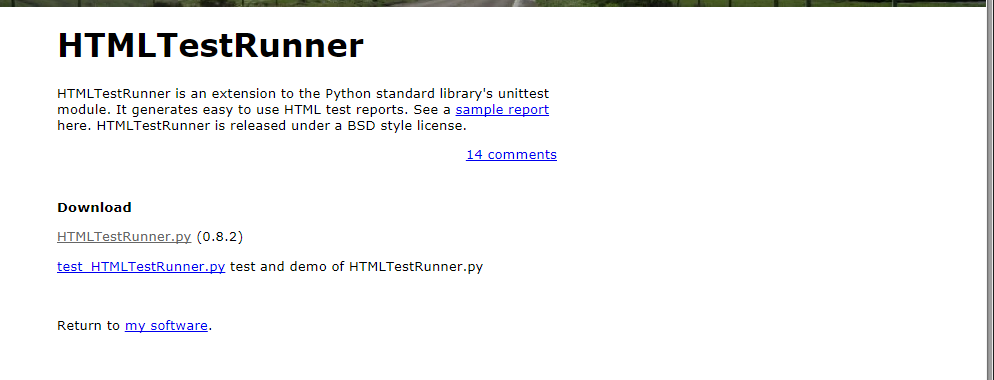
点击HTMLTestRunner后进入的是一个写满代码的网页,小编推荐操作:右键 --> 另存为,文件名称千万不要改
python3使用上述HTMLTestRunner可能会报错,可以替换如下文件
"""
A TestRunner for use with the Python unit testing framework. It
generates a HTML report to show the result at a glance. The simplest way to use this is to invoke its main method. E.g. import unittest
import HTMLTestRunner ... define your tests ... if __name__ == '__main__':
HTMLTestRunner.main() For more customization options, instantiates a HTMLTestRunner object.
HTMLTestRunner is a counterpart to unittest's TextTestRunner. E.g. # output to a file
fp = file('my_report.html', 'wb')
runner = HTMLTestRunner.HTMLTestRunner(
stream=fp,
title='My unit test',
description='This demonstrates the report output by HTMLTestRunner.'
) # Use an external stylesheet.
# See the Template_mixin class for more customizable options
runner.STYLESHEET_TMPL = '<link rel="stylesheet" href="my_stylesheet.css" type="text/css">' # run the test
runner.run(my_test_suite) ------------------------------------------------------------------------
Copyright (c) 2004-2007, Wai Yip Tung
All rights reserved. Redistribution and use in source and binary forms, with or without
modification, are permitted provided that the following conditions are
met: * Redistributions of source code must retain the above copyright notice,
this list of conditions and the following disclaimer.
* Redistributions in binary form must reproduce the above copyright
notice, this list of conditions and the following disclaimer in the
documentation and/or other materials provided with the distribution.
* Neither the name Wai Yip Tung nor the names of its contributors may be
used to endorse or promote products derived from this software without
specific prior written permission. THIS SOFTWARE IS PROVIDED BY THE COPYRIGHT HOLDERS AND CONTRIBUTORS "AS
IS" AND ANY EXPRESS OR IMPLIED WARRANTIES, INCLUDING, BUT NOT LIMITED
TO, THE IMPLIED WARRANTIES OF MERCHANTABILITY AND FITNESS FOR A
PARTICULAR PURPOSE ARE DISCLAIMED. IN NO EVENT SHALL THE COPYRIGHT OWNER
OR CONTRIBUTORS BE LIABLE FOR ANY DIRECT, INDIRECT, INCIDENTAL, SPECIAL,
EXEMPLARY, OR CONSEQUENTIAL DAMAGES (INCLUDING, BUT NOT LIMITED TO,
PROCUREMENT OF SUBSTITUTE GOODS OR SERVICES; LOSS OF USE, DATA, OR
PROFITS; OR BUSINESS INTERRUPTION) HOWEVER CAUSED AND ON ANY THEORY OF
LIABILITY, WHETHER IN CONTRACT, STRICT LIABILITY, OR TORT (INCLUDING
NEGLIGENCE OR OTHERWISE) ARISING IN ANY WAY OUT OF THE USE OF THIS
SOFTWARE, EVEN IF ADVISED OF THE POSSIBILITY OF SUCH DAMAGE.
""" # URL: http://tungwaiyip.info/software/HTMLTestRunner.html __author__ = "Wai Yip Tung"
__version__ = "0.8.2" """
Change History Version 0.8.2
* Show output inline instead of popup window (Viorel Lupu). Version in 0.8.1
* Validated XHTML (Wolfgang Borgert).
* Added description of test classes and test cases. Version in 0.8.0
* Define Template_mixin class for customization.
* Workaround a IE 6 bug that it does not treat <script> block as CDATA. Version in 0.7.1
* Back port to Python 2.3 (Frank Horowitz).
* Fix missing scroll bars in detail log (Podi).
""" # TODO: color stderr
# TODO: simplify javascript using ,ore than 1 class in the class attribute? import datetime
import io
import sys
import time
import unittest
from xml.sax import saxutils # ------------------------------------------------------------------------
# The redirectors below are used to capture output during testing. Output
# sent to sys.stdout and sys.stderr are automatically captured. However
# in some cases sys.stdout is already cached before HTMLTestRunner is
# invoked (e.g. calling logging.basicConfig). In order to capture those
# output, use the redirectors for the cached stream.
#
# e.g.
# >>> logging.basicConfig(stream=HTMLTestRunner.stdout_redirector)
# >>> class OutputRedirector(object):
""" Wrapper to redirect stdout or stderr """
def __init__(self, fp):
self.fp = fp def write(self, s):
self.fp.write(s) def writelines(self, lines):
self.fp.writelines(lines) def flush(self):
self.fp.flush() stdout_redirector = OutputRedirector(sys.stdout)
stderr_redirector = OutputRedirector(sys.stderr) # ----------------------------------------------------------------------
# Template class Template_mixin(object):
"""
Define a HTML template for report customerization and generation. Overall structure of an HTML report HTML
+------------------------+
|<html> |
| <head> |
| |
| STYLESHEET |
| +----------------+ |
| | | |
| +----------------+ |
| |
| </head> |
| |
| <body> |
| |
| HEADING |
| +----------------+ |
| | | |
| +----------------+ |
| |
| REPORT |
| +----------------+ |
| | | |
| +----------------+ |
| |
| ENDING |
| +----------------+ |
| | | |
| +----------------+ |
| |
| </body> |
|</html> |
+------------------------+
""" STATUS = {
0: 'pass',
1: 'fail',
2: 'error',
} DEFAULT_TITLE = 'Unit Test Report'
DEFAULT_DESCRIPTION = '' # ------------------------------------------------------------------------
# HTML Template HTML_TMPL = r"""<?xml version="1.0" encoding="UTF-8"?>
<!DOCTYPE html PUBLIC "-//W3C//DTD XHTML 1.0 Strict//EN" "http://www.w3.org/TR/xhtml1/DTD/xhtml1-strict.dtd">
<html xmlns="http://www.w3.org/1999/xhtml">
<head>
<title>%(title)s</title>
<meta name="generator" content="%(generator)s"/>
<meta http-equiv="Content-Type" content="text/html; charset=UTF-8"/>
%(stylesheet)s
</head>
<body>
<script language="javascript" type="text/javascript"><!--
output_list = Array(); /* level - 0:Summary; 1:Failed; 2:All */
function showCase(level) {
trs = document.getElementsByTagName("tr");
for (var i = 0; i < trs.length; i++) {
tr = trs[i];
id = tr.id;
if (id.substr(0,2) == 'ft') {
if (level < 1) {
tr.className = 'hiddenRow';
}
else {
tr.className = '';
}
}
if (id.substr(0,2) == 'pt') {
if (level > 1) {
tr.className = '';
}
else {
tr.className = 'hiddenRow';
}
}
}
} function showClassDetail(cid, count) {
var id_list = Array(count);
var toHide = 1;
for (var i = 0; i < count; i++) {
tid0 = 't' + cid.substr(1) + '.' + (i+1);
tid = 'f' + tid0;
tr = document.getElementById(tid);
if (!tr) {
tid = 'p' + tid0;
tr = document.getElementById(tid);
}
id_list[i] = tid;
if (tr.className) {
toHide = 0;
}
}
for (var i = 0; i < count; i++) {
tid = id_list[i];
if (toHide) {
document.getElementById('div_'+tid).style.display = 'none'
document.getElementById(tid).className = 'hiddenRow';
}
else {
document.getElementById(tid).className = '';
}
}
} function showTestDetail(div_id){
var details_div = document.getElementById(div_id)
var displayState = details_div.style.display
// alert(displayState)
if (displayState != 'block' ) {
displayState = 'block'
details_div.style.display = 'block'
}
else {
details_div.style.display = 'none'
}
} function html_escape(s) {
s = s.replace(/&/g,'&');
s = s.replace(/</g,'<');
s = s.replace(/>/g,'>');
return s;
} /* obsoleted by detail in <div>
function showOutput(id, name) {
var w = window.open("", //url
name,
"resizable,scrollbars,status,width=800,height=450");
d = w.document;
d.write("<pre>");
d.write(html_escape(output_list[id]));
d.write("\n");
d.write("<a href='javascript:window.close()'>close</a>\n");
d.write("</pre>\n");
d.close();
}
*/
--></script> %(heading)s
%(report)s
%(ending)s </body>
</html>
"""
# variables: (title, generator, stylesheet, heading, report, ending) # ------------------------------------------------------------------------
# Stylesheet
#
# alternatively use a <link> for external style sheet, e.g.
# <link rel="stylesheet" href="$url" type="text/css"> STYLESHEET_TMPL = """
<style type="text/css" media="screen">
body { font-family: verdana, arial, helvetica, sans-serif; font-size: 80%; }
table { font-size: 100%; }
pre { } /* -- heading ---------------------------------------------------------------------- */
h1 {
font-size: 16pt;
color: gray;
}
.heading {
margin-top: 0ex;
margin-bottom: 1ex;
} .heading .attribute {
margin-top: 1ex;
margin-bottom: 0;
} .heading .description {
margin-top: 4ex;
margin-bottom: 6ex;
} /* -- css div popup ------------------------------------------------------------------------ */
a.popup_link {
} a.popup_link:hover {
color: red;
} .popup_window {
display: none;
position: relative;
left: 0px;
top: 0px;
/*border: solid #627173 1px; */
padding: 10px;
background-color: #E6E6D6;
font-family: "Lucida Console", "Courier New", Courier, monospace;
text-align: left;
font-size: 8pt;
width: 500px;
} }
/* -- report ------------------------------------------------------------------------ */
#show_detail_line {
margin-top: 3ex;
margin-bottom: 1ex;
}
#result_table {
width: 80%;
border-collapse: collapse;
border: 1px solid #777;
}
#header_row {
font-weight: bold;
color: white;
background-color: #777;
}
#result_table td {
border: 1px solid #777;
padding: 2px;
}
#total_row { font-weight: bold; }
.passClass { background-color: #6c6; }
.failClass { background-color: #c60; }
.errorClass { background-color: #c00; }
.passCase { color: #6c6; }
.failCase { color: #c60; font-weight: bold; }
.errorCase { color: #c00; font-weight: bold; }
.hiddenRow { display: none; }
.testcase { margin-left: 2em; } /* -- ending ---------------------------------------------------------------------- */
#ending {
} </style>
""" # ------------------------------------------------------------------------
# Heading
# HEADING_TMPL = """<div class='heading'>
<h1>%(title)s</h1>
%(parameters)s
<p class='description'>%(description)s</p>
</div> """ # variables: (title, parameters, description) HEADING_ATTRIBUTE_TMPL = """<p class='attribute'><strong>%(name)s:</strong> %(value)s</p>
""" # variables: (name, value) # ------------------------------------------------------------------------
# Report
# REPORT_TMPL = """
<p id='show_detail_line'>Show
<a href='javascript:showCase(0)'>Summary</a>
<a href='javascript:showCase(1)'>Failed</a>
<a href='javascript:showCase(2)'>All</a>
</p>
<table id='result_table'>
<colgroup>
<col align='left' />
<col align='right' />
<col align='right' />
<col align='right' />
<col align='right' />
<col align='right' />
</colgroup>
<tr id='header_row'>
<td>Test Group/Test case</td>
<td>Count</td>
<td>Pass</td>
<td>Fail</td>
<td>Error</td>
<td>View</td>
</tr>
%(test_list)s
<tr id='total_row'>
<td>Total</td>
<td>%(count)s</td>
<td>%(Pass)s</td>
<td>%(fail)s</td>
<td>%(error)s</td>
<td> </td>
</tr>
</table>
""" # variables: (test_list, count, Pass, fail, error) REPORT_CLASS_TMPL = r"""
<tr class='%(style)s'>
<td>%(desc)s</td>
<td>%(count)s</td>
<td>%(Pass)s</td>
<td>%(fail)s</td>
<td>%(error)s</td>
<td><a href="javascript:showClassDetail('%(cid)s',%(count)s)">Detail</a></td>
</tr>
""" # variables: (style, desc, count, Pass, fail, error, cid) REPORT_TEST_WITH_OUTPUT_TMPL = r"""
<tr id='%(tid)s' class='%(Class)s'>
<td class='%(style)s'><div class='testcase'>%(desc)s</div></td>
<td colspan='5' align='center'> <!--css div popup start-->
<a class="popup_link" onfocus='this.blur();' href="javascript:showTestDetail('div_%(tid)s')" >
%(status)s</a> <div id='div_%(tid)s' class="popup_window">
<div style='text-align: right; color:red;cursor:pointer'>
<a onfocus='this.blur();' onclick="document.getElementById('div_%(tid)s').style.display = 'none' " >
[x]</a>
</div>
<pre>
%(script)s
</pre>
</div>
<!--css div popup end--> </td>
</tr>
""" # variables: (tid, Class, style, desc, status) REPORT_TEST_NO_OUTPUT_TMPL = r"""
<tr id='%(tid)s' class='%(Class)s'>
<td class='%(style)s'><div class='testcase'>%(desc)s</div></td>
<td colspan='5' align='center'>%(status)s</td>
</tr>
""" # variables: (tid, Class, style, desc, status) REPORT_TEST_OUTPUT_TMPL = r"""
%(id)s: %(output)s
""" # variables: (id, output) # ------------------------------------------------------------------------
# ENDING
# ENDING_TMPL = """<div id='ending'> </div>""" # -------------------- The end of the Template class ------------------- TestResult = unittest.TestResult class _TestResult(TestResult):
# note: _TestResult is a pure representation of results.
# It lacks the output and reporting ability compares to unittest._TextTestResult. def __init__(self, verbosity=1):
TestResult.__init__(self)
self.stdout0 = None
self.stderr0 = None
self.success_count = 0
self.failure_count = 0
self.error_count = 0
self.verbosity = verbosity # result is a list of result in 4 tuple
# (
# result code (0: success; 1: fail; 2: error),
# TestCase object,
# Test output (byte string),
# stack trace,
# )
self.result = [] def startTest(self, test):
TestResult.startTest(self, test)
# just one buffer for both stdout and stderr
self.outputBuffer = io.StringIO()
stdout_redirector.fp = self.outputBuffer
stderr_redirector.fp = self.outputBuffer
self.stdout0 = sys.stdout
self.stderr0 = sys.stderr
sys.stdout = stdout_redirector
sys.stderr = stderr_redirector def complete_output(self):
"""
Disconnect output redirection and return buffer.
Safe to call multiple times.
"""
if self.stdout0:
sys.stdout = self.stdout0
sys.stderr = self.stderr0
self.stdout0 = None
self.stderr0 = None
return self.outputBuffer.getvalue() def stopTest(self, test):
# Usually one of addSuccess, addError or addFailure would have been called.
# But there are some path in unittest that would bypass this.
# We must disconnect stdout in stopTest(), which is guaranteed to be called.
self.complete_output() def addSuccess(self, test):
self.success_count += 1
TestResult.addSuccess(self, test)
output = self.complete_output()
self.result.append((0, test, output, ''))
if self.verbosity > 1:
sys.stderr.write('ok ')
sys.stderr.write(str(test))
sys.stderr.write('\n')
else:
sys.stderr.write('.') def addError(self, test, err):
self.error_count += 1
TestResult.addError(self, test, err)
_, _exc_str = self.errors[-1]
output = self.complete_output()
self.result.append((2, test, output, _exc_str))
if self.verbosity > 1:
sys.stderr.write('E ')
sys.stderr.write(str(test))
sys.stderr.write('\n')
else:
sys.stderr.write('E') def addFailure(self, test, err):
self.failure_count += 1
TestResult.addFailure(self, test, err)
_, _exc_str = self.failures[-1]
output = self.complete_output()
self.result.append((1, test, output, _exc_str))
if self.verbosity > 1:
sys.stderr.write('F ')
sys.stderr.write(str(test))
sys.stderr.write('\n')
else:
sys.stderr.write('F') class HTMLTestRunner(Template_mixin):
"""
"""
def __init__(self, stream=sys.stdout, verbosity=1, title=None, description=None):
self.stream = stream
self.verbosity = verbosity
if title is None:
self.title = self.DEFAULT_TITLE
else:
self.title = title
if description is None:
self.description = self.DEFAULT_DESCRIPTION
else:
self.description = description self.startTime = datetime.datetime.now() def run(self, test):
"Run the given test case or test suite."
result = _TestResult(self.verbosity)
test(result)
self.stopTime = datetime.datetime.now()
self.generateReport(test, result)
# print >> sys.stderr, '\nTime Elapsed: %s' % (self.stopTime-self.startTime)
print(sys.stderr, '\nTime Elapsed: %s' % (self.stopTime-self.startTime))
return result def sortResult(self, result_list):
# unittest does not seems to run in any particular order.
# Here at least we want to group them together by class.
rmap = {}
classes = []
for n,t,o,e in result_list:
cls = t.__class__
if not cls in rmap:
rmap[cls] = []
classes.append(cls)
rmap[cls].append((n,t,o,e))
r = [(cls, rmap[cls]) for cls in classes]
return r def getReportAttributes(self, result):
"""
Return report attributes as a list of (name, value).
Override this to add custom attributes.
"""
startTime = str(self.startTime)[:19]
duration = str(self.stopTime - self.startTime)
status = []
if result.success_count: status.append('Pass %s' % result.success_count)
if result.failure_count: status.append('Failure %s' % result.failure_count)
if result.error_count: status.append('Error %s' % result.error_count )
if status:
status = ' '.join(status)
else:
status = 'none'
return [
('Start Time', startTime),
('Duration', duration),
('Status', status),
] def generateReport(self, test, result):
report_attrs = self.getReportAttributes(result)
generator = 'HTMLTestRunner %s' % __version__
stylesheet = self._generate_stylesheet()
heading = self._generate_heading(report_attrs)
report = self._generate_report(result)
ending = self._generate_ending()
output = self.HTML_TMPL % dict(
title = saxutils.escape(self.title),
generator = generator,
stylesheet = stylesheet,
heading = heading,
report = report,
ending = ending,
)
self.stream.write(output.encode('utf8')) def _generate_stylesheet(self):
return self.STYLESHEET_TMPL def _generate_heading(self, report_attrs):
a_lines = []
for name, value in report_attrs:
line = self.HEADING_ATTRIBUTE_TMPL % dict(
name = saxutils.escape(name),
value = saxutils.escape(value),
)
a_lines.append(line)
heading = self.HEADING_TMPL % dict(
title = saxutils.escape(self.title),
parameters = ''.join(a_lines),
description = saxutils.escape(self.description),
)
return heading def _generate_report(self, result):
rows = []
sortedResult = self.sortResult(result.result)
for cid, (cls, cls_results) in enumerate(sortedResult):
# subtotal for a class
np = nf = ne = 0
for n,t,o,e in cls_results:
if n == 0: np += 1
elif n == 1: nf += 1
else: ne += 1 # format class description
if cls.__module__ == "__main__":
name = cls.__name__
else:
name = "%s.%s" % (cls.__module__, cls.__name__)
doc = cls.__doc__ and cls.__doc__.split("\n")[0] or ""
desc = doc and '%s: %s' % (name, doc) or name row = self.REPORT_CLASS_TMPL % dict(
style = ne > 0 and 'errorClass' or nf > 0 and 'failClass' or 'passClass',
desc = desc,
count = np+nf+ne,
Pass = np,
fail = nf,
error = ne,
cid = 'c%s' % (cid+1),
)
rows.append(row) for tid, (n,t,o,e) in enumerate(cls_results):
self._generate_report_test(rows, cid, tid, n, t, o, e) report = self.REPORT_TMPL % dict(
test_list = ''.join(rows),
count = str(result.success_count+result.failure_count+result.error_count),
Pass = str(result.success_count),
fail = str(result.failure_count),
error = str(result.error_count),
)
return report def _generate_report_test(self, rows, cid, tid, n, t, o, e):
# e.g. 'pt1.1', 'ft1.1', etc
has_output = bool(o or e)
tid = (n == 0 and 'p' or 'f') + 't%s.%s' % (cid+1,tid+1)
name = t.id().split('.')[-1]
doc = t.shortDescription() or ""
desc = doc and ('%s: %s' % (name, doc)) or name
tmpl = has_output and self.REPORT_TEST_WITH_OUTPUT_TMPL or self.REPORT_TEST_NO_OUTPUT_TMPL # o and e should be byte string because they are collected from stdout and stderr?
if isinstance(o,str):
# TODO: some problem with 'string_escape': it escape \n and mess up formating
# uo = unicode(o.encode('string_escape'))
# uo = o.decode('latin-1')
uo = e
else:
uo = o
if isinstance(e,str):
# TODO: some problem with 'string_escape': it escape \n and mess up formating
# ue = unicode(e.encode('string_escape'))
# ue = e.decode('latin-1')
ue = e
else:
ue = e script = self.REPORT_TEST_OUTPUT_TMPL % dict(
id = tid,
output = saxutils.escape(str(uo)+ue),
) row = tmpl % dict(
tid = tid,
Class = (n == 0 and 'hiddenRow' or 'none'),
style = n == 2 and 'errorCase' or (n == 1 and 'failCase' or 'none'),
desc = desc,
script = script,
status = self.STATUS[n],
)
rows.append(row)
if not has_output:
return def _generate_ending(self):
return self.ENDING_TMPL ##############################################################################
# Facilities for running tests from the command line
############################################################################## # Note: Reuse unittest.TestProgram to launch test. In the future we may
# build our own launcher to support more specific command line
# parameters like test title, CSS, etc.
class TestProgram(unittest.TestProgram):
"""
A variation of the unittest.TestProgram. Please refer to the base
class for command line parameters.
"""
def runTests(self):
# Pick HTMLTestRunner as the default test runner.
# base class's testRunner parameter is not useful because it means
# we have to instantiate HTMLTestRunner before we know self.verbosity.
if self.testRunner is None:
self.testRunner = HTMLTestRunner(verbosity=self.verbosity)
unittest.TestProgram.runTests(self) main = TestProgram ##############################################################################
# Executing this module from the command line
############################################################################## if __name__ == "__main__":
main(module=None)
HTMLTestRunner
- 使用
接下来,小编将以登录网易邮箱为例,生成一份最基础的测试报告。小伙伴们copy走代码验证时一定记得修改账号密码哦。
目录结构如下:
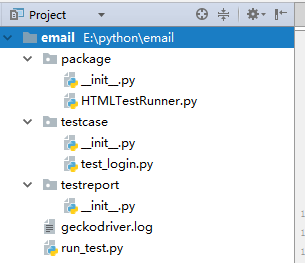
将HTMLTestRunner.py文件存放到package包下,将test_login.py存放到testcase目录下,用于编写测试用例,建立testreport包,用于存放测试报告,在email目录下建立run_test.py,用于执行测试
HTMLTestRunner的使用方法在代码注释中介绍和解释
【test_login.py】
from selenium import webdriver

import unittest,time

class Login(unittest.TestCase):

    def setUp(self):

        #打开百度,搜索“163网易邮箱”,登录

        driver=webdriver.Firefox()

        driver.implicitly_wait(5)

        self.driver=driver

        driver.get("https://www.baidu.com/")

        driver.find_element_by_id("kw").send_keys("163邮箱登录")

        driver.find_element_by_id("su").click()

        name = driver.find_element_by_id("op_email3_username")

        password = driver.find_element_by_class_name("op_email3_password")

        login = driver.find_element_by_css_selector(".c-btn")

        #如下操作可以使setUp中的变量被其他模块调用

        self.name=name

        self.password=password

        self.login=login

    def tearDown(self):

        self.driver.quit()

    def switch_window(self):

        #切换窗口

        for handle in self.driver.window_handles:

            self.driver.switch_to.window(handle)

            #j增加等待时间,可以提高测试用例执行的健壮性

            time.sleep(2)

        time.sleep(3)

    #成功登录

    def test_right_login(self):

        #账号密码自行填写

        self.name.send_keys("xxx")

        self.password.send_keys("xxx")

        self.login.click()

        self.switch_window()

        #t通过新窗口的title验证用例是否通过

        self.assertEqual(self.driver.title,"网易邮箱6.0版","登录失败")

    #密码为空登录

    def test_null_psw_login(self):

        self.name.send_keys("xxx")

        time.sleep(3)

        self.login.click()

        self.switch_window()

        # t通过新窗口的title验证用例是否通过

        self.assertEqual(self.driver.title,"网易帐号中心 > 用户验证","未跳转至用户验证界面")
【run_test.py】
#导入HTMLTestRunner的包

from package import HTMLTestRunner

#导入test_login的包,执行测试用例时需使用

from testcase.test_login import *

#定义要执行的测试用例的路径

test_dir = './testcase'

#定义要执行的测试用例的路径和名称格式

#test_*.py的意思是,./testcase路径下文件名称格式为test_*.py的文件,*为任意匹配,路径下有多少的test_*.py格式的文件,就依次执行几个

discover = unittest.defaultTestLoader.discover(test_dir, pattern='test_*.py')

#定义测试报告的名称和存储位置

filename = './testreport/loginReport.html'

#开始执行

if __name__ == '__main__':

    suit=unittest.TestSuite()

    suit.addTest(Login("test_right_login"))

    suit.addTest(Login("test_null_psw_login"))

    #以wb(可写的二进制文件)形式,打开文件,若文件不存在,则先执行创建,再执行打开

    fp = open(filename, 'wb')

    #调用HTMLTestRunner生成报告

    runner = HTMLTestRunner.HTMLTestRunner(

        # 指定测试报告的文件

        stream=fp,

        # 测试报告的标题

        title=u"登录网易邮箱测试报告",

        # 测试报告的副标题

        description=u'用例执行情况(win7 64位)'

    )

    #执行用例

    runner.run(discover)
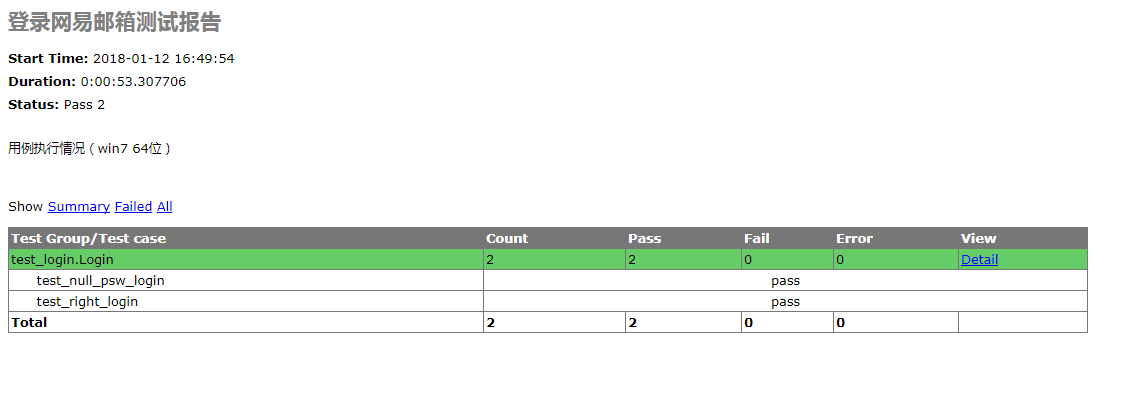
- 报告展示
Python自动化测试框架——生成测试报告的更多相关文章
- 【转】推荐4个不错的Python自动化测试框架
之前,开发团队接手一个项目并开始开发时,除了项目模块的实际开发之外,他们不得不为这个项目构建一个自动化测试框架.一个测试框架应该具有最佳的测试用例.假设(assumptions).脚本和技术来运行每一 ...
- Selenium WebDriver + python 自动化测试框架
目标 组内任何人都可以进行自动化测试用例的编写 完全分离测试用例和自动化测试代码,就像写手工测试用例一下,编写excel格式的测试用例,包括步骤.检查点,然后执行自动化工程,即可执行功能自动化测试用例 ...
- python自动化测试框架unittest
对于刚学习python自动化测试的小伙伴来说,unittest是一个非常适合的框架: 通过unittest,可以管理测试用例的执行,自动生成简单的自动化测试报告: 首先我们尝试编写编写一个最简单的un ...
- (原创)Python 自动化测试框架详解
自己折腾了一个python的自动化测试框架,梳理了一下流程,简单分享一下. 项目背景 B/S架构,进行用户界面的自动化测试 工具选择 python开发的自动化测试框架,足够灵活,可以随时根据需求进行变 ...
- python自动化测试框架
一.环境准备 1.python开发环境, python3.7 2.setuptools基础工具包 3.pip安装包管理工具 4.selenium自动化测试工具 chrom驱动下载地址: http:/ ...
- Python+自动化测试框架的设计编写
Python之一个简单的自动化测试框架:https://baijiahao.baidu.com/s?id=1578211870226409536&wfr=spider&for=pc h ...
- 解除你学习Python自动化测试框架的所有疑惑,开启学习直通车
学习框架第一步 前言 很多同学学完Python基础后出现迷茫......有同感的小伙伴,点赞关注........ 学习完Python还要学习什么? 什么是自动化测试框架? 如何搭建自动化测试框架? 甚 ...
- Python自动化 unittest生成测试报告(HTMLTestRunner)03
批量执行完用例后,生成的测试报告是文本形式的,不够直观,为了更好的展示测试报告,最好是生成HTML格式的. unittest里面是不能生成html格式报告的,需要导入一个第三方的模块:HTMLTest ...
- python + pytest + allure生成测试报告
pytest结合allure生成测试报告 环境搭建 要安装java环境,版本要是jdk1.8的,配置好java环境变量,不然输入allure命令会报错,JAVA_HOME环境,自行配置 安装allur ...
随机推荐
- codforces 1C Ancient Berland Circus(几何)
题意 给出正多边形上三个点的坐标,求正多边形的最小面积 分析 先用三边长求出外接圆半径(海伦公式),再求出三边长对应的角度,再求出三个角度的gcd,最后答案即为\(S*2π/gcd\),S为gcd对应 ...
- 问题 3: 糖果数(candy)
问题 3: 糖果数(candy) 题目描述 学校准备去春游,委托小明分发糖果,每位同学一袋,数量随机. 一共有N袋糖果,编号为1到N,小明拿了从编号a袋到编号b袋的糖果去分发,小明想知道,他一共拿了多 ...
- 决斗(Headshot )
#include<cstdio> #include<cstring> #include<algorithm> using namespace std; ; char ...
- Java | 基础归纳 | set
用于存储无序(存入和取出的顺序不一定相同)元素,值不能重复.
- selenium自动化测试实例
11.1使用JavaScripExecutor单击元素 被测试网页:http://www.sogou.com Java代码 public class NewTest { WebDriver ...
- POJ244Set Operation(bitset用法)
Bryce1010模板 /* 题意:给出n个集合(n<=1000),每个集合中最多有10000个数, 每个数的范围为1~10000,给出q次询问(q<=200000), 每次给出两个数u, ...
- javascript简单的表单验证
<html> <head> <title>用户登录</title> <script language="javascript" ...
- 转 PHP文件上传$_FILES数组各键值含义说明
文件上传的html表单: <form enctype="multipart/form-data" action="" method="POST& ...
- .net core区域设置方式
在Startup中配置 默认路由是这个,并不包含区域路由 routes.MapRoute( name: "default", template: "{controller ...
- JavaScript——数组的indexOf()方法在IE8中的兼容性问题
昨天在工作中遇到一个问题:数组的indexOf()方法在IE8中无效. 如以下代码在IE8中报错“对象不支持“indexOf”属性或方法”: var arr = [1,2,3]; var index ...