
MyBatis缓存机制(一级缓存,二级缓存)
一,MyBatis一级缓存(本地缓存)
<select id="selectStudentByIdAndName"  flushCache=”true”  resultType="student">

    select * from student where sid=#{Sid} and s_name=#{Sname}

</select>
public class MyBatisTest {

    public static void main( String[] args ) {

        SqlSession openSession = null;

        try {

            //mybatis配置文件

            String resourse="mybatis-cfg.xml";

            //通过 Resources 工具类将 ti -config.xm 配置文件读入 Reader

            InputStream inputStream=Resources.getResourceAsStream(resourse);

            //通过 SqlSessionFactoryBuilder 建造类使用 Reader 创建 SqlSessionFactory工厂对象

            SqlSessionFactory sqlSessionFactory=new SqlSessionFactoryBuilder().build(inputStream);

            //通过SqlSessionFactory工厂得到SqlSession

            openSession = sqlSessionFactory.openSession();

            //通过反射机制来获取对应的Mapper实例

            StudentMapper mapper=openSession.getMapper(StudentMapper.class);

            Student student1=mapper.selectStudentByIdAndName(2,"danghh");

            Student student2=mapper.selectStudentByIdAndName(2,"danghh");

            System.out.println(student1);

            openSession.commit();

        } catch (IOException e) {

            e.printStackTrace();

        }finally {

            //最后一定不要忘记关闭 SqlSession ,否则会因为连接没有关闭导致数据库连接数过多,造成系统崩旗

            openSession.close();

        }

    }

}
[DEBUG] - Setting autocommit to false on JDBC Connection[com.mysql.jdbc.JDBC4Connection@dfd3711]

[DEBUG] - ==>  Preparing: select * from student where sid=? and s_name=?

[DEBUG] - ==> Parameters: 2(Integer), danghh(String)

[DEBUG] - <==      Total: 1

 Student{SID=2, Sname='danghh', Sage=22, Ssex='nv', course=null}
 Student{SID=2, Sname='danghh', Sage=22, Ssex='nv', course=null}
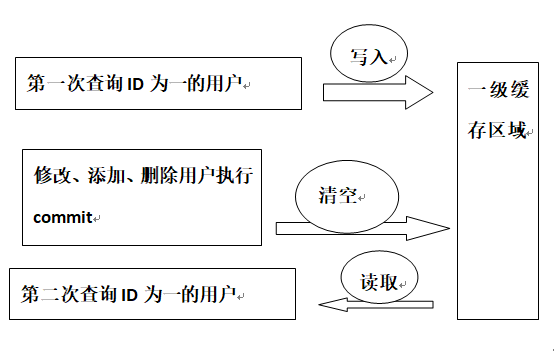
通过结果可以看出,由于代码中查询是在一个SqlSession,且两次查询过程中没有更新信息,不会导致一级缓存失效,所以结果只进行了一次数据库查询。
那如果是在两个SqlSession中分别进行查询呢?
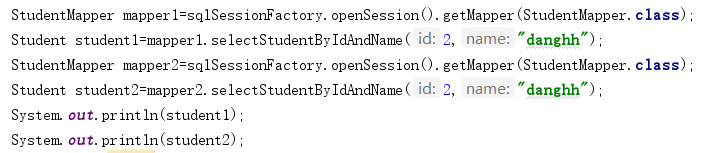
结果:
[DEBUG] - Opening JDBC Connection

[DEBUG] - Checked out connection 234698513 from pool.

[DEBUG] - Setting autocommit to false on JDBC Connection [com.mysql.jdbc.JDBC4Connection@dfd3711]

[DEBUG] - ==>  Preparing: select * from student where sid=? and s_name=?

[DEBUG] - ==> Parameters: 2(Integer), danghh(String)

[DEBUG] - <==      Total: 1

[DEBUG] - Opening JDBC Connection

[DEBUG] - Created connection 1836797772.

[DEBUG] - Setting autocommit to false on JDBC Connection [com.mysql.jdbc.JDBC4Connection@6d7b4f4c]

[DEBUG] - ==>  Preparing: select * from student where sid=? and s_name=?

[DEBUG] - ==> Parameters: 2(Integer), danghh(String)

[DEBUG] - <==      Total: 1

Student{SID=2, Sname='danghh', Sage=22, Ssex='nv', course=null}

Student{SID=2, Sname='danghh', Sage=22, Ssex='nv', course=null}

 [DEBUG] - ==>  Preparing: select * from student where sid=? and s_name=?

 [DEBUG] - ==> Parameters: 2(Integer), hjj(String)

 [DEBUG] - <==      Total: 1

 [DEBUG] - ==>  Preparing: update student set S_name=?,Sage=?,Ssex=? where Sid=?

 [DEBUG] - ==> Parameters: hjj(String), 23(Integer), null, 2(Integer)

 [DEBUG] - <==    Updates: 1

 [DEBUG] - ==>  Preparing: select * from student where sid=? and s_name=?

 [DEBUG] - ==> Parameters: 2(Integer), hjj(String)

 [DEBUG] - <==      Total: 1

  Student{SID=2, Sname='hjj', Sage=23, Ssex='null', course=null}

  Student{SID=2, Sname='hjj', Sage=23, Ssex='null', course=null}

(这个参数是二级缓存的全局开关,默认值是 true ,初始状态为启用状态,所以也可忽略此步的配置)
(由于MyBatis二级缓存和命名空间namespace是绑定的 ,即二级缓存还需要在 Mapper.xml 映射文件中配置或者在 Mapper.java 接口中配置。)

- LRU (最近最少使用的) 移除最长时间不被使用的对象,这是默认值
- FIFO (先进先出〉 按对象进入缓存的顺序来移除它们
- SOFT (软引用) 移除基于垃圾回收器状态和软引用规则的对象
- WEAK (弱引用) 更积极地移除基于垃圾收集器状态和弱引用规则的对象

代码:
public class MyBatisTest {

    public static void main( String[] args ) {

        SqlSession openSession1 = null;

        SqlSession openSession2 = null;

        try {

            //mybatis配置文件

            String resourse="mybatis-cfg.xml";

            //通过 Resources 工具类将 ti -config.xm 配置文件读入 Reader

            InputStream inputStream=Resources.getResourceAsStream(resourse);

            //通过 SqlSessionFactoryBuilder 建造类使用 Reader 创建 SqlSessionFactory工厂对象

            SqlSessionFactory sqlSessionFactory=new SqlSessionFactoryBuilder().build(inputStream);

            //通过SqlSessionFactory工厂得到SqlSession1

            openSession1 = sqlSessionFactory.openSession();

            StudentMapper mapper1=openSession1.getMapper(StudentMapper.class);

            //通过SqlSessionFactory工厂得到SqlSession2

            openSession2 = sqlSessionFactory.openSession();

            StudentMapper mapper2=openSession2.getMapper(StudentMapper.class);

            //使用会话1进行查询,此次查询结果只会存储在一级缓存中

            Student student1=mapper1.selectStudentByIdAndName(2,"hjj");

            System.out.println(student1);

            //使用会话2进行查询,前面会话未关闭,数据不会被刷到二级缓存中,所以本次仍会执行sql

            Student student2=mapper2.selectStudentByIdAndName(2,"hjj");

            System.out.println(student2);

            //使用会话2进行查询,由于前面已执行过该方法,所以可在一级缓存中查到

            Student student3=mapper2.selectStudentByIdAndName(2,"hjj");

            System.out.println(student3);

            openSession1.commit();

        } catch (IOException e) {

            e.printStackTrace();

        }finally {

            //最后一定不要忘记关闭 SqlSession ,否则会因为连接没有关闭导致数据库连接数过多,造成系统崩旗

            openSession1.close();

        }

    }

}
[DEBUG] - Cache Hit Ratio [MyBatisDemo.StudentMapper]: 0.0

[DEBUG] - Opening JDBC Connection

[DEBUG] - Checked out connection 234698513 from pool.

[DEBUG] - Setting autocommit to false on JDBC Connection [com.mysql.jdbc.JDBC4Connection@dfd3711]

[DEBUG] - ==>  Preparing: select * from student where sid=? and s_name=?

[DEBUG] - ==> Parameters: 2(Integer), hjj(String)

[DEBUG] - <==      Total: 1

     Student{SID=2, Sname='hjj', Sage=23, Ssex='null', course=null}

[DEBUG] - Cache Hit Ratio [MyBatisDemo.StudentMapper]: 0.0

[DEBUG] - Opening JDBC Connection

[DEBUG] - Created connection 1843368112.

[DEBUG] - Setting autocommit to false on JDBC Connection [com.mysql.jdbc.JDBC4Connection@6ddf90b0]

[DEBUG] - ==>  Preparing: select * from student where sid=? and s_name=?

[DEBUG] - ==> Parameters: 2(Integer), hjj(String)

[DEBUG] - <==      Total: 1

     Student{SID=2, Sname='hjj', Sage=23, Ssex='null', course=null}

[DEBUG] - Cache Hit Ratio [MyBatisDemo.StudentMapper]: 0.0

      Student{SID=2, Sname='hjj', Sage=23, Ssex='null', course=null}

[DEBUG] - Resetting autocommit to true on JDBC Connection [com.mysql.jdbc.JDBC4Connection@dfd3711]

[DEBUG] - Closing JDBC Connection [com.mysql.jdbc.JDBC4Connection@dfd3711]

[DEBUG] - Returned connection 234698513 to pool.
该颜色:表示会话1第一次查询的结果,由于第一次查询,一级缓存和二级缓存中都没有数据,所以Mapper命中率为0.0,且进行了数据库查询,并将结果存储到会话1一级缓存中。
该颜色:表示会话2第一次查询的结果,由于会话1没有关闭,所以会话1的一级缓存不会刷到Mapper的二级缓存中,并且是在会话2中第一次查询该方法,所以Mapper命中率为0.0,且进行了数据库查询,并将结果存储到会话2的一级缓存中。

运行结果:
[DEBUG] - Cache Hit Ratio [MyBatisDemo.StudentMapper]: 0.0

[DEBUG] - Opening JDBC Connection

[DEBUG] - Checked out connection 234698513 from pool.

[DEBUG] - Setting autocommit to false on JDBC Connection [com.mysql.jdbc.JDBC4Connection@dfd3711]

[DEBUG] - ==>  Preparing: select * from student where sid=? and s_name=?

[DEBUG] - ==> Parameters: 2(Integer), hjj(String)

[DEBUG] - <==      Total: 1

  Student{SID=2, Sname='hjj', Sage=23, Ssex='null', course=null}

[DEBUG] - Cache Hit Ratio [MyBatisDemo.StudentMapper]: 0.0

  Student{SID=2, Sname='hjj', Sage=23, Ssex='null', course=null}

[DEBUG] - Resetting autocommit to true on JDBC Connection [com.mysql.jdbc.JDBC4Connection@dfd3711]

[DEBUG] - Closing JDBC Connection [com.mysql.jdbc.JDBC4Connection@dfd3711]

[DEBUG] - Returned connection 234698513 to pool.

[DEBUG] - Cache Hit Ratio [MyBatisDemo.StudentMapper]: 0.3333333333333333

  Student{SID=2, Sname='hjj', Sage=23, Ssex='null', course=null}

[DEBUG] - Cache Hit Ratio [MyBatisDemo.StudentMapper]: 0.5

  Student{SID=2, Sname='hjj', Sage=23, Ssex='null', course=null}
MyBatis缓存机制(一级缓存,二级缓存)的更多相关文章
- mybatis学习--缓存(一级和二级缓存)
声明:学习摘要! MyBatis缓存 我们知道,频繁的数据库操作是非常耗费性能的(主要是因为对于DB而言,数据是持久化在磁盘中的,因此查询操作需要通过IO,IO操作速度相比内存操作速度慢了好几个量级) ...
- Mybatis学习(五)————— 延迟加载和缓存机制(一级二级缓存)
一.延迟加载 延迟加载就是懒加载,先去查询主表信息,如果用到从表的数据的话,再去查询从表的信息,也就是如果没用到从表的数据的话,就不查询从表的信息.所以这就是突出了懒这个特点.真是懒啊. Mybati ...
- Mybatis(五) 延迟加载和缓存机制(一级二级缓存)
踏踏实实踏踏实实,开开心心,开心是一天不开心也是一天,路漫漫其修远兮. --WH 一.延迟加载 延迟加载就是懒加载,先去查询主表信息,如果用到从表的数据的话,再去查询从表的信息,也就是如果没用到从表的 ...
- MyBatis加强(1)~缓存机制(一级缓存、二级缓存、第三方缓存技术redis、ehcache)
一.缓存机制 使用缓存可以使应用更快地获取数据,避免频繁的数据库交互操作,尤其是在查询越多,缓存命中率越高 的情况下,缓存的作用就越明显. 1.缓存原理:Map ■ 查询时,先从缓存区查询:找到,返回 ...
- Mybatis一级、二级缓存
Mybatis一级.二级缓存 一级缓存 首先做一个测试,创建一个mapper配置文件和mapper接口,我这里用了最简单的查询来演示. <mapper namespace="c ...
- mybatis缓存,包含一级缓存与二级缓存,包括ehcache二级缓存
一,引言 首先我们要明白一点,缓存所做的一切都是为了提高性能.明白了这一点下面我们开始进入正题. 二,mybatis缓存概要 ①.mybatis的缓存有两种,分别是一级缓存和二级缓存.两者都属于查询缓 ...
- Mybatis 的一级、二级缓存?
1)一级缓存: 基于 PerpetualCache 的 HashMap 本地缓存,其存储作用域为 Session,当 Session flush 或 close 之后,该 Session 中的所有 C ...
- Mybatis 的一级、二级缓存?
1)一级缓存: 基于 PerpetualCache 的 HashMap 本地缓存,其存储作用域为 Session,当 Session flush 或 close 之后,该 Session 中的所有 C ...
- Mybatis 源码分析之一二级缓存
一级缓存 其实关于 Mybatis 的一级缓存是比较抽象的,并没有什么特别的配置,都是在代码中体现出来的. 当调用 Configuration 的 newExecutor 方法来创建 executor ...
- Mybatis基于注解开启使用二级缓存
关于Mybatis的一级缓存和二级缓存的概念以及理解可以参照前面文章的介绍.前文连接:https://www.cnblogs.com/hopeofthevillage/p/11427438.html, ...
随机推荐
- 米特运输——(dfs)
米特是D星球上一种非常神秘的物质,蕴含着巨大的能量.在以米特为主要能源的D星上,这种米特能源的运输和储 存一直是一个大问题.D星上有N个城市,我们将其顺序编号为1到N,1号城市为首都.这N个城市由N- ...
- Cannot find libcrypto in Ubuntu
https://stackoverflow.com/questions/13811889/cannot-find-libcrypto-in-ubuntu sudo apt-get install li ...
- cocos2d 导演,场景
导演(Director) Cocos2d-x 使用导演的概念,这个导演和电影制作过程中的导演一样!导演控制电影制作流程,指导团队完成各项任务.在使用 Cocos2d-x 开发游戏的过程中,你可以认为自 ...
- office 365 激活
将以下代码复制到记事本 @echo off title Activate Microsoft Office ALL versions &echo - Microsoft Office Prof ...
- 《树莓派学习指南(基于Linux)》——本章小结
本节书摘来自异步社区<树莓派学习指南(基于Linux)>一书中的第二章的本章小结,作者[英]Peter Membrey ,[澳]David Hows ,译者 张志博,孙峻文,更多章节内容可 ...
- Redis(三):多机数据库的实现
复制 在Redis中,用户可以通过SLAVEOF命令或是slaveof选项设置服务器的主从关系,从(SLAVE)服务器会复制主(Master)服务器. 旧版复制功能实现(2.8以前) 旧版复制功能主要 ...
- Unity(GameObject)
####1. 这个方法用于发送一个数据到指定的方法中,第三个参数是是否强制接收 以下三种方法发送消息的形式,各有不同的效果,可以通过第一个参数指定要发送的方法名名,第二个是发送的参数值,第三个参数是是 ...
- HR问了我朋友什么是简单工厂模式,竟被质疑是否学过设计模式,是否是计算机专业?
越是简单的东西,越是容易被忽略,我来带你们好复习一下! 简单工厂模式 简单工厂模式也被称为静态工厂模式;使用简单工厂模式可以将产品的"消费"和生产完全分开,客户端只需要知道自己需要 ...
- The Preliminary Contest for ICPC Asia Xuzhou 2019 徐州网络赛 K题 center
You are given a point set with nn points on the 2D-plane, your task is to find the smallest number o ...
- unittest(封装用例)
from selenium import webdriver from time import sleep import unittest #导入unittest库 import HTMLTestRu ...