
java学习笔记之原型模式及深浅拷贝
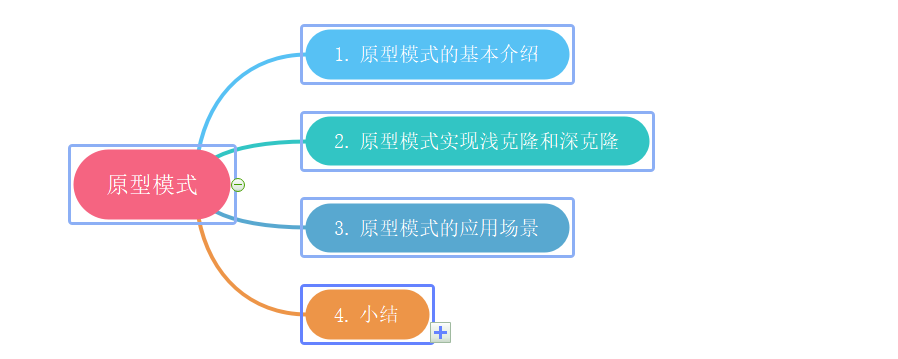
一、原型模式的基本介绍
在聊原型模式之前,我们来思考一个小问题,传统的方式我们是如何克隆对象呢?
那我们以多利羊(Sheep)为例,来说明上述这个问题,具体代码见下面:
多利羊(Sheep)
public class Sheep  {

    private String sname;

    private Date birthday;

    public Sheep(String sname, Date birthday) {

        this.sname = sname;

        this.birthday = birthday;

    }

    public String getSname() {

        return sname;

    }

    public void setSname(String sname) {

        this.sname = sname;

    }

    public Date getBirthday() {

        return birthday;

    }

    public void setBirthday(Date birthday) {

        this.birthday = birthday;

    }

}
测试类(Client)
public class Client {

    public static void main(String[] args) {

        Sheep sheep=new Sheep("多利",new Date());

        Sheep sheep2=new Sheep(sheep.getSname(),sheep.getBirthday());

        System.out.println("sheep:"+sheep.getSname()+sheep.getBirthday());

        System.out.println("sheep2:"+sheep2.getSname()+sheep2.getBirthday());

    }

}
那我们来分析一下:
1、在创建新对象时,总是需要获取原始对象的属性,如果我们在实际项目中创建的对象复杂的话,效率是很低的。
2、总是需要重新初始化对象,而不是动态地获取对象运行时的状态,不够灵活。
有什么方法可以改进吗?,原型模式闪亮登场
大家都知道在Java中有一个Object类,这个类提供了一个clone()方法,该方法可以将Java对象复制一份,前提是该类实现一个Cloneable接口,这就是原型模式的源头。
什么是原型模式:
用原型实例指定创建对象的种类,并且通过拷贝这些原型来创建新的对象。
看了这个定义可能有的小伙伴们比较蒙,那我们来撸一把代码来说明(多利羊克隆):
多利羊(Sheep)实现Cloneable
public class Sheep implements Cloneable {

    private String sname;

    private Date birthday;

    private Sheep mother;

    public Sheep getMother() {

        return mother;

    }

    public void setMother(Sheep mother) {

        this.mother = mother;

    }

    public Sheep(String sname, Date birthday) {

        this.sname = sname;

        this.birthday = birthday;

    }

    public String getSname() {

        return sname;

    }

    public void setSname(String sname) {

        this.sname = sname;

    }

    public Date getBirthday() {

        return birthday;

    }

    public void setBirthday(Date birthday) {

        this.birthday = birthday;

    }

    @Override

    public String toString() {

        return "Sheep{" +

                "sname='" + sname + '\'' +

                ", birthday=" + birthday +

                '}';

    }

    @Override

    protected Object clone() throws CloneNotSupportedException {

        Sheep sheep=null;

        try {

           sheep=(Sheep) super.clone();

        }catch (Exception e){

            e.printStackTrace();

        }

        return sheep;

    }

}
克隆方法的测试(Client)
public class Client {

    public static void main(String[] args) throws CloneNotSupportedException {

        Sheep sheep=new Sheep("多利",new Date());

        Sheep mother=new Sheep("多利的妈妈",new Date());

        sheep.setMother(mother);

        Sheep sheep1=(Sheep) sheep.clone();

        System.out.println("sheep:"+sheep);

        System.out.println("sheep1:"+sheep1);

        System.out.println("sheep:"+sheep.getMother().hashCode());

        System.out.println("sheep1:"+sheep1.getMother().hashCode());

    }

}
运行结果:hashcode 的值一样
sheep:Sheep{sname='多利', birthday=Sun May 17 11:56:58 CST 2020}
sheep1:Sheep{sname='多利', birthday=Sun May 17 11:56:58 CST 2020}
sheephashcode:2061475679
sheep1hashcode:2061475679
二、原型模式实现浅克隆和深克隆
浅克隆的介绍:
对于数据类型是基本数据类型的成员变量,浅拷贝会直接进行值传递,也就是将该属性值复制一份给新的对象。
对于数据类型是引用数据类型的成员变量(数组,对象),浅拷贝会进行引用传递,也就是将成员变量的引用值(内存地址)复制一份给新的对象,因为实际上两个对象的该成员变量都指向同一个实例(前面克隆羊就是浅拷贝,使用clone()方法实现)。
再次说明:其实就是克隆多利羊之后,克隆的对象没有被真正的复制一份,而是引用指向第一个对象的属性空间。
画图说明:
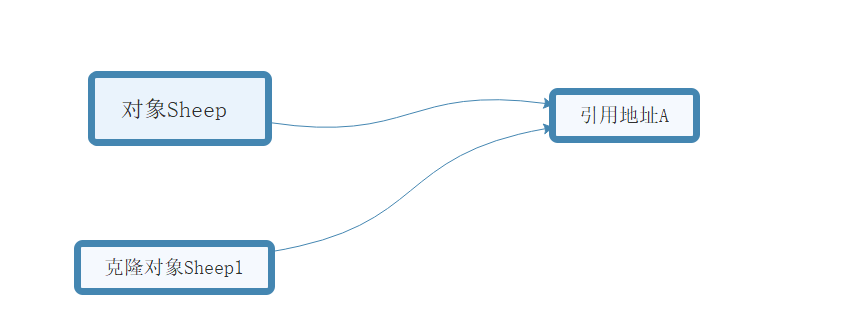
具体代码如下见上面(多利羊克隆)
深克隆的介绍:
1、对对象进行深拷贝要对整个对象(包括对象的引用类型)进行拷贝。
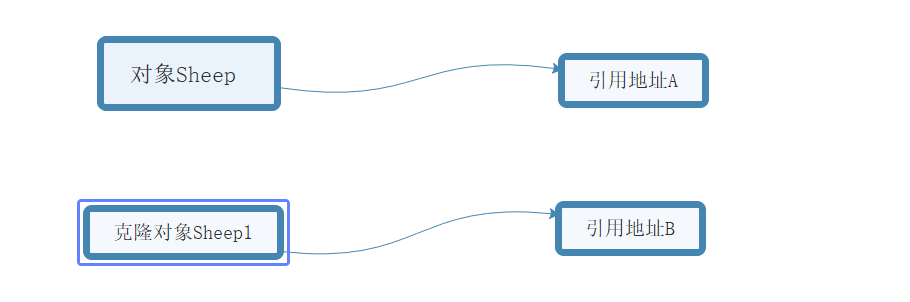
深克隆实现的方式:
1、重写clone()方法实现深克隆
2、通过对象序列化实现深克隆
第一种方式:重写clone()方法实现深克隆,参考下面代码实现:
public class Sheep implements Cloneable {

    private String sname;

    private Date birthday;

    public Mother mother;

    public Sheep() {

    }

    public Sheep(String sname, Date birthday,Mother mother ) {

        this.sname = sname;

        this.birthday = birthday;

        this.mother=mother;

    }

    @Override

    public String toString() {

        return "Sheep{" +

                "sname='" + sname + '\'' +

                ", birthday=" + birthday +

                ", mother=" + mother +

                '}';

    }

    @Override

    protected Object clone() throws CloneNotSupportedException {

        Sheep sheep=null;

        try {

            Object obj= super.clone();

            sheep=(Sheep) obj;

            sheep.mother=(Mother) mother.clone();

        } catch (Exception e) {

            e.printStackTrace();

        }

        return sheep;

    }

}
多利的妈咪
public class Mother implements Cloneable {

    private int age;

    private String name;

    public Mother(int age, String name) {

        this.age = age;

        this.name = name;

    }

    @Override

    protected Object clone() throws CloneNotSupportedException {

        return super.clone();

    }

}
客户端测试:
public class Client {

    public static void main(String[] args) throws CloneNotSupportedException {

        Sheep sheep=new Sheep("多利",new Date(),new Mother(12,"多利的妈妈"));

        Sheep sheep1=(Sheep) sheep.clone();

        System.out.println("sheep:"+sheep);

        System.out.println("sheep1:"+sheep1);

        System.out.println("sheephashcode:"+sheep.mother.hashCode());

        System.out.println("sheep1hashcode:"+sheep1.mother.hashCode());

    }

}
运行结果:hashcode 的值不一样
sheep:Sheep{sname='多利', birthday=Sun May 17 13:20:51 CST 2020, mother=com.designpattern.pattern.prototypepattern.sprototype.Mother@7adf9f5f}
sheep1:Sheep{sname='多利', birthday=Sun May 17 13:20:51 CST 2020, mother=com.designpattern.pattern.prototypepattern.sprototype.Mother@85ede7b}
sheephashcode:2061475679
sheep1hashcode:140435067
第二种方式:序列化和反序列化
需要在Sheep ,Mother 类实现一个序列化 Serializable,具体代码和上面第一种方式的代码一样,就是这Sheep代码中增加以下这段核心代码:
  // 通过对象的序列化实现

    public Object deepClone() throws Exception {

        ByteArrayOutputStream  bos=new ByteArrayOutputStream();

        ObjectOutputStream oos=new ObjectOutputStream(bos);

        oos.writeObject(this);

        ObjectInputStream ois=new ObjectInputStream(new ByteArrayInputStream(bos.toByteArray()));

        Sheep sheep=(Sheep) ois.readObject();

        return sheep;

    }
运行结果:
sheep:Sheep{sname='多利', birthday=Sun May 17 13:51:23 CST 2020, mother=com.designpattern.pattern.prototypepattern.sprototype.Mother@72ea2f77}
sheep1:Sheep{sname='多利', birthday=Sun May 17 13:51:23 CST 2020, mother=com.designpattern.pattern.prototypepattern.sprototype.Mother@17f052a3}
sheephashcode:1927950199
sheep1hashcode:401625763
三、原型模式的应用场景
Spring 中bean 的scope 属性的声明:
<bean id="student" class="com.Student" scope="prototype"/>
public class ProtoType {

 public static void main(String[] args) {

 	// TODO Auto-generated method stub

 	ApplicationContext applicationContext = new ClassPathXmlApplicationContext("beans.xml");

 	// 获取monster[通过id获取monster]

 	Object bean = applicationContext.getBean("student");

 	System.out.println("bean:" + bean);

 	Object bean2 = applicationContext.getBean("student");

 	System.out.println("bean1" + bean2);

 	System.out.println(bean == bean2);

 }

}
运行结果
bean:com.atguigu.spring.bean.Student@52bf72b5
bean1com.atguigu.spring.bean.Student@37afeb11
false
四、小结
优点:
1、创建新的对象比较复杂时,可以利用原型模式创建新的对象,不用重新初始化对象,而是动态地获得对象运行时的状态。
2、如果原始对象发生变化,其克隆的对象也会发生响应的变化,不需要修改代码来实现
缺点:
需要为每一个类配置一个克隆方法,需要器修改源代码,不符合OCP原则。
技术之路还很长,慢慢来吧,时间会证明一切。
java学习笔记之原型模式及深浅拷贝的更多相关文章
- python学习笔记:第7天 深浅拷贝
目录 1. 基础数据类型补充 2. set集合 3. 深浅拷贝 1. 基础数据类型补充 (1)join方法 join方法是把一个列表中的数据进行拼接,拼接成字符串(与split方法相反,split方法 ...
- 设计模式学习笔记——Prototype原型模式
原型模型就是克隆. 还有深克隆.浅克隆,一切听上去都那么耳熟能详.
- 《Java学习笔记(第8版)》学习指导
<Java学习笔记(第8版)>学习指导 目录 图书简况 学习指导 第一章 Java平台概论 第二章 从JDK到IDE 第三章 基础语法 第四章 认识对象 第五章 对象封装 第六章 继承与多 ...
- 20145330《Java学习笔记》第一章课后练习8知识总结以及IDEA初次尝试
20145330<Java学习笔记>第一章课后练习8知识总结以及IDEA初次尝试 题目: 如果C:\workspace\Hello\src中有Main.java如下: package cc ...
- Java学习笔记4
Java学习笔记4 1. JDK.JRE和JVM分别是什么,区别是什么? 答: ①.JDK 是整个Java的核心,包括了Java运行环境.Java工具和Java基础类库. ②.JRE(Java Run ...
- java学习笔记13--反射机制与动态代理
本文地址:http://www.cnblogs.com/archimedes/p/java-study-note13.html,转载请注明源地址. Java的反射机制 在Java运行时环境中,对于任意 ...
- Java学习笔记之---方法和数组
Java学习笔记之---方法与数组 (一)方法 (1)什么是方法? 方法是解决一类问题的步骤的有序组合 方法包含于类或对象中 方法在程序中被创建,在其他地方被引用 (2)方法的优点 使程序变得更简短而 ...
- java学习笔记之基础篇
java选择语句之switch //switch可以用于等值判断 switch (e) //int ,或则可以自动转化成int 的类型,(byte char short)枚举jdk 7中可以防止字 ...
- java学习笔记(1)java的基础介绍 、JDK下载、配置环境变量、运行java程序
java工程师是开发软件的 什么是软件呢? 计算机包括两部分: 硬件: 鼠标.键盘.显示器.主机箱内部的cpu.内存条.硬盘等 软件: 软件包括:系统软件和应用软件 系统软件:直接和硬件交互的软件:w ...
随机推荐
- 用python把技术文档中,每个模块系列截图生成一个动态GIF
前言 本文的文字及图片来源于网络,仅供学习.交流使用,不具有任何商业用途,版权归原作者所有,如有问题请及时联系我们以作处理. 最近在写技术文档的时候,发现一个问题.对于每个技术步骤,都需要一个截图,这 ...
- 20199310《Linux内核原理与分析》第十五周作业 Linux安全实验
1 补充知识 缓冲区溢出是指程序试图向缓冲区写入超出预分配固定长度数据的情况.这一漏洞可以被恶意用户利用来改变程序的流控制,甚至执行代码的任意片段.这一漏洞的出现是由于数据缓冲器和返回地址的暂时关闭, ...
- [Windows] 如何用编程的方式格式化硬盘
If memory serves, you're looking for SHFormatDrive(). Use the Format method of the Win32_Volume clas ...
- C++多线程队列实现
C++多线程队列实现 C++多线程队列学习 介绍 在项目中,进行多线程队列实现是一个比较麻烦的事, 找到了一个实现比较好的多线程队列实现, 自己做了一点修改更加适应自己的项目, 记录下来, 有需要的自 ...
- 素数&欧拉函数
素数表 const int maxN找[1,maxN)内的素数 int prime[int I]第I个素数 const int maxN=1e5+5; int prime[maxN]; bool ma ...
- Python3 字符串格式化(%操作符)
格式符 格式符为真实值预留位置,并控制显示的格式.格式符可以包含有一个类型码,用以控制显示的类型,如下: %s 字符串 (采用str()的显示) %r 字符串 (采用repr()的显示) ...
- Django入门3:视图views
1.获取用户请求数据 1.1 request.GET 获取request.method='GET'的数据 request.GET.get('name',None) 1.2 request.POST 获 ...
- embed git commit hash to assembly
https://stackoverflow.com/a/41200059/3782855 https://github.com/304NotModified/Fody.Stamp
- extend()和append()区别
extend()和append()都可以用来添加. 例: a = [1,2,3,4,5,6] b = [7,8,9,10] c = {'aa':123,'bb':456,'cc':789} 1. ...
- Java9新特性系列(module&maven&starter)
上篇已经深入分析了Java9中的模块化,有读者又提到了module与starter是什么关系?本篇将进行分析. 首先先回顾下module与maven/gradle的关系: module与maven/g ...