
python数据结构之图论
本篇学习笔记内容为图的各项性质、图的表示方法、图ADT的python实现
图(Graph)
是数据结构和算法学中最强大的框架之一(或许没有之一)。图几乎可以用来表现所有类型的结构或系统,从交通网络到通信网络,从下棋游戏到最优流程,从任务分配到人际交互网络,图都有广阔的用武之地。
我们会把图视为一种由“顶点”组成的抽象网络,网络中的各顶点可以通过“边”实现彼此的连接,表示两顶点有关联。我们要知道最基础最基本的2个概念,顶点(vertex)和边(edge)。
G=(V,E)来表示图。经常用邻接矩阵或者邻接表来描述一副图。首先是链表、树与图的对比图:
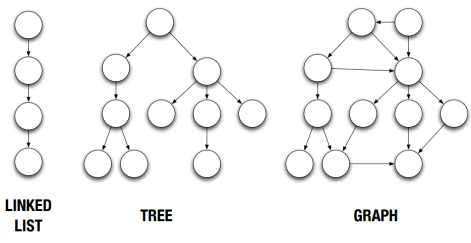
圆为顶点、线为边
图的术语

图 G 是顶点V 和边 E的集合
两个顶点之间:边
如果顶点 x 和 y 共享边,则它们相邻,或者它们是相邻的
无向图 :无向图中的一个边可以在任一方向上遍历
路径::通过边连接的顶点序列
周期:第一个和最后一个顶点相同的路径
入度::顶点的度数V是以V为端点的边数
出度: 顶点的出度v是以v为起点的边的数量
度:顶点的度数是其入度和出度的总和
图的ADT
数据成员 :
顶点 (vertex)
边缘 (edge)
操作 :
有多少顶点?
有多少个边缘?
添加一个新的顶点
添加一个新的边缘
获取所有邻居? (进出)
U,V连接吗?
反转所有边缘?
获取2跳邻居
图表示法:邻接矩阵

class Vertex:

    def __init__(self, node):

        self.id = node

        # Mark all nodes unvisited

        self.visited = False

    def addNeighbor(self, neighbor, G):

        G.addEdge(self.id, neighbor)

    def getConnections(self, G):

        return G.adjMatrix[self.id]

    def getVertexID(self):

        return self.id

    def setVertexID(self, id):

        self.id = id

    def setVisited(self):

        self.visited = True

    def __str__(self):

        return str(self.id)

class Graph:

    def __init__(self, numVertices=10, directed=False):

        self.adjMatrix = [[None] * numVertices for _ in range(numVertices)]

        self.numVertices = numVertices

        self.vertices = []

        self.directed = directed

        for i in range(0, numVertices):

            newVertex = Vertex(i)

            self.vertices.append(newVertex)

    def addVertex(self, vtx, id):  #增加点,这个function没有扩展功能

        if 0 <= vtx < self.numVertices:

            self.vertices[vtx].setVertexID(id)

    def getVertex(self, n):

        for vertxin in range(0, self.numVertices):

            if n == self.vertices[vertxin].getVertexID():

                return vertxin

        return None

    def addEdge(self, frm, to, cost=0): #返回全部连线/航线

        #print("from",frm, self.getVertex(frm))

        #print("to",to, self.getVertex(to))

        if self.getVertex(frm) is not None and self.getVertex(to) is not None:

            self.adjMatrix[self.getVertex(frm)][self.getVertex(to)] = cost

            if not self.directed:

                # For directed graph do not add this

                self.adjMatrix[self.getVertex(to)][self.getVertex(frm)] = cost

    def getVertices(self):

        vertices = []

        for vertxin in range(0, self.numVertices):

            vertices.append(self.vertices[vertxin].getVertexID())

        return vertices

    def printMatrix(self):

        for u in range(0, self.numVertices):

            row = []

            for v in range(0, self.numVertices):

                row.append(str(self.adjMatrix[u][v]) if self.adjMatrix[u][v] is not None else '/')

            print(row)

    def getEdges(self):

        edges = []

        for v in range(0, self.numVertices):

            for u in range(0, self.numVertices):

                if self.adjMatrix[u][v] is not None:

                    vid = self.vertices[v].getVertexID()

                    wid = self.vertices[u].getVertexID()

                    edges.append((vid, wid, self.adjMatrix[u][v]))

        return edges

    def getNeighbors(self, n):

        neighbors = []

        for vertxin in range(0, self.numVertices):

            if n == self.vertices[vertxin].getVertexID():

                for neighbor in range(0, self.numVertices):

                    if (self.adjMatrix[vertxin][neighbor] is not None):

                        neighbors.append(self.vertices[neighbor].getVertexID())

        return neighbors

    def isConnected(self, u, v):

        uidx = self.getVertex(u)

        vidx = self.getVertex(v)

        return self.adjMatrix[uidx][vidx] is not None

    def get2Hops(self, u): #转一次机可以到达哪里

        neighbors = self.getNeighbors(u)

        print(neighbors)

        hopset = set()

        for v in neighbors:

            hops = self.getNeighbors(v)

            hopset |= set(hops)

        return list(hopset)
图表示法:邻接表
用邻接矩阵来表示,每一行表示一个节点与其他所有节点是否相连,但对于邻接表来说,一行只代表和他相连的节点:
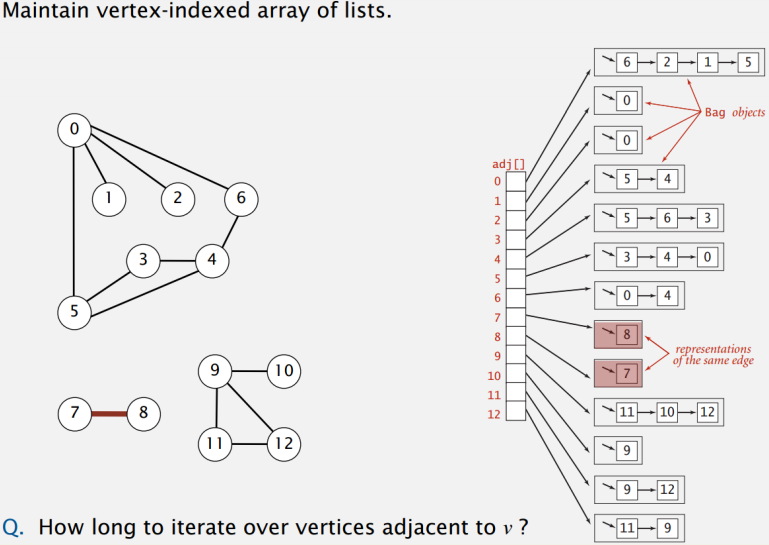
可见邻接表在空间上是更省资源的。
邻接表适合表示稀疏图,邻接矩阵适合表示稠密图。
import sys

class Vertex:

    def __init__(self, node):

        self.id = node

        self.adjacent = {}

        #为所有节点设置距离无穷大

        self.distance = sys.maxsize

        # 标记未访问的所有节点

        self.visited = False

        # Predecessor

        self.previous = None

    def addNeighbor(self, neighbor, weight=0):

        self.adjacent[neighbor] = weight

    # returns a list

    def getConnections(self): # neighbor keys

        return self.adjacent.keys()

    def getVertexID(self):

        return self.id

    def getWeight(self, neighbor):

        return self.adjacent[neighbor]

    def setDistance(self, dist):

        self.distance = dist

    def getDistance(self):

        return self.distance

    def setPrevious(self, prev):

        self.previous = prev

    def setVisited(self):

        self.visited = True

    def __str__(self):

        return str(self.id) + ' adjacent: ' + str([x.id for x in self.adjacent])

    def __lt__(self, other):

        return self.distance < other.distance and self.id < other.id

class Graph:

    def __init__(self, directed=False):

        # key is string, vertex id

        # value is Vertex

        self.vertDictionary = {}

        self.numVertices = 0

        self.directed = directed

    def __iter__(self):

        return iter(self.vertDictionary.values())

    def isDirected(self):

        return self.directed

    def vectexCount(self):

        return self.numVertices

    def addVertex(self, node):

        self.numVertices = self.numVertices + 1

        newVertex = Vertex(node)

        self.vertDictionary[node] = newVertex

        return newVertex

    def getVertex(self, n):

        if n in self.vertDictionary:

            return self.vertDictionary[n]

        else:

            return None

    def addEdge(self, frm, to, cost=0):

        if frm not in self.vertDictionary:

            self.addVertex(frm)

        if to not in self.vertDictionary:

            self.addVertex(to)

        self.vertDictionary[frm].addNeighbor(self.vertDictionary[to], cost)

        if not self.directed:

            # For directed graph do not add this

            self.vertDictionary[to].addNeighbor(self.vertDictionary[frm], cost)

    def getVertices(self):

        return self.vertDictionary.keys()

    def setPrevious(self, current):

        self.previous = current

    def getPrevious(self, current):

        return self.previous

    def getEdges(self):

        edges = []

        for key, currentVert in self.vertDictionary.items():

            for nbr in currentVert.getConnections():

                currentVertID = currentVert.getVertexID()

                nbrID = nbr.getVertexID()

                edges.append((currentVertID, nbrID, currentVert.getWeight(nbr))) # tuple

        return edges

    def getNeighbors(self, v):

        vertex = self.vertDictionary[v]

        return vertex.getConnections()
学习资料参考:图论算法初步、python算法图论
python数据结构之图论的更多相关文章
- python数据结构与算法
最近忙着准备各种笔试的东西,主要看什么数据结构啊,算法啦,balahbalah啊,以前一直就没看过这些,就挑了本简单的<啊哈算法>入门,不过里面的数据结构和算法都是用C语言写的,而自己对p ...
- python数据结构与算法——链表
具体的数据结构可以参考下面的这两篇博客: python 数据结构之单链表的实现: http://www.cnblogs.com/yupeng/p/3413763.html python 数据结构之双向 ...
- python数据结构之图的实现
python数据结构之图的实现,官方有一篇文章介绍,http://www.python.org/doc/essays/graphs.html 下面简要的介绍下: 比如有这么一张图: A -> B ...
- Python数据结构与算法--List和Dictionaries
Lists 当实现 list 的数据结构的时候Python 的设计者有很多的选择. 每一个选择都有可能影响着 list 操作执行的快慢. 当然他们也试图优化一些不常见的操作. 但是当权衡的时候,它们还 ...
- Python数据结构与算法--算法分析
在计算机科学中,算法分析(Analysis of algorithm)是分析执行一个给定算法需要消耗的计算资源数量(例如计算时间,存储器使用等)的过程.算法的效率或复杂度在理论上表示为一个函数.其定义 ...
- SDUT 2141 【TEST】数据结构实验图论一:基于邻接矩阵的广度优先搜索遍历
数据结构实验图论一:基于邻接矩阵的广度优先搜索遍历 Time Limit: 1000MS Memory Limit: 65536KB Submit Statistic Discuss Problem ...
- Python数据结构与循环语句
# Python数据结构与循环语句: 首先编程是一项技能,类似跑步,期初不必在意细节,能使用起来就行,等学的游刃有余了再回过头来关注细节问题也不迟. 关于买书: 学会python之后,才需要买书 ...
- python数据结构之栈与队列
python数据结构之栈与队列 用list实现堆栈stack 堆栈:后进先出 如何进?用append 如何出?用pop() >>> >>> stack = [3, ...
- python数据结构之树和二叉树(先序遍历、中序遍历和后序遍历)
python数据结构之树和二叉树(先序遍历.中序遍历和后序遍历) 树 树是\(n\)(\(n\ge 0\))个结点的有限集.在任意一棵非空树中,有且只有一个根结点. 二叉树是有限个元素的集合,该集合或 ...
随机推荐
- 每帧创建一个item
-- 加载列表测试 function UIBagController:onLoadTest() self.goodsprop = DB.getTable("goodsprop"); ...
- linux每日命令(17):which命令
我们经常在linux要查找某个文件,但不知道放在哪里了,可以使用下面的一些命令来搜索: which 查看可执行文件的位置. whereis 查看文件的位置. locate 配合数据库查看文件位置. f ...
- golang 命令行cobra妙用
为什么使用命令行 大型项目中少不了数据升级,如果采用web服务,一来不够安全,二来数据量大的时候也会出超时的情况.这时使用命令行是比较合适的方式了. 命令行中的MVC web项目一般采用MVC模式,对 ...
- <BEA-141281> <unable to get file lock, will retry ...>
原文:http://gdutlzh.blog.163.com/blog/static/164746951201291903824812/ <BEA-141281> <unable t ...
- Android Launcher分析和修改4——初始化加载数据
上面一篇文章说了Launcher是如何被启动的,Launcher启动的过程主要是加载界面数据然后显示出来, 界面数据都是系统APP有关的数据,都是从Launcher的数据库读取,下面我们详细分析Lau ...
- 9patch图的尺寸尽量为偶数
美工做了一张.9的背景图,宽度110*80 像素,描点如下: 放到720p的智能电视上观看,总感觉怪怪的.仔细观看可以发现,前景图总是不能完全的覆盖掉背景图.总有那么一个像素的点多余出来,如图所示: ...
- MVC的Membership
摘自:http://stackoverflow.com/a/16734651/1616023 See the summaries below each quote for a quick answer ...
- 关于Solaris 的磁盘的分区
也许是深受LINUX Windows fdisk 影响,每次看完Solaris的format命令,总是云里雾里.我今天总结一下,各位给点指点 一. Linux.Windows 传统的磁盘区层级, ...
- linux 修改文件类型
:Unix及类Unix系统里,每行结尾只有换行“\n”,Windows系统里面,每行结尾是换行+回车“\n\r”. 利用Linux下的vim编辑器,可以方便的在dos文件.unix文件之间进行切换,且 ...
- [Tensorflow] Cookbook - Neural Network
In this chapter, we'll cover the following recipes: Implementing Operational Gates Working with Gate ...