
POJ2528Mayor's posters[线段树 离散化]
| Time Limit: 1000MS | Memory Limit: 65536K | |
| Total Submissions: 59683 | Accepted: 17296 |
Description
- Every candidate can place exactly one poster on the wall.
- All posters are of the same height equal to the height of the wall; the width of a poster can be any integer number of bytes (byte is the unit of length in Bytetown).
- The wall is divided into segments and the width of each segment is one byte.
- Each poster must completely cover a contiguous number of wall segments.
They have built a wall 10000000 bytes long (such that there is enough place for all candidates). When the electoral campaign was restarted, the candidates were placing their posters on the wall and their posters differed widely in width. Moreover, the candidates started placing their posters on wall segments already occupied by other posters. Everyone in Bytetown was curious whose posters will be visible (entirely or in part) on the last day before elections.
Your task is to find the number of visible posters when all the posters are placed given the information about posters' size, their place and order of placement on the electoral wall.
Input
Output
The picture below illustrates the case of the sample input. 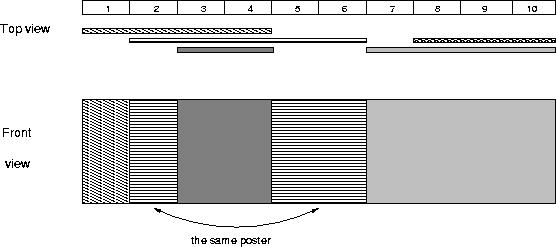
Sample Input
1

5

1 4

2 6

8 10

3 4

7 10
Sample Output
4
Source
notonlysuccess大神的题解
题意:在墙上贴海报,海报可以互相覆盖,问最后可以看见几张海报 思路:这题数据范围很大,直接搞超时+超内存,需要离散化: 离散化简单的来说就是只取我们需要的值来用,比如说区间[,],[,] 我们用不到[-∞,][,][,][,][,+∞]这些值,所以我只需要1000,,,2012就够了,将其分别映射到0,,,,在于复杂度就大大的降下来了 所以离散化要保存所有需要用到的值,排序后,分别映射到1~n,这样复杂度就会小很多很多 而这题的难点在于每个数字其实表示的是一个单位长度(并且一个点),这样普通的离散化会造成许多错误(包括我以前的代码,poj这题数据奇弱) 给出下面两个简单的例子应该能体现普通离散化的缺陷: - - - - - - 为了解决这种缺陷,我们可以在排序后的数组上加些处理,比如说[,,,] 如果相邻数字间距大于1的话,在其中加上任意一个数字,比如加成[,,,,,],然后再做线段树就好了. 线段树功能:update:成段替换 query:简单hash
说一下离散化,用map完美TLE,改成1e7大数组因为memset太耗时,再改成二分搜索用下标快好多
#include <iostream>

#include <cstdio>

#include <cstring>

#include <algorithm>

#include <map>

using namespace std;

const int N=1e4+,TREE=4e4+;

#define m (l+r)/2

#define lson o<<1,l,m

#define rson o<<1|1,m+1,r

#define lc o<<1

#define rc o<<1|1

inline int read(){

    char c=getchar();int x=,f=;

    while(c<''||c>''){if(c=='-')f=-;c=getchar();}

    while(c>=''&&c<=''){x=x*+c-'';c=getchar();}

    return x*f;

}

//map<int,int> mp;

//int mp[10000009];

int mp[N<<];

int t[TREE<<];

int T,n,ll[N],rr[N],a[N<<];

inline void paint(int o,int v){

    t[o]=v;

}

inline void pushDown(int o){

    if(t[o]!=){

        paint(lc,t[o]);

        paint(rc,t[o]);

        t[o]=;

    }

}

void draw(int o,int l,int r,int ql,int qr,int v){//printf("draw %d %d %d\n",o,l,r);

    if(ql<=l&&r<=qr) paint(o,v);

    else{

        pushDown(o);

        if(ql<=m) draw(lson,ql,qr,v);

        if(m<qr) draw(rson,ql,qr,v);

    }

}

int vis[N],ans=;

void query(int o,int l,int r,int ql,int qr){//printf("quer %d %d %d\n",o,l,r);

    if(t[o]){

        if(!vis[t[o]]){ans++;vis[t[o]]=;}

    }else{

        if(l==r) return;

        if(ql<=m) query(lson,ql,qr);

        if(m<qr) query(rson,ql,qr);

    }

}

int main(){

    T=read();

    while(T--){

        n=read();

        memset(t,,sizeof(t));

        //mp.clear();

        //memset(mp,0,sizeof(mp));

        for(int i=;i<=n;i++){ll[i]=read();rr[i]=read();a[*i-]=ll[i];a[*i]=rr[i];}

        sort(a+,a++*n);

        int cnt=;

//        mp[a[1]]=++cnt;

//        for(int i=2;i<=2*n;i++)

//            if(a[i]!=a[i-1]){

//                //if(!mp.count(a[i]-1)) mp[a[i]-1]=++cnt;

//                if(!mp[a[i]-1]) mp[a[i]-1]=++cnt;

//                mp[a[i]]=++cnt;

//            }

//        for(int i=1;i<=n;i++){

//            int ql=mp[ll[i]],qr=mp[rr[i]];//printf("hi %d %d\n",ql,qr);

//            draw(1,1,cnt,ql,qr,i);

//        }

//

        for(int i=;i<=*n;i++) if(a[i]!=a[i-]) mp[++cnt]=a[i];

        for(int i=cnt;i>=;i--) if(mp[i]!=mp[i-]+) mp[++cnt]=mp[i-]+;

        sort(mp+,mp++cnt);

        for(int i=;i<=n;i++){

            int ql=lower_bound(mp+,mp++cnt,ll[i])-mp,qr=lower_bound(mp+,mp++cnt,rr[i])-mp;

            draw(,,cnt,ql,qr,i);

        }

        ans=;

        memset(vis,,sizeof(vis));

        query(,,cnt,,cnt);

        printf("%d\n",ans);

        //printf("\n\ncnt %d\n",cnt);

        //for(int i=1;i<=10;i++) printf("mp %d %d\n",i,mp[i]);

    }

}
POJ2528Mayor's posters[线段树 离散化]的更多相关文章
- POJ 2528 Mayor's posters(线段树+离散化)
Mayor's posters 转载自:http://blog.csdn.net/winddreams/article/details/38443761 [题目链接]Mayor's posters [ ...
- [poj2528] Mayor's posters (线段树+离散化)
线段树 + 离散化 Description The citizens of Bytetown, AB, could not stand that the candidates in the mayor ...
- poj 2528 Mayor's posters 线段树+离散化技巧
poj 2528 Mayor's posters 题目链接: http://poj.org/problem?id=2528 思路: 线段树+离散化技巧(这里的离散化需要注意一下啊,题目数据弱看不出来) ...
- Mayor's posters (线段树+离散化)
Mayor's posters Description The citizens of Bytetown, AB, could not stand that the candidates in the ...
- POJ2528Mayor's posters 线段树,离散化技巧
题意:一个坐标轴从1~1e7,每次覆盖一个区间(li,ri),问最后可见区间有多少个(没有被其他区间挡住的) 线段树,按倒序考虑,贴上的地方记为1,每次看(li,ri)这个区间是否全是1,全是1就说明 ...
- Mayor's posters(线段树+离散化POJ2528)
Mayor's posters Time Limit: 1000MS Memory Limit: 65536K Total Submissions: 51175 Accepted: 14820 Des ...
- POJ 2528 Mayor's posters (线段树+离散化)
Mayor's posters Time Limit: 1000MS Memory Limit: 65536K Total Submissions:75394 Accepted: 21747 ...
- poj 2528 Mayor's posters 线段树+离散化 || hihocode #1079 离散化
Mayor's posters Description The citizens of Bytetown, AB, could not stand that the candidates in the ...
- poj 2528 Mayor's posters(线段树+离散化)
/* poj 2528 Mayor's posters 线段树 + 离散化 离散化的理解: 给你一系列的正整数, 例如 1, 4 , 100, 1000000000, 如果利用线段树求解的话,很明显 ...
随机推荐
- Top 15 不起眼却有大作用的 .NET功能集
目录 1. ObsoleteAttribute2. 设置默认值属性: DefaultValueAttribute3. DebuggerBrowsableAttribute4. ??运算符5. Curr ...
- MyEclipse10查看Struts2源码及Javadoc文档
1:查看Struts2源码 (1):Referenced Libraries >struts2-core-2.1.6.jar>右击>properties. (2):Java Sour ...
- 使用MyEclipse中servlet对SQL Server 2008的CRUD
1.在MyEclipse下建立Web Project,找到根目录建立Database文件夹和Doc文件夹,Database用于保存数据库信息,Doc用于保存数据库表信息. 2.打开SQL Server ...
- 装配bean
spring有三种装配bean的方式:隐式装配.java代码装配.xml装配 隐式装配最为省事方便,也称为自动化装配 这三种装配方式可以混搭着来用 在这里通过一个例子来讲述配置 CD的两个实现,一个是 ...
- js基础知识梳理(最简版)
基础的JavaScript知识,只放XMind截图.小白 JS01 JS02 JS03 最基础的js知识--!
- angular源码分析:$compile服务——指令的编写
这一期中,我不会分析源码,只是翻译一下"https://docs.angularjs.org/api/ng/service/$compile",当然不是逐字逐句翻译,讲解指令应该如 ...
- 天津政府应急系统之GIS一张图(arcgis api for flex)讲解(九)地图定位模块
config.xml文件的配置如下: <widget label="地图定位" config="widgets/esri/Location/LocationWidg ...
- UIViewController相关知识
title: UIViewController 相关知识date: 2015-12-13 11:50categories: IOS tags: UIViewController 小小程序猿我的博客:h ...
- “#if 0/#if 1 ... #endif”的作用
1. "#if 0/#if 1 ... #endif"的作用,我们知道,C标准不提供C++里的"//"这样的单行风格注释而只提供"/* */" ...
- Java中的Atomic包
Atomic包的作用 方便程序员在多线程环境下,无锁的进行原子操作 Atomic包核心 Atomic包里的类基本都是使用Unsafe实现的包装类,核心操作是CAS原子操作: 关于CAS compare ...