
normalization(统计)
In statistics and applications of statistics, normalization can have a range of meanings.[1] In the simplest cases, normalization of ratings means adjusting values measured on different scales to a notionally common scale, often prior to averaging. In more complicated cases, normalization may refer to more sophisticated adjustments where the intention is to bring the entire probability distributions of adjusted values into alignment. In the case of normalization of scores in educational assessment, there may be an intention to align distributions to a normal distribution. A different approach to normalization of probability distributions is quantile normalization, where the quantiles of the different measures are brought into alignment.
In another usage in statistics, normalization refers to the creation of shifted and scaled versions of statistics, where the intention is that these normalized values allow the comparison of corresponding normalized values for different datasets in a way that eliminates the effects of certain gross influences, as in an anomaly time series. Some types of normalization involve only a rescaling, to arrive at values relative to some size variable. In terms of levels of measurement, such ratios only make sense for ratio measurements (where ratios of measurements are meaningful), not interval measurements (where only distances are meaningful, but not ratios).
In theoretical statistics, parametric normalization can often lead to pivotal quantities – functions whose sampling distribution does not depend on the parameters – and to ancillary statistics – pivotal quantities that can be computed from observations, without knowing parameters.
在统计学和应用统计学中,normalization有着宽泛的意义。最简单的理解,比如评级的标准化,意味着不同尺度上测量的数据,调整为理论上的共同尺度,这通常要先于平均运算。在复杂的案例中,normalization通常也意味着复杂的调整,目的就是要使得调整后的数据的概率分布,保证某种尺度上的一致。举个例子,在教育评估中,不同科目难易不同,不同的学生选择了不同的科目,得了不同的分数,如何评价他们的好坏?要想使不同科目的分数具有科比性,就需要以‘标准分布(normal distribution)’作为比较的基准。与概率分布标准化不同的一种方法,就是‘分位点标准化( quantile normalization)’,也就是使得不同测量方法的分位点保持一致(我估计是不是类似于举重、拳击的轻量级、重量级的分位)。
在统计学的另一个术语中,标准化normalization特指经过平移和缩放后的统计版本,目的是这些标准化的数据使得来源于不同数据集合中的经归一化后,能够互相比较。以这样的方式消除总体影响效果,比如“异常事件序列( anomaly time series)”。某些类型的标准化只包括一个缩放因子,相对于尺度变量,使其达到某个某个量值。根据测量等级,这样的比率只对比率测量有意义(其中,测量的比率才是有意义的),而不是间隔测量(其中,只有距离是有意义的,而不是比率)
在理论统计学中,参数标准化常常可以导致基准量—采样分布函数不依赖于参数;并且产生一些辅助统计—基准量,这些基准量可以从观察数据计算得到,不需要知道具体参数。
Contents
[hide]
Examples[edit]
There are various normalizations in statistics – nondimensional ratios of errors, residuals, means and standard deviations, which are hence scale invariant – some of which may be summarized as follows. Note that in terms of levels of measurement, these ratios only make sense for ratio measurements (where ratios of measurements are meaningful), not interval measurements (where only distances are meaningful, but not ratios). See also Category:Statistical ratios...
在统计学上,有多种不同的标准化:比如无量纲的误差、残差、均值和标准差等的比率。因为是无量纲比率,所以是尺度不变的。某些比率可以概括如下。注意,根据测量等级,这些比率只是对“比率测量(ratio measurement)”有意义,其中的测量比率是有意义的。See also Category:Statistical ratios...
| Name | Formula | Use |
|---|---|---|
| Standard score |  |
Normalizing errors when population parameters are known. Works well for populations that are normally distributed |
| Student's t-statistic |  |
Normalizing residuals when population parameters are unknown (estimated). |
| Studentized residual | 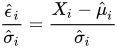 |
Normalizing residuals when parameters are estimated, particularly across different data points in regression analysis. |
| Standardized moment |  |
Normalizing moments, using the standard deviation {\displaystyle \sigma } as a measure of scale. as a measure of scale. |
| Coefficient of variation |
 |
Normalizing dispersion, using the mean {\displaystyle \mu } as a measure of scale, particularly for positive distribution such as the exponential distribution and Poisson distribution. as a measure of scale, particularly for positive distribution such as the exponential distribution and Poisson distribution. |
| Feature scaling | 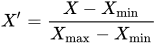 |
Feature scaling is used to bring all values into the range [0,1]. This can be generalized to restrict the range of values in the dataset between any arbitrary points a and b usings
|
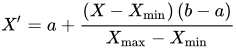 .
.Note that some other ratios, such as the variance-to-mean ratio {\displaystyle \left({\frac {\sigma ^{2}}{\mu }}\right)}
Other types[edit]
Other non-dimensional normalizations that can be used with no assumptions on the distribution include:
- Assignment of percentiles. This is common on standardized tests. See also quantile normalization.
- Normalization by adding and/or multiplying by constants so values fall between 0 and 1. This used for probability density functions, with applications in fields such as physical chemistry in assigning probabilities to |ψ|2.
See also[edit]
References[edit]
- Jump up^ Dodge, Y (2003) The Oxford Dictionary of Statistical Terms, OUP. ISBN 0-19-920613-9 (entry for normalization of scores)
normalization(统计)的更多相关文章
- 归一化方法 Normalization Method
1. 概要 数据预处理在众多深度学习算法中都起着重要作用,实际情况中,将数据做归一化和白化处理后,很多算法能够发挥最佳效果.然而除非对这些算法有丰富的使用经验,否则预处理的精确参数并非显而易见. 2. ...
- 从Bayesian角度浅析Batch Normalization
前置阅读:http://blog.csdn.net/happynear/article/details/44238541——Batch Norm阅读笔记与实现 前置阅读:http://www.zhih ...
- [CS231n-CNN] Training Neural Networks Part 1 : activation functions, weight initialization, gradient flow, batch normalization | babysitting the learning process, hyperparameter optimization
课程主页:http://cs231n.stanford.edu/ Introduction to neural networks -Training Neural Network ________ ...
- 数据标准化/归一化normalization
http://blog.csdn.net/pipisorry/article/details/52247379 基础知识参考: [均值.方差与协方差矩阵] [矩阵论:向量范数和矩阵范数] 数据的标准化 ...
- (转载)深度剖析 | 可微分学习的自适配归一化 (Switchable Normalization)
深度剖析 | 可微分学习的自适配归一化 (Switchable Normalization) 作者:罗平.任家敏.彭章琳 编写:吴凌云.张瑞茂.邵文琪.王新江 转自:知乎.原论文参考arXiv:180 ...
- 图像分类(二)GoogLenet Inception_v2:Batch Normalization: Accelerating Deep Network Training by Reducing Internal Covariate Shift
Inception V2网络中的代表是加入了BN(Batch Normalization)层,并且使用 2个 3*3卷积替代 1个5*5卷积的改进版,如下图所示: 其特点如下: 学习VGG用2个 3* ...
- tensorflow中batch normalization的用法
网上找了下tensorflow中使用batch normalization的博客,发现写的都不是很好,在此总结下: 1.原理 公式如下: y=γ(x-μ)/σ+β 其中x是输入,y是输出,μ是均值,σ ...
- BN(Batch Normalization)
Batch Nornalization Question? 1.是什么? 2.有什么用? 3.怎么用? paper:<Batch Normalization: Accelerating Deep ...
- 单细胞数据初步处理 | drop-seq | QC | 质控 | 正则化 normalization
比对 The raw Drop-seq data was processed with the standard pipeline (Drop-seq tools version 1.12 from ...
随机推荐
- string::find_last_not_of
#include <iostream>#include <string> using namespace std;int main(){ string s1("abc ...
- Spring MVC HandlerMapping
http://www.cnblogs.com/tengyunhao/p/7658952.html http://www.cnblogs.com/tengyunhao/p/7518481.html Sp ...
- Linux内核编译完整过程
Linux内核编译完整过程 通过网上的资料我自己的实际内核编译,我把对Linux内核编译的过程写在这里,也许对其他的Linux爱好者的编译学习有些帮助,其中很大部分是网上的资料,另外就是我在实际编译过 ...
- "TypeError: handler.call is not a function"问题
进入组件页面时,vue报错:Error in mounted hook: "TypeError: handler.call is not a function", 造成报错原因就是 ...
- Table表中数据类型的转换
各位大神帮我看下这还有别的方法转换类型吗? using System;using System.Collections.Generic;using System.Linq;using System.T ...
- TensorFlow使用记录 (一): 基本概念
基本使用 使用graph来表示计算任务 在被称之为Session的上下文中执行graph 使用tensor表示数据 通过Variable维护状态 使用feed和fetch可以为任意的操作(op)赋值或 ...
- [VIJOS2053][SDOI2019]世界地图:最小生成树+虚树
分析 可以发现第一列和最后一列永远不会被删除,于是我们可以想到维护前后缀最小生成树,但是直接维护的话显然时间空间两爆炸.(通过上网找题解)可以发现我们关心的只是最左边和最右边两列,而不关心内部的连边情 ...
- es6字符串的扩展——模板
todo1.模板字符串 传统的 JavaScript 语言,输出模板通常是这样写的(下面使用了 jQuery 的方法). $('#result').append( 'There are <b&g ...
- 拉格朗日插值法板子(dls)
namespace polysum { ; ll a[D],f[D],g[D],p[D],p1[D],p2[D],b[D],h[D][],C[D]; ll calcn(int d,ll *a,ll n ...
- C++入门经典-例4.6-使用重载函数
1:代码如下: // 4.6.cpp : 定义控制台应用程序的入口点. // #include "stdafx.h" #include <iostream> using ...