
c# linq 分组groupby
转载: https://www.cnblogs.com/cncc/p/9846390.html
一、先准备要使用的类:
1、Person类:

    class Person

    {

        public string Name { set; get; }

        public int Age { set; get; }

        public string Gender { set; get; }

        public override string ToString() => Name;

    }
2、准备要使用的List,用于分组(GroupBy):
        List<Person> personList = new List<Person>

        {

            new Person

            {

                Name = "P1", Age = 18, Gender = "Male"

            },

            new Person

            {

                Name = "P2", Age = 19, Gender = "Male",

            },

            new Person

            {

                Name = "P2", Age = 17,Gender = "Female",

            }

        };
二、第一种用法:
public static IEnumerable<IGrouping<TKey, TSource>> GroupBy<TSource, TKey>(this IEnumerable<TSource> source, Func<TSource, TKey> keySelector);
官方释义:根据指定的键选择器函数对序列中的元素进行分组。
我们要分组的集合为source,集合内每个元素的类型为TSource,这里第一个参数keySelector的类型为Func<TSource, TKey>,用于将TSource元素按照由此委托返回的类型TKey进行分组,结果为一个已分好组的集合(集合中的集合)。
编写客户端试验代码如下:
        var groups = personList.GroupBy(p => p.Gender);

        foreach (var group in groups)

        {

            Console.WriteLine(group.Key);

            foreach(var person in group)

            {

                Console.WriteLine($"\t{person.Name},{person.Age}");

            }

        }
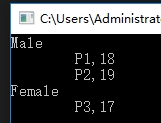
以上代码指定的KeySelector是Person类的Gender属性,因此,以上会按照Gender(性别)进行分组,我们使用两个嵌套的foreach循环将分组的内容打印到控制台。
因为groups返回的类型为IEnumerable<IGouping<TKey,TSource>>,因此以上返回的类型为IEnumerable<IGouping<string,Person>>。
IGouping<string,Person>是已经分组后的集合,内部集合元素为Person,且IGouping有一个Key属性,类型为string(指的是Gender属性类型),用于分组的标识。
输出结果如下:
其等价的LINQ语句为:
var groups = from p in personList

             group p by p.Gender;
以上的意思可以这样理解:从personList取出p,并对p进行分组,使用分组的依据(Key)为p.Gender,并将分组的结果存储到pGroup,并将分组的结果选择出来合并成一个集合。
三、第二种用法:
public static IEnumerable<IGrouping<TKey, TSource>> GroupBy<TSource, TKey>(this IEnumerable<TSource> source, Func<TSource, TKey> keySelector, IEqualityComparer<TKey> comparer);
官方释义:根据指定的键选择器函数对序列中的元素进行分组,并使用指定的比较器对键进行比较。
这种比第一种方法多了一个参数,那就是一个相等比较器,目的是为了当TKey为自定义的类时,GroupBy能根据TKey指定的类根据相等比较器进行分组,
因此,自定义类如何进行分组,GroupBy是不知道的,需要自己定义自己的相等比较器。
首先,将personList更改如下(下划线部分):
        List<Person> personList = new List<Person>

        {

            new Person

            {

                Name = "P1", Age = 18, Gender = "Male"

            },

            new Person

            {

                Name = "P1", Age = 19, Gender = "Male",

            },

            new Person

            {

                Name = "P3", Age = 17,Gender = "Female",

            }

        };
其次,增加一个相等比较器类,用于对Person进行分组:
    class PersonEqualityComparer : IEqualityComparer<Person>

    {

        public bool Equals(Person x, Person y) => x.Name == y.Name;

        public int GetHashCode(Person obj) => obj.Name.GetHashCode();

    }
其中定义了如何对一个Person相等性定义,只要实现IEqualityComparer<Person>即可,这里以Name作为Person类是否相同的依据。
最后,现在我们对Person类进行分组,编写客户端实验代码如下:
        var groups = personList.GroupBy(p => p, new PersonEqualityComparer());

        foreach (var group in groups)

        {

            Console.WriteLine(group.Key.ToString());

            foreach(var person in group)

            {

                Console.WriteLine($"\t{person.Age},{person.Gender}");

            }

        }
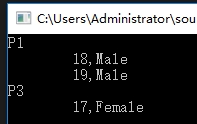
以上的分组依据是Person类,并运用了自己定义的Person类相同比较器,只要Name相同,就分为一组,
输出结果如下:
四、第三种用法:
public static IEnumerable<IGrouping<TKey, TElement>> GroupBy<TSource, TKey, TElement>(this IEnumerable<TSource> source, Func<TSource, TKey> keySelector, Func<TSource, TElement> elementSelector);
官方释义:根据指定的键选择器函数对序列中的元素进行分组,并且通过使用指定的函数对每个组中的元素进行投影。
这个比第一种用法多了一个elementSelector,第一种用法是对集合本身按照TKey分组,并将自己(TSource)添加到分组内,而当前的用法则可以选择自己想要添加到分组内的元素类型。
编写客户端实验代码如下:
        var groups = personList.GroupBy(p => p.Gender, p=>p.Name);

        foreach (var group in groups)

        {

            Console.WriteLine(group.Key.ToString());

            foreach(var name in group)

            {

                Console.WriteLine($"\t{name}");

            }

        }
以上代码是按照p.Gender进行分组,并将p.Name作为组内的元素。
输出结果如下:

其等价的LINQ语句为:
var groups = from p in personList

             group p.Name by p.Gender;
五、第四种用法:
public static IEnumerable<TResult> GroupBy<TSource, TKey, TResult>(this IEnumerable<TSource> source, Func<TSource, TKey> keySelector, Func<TKey, IEnumerable<TSource>, TResult> resultSelector);
官方释义:根据指定的键选择器函数对序列中的元素进行分组,并且从每个组及其键中创建结果值。
这个跟之前的用法都不同,之前的用法都是将结果进行分组,并返回IGrouping<TKey,TSource>对象,而当前用法则是返回自己定义的类型(TResult),在返回自己定义类型之前,将会传入两个参数,一个是TKey,为分组时指定的对象,另外一个则是IEnumerable<TSource>,为分组后的内部对象集合。
编写客户端实验代码如下:
            string GetPersonInfo(string gender, IEnumerable<Person> persons)

            {

                string result = $"{gender}:\t";

                foreach (var p in persons)

                {

                    result += $"{p.Name},{p.Age}\t";

                }

                return result;

            }

            var results = personList.GroupBy(p => p.Gender,(g, ps) => GetPersonInfo(g,ps));

            foreach (var result in results)

            {

                Console.WriteLine(result);

            }
GetPersonInfo为局部方法,见于C#7.0及以上。
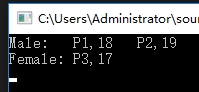
以上代码将分组后的内容(一个是TKey,为p.Gender,另外一个是IEnumerable<TSource>,为IEnumerable<Person>)作为字符串输出,因此,将返回的类型为字符串集合。
输出结果如下:
其等价的LINQ语句为:
            var results = from p in personList

                          group p by p.Gender into pGroup

                          select GetPersonInfo(pGroup.Key, pGroup);
六、第五种用法:
public static IEnumerable<IGrouping<TKey, TElement>> GroupBy<TSource, TKey, TElement>(this IEnumerable<TSource> source, Func<TSource, TKey> keySelector, Func<TSource, TElement> elementSelector, IEqualityComparer<TKey> comparer);
官方释义:根据键选择器函数对序列中的元素进行分组。通过使用比较器对键进行比较,并且通过使用指定的函数对每个组的元素进行投影。
与第三种用法基本相同,只是多了一个相等比较器,用于分组的依据。
使用第二种用法的personList及PersonEqualityComparer,编写客户端实验代码如下:
            var groups = personList.GroupBy(p => p, p => new { p.Age,p.Gender },new PersonEqualityComparer());

            foreach (var group in groups)

            {

                Console.WriteLine(group.Key.ToString());

                foreach (var name in group)

                {

                    Console.WriteLine($"\t{name.Age},{name.Gender}");

                }

            }
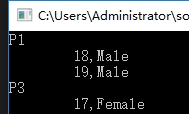
以上代码的分组依据是Person,PersonEqualityComparer则是作为Person分组的比较器,每个组内为一个匿名类型集合。
输出结果如下:
七、第六种用法:
public static IEnumerable<TResult> GroupBy<TSource, TKey, TResult>(this IEnumerable<TSource> source, Func<TSource, TKey> keySelector, Func<TKey, IEnumerable<TSource>, TResult> resultSelector, IEqualityComparer<TKey> comparer);
官方释义:根据指定的键选择器函数对序列中的元素进行分组,并且从每个组及其键中创建结果值。通过使用指定的比较器对键进行比较。
与第四种用法基本相同,只是多了一个相等比较器,用于分组的依据。
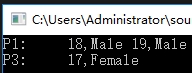
使用第二种用法的personList及PersonEqualityComparer,编写客户端实验代码如下:
            string GetPersonInfo(Person person, IEnumerable<Person> persons)

            {

                string result = $"{person.ToString()}:\t";

                foreach (var p in persons)

                {

                    result += $"{p.Age},{p.Gender}\t";

                }

                return result;

            }

            var results = personList.GroupBy(p => p, (p, ps) => GetPersonInfo(p, ps),new PersonEqualityComparer());

            foreach (var result in results)

            {

                Console.WriteLine(result);

            }
以上代码的分组依据是Person,PersonEqualityComparer则是作为Person分组的比较器,每个组内为一个Person集合,并将返回类型为string的字符串输出。
输出结果如下:
八、第七种用法:
public static IEnumerable<TResult> GroupBy<TSource, TKey, TElement, TResult>(this IEnumerable<TSource> source, Func<TSource, TKey> keySelector, Func<TSource, TElement> elementSelector, Func<TKey, IEnumerable<TElement>, TResult> resultSelector);
官方释义:根据指定的键选择器函数对序列中的元素进行分组,并且从每个组及其键中创建结果值。通过使用指定的函数对每个组的元素进行投影。
与第四种方法很类似,只是对分组内的元素进行选择,原有为TSource,现改为TElement。
编写客户端实验代码如下:
            string GetPersonInfo(string gender, IEnumerable<string> names)

            {

                string result = $"{gender}:\t";

                foreach (var name in names)

                {

                    result += $"{name}\t";

                }

                return result;

            }

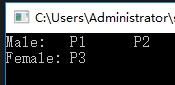
            var results = personList.GroupBy(p => p.Gender, (p=>p.Name) ,(g, ns) => GetPersonInfo(g, ns));

            foreach (var result in results)

            {

                Console.WriteLine(result);

            }
以上代码将使用Gender分组,并将分组后的信息组合成一条字符串,并输出到控制台。
输出结果如下:
九、第八种用法:
public static IEnumerable<TResult> GroupBy<TSource, TKey, TElement, TResult>(this IEnumerable<TSource> source, Func<TSource, TKey> keySelector, Func<TSource, TElement> elementSelector, Func<TKey, IEnumerable<TElement>, TResult> resultSelector, IEqualityComparer<TKey> comparer);
官方释义: 根据指定的键选择器函数对序列中的元素进行分组,并且从每个组及其键中创建结果值。通过使用指定的比较器对键值进行比较,并且通过使用指定的函数对每个组的元素进行投影。
与第七种用法基本相同,只是多了一个相等比较器,用于分组的依据。
使用第二种用法的personList及PersonEqualityComparer,编写客户端实验代码如下:
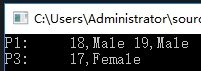
            var results = personList.GroupBy(p => p, (p=>new { p.Age,p.Gender}),

                (p, ns) =>

                {

                    string result = $"{p.ToString()}:\t";

                    foreach (var n in ns)

                    {

                        result += $"{n.Age},{p.Gender}\t";

                    }

                    return result;

                },new PersonEqualityComparer());

            foreach (var result in results)

            {

                Console.WriteLine(result);

            }
以上代码将使用Person分组,使用Person比较器作为分组的依据,并将分组后的信息组合成一条字符串,并输出到控制台。
输出结果如下:
c# linq 分组groupby的更多相关文章
- Linq 中按照多个值进行分组(GroupBy)
Linq 中按照多个值进行分组(GroupBy) .GroupBy(x => new { x.Age, x.Sex }) group emp by new { emp.Age, emp.Sex ...
- Linq分组操作之GroupBy,GroupJoin扩展方法源码分析
Linq分组操作之GroupBy,GroupJoin扩展方法源码分析 一. GroupBy 解释: 根据指定的键选择器函数对序列中的元素进行分组,并且从每个组及其键中创建结果值. 查询表达式: var ...
- linq lambda GroupBy 用法
Linq 中按照多个值进行分组(GroupBy) /// <summary>要查询的对象</summary> class Employee { public int ID ...
- Linq分组功能
Linq在集合操作上很方便,很多语法都借鉴自sql,但linq的分组却与sql有一定的区别,故整理发布如下. 1. Linq分组 分组后以Key属性访问分组键值. 每一组为一个IEnumberAbl ...
- Linq Mysql GroupBy语句的问题处理
语句如下: var resumeList = db.ChannelResume.Where(model); var groupValues = resumeList.GroupBy(t => n ...
- Linq 和 Lambda 查询中按照多个值进行分组GroupBy
创建要查询的对象: class Employee { public int ID { get;set; } public string FName { get; set; } public int A ...
- 转载有个小孩跟我说LINQ(重点讲述Linq中GroupBy的原理及用法)
转载原出处: http://www.cnblogs.com/AaronYang/archive/2013/04/02/2994635.html 小孩LINQ系列导航:(一)(二)(三)(四)(五)(六 ...
- 转载Linq中GroupBy方法的使用总结
Group在SQL经常使用,通常是对一个字段或者多个字段分组,求其总和,均值等. Linq中的Groupby方法也有这种功能.具体实现看代码: 假设有如下的一个数据集: public class St ...
- Linq分组,linq方法分组
Group在SQL经常使用,通常是对一个字段或者多个字段分组,求其总和,均值等. Linq中的Groupby方法也有这种功能.具体实现看代码: 假设有如下的一个数据集: 01.public class ...
随机推荐
- LeetCode.1009-十进制数的补码(Complement of Base 10 Integer)
这是小川的第377次更新,第404篇原创 01 看题和准备 今天介绍的是LeetCode算法题中Easy级别的第238题(顺位题号是1009).每个非负整数N都具有二进制表示.例如,5可以二进制表示为 ...
- centos6.5安装mysql报错
安装完mysql后,mysql服务无法打开. 报错 查看mysql日志 执行命令:less /var/log/mysqld.log 发现是权限不够,不能创建pid文件.因此改变权限,再次启动服务 问 ...
- ARM的编程模式及寄存器
根据朱老师的课程及下面博客整理 http://blog.chinaunix.net/uid-20443992-id-5700979.html ARM 采用的是32位架构 ARM 约定: Byte : ...
- 简述在Js或Vue中监听页面的刷新、关闭操作
1.背景 大家是否经常遇到在关闭网页的时候,会看到一个确定是否离开当前页面的提示框?想一些在线测试系统.信息录入系统等就经常会有这一些提示,避免用户有意或者无意中关掉了页面,导致数据丢失.而最近在做项 ...
- css实现毛玻璃效果
css实现毛玻璃效果,效果图 1,html代码 <div class="mainHolder"> <div class="textHolder" ...
- Sqlserver 2012附加数据库时出错提示操作系统错误5(拒绝访问)错误5120的解决办法
环境: Win10系统 SQLSERver 2012 情况: 使用混合登陆方式,sa账户密码正确登陆后,附加.mdf文件出现此错误. 尝试解决方法一:使用管理员运行SQLSERver2012,sa账户 ...
- XSS跨站简析
XSS跨站脚本原理 当应用程序发送给浏览器的页面中包含用户提交的数据,但没有经过适当验证或转义时,就会导致跨站脚本漏洞 这个“跨”实际上属于浏览器的特性,而不是缺陷 (参考:浏览器同源策略) 不去直接 ...
- show slave status 命令判断MySQL复制同步状态
1. show slave status命令可以显示主从同步的状态 MySQL> show slave status \G; *************************** 1. row ...
- 【转帖】是时候给大家介绍 Spring Boot/Cloud 背后豪华的研发团队了。
是时候给大家介绍 Spring Boot/Cloud 背后豪华的研发团队了. 2019/01/03 http://www.ityouknow.com/springboot/2019/01/03/spr ...
- 【转帖】大话Spring Cloud
springcloud(一):大话Spring Cloud 2017/05/01 http://www.ityouknow.com/springcloud/2017/05/01/simple-sp ...