
第十三节,使用带有全局平均池化层的CNN对CIFAR10数据集分类
这里使用的数据集仍然是CIFAR-10,由于之前写过一篇使用AlexNet对CIFAR数据集进行分类的文章,已经详细介绍了这个数据集,当时我们是直接把这些图片的数据文件下载下来,然后使用pickle进行反序列化获取数据的,具体内容可以参考这里:第十六节,卷积神经网络之AlexNet网络实现(六)
与MNIST类似,TensorFlow中也有一个下载和导入CIFAR数据集的代码文件,不同的是,自从TensorFlow1.0之后,将里面的Models模块分离了出来,分离和导入CIFAR数据集的代码在models中,所以要先去TensorFlow的GitHub网站将其下载下来。点击下载地址开始下载。

一 描述
在该例子中,使用了全局平均池化层来代替传统的全连接层,使用了3个卷积层的同卷积网络,滤波器为5x5,每个卷积层后面跟有一个步长2x2的池化层,滤波器大小为2x2,最后一个池化层为全局平均池化层,输出后为batch_sizex1x1x10,我们对其进行形状变换为batch_sizex10,得到10个特征,再对这10个特征进行softmax计算,其结果代表最终分类。
- 输入图片大小为24x24x3
- 经过5x5的同卷积操作(步长为1),输出64个通道,得到24x24x64的输出
- 经过f=2,s=2的池化层,得到大小为12x12x24的输出
- 经过5x5的同卷积操作(步长为1),输出64个通道,得到12x12x64的输出
- 经过f=2,s=2的池化层,得到大小为6x6x64的输出
- 经过5x5的同卷积操作(步长为1),输出10个通道,得到6x6x10的输出
- 经过一个全局平均池化层f=6,s=6,得到1x1x10的输出
- 展开成1x10的形状,经过softmax函数计算,进行分类
二 导入数据集
'''

一 引入数据集

'''

batch_size = 128

learning_rate = 1e-4

training_step = 15000

display_step = 200

#数据集目录

data_dir = './cifar10_data/cifar-10-batches-bin'

print('begin')

#获取训练集数据

images_train,labels_train = cifar10_input.inputs(eval_data=False,data_dir = data_dir,batch_size=batch_size)

print('begin data')
注意这里调用了cifar10_input.inputs()函数,这个函数是专门获取数据的函数,返回数据集合对应的标签,但是这个函数会将图片裁切好,由原来的32x32x3变成24x24x3,该函数默认使用测试数据集,如果使用训练数据集,可以将第一个参数传入eval_data=False。另外再将batch_size和dir传入,就可以得到dir下面的batch_size个数据了。我们可以查看一下这个函数的实现:
def inputs(eval_data, data_dir, batch_size):

  """Construct input for CIFAR evaluation using the Reader ops.

  Args:

    eval_data: bool, indicating if one should use the train or eval data set.

    data_dir: Path to the CIFAR-10 data directory.

    batch_size: Number of images per batch.

  Returns:

    images: Images. 4D tensor of [batch_size, IMAGE_SIZE, IMAGE_SIZE, 3] size.

    labels: Labels. 1D tensor of [batch_size] size.

  """

  if not eval_data:

    filenames = [os.path.join(data_dir, 'data_batch_%d.bin' % i)

                 for i in xrange(1, 6)]

    num_examples_per_epoch = NUM_EXAMPLES_PER_EPOCH_FOR_TRAIN

  else:

    filenames = [os.path.join(data_dir, 'test_batch.bin')]

    num_examples_per_epoch = NUM_EXAMPLES_PER_EPOCH_FOR_EVAL

  for f in filenames:

    if not tf.gfile.Exists(f):

      raise ValueError('Failed to find file: ' + f)

  with tf.name_scope('input'):

    # Create a queue that produces the filenames to read.

    filename_queue = tf.train.string_input_producer(filenames)

    # Read examples from files in the filename queue.

    read_input = read_cifar10(filename_queue)

    reshaped_image = tf.cast(read_input.uint8image, tf.float32)

    height = IMAGE_SIZE

    width = IMAGE_SIZE

    # Image processing for evaluation.

    # Crop the central [height, width] of the image.

    resized_image = tf.image.resize_image_with_crop_or_pad(reshaped_image,

                                                           height, width)

    # Subtract off the mean and divide by the variance of the pixels.

    float_image = tf.image.per_image_standardization(resized_image)

    # Set the shapes of tensors.

    float_image.set_shape([height, width, 3])

    read_input.label.set_shape([1])

    # Ensure that the random shuffling has good mixing properties.

    min_fraction_of_examples_in_queue = 0.4

    min_queue_examples = int(num_examples_per_epoch *

                             min_fraction_of_examples_in_queue)

  # Generate a batch of images and labels by building up a queue of examples.

  return _generate_image_and_label_batch(float_image, read_input.label,

                                         min_queue_examples, batch_size,

                                         shuffle=False)
这个函数主要包含以下几步:
- 读取测试集文件名或者训练集文件名,并创建文件名队列。
- 使用文件读取器读取一张图像的数据和标签,并返回一个存放这些张量数据的类对象。
- 对图像进行裁切处理。
- 归一化输入。
- 读取batch_size个图像和标签。(返回的是一个张量,必须要在会话中执行才能得到数据)
三 定义网络结构
'''

二 定义网络结构

'''

def weight_variable(shape):

    '''

    初始化权重

    args:

        shape:权重shape

    '''

    initial = tf.truncated_normal(shape=shape,mean=0.0,stddev=0.1)

    return tf.Variable(initial)

def bias_variable(shape):

    '''

    初始化偏置

    args:

        shape:偏置shape

    '''

    initial =tf.constant(0.1,shape=shape)

    return tf.Variable(initial)

def conv2d(x,W):

    '''

    卷积运算 ,使用SAME填充方式   卷积层后

         out_height = in_hight / strides_height(向上取整)

         out_width = in_width / strides_width(向上取整)

    args:

        x:输入图像 形状为[batch,in_height,in_width,in_channels]

        W:权重 形状为[filter_height,filter_width,in_channels,out_channels]

    '''

    return tf.nn.conv2d(x,W,strides=[1,1,1,1],padding='SAME')

def max_pool_2x2(x):

    '''

    最大池化层,滤波器大小为2x2,'SAME'填充方式  池化层后

         out_height = in_hight / strides_height(向上取整)

         out_width = in_width / strides_width(向上取整)

    args:

        x:输入图像 形状为[batch,in_height,in_width,in_channels]

    '''

    return tf.nn.max_pool(x,ksize=[1,2,2,1],strides=[1,2,2,1],padding='SAME')

def avg_pool_6x6(x):

    '''

    全局平均池化层,使用一个与原有输入同样尺寸的filter进行池化,'SAME'填充方式  池化层后

         out_height = in_hight / strides_height(向上取整)

         out_width = in_width / strides_width(向上取整)

    args;

        x:输入图像 形状为[batch,in_height,in_width,in_channels]

    '''

    return tf.nn.avg_pool(x,ksize=[1,6,6,1],strides=[1,6,6,1],padding='SAME')

def print_op_shape(t):

    '''

    输出一个操作op节点的形状

    '''

    print(t.op.name,'',t.get_shape().as_list())

#定义占位符

input_x = tf.placeholder(dtype=tf.float32,shape=[None,24,24,3])   #图像大小24x24x

input_y = tf.placeholder(dtype=tf.float32,shape=[None,10])        #0-9类别

x_image = tf.reshape(input_x,[-1,24,24,3])

#1.卷积层 ->池化层

W_conv1 = weight_variable([5,5,3,64])

b_conv1 = bias_variable([64])

h_conv1 = tf.nn.relu(conv2d(x_image,W_conv1) + b_conv1)    #输出为[-1,24,24,64]

print_op_shape(h_conv1)

h_pool1 = max_pool_2x2(h_conv1)                            #输出为[-1,12,12,64]

print_op_shape(h_pool1)

#2.卷积层 ->池化层

W_conv2 = weight_variable([5,5,64,64])

b_conv2 = bias_variable([64])

h_conv2 = tf.nn.relu(conv2d(h_pool1,W_conv2) + b_conv2)    #输出为[-1,12,12,64]

print_op_shape(h_conv2)

h_pool2 = max_pool_2x2(h_conv2)                            #输出为[-1,6,6,64]

print_op_shape(h_pool2)

#3.卷积层 ->全局平均池化层

W_conv3 = weight_variable([5,5,64,10])

b_conv3 = bias_variable([10])

h_conv3 = tf.nn.relu(conv2d(h_pool2,W_conv3) + b_conv3)   #输出为[-1,6,6,10]

print_op_shape(h_conv3)

nt_hpool3 = avg_pool_6x6(h_conv3)                         #输出为[-1,1,1,10]

print_op_shape(nt_hpool3)

nt_hpool3_flat = tf.reshape(nt_hpool3,[-1,10])

y_conv = tf.nn.softmax(nt_hpool3_flat)
四 定义求解器
'''

三 定义求解器

'''

#softmax交叉熵代价函数

cost = tf.reduce_mean(-tf.reduce_sum(input_y * tf.log(y_conv),axis=1))

#求解器

train = tf.train.AdamOptimizer(learning_rate).minimize(cost)

#返回一个准确度的数据

correct_prediction = tf.equal(tf.arg_max(y_conv,1),tf.arg_max(input_y,1))

#准确率

accuracy = tf.reduce_mean(tf.cast(correct_prediction,dtype=tf.float32))
五 开始测试
'''

四 开始训练

'''

sess = tf.Session();

sess.run(tf.global_variables_initializer())

# 启动计算图中所有的队列线程 调用tf.train.start_queue_runners来将文件名填充到队列,否则read操作会被阻塞到文件名队列中有值为止。

tf.train.start_queue_runners(sess=sess)

for step in range(training_step):

    #获取batch_size大小数据集

    image_batch,label_batch = sess.run([images_train,labels_train])

    #one hot编码

    label_b = np.eye(10,dtype=np.float32)[label_batch]

    #开始训练

    train.run(feed_dict={input_x:image_batch,input_y:label_b},session=sess)

    if step % display_step == 0:

        train_accuracy = accuracy.eval(feed_dict={input_x:image_batch,input_y:label_b},session=sess)

        print('Step {0} tranining accuracy {1}'.format(step,train_accuracy))
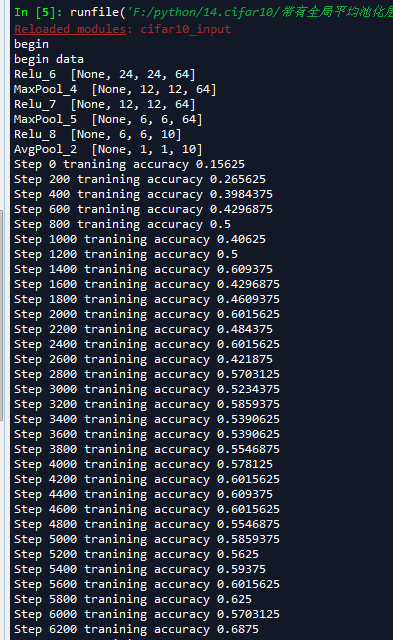
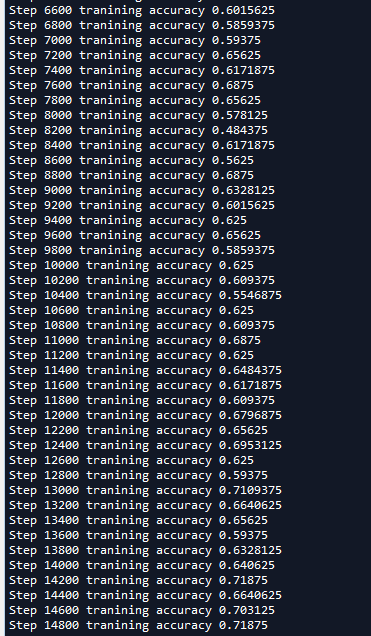
我们可以看到这个模型准确率接近70%,这主要是因为我们在图像预处理是进行了输入归一化处理,导致比我们在第十六节,卷积神经网络之AlexNet网络实现(六)文章中使用传统神经网络训练准确度52%要提高了不少,并且比AlexNet的60%高了一些(AlexNet我迭代的轮数比较少,因为太耗时)。
完整代码:
# -*- coding: utf-8 -*-

"""

Created on Thu May  3 12:29:16 2018

@author: zy

"""

'''

建立一个带有全局平均池化层的卷积神经网络  并对CIFAR-10数据集进行分类

1.使用3个卷积层的同卷积操作,滤波器大小为5x5,每个卷积层后面都会跟一个步长为2x2的池化层,滤波器大小为2x2

2.对输出的10个feature map进行全局平均池化,得到10个特征

3.对得到的10个特征进行softmax计算,得到分类

'''

import cifar10_input

import tensorflow as tf

import numpy as np

'''

一 引入数据集

'''

batch_size = 128

learning_rate = 1e-4

training_step = 15000

display_step = 200

#数据集目录

data_dir = './cifar10_data/cifar-10-batches-bin'

print('begin')

#获取训练集数据

images_train,labels_train = cifar10_input.inputs(eval_data=False,data_dir = data_dir,batch_size=batch_size)

print('begin data')

'''

二 定义网络结构

'''

def weight_variable(shape):

    '''

    初始化权重

    args:

        shape:权重shape

    '''

    initial = tf.truncated_normal(shape=shape,mean=0.0,stddev=0.1)

    return tf.Variable(initial)

def bias_variable(shape):

    '''

    初始化偏置

    args:

        shape:偏置shape

    '''

    initial =tf.constant(0.1,shape=shape)

    return tf.Variable(initial)

def conv2d(x,W):

    '''

    卷积运算 ,使用SAME填充方式   池化层后

         out_height = in_hight / strides_height(向上取整)

         out_width = in_width / strides_width(向上取整)

    args:

        x:输入图像 形状为[batch,in_height,in_width,in_channels]

        W:权重 形状为[filter_height,filter_width,in_channels,out_channels]

    '''

    return tf.nn.conv2d(x,W,strides=[1,1,1,1],padding='SAME')

def max_pool_2x2(x):

    '''

    最大池化层,滤波器大小为2x2,'SAME'填充方式  池化层后

         out_height = in_hight / strides_height(向上取整)

         out_width = in_width / strides_width(向上取整)

    args:

        x:输入图像 形状为[batch,in_height,in_width,in_channels]

    '''

    return tf.nn.max_pool(x,ksize=[1,2,2,1],strides=[1,2,2,1],padding='SAME')

def avg_pool_6x6(x):

    '''

    全局平均池化层,使用一个与原有输入同样尺寸的filter进行池化,'SAME'填充方式  池化层后

         out_height = in_hight / strides_height(向上取整)

         out_width = in_width / strides_width(向上取整)

    args;

        x:输入图像 形状为[batch,in_height,in_width,in_channels]

    '''

    return tf.nn.avg_pool(x,ksize=[1,6,6,1],strides=[1,6,6,1],padding='SAME')

def print_op_shape(t):

    '''

    输出一个操作op节点的形状

    '''

    print(t.op.name,'',t.get_shape().as_list())

#定义占位符

input_x = tf.placeholder(dtype=tf.float32,shape=[None,24,24,3])   #图像大小24x24x

input_y = tf.placeholder(dtype=tf.float32,shape=[None,10])        #0-9类别

x_image = tf.reshape(input_x,[-1,24,24,3])

#1.卷积层 ->池化层

W_conv1 = weight_variable([5,5,3,64])

b_conv1 = bias_variable([64])

h_conv1 = tf.nn.relu(conv2d(x_image,W_conv1) + b_conv1)    #输出为[-1,24,24,64]

print_op_shape(h_conv1)

h_pool1 = max_pool_2x2(h_conv1)                            #输出为[-1,12,12,64]

print_op_shape(h_pool1)

#2.卷积层 ->池化层

W_conv2 = weight_variable([5,5,64,64])

b_conv2 = bias_variable([64])

h_conv2 = tf.nn.relu(conv2d(h_pool1,W_conv2) + b_conv2)    #输出为[-1,12,12,64]

print_op_shape(h_conv2)

h_pool2 = max_pool_2x2(h_conv2)                            #输出为[-1,6,6,64]

print_op_shape(h_pool2)

#3.卷积层 ->全局平均池化层

W_conv3 = weight_variable([5,5,64,10])

b_conv3 = bias_variable([10])

h_conv3 = tf.nn.relu(conv2d(h_pool2,W_conv3) + b_conv3)   #输出为[-1,6,6,10]

print_op_shape(h_conv3)

nt_hpool3 = avg_pool_6x6(h_conv3)                         #输出为[-1,1,1,10]

print_op_shape(nt_hpool3)

nt_hpool3_flat = tf.reshape(nt_hpool3,[-1,10])

y_conv = tf.nn.softmax(nt_hpool3_flat)

'''

三 定义求解器

'''

#softmax交叉熵代价函数

cost = tf.reduce_mean(-tf.reduce_sum(input_y * tf.log(y_conv),axis=1))

#求解器

train = tf.train.AdamOptimizer(learning_rate).minimize(cost)

#返回一个准确度的数据

correct_prediction = tf.equal(tf.arg_max(y_conv,1),tf.arg_max(input_y,1))

#准确率

accuracy = tf.reduce_mean(tf.cast(correct_prediction,dtype=tf.float32))

'''

四 开始训练

'''

sess = tf.Session();

sess.run(tf.global_variables_initializer())

tf.train.start_queue_runners(sess=sess)

for step in range(training_step):

    image_batch,label_batch = sess.run([images_train,labels_train])

    label_b = np.eye(10,dtype=np.float32)[label_batch]

    train.run(feed_dict={input_x:image_batch,input_y:label_b},session=sess)

    if step % display_step == 0:

        train_accuracy = accuracy.eval(feed_dict={input_x:image_batch,input_y:label_b},session=sess)

        print('Step {0} tranining accuracy {1}'.format(step,train_accuracy))
第十三节,使用带有全局平均池化层的CNN对CIFAR10数据集分类的更多相关文章
- 全连接层(FC)与全局平均池化层(GAP)
在卷积神经网络的最后,往往会出现一两层全连接层,全连接一般会把卷积输出的二维特征图转化成一维的一个向量,全连接层的每一个节点都与上一层每个节点连接,是把前一层的输出特征都综合起来,所以该层的权值参数是 ...
- 【深度学习篇】--神经网络中的池化层和CNN架构模型
一.前述 本文讲述池化层和经典神经网络中的架构模型. 二.池化Pooling 1.目标 降采样subsample,shrink(浓缩),减少计算负荷,减少内存使用,参数数量减少(也可防止过拟合)减少输 ...
- 图像处理池化层pooling和卷积核
1.池化层的作用 在卷积神经网络中,卷积层之间往往会加上一个池化层.池化层可以非常有效地缩小参数矩阵的尺寸,从而减少最后全连层中的参数数量.使用池化层即可以加快计算速度也有防止过拟合的作用. 2.为什 ...
- 『TensorFlow』卷积层、池化层详解
一.前向计算和反向传播数学过程讲解
- CNN-卷积层和池化层学习
卷积神经网络(CNN)由输入层.卷积层.激活函数.池化层.全连接层组成,即INPUT-CONV-RELU-POOL-FC (1)卷积层:用它来进行特征提取,如下: 输入图像是32*32*3,3是它的深 ...
- [DeeplearningAI笔记]卷积神经网络1.9-1.11池化层/卷积神经网络示例/优点
4.1卷积神经网络 觉得有用的话,欢迎一起讨论相互学习~Follow Me 1.9池化层 优点 池化层可以缩减模型的大小,提高计算速度,同时提高所提取特征的鲁棒性. 池化层操作 池化操作与卷积操作类似 ...
- ubuntu之路——day17.3 简单的CNN和CNN的常用结构池化层
来看上图的简单CNN: 从39x39x3的原始图像 不填充且步长为1的情况下经过3x3的10个filter卷积后 得到了 37x37x10的数据 不填充且步长为2的情况下经过5x5的20个filter ...
- TensorFlow池化层-函数
池化层的作用如下-引用<TensorFlow实践>: 池化层的作用是减少过拟合,并通过减小输入的尺寸来提高性能.他们可以用来对输入进行降采样,但会为后续层保留重要的信息.只使用tf.nn. ...
- 学习笔记TF014:卷积层、激活函数、池化层、归一化层、高级层
CNN神经网络架构至少包含一个卷积层 (tf.nn.conv2d).单层CNN检测边缘.图像识别分类,使用不同层类型支持卷积层,减少过拟合,加速训练过程,降低内存占用率. TensorFlow加速所有 ...
随机推荐
- Java集合和数组的区别
参考:Java集合和数组的区别 集合和容器都是Java中的容器. 区别 数组特点:大小固定,只能存储相同数据类型的数据 集合特点:大小可动态扩展,可以存储各种类型的数据 转换 数组转换为集合: A ...
- git放弃修改,强制覆盖本地代码
$ git fetch --all $ git reset --hard origin/master $ git pull
- Delphi窗体之间互相调用的简单问题
问题是这样的,我的程序主窗口Form1上面有一个数据连接(ADOCONNECTION1)和ADOQUERY,然后还有一些数据感知组件用于浏览用的,我打算点击From1中的一个“修改数据”按钮,就弹出F ...
- Lodop打印控件 打印透明图问题
Lodop通过增设transcolor属性实现了“先字后章”效果,这个属性可以把某种颜色转成类似透明的效果.例如:把图章的底色白色变成透明:transcolor="#FFFFFF" ...
- Spring Boot 构建电商基础秒杀项目 (三) 通用的返回对象 & 异常处理
SpringBoot构建电商基础秒杀项目 学习笔记 定义通用的返回对象 public class CommonReturnType { // success, fail private String ...
- Modbus CRC 16 (C#)
算法 1.预置一个值为 0xFFFF 的 16 位寄存器,此寄存器为 CRC 寄存器. 2.把第 1 个 8 位二进制数据(即通信消息帧的第 1 个字节)与 16 位的 CRC 寄存器相异或,异或的结 ...
- 晨读笔记:CSS3选择器之属性选择器
一.属性选择器 1.E[foo^="bar"]:该属性选择器描述的是选择属性以bar开头的元素,如: //所有以名称g_开头的div的字体颜色为红色div[name^=" ...
- 检测某一目录下md5相同的文件
import org.apache.commons.codec.digest.DigestUtils; import org.apache.commons.io.IOUtils; import jav ...
- wpgwhpg
//f[i][j]就是第is时wpgwhpg的疲劳度是j,那么我们就可以就ta这1s是否休息进行讨论 #include<bits/stdc++.h> using namespace std ...
- Cetos 7 防火墙设置
1.关闭防火墙: # systemctl stop firewalld.service 2.开启防火墙: # systemctl start firewalld.service 3.关闭开机启动: # ...