
使用ThreadLocal管理Mybatis中SqlSession对象
转自http://blog.csdn.net/qq_29227939/article/details/52029065
public class MybatisUtil {

    private static SqlSessionFactory factory;

    // 解决资源争抢问题.

    private static ThreadLocal<SqlSession> localSessions = new ThreadLocal<SqlSession>();

    static {

        Reader reader = null;

        try {

            // 加载Mybatis的配置文件

            reader = Resources.getResourceAsReader("mybatis.xml");

            // 创建SqlSessionFactory对象.

            factory = new SqlSessionFactoryBuilder().build(reader);

        } catch (IOException e) {

            e.printStackTrace();

        } finally {

            if (reader != null) {

                try {

                    reader.close();

                } catch (IOException e) {

                    e.printStackTrace();

                }

            }

        }

    }

    // 获取Session对象

    public static SqlSession getSession() {

        SqlSession session = localSessions.get();

        if (session == null) {

            session = factory.openSession();

            localSessions.set(session);

        }

        return session;

    }

    // 关闭session的方法

    public static void closeSession() {

        SqlSession session = localSessions.get();

        if (session != null) {

            session.close();

            localSessions.remove();

        }

    }

}
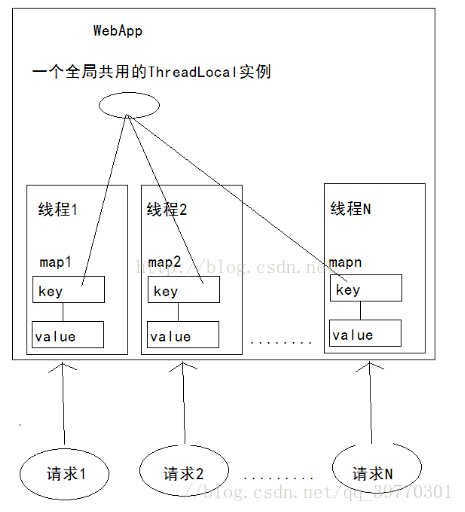
首先,ThreadLocal 不是用来解决共享对象的多线程访问问题的,一般情况下,通过ThreadLocal.set() 到线程中的对象是该线程自己使用的对象,其他线程是不需要访问的,也访问不到的。各个线程中访问的是不同的对象。
另外,说ThreadLocal使得各线程能够保持各自独立的一个对象,并不是通过ThreadLocal.set()来实现的,而是通过每个线程中的new
对象
的操作来创建的对象,每个线程创建一个,不是什么对象的拷贝或副本。通过ThreadLocal.set()将这个新创建的对象的引用保存到各线程的自己的一个map中,每个线程都有这样一个map,执行ThreadLocal.get()时,各线程从自己的map中取出放进去的对象,因此取出来的是各自自己线程中的对象,ThreadLocal实例是作为map的key来使用的。
如果ThreadLocal.set()进去的东西本来就是多个线程共享的同一个对象,那么多个线程的ThreadLocal.get()取得的还是这个共享对象本身,还是有并发访问问题。
下面来看一个hibernate中典型的ThreadLocal的应用:
     private static final ThreadLocal threadSession = new ThreadLocal();

    public static Session getSession() throws InfrastructureException {

        Session s = (Session) threadSession.get();

        try {

            if (s == null) {

                s = getSessionFactory().openSession();

                threadSession.set(s);

            }

        } catch (HibernateException ex) {

            throw new InfrastructureException(ex);

        }

        return s;

    }
可以看到在getSession()方法中,首先判断当前线程中有没有放进去session,如果还没有,那么通过sessionFactory().openSession()来创建一个session,再将session set到线程中,实际是放到当前线程的ThreadLocalMap这个map中,这时,对于这个session的唯一引用就是当前线程中的那个ThreadLocalMap(下面会讲到),而threadSession作为这个值的key,要取得这个session可以通过threadSession.get()来得到,里面执行的操作实际是先取得当前线程中的ThreadLocalMap,然后将threadSession作为key将对应的值取出。这个session相当于线程的私有变量,而不是public的。
显然,其他线程中是取不到这个session的,他们也只能取到自己的ThreadLocalMap中的东西。要是session是多个线程共享使用的,那还不乱套了。
试想如果不用ThreadLocal怎么来实现呢?可能就要在action中创建session,然后把session一个个传到service和dao中,这可够麻烦的。或者可以自己定义一个静态的map,将当前thread作为key,创建的session作为值,put到map中,应该也行,这也是一般人的想法,但事实上,ThreadLocal的实现刚好相反,它是在每个线程中有一个map,而将ThreadLocal实例作为key,这样每个map中的项数很少,而且当线程销毁时相应的东西也一起销毁了,不知道除了这些还有什么其他的好处。
总之,ThreadLocal不是用来解决对象共享访问问题的,而主要是提供了保持对象的方法和避免参数传递的方便的对象访问方式。归纳了两点:
1。每个线程中都有一个自己的ThreadLocalMap类对象,可以将线程自己的对象保持到其中,各管各的,线程可以正确的访问到自己的对象。
2。将一个共用的ThreadLocal静态实例作为key,将不同对象的引用保存到不同线程的ThreadLocalMap中,然后在线程执行的各处通过这个静态ThreadLocal实例的get()方法取得自己线程保存的那个对象,避免了将这个对象作为参数传递的麻烦。
当然如果要把本来线程共享的对象通过ThreadLocal.set()放到线程中也可以,可以实现避免参数传递的访问方式,但是要注意get()到的是那同一个共享对象,并发访问问题要靠其他手段来解决。但一般来说线程共享的对象通过设置为某类的静态变量就可以实现方便的访问了,似乎没必要放到线程中。
ThreadLocal的应用场合,我觉得最适合的是按线程多实例(每个线程对应一个实例)的对象的访问,并且这个对象很多地方都要用到。
下面来看看ThreadLocal的实现原理(jdk1.5源码)
     public class ThreadLocal<T> {

        /**

         * ThreadLocals rely on per-thread hash maps attached to each thread

         * (Thread.threadLocals and inheritableThreadLocals).  The ThreadLocal

         * objects act as keys, searched via threadLocalHashCode.  This is a

         * custom hash code (useful only within ThreadLocalMaps) that eliminates

         * collisions in the common case where consecutively constructed

         * ThreadLocals are used by the same threads, while remaining well-behaved

         * in less common cases.

         */

        private final int threadLocalHashCode = nextHashCode();

        /**

         * The next hash code to be given out. Accessed only by like-named method.

         */

        private static int nextHashCode = 0;

        /**

         * The difference between successively generated hash codes - turns

         * implicit sequential thread-local IDs into near-optimally spread

         * multiplicative hash values for power-of-two-sized tables.

         */

        private static final int HASH_INCREMENT = 0x61c88647;

        /**

         * Compute the next hash code. The static synchronization used here

         * should not be a performance bottleneck. When ThreadLocals are

         * generated in different threads at a fast enough rate to regularly

         * contend on this lock, memory contention is by far a more serious

         * problem than lock contention.

         */

        private static synchronized int nextHashCode() {

            int h = nextHashCode;

            nextHashCode = h + HASH_INCREMENT;

            return h;

        }

        /**

         * Creates a thread local variable.

         */

        public ThreadLocal() {

        }

        /**

         * Returns the value in the current thread's copy of this thread-local

         * variable.  Creates and initializes the copy if this is the first time

         * the thread has called this method.

         *

         * @return the current thread's value of this thread-local

         */

        public T get() {

            Thread t = Thread.currentThread();

            ThreadLocalMap map = getMap(t);

            if (map != null)

                return (T)map.get(this);

            // Maps are constructed lazily.  if the map for this thread

            // doesn't exist, create it, with this ThreadLocal and its

            // initial value as its only entry.

            T value = initialValue();

            createMap(t, value);

            return value;

        }

        /**

         * Sets the current thread's copy of this thread-local variable

         * to the specified value.  Many applications will have no need for

         * this functionality, relying solely on the {@link #initialValue}

         * method to set the values of thread-locals.

         *

         * @param value the value to be stored in the current threads' copy of

         *        this thread-local.

         */

        public void set(T value) {

            Thread t = Thread.currentThread();

            ThreadLocalMap map = getMap(t);

            if (map != null)

                map.set(this, value);

            else

                createMap(t, value);

        }

        /**

         * Get the map associated with a ThreadLocal. Overridden in

         * InheritableThreadLocal.

         *

         * @param  t the current thread

         * @return the map

         */

        ThreadLocalMap getMap(Thread t) {

            return t.threadLocals;

        }

        /**

         * Create the map associated with a ThreadLocal. Overridden in

         * InheritableThreadLocal.

         *

         * @param t the current thread

         * @param firstValue value for the initial entry of the map

         * @param map the map to store.

         */

        void createMap(Thread t, T firstValue) {

            t.threadLocals = new ThreadLocalMap(this, firstValue);

        }

        .......

        /**

         * ThreadLocalMap is a customized hash map suitable only for

         * maintaining thread local values. No operations are exported

         * outside of the ThreadLocal class. The class is package private to

         * allow declaration of fields in class Thread.  To help deal with

         * very large and long-lived usages, the hash table entries use

         * WeakReferences for keys. However, since reference queues are not

         * used, stale entries are guaranteed to be removed only when

         * the table starts running out of space.

         */

        static class ThreadLocalMap {

        ........

        }

    }
可以看到ThreadLocal类中的变量只有这3个int型:
    private final int threadLocalHashCode = nextHashCode();

    private static int nextHashCode = 0;

    private static final int HASH_INCREMENT = 0x61c88647;
而作为ThreadLocal实例的变量只有 threadLocalHashCode 这一个,nextHashCode 和HASH_INCREMENT 是ThreadLocal类的静态变量,实际上HASH_INCREMENT是一个常量,表示了连续分配的两个ThreadLocal实例的threadLocalHashCode值的增量,而nextHashCode 的表示了即将分配的下一个ThreadLocal实例的threadLocalHashCode 的值。
可以来看一下创建一个ThreadLocal实例即new ThreadLocal()时做了哪些操作,从上面看到构造函数ThreadLocal()里什么操作都没有,唯一的操作是这句:
private final int threadLocalHashCode = nextHashCode();
那么nextHashCode()做了什么呢:
     private static synchronized int nextHashCode() {

        int h = nextHashCode;

        nextHashCode = h + HASH_INCREMENT;

        return h;

    }
就是将ThreadLocal类的下一个hashCode值即nextHashCode的值赋给实例的threadLocalHashCode,然后nextHashCode的值增加HASH_INCREMENT这个值。
因此ThreadLocal实例的变量只有这个threadLocalHashCode,而且是final的,用来区分不同的ThreadLocal实例,ThreadLocal类主要是作为工具类来使用,那么ThreadLocal.set()进去的对象是放在哪儿的呢?
看一下上面的set()方法,两句合并一下成为
ThreadLocalMap map = Thread.currentThread().threadLocals;
这个ThreadLocalMap 类是ThreadLocal中定义的内部类,但是它的实例却用在Thread类中:
     public class Thread implements Runnable {

        ......

        /* ThreadLocal values pertaining to this thread. This map is maintained

         * by the ThreadLocal class. */

        ThreadLocal.ThreadLocalMap threadLocals = null;

        ......

    }
再看这句:
     if (map != null)

        map.set(this, value);
也就是将该ThreadLocal实例作为key,要保持的对象作为值,设置到当前线程的ThreadLocalMap 中,get()方法同样大家看了代码也就明白了。VIA:http://www.iteye.com/topic/103804
使用ThreadLocal管理Mybatis中SqlSession对象的更多相关文章
- 对 Service中sqlsession对象的优化
在本线程中添加object数据,必须在本线程中才能获取出来..其他线程获取不到. public class Test { public static void main(String[] args) ...
- SSM-MyBatis-10:Mybatis中SqlSession的getMapper()和简单的工具类MyBatisUtils
------------吾亦无他,唯手熟尔,谦卑若愚,好学若饥------------- getMapper的作用,获取到接口,直接通过点的方式调用方法,以免直接手打的方式写错方法名,(强类型的方式) ...
- SSM-MyBatis-07:Mybatis中SqlSession的insert和delete底层到底做了什么
------------吾亦无他,唯手熟尔,谦卑若愚,好学若饥------------- 先点进去看一下insert方法 用ctrl加鼠标左键点进去看 发现是一个接口SqlSession的方法,没有实 ...
- spring如何管理mybatis(二) ----- SqlSession的线程安全性
在之前的文章中我们了解到最终的数据库最终操作是走的代理类的方法: @Override public Object invoke(Object proxy, Method method, Object[ ...
- SSM-MyBatis-09:Mybatis中SqlSession的close为什么能造成事务的回滚
------------吾亦无他,唯手熟尔,谦卑若愚,好学若饥------------- 经过上几次的查找,笔者我就简单的说一下查找的思路,留给读者自己实践 同样找到sqlsession的实现类,-- ...
- SSM-MyBatis-08:Mybatis中SqlSession的commit方法为什么会造成事物的提交
------------吾亦无他,唯手熟尔,谦卑若愚,好学若饥------------- 如题目所示,本小章节讨论为什么SqlSession的commit会造成事物的提交 首先先看SqlSessi ...
- MyBatis中sqlSession操作数据库,不报错但无法实现数据修改(增、改、删)
public void addCustomerTest() throws Exception { SqlSession sqlSession = MyBatisUtils.getSession(); ...
- 阶段3 1.Mybatis_11.Mybatis的缓存_6 Mybatis中的一级缓存
Mybatis中的一级缓存和二级缓存 一级缓存: 它指的是Mybatis中SqlSession对象的缓存. 当我们执行查询之后,查询的结 ...
- mybatis中常见的问题总结
如下所有举例基于springboot+mybatis项目中,SSH使用mybatis的写法也一样,只是形式不同而已 问题1.org.apache.ibatis.binding.BindingExcep ...
随机推荐
- February 12th, 2018 Week 7th Monday
One man's fault is another man's lesson. 前车之覆,后车之鉴. We make mistakes every day, large or small, fail ...
- qt designer设置界面是label中文字与文本框对齐设置
往往在使用 qt designer布置界面时,添加的label和文本框中是直接从工具箱中拖进去的,由于每个控件尺寸大小不一,就会造成label中的文字相对于文本框比较较偏上,看下面未经调整的直接效果 ...
- A - Packets 贪心
A factory produces products packed in square packets of the same height h and of the sizes 1*1, 2*2, ...
- C#のsocket通信
博主要做一个手机和电脑端(C#)通讯的程序,便览了网络上关乎socket的东西.但是接收文件的时候卡住了,怎么也接收不全.后来做了分片处理,如果分片,发送的时候就会有不同的socket(客户端开发不是 ...
- poj2635
版权声明:本文为博主原创文章,未经博主同意不得转载. https://blog.csdn.net/chaoweilanmao/article/details/33417423 这道题一看是大数题就知道 ...
- css样式的书写顺序及原理
刚开始学习前端的时候,每次写css样式都是用到什么就在样式表后添加什么,完全没有考虑到样式属性的书写顺序对网页加载代码的影响.后来逐渐才知道正确的样式顺序不仅易于查看,并且也属于css样式优化的一种方 ...
- [HEOI2016/TJOI2016]字符串
嘟嘟嘟 今天复习一下SAM. lcp固然不好做,干脆直接翻过来变成后缀.首先答案一定满足单调性,所以我们二分lcp的长度\(mid\),然后判断\(s[d \ldots d + mid - 1]\)是 ...
- ubantu下装Docker
Docker 要求 Ubuntu 系统的内核版本高于 3.10 ,查看本页面的前提条件来验证你的 Ubuntu 版本是否支持 Docker. 通过 uname -r 命令查看你当前的内核版本 unam ...
- PostgreSQL安装和使用
青岛OJ系统用的关系型数据库是PostgreSQL,为此对PostgreSQL大致了解下. 今天的主要话题围绕下面两个方面: PostgreSQL安装 PostgreSQL使用 一.PostgreSQ ...
- Python脱产8期 Day11 2019/4/25
一 字符串比较 1.字符串比较:字符串对应的ascii进行比较 2.多个字符的字符串进行比较:从前往后逐个字符进行比较,一旦哪个位置的字符出现了大小关系就结束比较. 二 形参与实参 1.参数介绍: 函 ...