
The world beyond batch: Streaming 101
https://www.oreilly.com/ideas/the-world-beyond-batch-streaming-101
https://www.oreilly.com/ideas/the-world-beyond-batch-streaming-102
这篇文章,首先要说清的一个问题是,给‘Streaming’正名
What is streaming?
The crux of the problem is that many things that ought to be described bywhat they are (e.g., unbounded data processing, approximate results, etc.), have come to be described colloquially by how they historically have been accomplished (i.e., via streaming execution engines).
当前我们对Streaming的定义是不准确的,导致我们对Streaming会有些误解
比如,认为Streaming就意味着Low-latency, approximate,lack of precision
这个问题的症结在于,我们把一样东西的本质是什么和这样东西被完成到什么程度给混淆了
所以这里作者给出streaming的定义,
I prefer to isolate the term streaming to a very specific meaning: a type of data processing engine that is designed with infinite data sets in mind. Nothing more.
而对于常常出现的和streaming相关的词,也加以区别定义
Unbounded data: A type of ever-growing, essentially infinite data set.
这个词用于描述数据集本身的特性,而Streaming用于描述processing engine
Unbounded data processing: An ongoing mode of data processing, applied to the aforementioned type of unbounded data.
which is at best misleading:repeated runs of batch engines have been used to process unbounded data since batch systems were first conceived
batch engine也可以用于repeated的处理Unbounded data
同样Streaming engine也可以用于处理Bounded data
所以这个词并不等同于Streaming
Low-latency, approximate, and/or speculative results:
作者认为只是,batch engine在设计时没有考虑要针对low-latency的场景,batch也可以做到low-latency,也可以得出approximate或speculative结果
反之,streaming也可以balance low-latency来达到准确的结果
So,
From here on out, any time I use the term “streaming,” you can safely assume I mean an execution engine designed for unbounded data sets, and nothing more.
What streaming can do?
近期流计算的兴起于Twitter’s Nathan Marz (creator of Storm)的Storm,当然也带给Streaming以low-latency, inaccurate/speculative results这样的标签
为了提供eventually correct results,Marz提出Lambda Architecture. 这种架构虽然看上去很简单,但是给出一种balance一致性和可用性的思路;
当然问题也很明显,你需要维护streaming和batch两个pipeline,这个代价是很大的。
作者表示对于这种架构 a bit unsavory。
Unsurprisingly, I was a huge fan of Jay Kreps’Questioning the Lambda Architecture post when it came out.
所以下位出场的是linkedin的Jay Krep,他提出的是基于Kafka的Kappa Architecture,
该架构也很简单,但给出将两个pipeline合并成一个pipeline的思路;更关键的这个方案用well-designed streaming system替代了batch pipeline,这个对于作者是有很大启发的
作者对这个架构的评价,I’m not convinced that notion itself requires a name, but I fully support the idea in principle.
Quite honestly, I’d take things a step further.
I would argue that well-designed streaming systems actually provide a strict superset of batch functionality.
作者进步提出,Streaming是Batch的超集,即这个时代已经不需要batch了,该退休了
Steaming要击败Batch,只需要做到两件事,
Correctness — This gets you parity with batch.
只要做到这点,就至少可以等同于batch
At the core, correctness boils down to consistent storage.
Streaming systems need a method for checkpointing persistent state over time (something Kreps has talked about in his Why local state is a fundamental primitive in stream processing post), and it must be well-designed enough to remain consistent in light of machine failures.
If you’re curious to learn more about what it takes to get strong consistency in a streaming system, I recommend you check out theMillWheel and Spark Streaming papers.
Tools for reasoning about time — This gets you beyond batch.
做到这点就可以超越batch
Good tools for reasoning about time are essential for dealing with unbounded, unordered data of varying event-time skew.
这是作者的重点,讨论如何处理unbounded, unordered data
因为在现实中,我们往往需要安装event-time来处理数据,而不是按照process-time
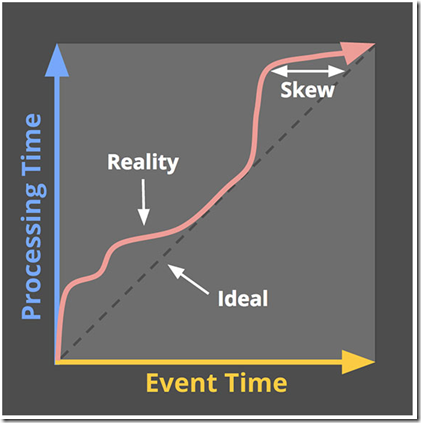
In the context of unbounded data, disorder and variable skew induce a completeness problem for event time windows:
lacking a predictable mapping between processing time and event time, how can you determine when you’ve observed all the data for a given event time X? For many real-world data sources, you simply can’t. The vast majority of data processing systems in use today rely on some notion of completeness, which puts them at a severe disadvantage when applied to unbounded data sets.
这个问题会在102中详细的描述,其实就是dataflow论文里面的内容
Data processing patterns
最终,作者描述下当前的数据处理的patterns
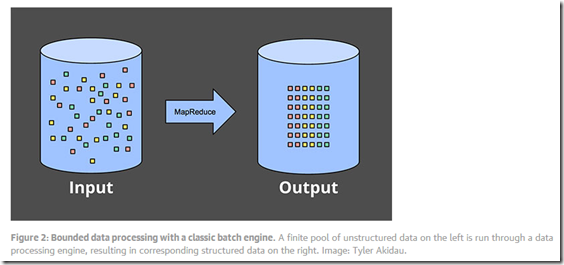
Bounded data
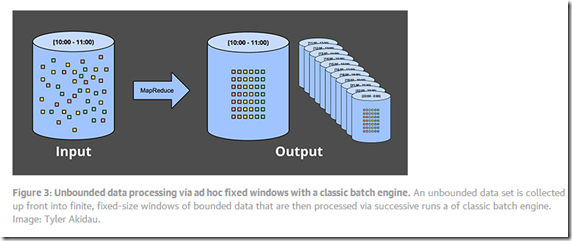
Fixed windows
Sessions
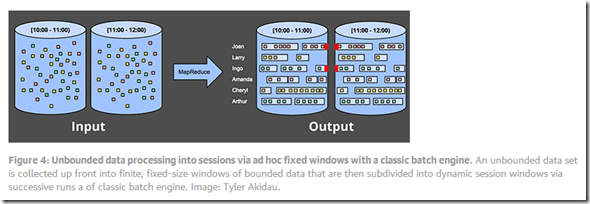
这个和上面fixed windows的区别,人为的划分fixed windows会切断sessions,如图中红色
Unbounded data — streaming
现实中,unbounded data往往有两个特点,
- Highly unordered with respect to event times, meaning you need some sort of time-based shuffle in your pipeline if you want to analyze the data in the context in which they occurred.
- Of varying event time skew, meaning you can’t just assume you’ll always see most of the data for a given event time X within some constant epsilon of time Y.
对于这样的数据,处理的方式有如下几类,
Time-agnostic
Time-agnostic processing is used in cases where time is essentially irrelevant — i.e., all relevant logic is data driven.
这个最简单,时间无关的应用,所以stateless的情况,比如map或filter都属于这个case
这种场景没啥好说的,任何Streaming平台都可以很好的处理
Approximation algorithms
The second major category of approaches is approximation algorithms, such as approximate Top-N, streaming K-means, etc.
Windowing by processing time
There are a few nice properties of processing time windowing:
- It’s simple.
- Judging window completeness is straightforward.
- If you’re wanting to infer information about the source as it is observed, processing time windowing is exactly what you want.
Windowing by event time
Event time windowing is what you use when you need to observe a data source in finite chunks that reflect the times at which those events actually happened.
It’s the gold standard of windowing. Sadly, most data processing systems in use today lack native support for it.
这种方式是作者所采用的,他认为是gold standard of windowing,而当前的system往往都是native不支持的,原因是比较困难,这也是作者的主要贡献,102中会详细描述
Of course, powerful semantics rarely come for free, and event time windows are no exception. Event time windows have two notable drawbacks due to the fact that windows must often live longer (in processing time) than the actual length of the window itself:
Buffering: Due to extended window lifetimes, more buffering of data is required.
Completeness: Given that we often have no good way of knowing when we’ve seen all the data for a given window, how do we know when the results for the window are ready to materialize? In truth, we simply don’t.
The world beyond batch: Streaming 101的更多相关文章
- Streaming 101
开宗明义!本文根据Google Beam大神Tyler Akidau的系列文章<The world beyond batch: Streaming 101>(批处理之外的流式世界)整理而成 ...
- 《Streaming Systems》第一章: Streaming 101
数据的价值在其产生之后,将随着时间的流逝逐渐降低.因此,为了获得最大化的数据价值,尽可能实时.快速地处理新产生的数据就显得尤为重要.实时数据处理将在越来越多的场景中体现出更大的价值所在 -- 实时即未 ...
- Flink-v1.12官方网站翻译-P017-Execution Mode (Batch/Streaming)
执行模式(批处理/流处理) DataStream API 支持不同的运行时执行模式,您可以根据用例的要求和作业的特点从中选择.DataStream API 有一种 "经典 "的执行 ...
- All the Apache Streaming Projects: An Exploratory Guide
The speed at which data is generated, consumed, processed, and analyzed is increasing at an unbeliev ...
- Streaming-大数据的未来
分享一篇关于实时流式计算的经典文章,这篇文章名为Streaming 101: The world beyond batch 那么流计算如何超越批处理呢? 从这几个方面说明:实时流计算系统,数据处理模式 ...
- 实时计算大数据处理的基石-Google Dataflow
此文选自Google大神Tyler Akidau的另一篇文章:Streaming 102: The world beyond batch 欢迎回来!如果您错过了我以前的帖子,Streaming ...
- Mongodb Manual阅读笔记:CH2 Mongodb CRUD 操作
2 Mongodb CRUD 操作 Mongodb Manual阅读笔记:CH2 Mongodb CRUD 操作Mongodb Manual阅读笔记:CH3 数据模型(Data Models)Mong ...
- Flink Program Guide (3) -- Event Time (DataStream API编程指导 -- For Java)
Event Time 本文翻译自DataStream API Docs v1.2的Event Time ------------------------------------------------ ...
- 初探Apache Beam
文章作者:luxianghao 文章来源:http://www.cnblogs.com/luxianghao/p/9010748.html 转载请注明,谢谢合作. 免责声明:文章内容仅代表个人观点, ...
随机推荐
- 手把手教你在Windows下使用MinGW编译libav(参考libx264的编入)
转自:http://www.th7.cn/Program/cp/201407/242762.shtml 手把手教你在Windows下使用MinGW编译libav libav是在Linux下使用纯c语言 ...
- Action类为何要 extends ActionSupport
我做的时候,我的action是继承ActionSupport的 Struts 2的Action无须实现任何接口或继承任何类型,普通的POJO类就可以用做Action类,但是,我们为了方便实现Actio ...
- 电赛菜鸟营培训(零)——Keil环境搭建
一.Keil开发软件安装 1.安装keil软件 2.使用注册机进行破解 将方框内的ID号复制到注册机,然后得到License,放到最底下就可以完成了. 二.Keil工程搭建 表示参考数据手册,在这里建 ...
- Servlet应用的运行流程
其中,红色部分为我们开发人员要做的,其他部分是框架做的. 学习就要搞懂整个运行的流程!否则,不利于个人技术的积累!
- C#环境datagidview添加删除操作
添加 行 dataGridView1.Rows.Add();//添加空行 dataGridView1.Rows.Add("a","b"……);//添加指定列数的 ...
- LCS(打印全路径) POJ 2264 Advanced Fruits
题目传送门 题意:两个字符串结合起来,公共的字符只输出一次 分析:LCS,记录每个字符的路径 代码: /* LCS(记录路径)模板题: 用递归打印路径:) */ #include <cstdio ...
- iOS @try
try{ //1:抛出异常的代码 //2:代码 }catch(){ //3:代码 //4:抛出异常 }finally{ //5:代码 } //6:代码要明确的一点是:不管try是否抛出异常,final ...
- BZOJ3356 : [Usaco2004 Jan]禁闭围栏
首先将坐标离散化,考虑从左往右扫描线 碰到插入操作则插入 碰到删除操作的: 当前包含i的矩形数=y1在[1,y2[i]]之间的矩形数-y2在[1,y1[i]-1]之间的矩形数 用两棵树状数组维护即可, ...
- 详细讲解css单位px,em和rem的含义以及它们之间的区别
一.首先介绍一下px px就是css中最基本的长度单位了,用px做单位基本上没什么问题,可以做到让页面按套路精确的展现! 可但是!但可是!如果全篇用px布局会暗藏一个蛋疼的问题,就是当用户和Ctrl滚 ...
- 关于 List<T>
System.Object System.Collections.Generic.List<T> list<string,string>,这种形式本身就是错误的,你可以 ...