
μC/OS-III---I笔记7---消息队列
消息队列
任务之间仅仅靠信号量进行“沟通”是不够的,信号量可以标志事件的发生,却无法传递更多的数据,在需要任务间的数据信息传递时就绪要用到消息队列,传统我们一般在前后太系统中都是通过全局变量来传递,但是在复杂的操作系统里这样的用法是很不方便管理的且堆内存的开销也是很大的对于一个轻量级的实时操作系统来说是很不合理的用法,因此在实时操作系统USOC内采用了消息队列。
消息队列的数据结构;
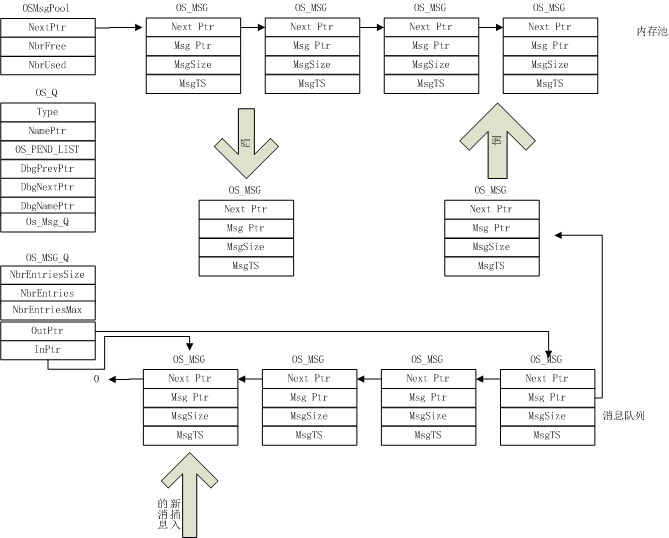
消息队列在系统初始化时先初始化了消息池:
OS_MsgPoolInit(p_err);其中调用OS_MsgPoolCreate将一个数组串成一个单链表方便消息队列的“舀”和“倒”。对应的舀和到就是单向链表的一些操作。
和其他信号量类似,OS_Q定义完成后就调用OSQCreate()创建消息队列。
1,创建消息队列:
************************************************************************************************************************

*                                               CREATE A MESSAGE QUEUE

*

* Description: This function is called by your application to create a message queue.  Message queues MUST be created

*              before they can be used.

*

* Arguments  : p_q         is a pointer to the message queue

*

*              p_name      is a pointer to an ASCII string that will be used to name the message queue

*

*              max_qty     indicates the maximum size of the message queue (must be non-zero).  Note that it's also not

*                          possible to have a size higher than the maximum number of OS_MSGs available.

*

*              p_err       is a pointer to a variable that will contain an error code returned by this function.

*

*                              OS_ERR_NONE                    the call was successful

*                              OS_ERR_CREATE_ISR              can't create from an ISR

*                              OS_ERR_ILLEGAL_CREATE_RUN_TIME if you are trying to create the Queue after you called

*                                                               OSSafetyCriticalStart().

*                              OS_ERR_NAME                    if 'p_name' is a NULL pointer

*                              OS_ERR_OBJ_CREATED             if the message queue has already been created

*                              OS_ERR_OBJ_PTR_NULL            if you passed a NULL pointer for 'p_q'

*                              OS_ERR_Q_SIZE                  if the size you specified is 0

*

* Returns    : none

************************************************************************************************************************

*/

void  OSQCreate (OS_Q        *p_q,

                 CPU_CHAR    *p_name,

                 OS_MSG_QTY   max_qty,

                 OS_ERR      *p_err)

{

    CPU_SR_ALLOC();

#ifdef OS_SAFETY_CRITICAL

    if (p_err == (OS_ERR *)0) {

        OS_SAFETY_CRITICAL_EXCEPTION();

        return;

    }

#endif

#ifdef OS_SAFETY_CRITICAL_IEC61508

    if (OSSafetyCriticalStartFlag == DEF_TRUE) {

       *p_err = OS_ERR_ILLEGAL_CREATE_RUN_TIME;

        return;

    }

#endif

#if OS_CFG_CALLED_FROM_ISR_CHK_EN > 0u

    if (OSIntNestingCtr > (OS_NESTING_CTR)0) {              /* Not allowed to be called from an ISR                   */

       *p_err = OS_ERR_CREATE_ISR;

        return;

    }

#endif

#if OS_CFG_ARG_CHK_EN > 0u

    if (p_q == (OS_Q *)0) {                                 /* Validate arguments                                     */

       *p_err = OS_ERR_OBJ_PTR_NULL;

        return;

    }

    if (max_qty == (OS_MSG_QTY)0) {                         /* Cannot specify a zero size queue                       */

       *p_err = OS_ERR_Q_SIZE;

        return;

    }

#endif

    OS_CRITICAL_ENTER();

    p_q->Type    = OS_OBJ_TYPE_Q;                           /* Mark the data structure as a message queue             */

    p_q->NamePtr = p_name;

    OS_MsgQInit(&p_q->MsgQ,                                 /* Initialize the queue                                   */

                max_qty);

    OS_PendListInit(&p_q->PendList);                        /* Initialize the waiting list                            */

#if OS_CFG_DBG_EN > 0u

    OS_QDbgListAdd(p_q);

#endif

    OSQQty++;                                               /* One more queue created                                 */

    OS_CRITICAL_EXIT_NO_SCHED();

   *p_err = OS_ERR_NONE;

}
OSQCreate ()
创建完消息队列后,队列里的消息数为零,内存全在内存池里。
2,请求消息,此函数是一个指针函数因此在消息可用是即返回消息首地址同时传入的消息长度变量指针将消息长度传回请求任务。
请求的过程就是从消息队列按照消息队列的模式(LIFO或者FIFO)进行单链表的操作,同时完成后还要将内存放回内存池。
函数注释:
************************************************************************************************************************

*                                            PEND ON A QUEUE FOR A MESSAGE

*

* Description: This function waits for a message to be sent to a queue

*

* Arguments  : p_q           is a pointer to the message queue

*

*              timeout       is an optional timeout period (in clock ticks).  If non-zero, your task will wait for a

*                            message to arrive at the queue up to the amount of time specified by this argument.  If you

*                            specify 0, however, your task will wait forever at the specified queue or, until a message

*                            arrives.

*

*              opt           determines whether the user wants to block if the queue is empty or not:

*

*                                OS_OPT_PEND_BLOCKING

*                                OS_OPT_PEND_NON_BLOCKING

*

*              p_msg_size    is a pointer to a variable that will receive the size of the message

*

*              p_ts          is a pointer to a variable that will receive the timestamp of when the message was

*                            received, pend aborted or the message queue deleted,  If you pass a NULL pointer (i.e.

*                            (CPU_TS *)0) then you will not get the timestamp.  In other words, passing a NULL pointer

*                            is valid and indicates that you don't need the timestamp.

*

*              p_err         is a pointer to a variable that will contain an error code returned by this function.

*

*                                OS_ERR_NONE               The call was successful and your task received a message.

*                                OS_ERR_OBJ_PTR_NULL       if you pass a NULL pointer for 'p_q'

*                                OS_ERR_OBJ_TYPE           if the message queue was not created

*                                OS_ERR_PEND_ABORT         the pend was aborted

*                                OS_ERR_PEND_ISR           if you called this function from an ISR

*                                OS_ERR_PEND_WOULD_BLOCK   If you specified non-blocking but the queue was not empty

*                                OS_ERR_SCHED_LOCKED       the scheduler is locked

*                                OS_ERR_TIMEOUT            A message was not received within the specified timeout

*                                                          would lead to a suspension.

*

* Returns    : != (void *)0  is a pointer to the message received

*              == (void *)0  if you received a NULL pointer message or,

*                            if no message was received or,

*                            if 'p_q' is a NULL pointer or,

*                            if you didn't pass a pointer to a queue.

************************************************************************************************************************

*/

void  *OSQPend (OS_Q         *p_q,

                OS_TICK       timeout,

                OS_OPT        opt,

                OS_MSG_SIZE  *p_msg_size,

                CPU_TS       *p_ts,

                OS_ERR       *p_err)

{

    OS_PEND_DATA  pend_data;

    void         *p_void;

    CPU_SR_ALLOC();

#ifdef OS_SAFETY_CRITICAL

    if (p_err == (OS_ERR *)0) {

        OS_SAFETY_CRITICAL_EXCEPTION();

        return ((void *)0);

    }

#endif

#if OS_CFG_CALLED_FROM_ISR_CHK_EN > 0u

    if (OSIntNestingCtr > (OS_NESTING_CTR)0) {              /* Not allowed to call from an ISR                        */

       *p_err = OS_ERR_PEND_ISR;

        return ((void *)0);

    }

#endif

#if OS_CFG_ARG_CHK_EN > 0u

    if (p_q == (OS_Q *)0) {                                 /* Validate arguments                                     */

       *p_err = OS_ERR_OBJ_PTR_NULL;

        return ((void *)0);

    }

    if (p_msg_size == (OS_MSG_SIZE *)0) {

       *p_err = OS_ERR_PTR_INVALID;

        return ((void *)0);

    }

    switch (opt) {

        case OS_OPT_PEND_BLOCKING:

        case OS_OPT_PEND_NON_BLOCKING:

             break;

        default:

            *p_err = OS_ERR_OPT_INVALID;

             return ((void *)0);

    }

#endif

#if OS_CFG_OBJ_TYPE_CHK_EN > 0u

    if (p_q->Type != OS_OBJ_TYPE_Q) {                       /* Make sure message queue was created                    */

       *p_err = OS_ERR_OBJ_TYPE;

        return ((void *)0);

    }

#endif

    if (p_ts != (CPU_TS *)0) {

       *p_ts  = (CPU_TS  )0;                                /* Initialize the returned timestamp                      */

    }

    CPU_CRITICAL_ENTER();

    //获取消息的地址

    p_void = OS_MsgQGet(&p_q->MsgQ,                         /* Any message waiting in the message queue?              */

                        p_msg_size,

                        p_ts,

                        p_err);

    if (*p_err == OS_ERR_NONE) {

        CPU_CRITICAL_EXIT();

        return (p_void);                                    /* Yes, Return message received                           */

    }

    //没有请求到消息

    if ((opt & OS_OPT_PEND_NON_BLOCKING) != (OS_OPT)0) {    /* Caller wants to block if not available?                */

        CPU_CRITICAL_EXIT();

       *p_err = OS_ERR_PEND_WOULD_BLOCK;                    /* No                                                     */

        return ((void *)0);

    } else {

        if (OSSchedLockNestingCtr > (OS_NESTING_CTR)0) {    /* Can't pend when the scheduler is locked                */

            CPU_CRITICAL_EXIT();

           *p_err = OS_ERR_SCHED_LOCKED;

            return ((void *)0);

        }

    }

                                                            /* Lock the scheduler/re-enable interrupts                */

    OS_CRITICAL_ENTER_CPU_EXIT();

    //阻塞任务并加入等待队列

    OS_Pend(&pend_data,                                     /* Block task pending on Message Queue                    */

            (OS_PEND_OBJ *)((void *)p_q),

            OS_TASK_PEND_ON_Q,

            timeout);

    OS_CRITICAL_EXIT_NO_SCHED();

    OSSched();                                              /* Find the next highest priority task ready to run       */

    CPU_CRITICAL_ENTER();

    switch (OSTCBCurPtr->PendStatus) {

        case OS_STATUS_PEND_OK:                             /* Extract message from TCB (Put there by Post)           */

             p_void     = OSTCBCurPtr->MsgPtr;

            *p_msg_size = OSTCBCurPtr->MsgSize;

             if (p_ts  != (CPU_TS *)0) {

                *p_ts   =  OSTCBCurPtr->TS;

             }

            *p_err      = OS_ERR_NONE;

             break;

        case OS_STATUS_PEND_ABORT:                          /* Indicate that we aborted                               */

             p_void     = (void      *)0;

            *p_msg_size = (OS_MSG_SIZE)0;

             if (p_ts  != (CPU_TS *)0) {

                *p_ts   =  OSTCBCurPtr->TS;

             }

            *p_err      = OS_ERR_PEND_ABORT;

             break;

        case OS_STATUS_PEND_TIMEOUT:                        /* Indicate that we didn't get event within TO            */

             p_void     = (void      *)0;

            *p_msg_size = (OS_MSG_SIZE)0;

             if (p_ts  != (CPU_TS *)0) {

                *p_ts   = (CPU_TS  )0;

             }

            *p_err      = OS_ERR_TIMEOUT;

             break;

        case OS_STATUS_PEND_DEL:                            /* Indicate that object pended on has been deleted        */

             p_void     = (void      *)0;

            *p_msg_size = (OS_MSG_SIZE)0;

             if (p_ts  != (CPU_TS *)0) {

                *p_ts   =  OSTCBCurPtr->TS;

             }

            *p_err      = OS_ERR_OBJ_DEL;

             break;

        default:

             p_void     = (void      *)0;

            *p_msg_size = (OS_MSG_SIZE)0;

            *p_err      = OS_ERR_STATUS_INVALID;

             break;

    }

    CPU_CRITICAL_EXIT();

    //返回消息的地址

    return (p_void);

}
void *OSQPend()
************************************************************************************************************************

*                                           RETRIEVE MESSAGE FROM MESSAGE QUEUE

*

* Description: This function retrieves a message from a message queue

*

* Arguments  : p_msg_q     is a pointer to the message queue where we want to extract the message from

*              -------

*

*              p_msg_size  is a pointer to where the size (in bytes) of the message will be placed

*

*              p_ts        is a pointer to where the time stamp will be placed

*

*              p_err       is a pointer to an error code that will be returned from this call.

*

*                              OS_ERR_Q_EMPTY

*                              OS_ERR_NONE

*

* Returns    : The message (a pointer)

*

* Note(s)    : 1) This function is INTERNAL to uC/OS-III and your application MUST NOT call it.

************************************************************************************************************************

*/

void  *OS_MsgQGet (OS_MSG_Q     *p_msg_q,

                   OS_MSG_SIZE  *p_msg_size,

                   CPU_TS       *p_ts,

                   OS_ERR       *p_err)

{

    OS_MSG  *p_msg;

    void    *p_void;

#ifdef OS_SAFETY_CRITICAL

    if (p_err == (OS_ERR *)0) {

        OS_SAFETY_CRITICAL_EXCEPTION();

        return ((void *)0);

    }

#endif

    //消息队列为空?

    if (p_msg_q->NbrEntries == (OS_MSG_QTY)0) {             /* Is the queue empty?                                    */

       *p_msg_size = (OS_MSG_SIZE)0;                        /* Yes                                                    */

        if (p_ts != (CPU_TS *)0) {

           *p_ts  = (CPU_TS  )0;

        }

       *p_err = OS_ERR_Q_EMPTY;

        return ((void *)0);

    }

    //不为空 ,取出消息地址及大小

    p_msg           = p_msg_q->OutPtr;                      /* No, get the next message to extract from the queue     */

    p_void          = p_msg->MsgPtr;

   *p_msg_size      = p_msg->MsgSize;

    if (p_ts != (CPU_TS *)0) {

       *p_ts  = p_msg->MsgTS;

    }

    //修改消息队列出队地址

    p_msg_q->OutPtr = p_msg->NextPtr;                       /* Point to next message to extract                       */

    if (p_msg_q->OutPtr == (OS_MSG *)0) {                   /* Are there any more messages in the queue?              */

        p_msg_q->InPtr      = (OS_MSG   *)0;                /* No                                                     */

        p_msg_q->NbrEntries = (OS_MSG_QTY)0;

    } else {

    //消息队列数减一

        p_msg_q->NbrEntries--;                              /* Yes, One less message in the queue                     */

    }

    //倒回消息池

    p_msg->NextPtr    = OSMsgPool.NextPtr;                  /* Return message control block to free list              */

    OSMsgPool.NextPtr = p_msg;

    OSMsgPool.NbrFree++;

    OSMsgPool.NbrUsed--;

   *p_err             = OS_ERR_NONE;

    return (p_void);

}
*OS_MsgQGet()
3,发布消息
在消息的发布过程中如果有任务在等待消息就不用调用)OS_MsgQPut()函数将消息放入消息队列而是直接传入请求任务,负责就舀一个消息的内存存放消息,并且将消息放入消息队列,在放入时根据Opt选项判断消息队列的模式然后进行但向链表的插入操作。
************************************************************************************************************************

*                                               POST MESSAGE TO A QUEUE

*

* Description: This function sends a message to a queue.  With the 'opt' argument, you can specify whether the message

*              is broadcast to all waiting tasks and/or whether you post the message to the front of the queue (LIFO)

*              or normally (FIFO) at the end of the queue.

*

* Arguments  : p_q           is a pointer to a message queue that must have been created by OSQCreate().

*

*              p_void        is a pointer to the message to send.

*

*              msg_size      specifies the size of the message (in bytes)

*

*              opt           determines the type of POST performed:

*

*                                OS_OPT_POST_ALL          POST to ALL tasks that are waiting on the queue.  This option

*                                                         can be added to either OS_OPT_POST_FIFO or OS_OPT_POST_LIFO

*                                OS_OPT_POST_FIFO         POST message to end of queue (FIFO) and wake up a single

*                                                         waiting task.

*                                OS_OPT_POST_LIFO         POST message to the front of the queue (LIFO) and wake up

*                                                         a single waiting task.

*                                OS_OPT_POST_NO_SCHED     Do not call the scheduler

*

*                            Note(s): 1) OS_OPT_POST_NO_SCHED can be added (or OR'd) with one of the other options.

*                                     2) OS_OPT_POST_ALL      can be added (or OR'd) with one of the other options.

*                                     3) Possible combination of options are:

*

*                                        OS_OPT_POST_FIFO

*                                        OS_OPT_POST_LIFO

*                                        OS_OPT_POST_FIFO + OS_OPT_POST_ALL

*                                        OS_OPT_POST_LIFO + OS_OPT_POST_ALL

*                                        OS_OPT_POST_FIFO + OS_OPT_POST_NO_SCHED

*                                        OS_OPT_POST_LIFO + OS_OPT_POST_NO_SCHED

*                                        OS_OPT_POST_FIFO + OS_OPT_POST_ALL + OS_OPT_POST_NO_SCHED

*                                        OS_OPT_POST_LIFO + OS_OPT_POST_ALL + OS_OPT_POST_NO_SCHED

*

*              p_err         is a pointer to a variable that will contain an error code returned by this function.

*

*                                OS_ERR_NONE            The call was successful and the message was sent

*                                OS_ERR_MSG_POOL_EMPTY  If there are no more OS_MSGs to use to place the message into

*                                OS_ERR_OBJ_PTR_NULL    If 'p_q' is a NULL pointer

*                                OS_ERR_OBJ_TYPE        If the message queue was not initialized

*                                OS_ERR_Q_MAX           If the queue is full

*

* Returns    : None

************************************************************************************************************************

*/

void  OSQPost (OS_Q         *p_q,

               void         *p_void,

               OS_MSG_SIZE   msg_size,

               OS_OPT        opt,

               OS_ERR       *p_err)

{

    CPU_TS  ts;

#ifdef OS_SAFETY_CRITICAL

    if (p_err == (OS_ERR *)0) {

        OS_SAFETY_CRITICAL_EXCEPTION();

        return;

    }

#endif

#if OS_CFG_ARG_CHK_EN > 0u

    if (p_q == (OS_Q *)0) {                                 /* Validate 'p_q'                                         */

       *p_err = OS_ERR_OBJ_PTR_NULL;

        return;

    }

    switch (opt) {                                          /* Validate 'opt'                                         */

       //发布模式选择

        case OS_OPT_POST_FIFO:

        case OS_OPT_POST_LIFO:

        case OS_OPT_POST_FIFO | OS_OPT_POST_ALL:

        case OS_OPT_POST_LIFO | OS_OPT_POST_ALL:

        case OS_OPT_POST_FIFO | OS_OPT_POST_NO_SCHED:

        case OS_OPT_POST_LIFO | OS_OPT_POST_NO_SCHED:

        case OS_OPT_POST_FIFO | OS_OPT_POST_ALL | OS_OPT_POST_NO_SCHED:

        case OS_OPT_POST_LIFO | OS_OPT_POST_ALL | OS_OPT_POST_NO_SCHED:

             break;

        default:

            *p_err =  OS_ERR_OPT_INVALID;

             return;

    }

#endif

#if OS_CFG_OBJ_TYPE_CHK_EN > 0u

    if (p_q->Type != OS_OBJ_TYPE_Q) {                       /* Make sure message queue was created                    */

       *p_err = OS_ERR_OBJ_TYPE;

        return;

    }

#endif

    ts = OS_TS_GET();                                       /* Get timestamp                                          */

//是否延迟发布?

#if OS_CFG_ISR_POST_DEFERRED_EN > 0u

    if (OSIntNestingCtr > (OS_NESTING_CTR)0) {

        OS_IntQPost((OS_OBJ_TYPE)OS_OBJ_TYPE_Q,             /* Post to ISR queue                                      */

                    (void      *)p_q,

                    (void      *)p_void,

                    (OS_MSG_SIZE)msg_size,

                    (OS_FLAGS   )0,

                    (OS_OPT     )opt,

                    (CPU_TS     )ts,

                    (OS_ERR    *)p_err);

        return;

    }

#endif

//否,立即发布

    OS_QPost(p_q,

             p_void,

             msg_size,

             opt,

             ts,

             p_err);

}
OSQPost ()
void  OS_QPost (OS_Q         *p_q,

                void         *p_void,

                OS_MSG_SIZE   msg_size,

                OS_OPT        opt,

                CPU_TS        ts,

                OS_ERR       *p_err)

{

    OS_OBJ_QTY     cnt;

    OS_OPT         post_type;

    OS_PEND_LIST  *p_pend_list;

    OS_PEND_DATA  *p_pend_data;

    OS_PEND_DATA  *p_pend_data_next;

    OS_TCB        *p_tcb;

    CPU_SR_ALLOC();

    OS_CRITICAL_ENTER();

    //取出等待队列

    p_pend_list = &p_q->PendList;

    //无等待队列?

    if (p_pend_list->NbrEntries == (OS_OBJ_QTY)0) {         /* Any task waiting on message queue?                     */

        // 是,队列模式选择

        if ((opt & OS_OPT_POST_LIFO) == (OS_OPT)0) {        /* Determine whether we post FIFO or LIFO                 */

            post_type = OS_OPT_POST_FIFO;

        } else {

            post_type = OS_OPT_POST_LIFO;

        }

        //将消息放入消息对列

        OS_MsgQPut(&p_q->MsgQ,                              /* Place message in the message queue                     */

                   p_void,

                   msg_size,

                   post_type,

                   ts,

                   p_err);

        OS_CRITICAL_EXIT();

        return;

    }

    //有等待队列,选则发布给最高优先级任务还是全部发布

    if ((opt & OS_OPT_POST_ALL) != (OS_OPT)0) {             /* Post message to all tasks waiting?                     */

        cnt = p_pend_list->NbrEntries;                      /* Yes                                                    */

    } else {

        cnt = (OS_OBJ_QTY)1;                                /* No                                                     */

    }

    //取出等待队列头地址

    p_pend_data = p_pend_list->HeadPtr;

    while (cnt > 0u) {

        p_tcb            = p_pend_data->TCBPtr;

        p_pend_data_next = p_pend_data->NextPtr;

        //发布信号给一个任务

        OS_Post((OS_PEND_OBJ *)((void *)p_q),

                p_tcb,

                p_void,

                msg_size,

                ts);

        p_pend_data = p_pend_data_next;

        cnt--;

    }

    OS_CRITICAL_EXIT_NO_SCHED();

    if ((opt & OS_OPT_POST_NO_SCHED) == (OS_OPT)0) {

        OSSched();                                          /* Run the scheduler                                      */

    }

   *p_err = OS_ERR_NONE;

}
OS_QPost()
将消息加入队列
void  OS_MsgQPut (OS_MSG_Q     *p_msg_q,

                  void         *p_void,

                  OS_MSG_SIZE   msg_size,

                  OS_OPT        opt,

                  CPU_TS        ts,

                  OS_ERR       *p_err)

{

    OS_MSG  *p_msg;

    OS_MSG  *p_msg_in;

#ifdef OS_SAFETY_CRITICAL

    if (p_err == (OS_ERR *)0) {

        OS_SAFETY_CRITICAL_EXCEPTION();

        return;

    }

#endif

    if (p_msg_q->NbrEntries >= p_msg_q->NbrEntriesSize) {

       *p_err = OS_ERR_Q_MAX;                               /* Message queue cannot accept any more messages          */

        return;

    }

    //消息池剩余空

    if (OSMsgPool.NbrFree == (OS_MSG_QTY)0) {

       *p_err = OS_ERR_MSG_POOL_EMPTY;                      /* No more OS_MSG to use                                  */

        return;

    }

    //舀

    p_msg             = OSMsgPool.NextPtr;                  /* Remove message control block from free list            */

    OSMsgPool.NextPtr = p_msg->NextPtr;

    OSMsgPool.NbrFree--;

    OSMsgPool.NbrUsed++;

    if (OSMsgPool.NbrUsedMax < OSMsgPool.NbrUsed) {

        OSMsgPool.NbrUsedMax = OSMsgPool.NbrUsed;

    }

    //队列为空的插入

    if (p_msg_q->NbrEntries == (OS_MSG_QTY)0) {             /* Is this first message placed in the queue?             */

        p_msg_q->InPtr         = p_msg;                     /* Yes                                                    */

        p_msg_q->OutPtr        = p_msg;

        p_msg_q->NbrEntries    = (OS_MSG_QTY)1;

        p_msg->NextPtr         = (OS_MSG *)0;

    } else {                                                /* No                                                     */

        if ((opt & OS_OPT_POST_LIFO) == OS_OPT_POST_FIFO) { /* Is it FIFO or LIFO?                                    */

            //FIFO 模式插入

            p_msg_in           = p_msg_q->InPtr;            /* FIFO, add to the head                                  */

            p_msg_in->NextPtr  = p_msg;

            p_msg_q->InPtr     = p_msg;

            p_msg->NextPtr     = (OS_MSG *)0;

        } else {

            //LIFO 模式插入

            p_msg->NextPtr     = p_msg_q->OutPtr;           /* LIFO, add to the tail                                  */

            p_msg_q->OutPtr    = p_msg;

        }

        p_msg_q->NbrEntries++;

    }

    //跟新历史最大达用量值

    if (p_msg_q->NbrEntriesMax < p_msg_q->NbrEntries) {

        p_msg_q->NbrEntriesMax = p_msg_q->NbrEntries;

    }

    //消息放入p_msg

    p_msg->MsgPtr  = p_void;                                /* Deposit message in the message queue entry             */

    p_msg->MsgSize = msg_size;

    p_msg->MsgTS   = ts;

   *p_err          = OS_ERR_NONE;

}

#endif
OS_MsgQPut ()
发布消息的过程如果有任务在等待信号就不用放入消息队列,直接发给等待的任务。消息队列的数据结构组成清楚后,理解消息队列的发布过程请求等过程就显得容易很多了,其中如果消息队列的长为一字节在早期称为消息邮箱。对于所有的Pend的过程中函数内定义的Pend_data设计的非常巧妙,利用编译器自动释放内存的机制,在用完后及时的自动释放内存,从而减小了系统内核的内存开销和效率。
剩下的就是一些对消息队列进行操作的相关函数主要有:
删除消息队列
************************************************************************************************************************

*                                               DELETE A MESSAGE QUEUE

*

* Description: This function deletes a message queue and readies all tasks pending on the queue.

*

* Arguments  : p_q       is a pointer to the message queue you want to delete

*

*              opt       determines delete options as follows:

*

*                            OS_OPT_DEL_NO_PEND          Delete the queue ONLY if no task pending

*                            OS_OPT_DEL_ALWAYS           Deletes the queue even if tasks are waiting.

*                                                        In this case, all the tasks pending will be readied.

*

*              p_err     is a pointer to a variable that will contain an error code returned by this function.

*

*                            OS_ERR_NONE                 The call was successful and the queue was deleted

*                            OS_ERR_DEL_ISR              If you tried to delete the queue from an ISR

*                            OS_ERR_OBJ_PTR_NULL         if you pass a NULL pointer for 'p_q'

*                            OS_ERR_OBJ_TYPE             if the message queue was not created

*                            OS_ERR_OPT_INVALID          An invalid option was specified

*                            OS_ERR_TASK_WAITING         One or more tasks were waiting on the queue

*

* Returns    : == 0          if no tasks were waiting on the queue, or upon error.

*              >  0          if one or more tasks waiting on the queue are now readied and informed.

*

* Note(s)    : 1) This function must be used with care.  Tasks that would normally expect the presence of the queue MUST

*                 check the return code of OSQPend().

*

*              2) OSQAccept() callers will not know that the intended queue has been deleted.

*

*              3) Because ALL tasks pending on the queue will be readied, you MUST be careful in applications where the

*                 queue is used for mutual exclusion because the resource(s) will no longer be guarded by the queue.

************************************************************************************************************************

*/

#if OS_CFG_Q_DEL_EN > 0u

OS_OBJ_QTY  OSQDel (OS_Q    *p_q,

                    OS_OPT   opt,

                    OS_ERR  *p_err)

{

    OS_OBJ_QTY     cnt;

    OS_OBJ_QTY     nbr_tasks;

    OS_PEND_DATA  *p_pend_data;

    OS_PEND_LIST  *p_pend_list;

    OS_TCB        *p_tcb;

    CPU_TS         ts;

    CPU_SR_ALLOC();

#ifdef OS_SAFETY_CRITICAL

    if (p_err == (OS_ERR *)0) {

        OS_SAFETY_CRITICAL_EXCEPTION();

        return ((OS_OBJ_QTY)0);

    }

#endif

#if OS_CFG_CALLED_FROM_ISR_CHK_EN > 0u

    if (OSIntNestingCtr > (OS_NESTING_CTR)0) {              /* Can't delete a message queue from an ISR               */

       *p_err = OS_ERR_DEL_ISR;

        return ((OS_OBJ_QTY)0);

    }

#endif

#if OS_CFG_ARG_CHK_EN > 0u

    if (p_q == (OS_Q *)0) {                                 /* Validate 'p_q'                                         */

       *p_err =  OS_ERR_OBJ_PTR_NULL;

        return ((OS_OBJ_QTY)0u);

    }

    switch (opt) {                                          /* Validate 'opt'                                         */

        case OS_OPT_DEL_NO_PEND:

        case OS_OPT_DEL_ALWAYS:

             break;

        default:

            *p_err =  OS_ERR_OPT_INVALID;

             return ((OS_OBJ_QTY)0u);

    }

#endif

#if OS_CFG_OBJ_TYPE_CHK_EN > 0u

    if (p_q->Type != OS_OBJ_TYPE_Q) {                       /* Make sure message queue was created                    */

       *p_err = OS_ERR_OBJ_TYPE;

        return ((OS_OBJ_QTY)0);

    }

#endif

    CPU_CRITICAL_ENTER();

    p_pend_list = &p_q->PendList;

    cnt         = p_pend_list->NbrEntries;

    nbr_tasks   = cnt;

    switch (opt) {

        case OS_OPT_DEL_NO_PEND:                            /* Delete message queue only if no task waiting           */

             if (nbr_tasks == (OS_OBJ_QTY)0) {

#if OS_CFG_DBG_EN > 0u

                 OS_QDbgListRemove(p_q);

#endif

                 OSQQty--;

                 OS_QClr(p_q);

                 CPU_CRITICAL_EXIT();

                *p_err = OS_ERR_NONE;

             } else {

                 CPU_CRITICAL_EXIT();

                *p_err = OS_ERR_TASK_WAITING;

             }

             break;

        case OS_OPT_DEL_ALWAYS:                             /* Always delete the message queue                        */

             OS_CRITICAL_ENTER_CPU_EXIT();

             ts = OS_TS_GET();                              /* Get local time stamp so all tasks get the same time    */

             while (cnt > 0u) {                             /* Remove all tasks from the pend list                    */

                 p_pend_data = p_pend_list->HeadPtr;

                 p_tcb       = p_pend_data->TCBPtr;

                 OS_PendObjDel((OS_PEND_OBJ *)((void *)p_q),

                               p_tcb,

                               ts);

                 cnt--;

             }

#if OS_CFG_DBG_EN > 0u

             OS_QDbgListRemove(p_q);

#endif

             OSQQty--;

             OS_QClr(p_q);

             OS_CRITICAL_EXIT_NO_SCHED();

             OSSched();                                     /* Find highest priority task ready to run                */

            *p_err = OS_ERR_NONE;

             break;

        default:

             CPU_CRITICAL_EXIT();

            *p_err = OS_ERR_OPT_INVALID;

             break;

    }

    return (nbr_tasks);

}

#endif
OSQDel ()
初始化消息池
************************************************************************************************************************

*                                            INITIALIZE THE POOL OF 'OS_MSG'

*

* Description: This function is called by OSInit() to initialize the free list of OS_MSGs.

*

* Argument(s): p_err     is a pointer to a variable that will contain an error code returned by this function.

*

*                            OS_ERR_MSG_POOL_NULL_PTR

*                            OS_ERR_MSG_POOL_EMPTY

*                            OS_ERR_NONE

*

* Returns    : none

*

* Note(s)    : 1) This function is INTERNAL to uC/OS-III and your application MUST NOT call it.

************************************************************************************************************************

*/

void  OS_MsgPoolInit (OS_ERR  *p_err)

{

    OS_MSG      *p_msg1;

    OS_MSG      *p_msg2;

    OS_MSG_QTY   i;

    OS_MSG_QTY   loops;

#ifdef OS_SAFETY_CRITICAL

    if (p_err == (OS_ERR *)0) {

        OS_SAFETY_CRITICAL_EXCEPTION();

        return;

    }

#endif

#if OS_CFG_ARG_CHK_EN > 0u

    if (OSCfg_MsgPoolBasePtr == (OS_MSG *)0) {

       *p_err = OS_ERR_MSG_POOL_NULL_PTR;

        return;

    }

    if (OSCfg_MsgPoolSize == (OS_MSG_QTY)0) {

       *p_err = OS_ERR_MSG_POOL_EMPTY;

        return;

    }

#endif

    p_msg1 = OSCfg_MsgPoolBasePtr;

    p_msg2 = OSCfg_MsgPoolBasePtr;

    p_msg2++;

    loops  = OSCfg_MsgPoolSize - 1u;

    for (i = 0u; i < loops; i++) {                          /* Init. list of free OS_MSGs                             */

        p_msg1->NextPtr = p_msg2;

        p_msg1->MsgPtr  = (void      *)0;

        p_msg1->MsgSize = (OS_MSG_SIZE)0u;

        p_msg1->MsgTS   = (CPU_TS     )0u;

        p_msg1++;

        p_msg2++;

    }

    p_msg1->NextPtr = (OS_MSG    *)0;                       /* Last OS_MSG                                            */

    p_msg1->MsgPtr  = (void      *)0;

    p_msg1->MsgSize = (OS_MSG_SIZE)0u;

    p_msg1->MsgTS   = (CPU_TS     )0u;

    OSMsgPool.NextPtr    =  OSCfg_MsgPoolBasePtr;

    OSMsgPool.NbrFree    =  OSCfg_MsgPoolSize;

    OSMsgPool.NbrUsed    = (OS_MSG_QTY)0;

    OSMsgPool.NbrUsedMax = (OS_MSG_QTY)0;

   *p_err                =  OS_ERR_NONE;

}
OS_MsgPoolInit ()
还有的其他操作函数就是和信号量相似的操作函数了。
μC/OS-III---I笔记7---消息队列的更多相关文章
- Linux进程间通信IPC学习笔记之消息队列(SVR4)
Linux进程间通信IPC学习笔记之消息队列(SVR4)
- Redis学习笔记~实现消息队列比MSMQ更方便
什么是队列:简单的说就是数据存储到一个空间里(可以是内存,也可以是物理文件),先存储的数据对象,先被取出来,这与堆栈正好相反,消息队列也是这样,将可能出现高并发的数据进行队列存储,并按着入队的顺序依次 ...
- Linux进程间通信IPC学习笔记之消息队列(Posix)
基础知识: 消息队列可认为是一个消息链表,有足够写权限的线程可往队列中放置消息,有足够读权限的线程可以从队列中取走消息.在某个进程往一人队列写入消息之前,并不需要另外某个进程在该队列上等待消息的到达. ...
- PetShop 4.0学习笔记:消息队列MSMQ
直到今天才知道,在我们每天都在用的Window系统里还有这么好用的一个编程组件:消息队列.它能够解决在大数据量交换的情况下的性能问题,特别是BS系统的数据库性能.而且它的异步处理方式能给程序员最大的便 ...
- Linux学习笔记28——消息队列
一 关于消息队列 消息队列提供了一种从一个进程向另一个进程发送一个数据块的方法,而且,每个数据块都被认为含有一个类型,接收进程可以独立地接受含有不同类型值的数据块.可以通过发送消息来几乎完全避免命名管 ...
- Spring学习笔记3——消息队列(rabbitmq), 发送邮件
本节的内容是用户注册时,将邮箱地址先存入rabbitmq队列,之后返回给用户注册成功:之后消息队列的接收者从队列中获取消息,发送邮件给用户. 一.RabbitMQ介绍 如果之前对rabbitm ...
- RocketMQ读书笔记5——消息队列的核心机制
[Broker简述] Broker是RocketMQ的核心,大部分“重量级”的工作都是由Broker完成的,包括: 1.接受Producer发过来的消息: 2.处理Consumer的消费信息请求: 3 ...
- 【mq读书笔记】消息队列负载与重新分配(分配 新队列pullRequest入队)
回顾PullMessageService#run: 如果队列总没有PullRequest对象,线程将阻塞. 围绕PullRequest有2个问题: 1.PullRequest对象在什么时候创建并加入p ...
- 揭开.NET消息循环的神秘面纱(GetMessage()无法取得任何消息,就会进入Idle(空闲)状态,进入睡眠状态(而不是Busy Waiting)。当消息队列不再为空的时候,程序会自动醒过来)
揭开.NET消息循环的神秘面纱(-) http://hi.baidu.com/sakiwer/item/f17dc33274a04df2a9842866 曾经在Win32平台下奋战的程序员们想必记得, ...
- 异数OS 织梦师-水母(一)--消息队列篇
异数OS 织梦师-水母(一)–消息队列篇 本文来自异数OS社区 github: https://github.com/yds086/HereticOS 异数OS社区QQ群: 652455784 异数O ...
随机推荐
- 10_1_OS模块
1.常用函数目录 函数名 功能 os.name 指示用户正在使用的工作平台 os.getcwd ( ) 获取当前的工作目录 os.listdir ( ) 返回指定目录下的所有文件和目录名 os.rem ...
- Swagger2配置与使用
Swagger2配置与使用 Swagger2介绍 前后端分离开发模式中,api文档是最好的沟通方式. Swagger 是一个规范和完整的框架,用于生成.描述.调用和可视化 RESTful 风格的 We ...
- IDEA 2019 Unable to get current time from Google's servers 解决
取消android support即可
- Scheduling Multithreaded Computations by Work Stealing
steal.pdf http://supertech.csail.mit.edu/papers/steal.pdf This paper studies the problem of eciently ...
- 思考gRPC :为什么是HTTP/2
Introducing gRPC Support with NGINX 1.13.10 - NGINX https://www.nginx.com/blog/nginx-1-13-10-grpc/ 思 ...
- 从源码解析Nginx对 Native aio支持_运维_youbingchen的博客-CSDN博客 https://blog.csdn.net/youbingchen/article/details/51767587
从源码解析Nginx对 Native aio支持_运维_youbingchen的博客-CSDN博客 https://blog.csdn.net/youbingchen/article/details/ ...
- Compile-time Dependency Injection With Go Cloud's Wire 编译时依赖注入 运行时依赖注入
Compile-time Dependency Injection With Go Cloud's Wire - The Go Blog https://blog.golang.org/wire Co ...
- LOJ10019生日蛋糕
Mr.W 要制作一个体积为 N*π 的 M 层生日蛋糕,每层都是一个圆柱体. 设从下往上数第 i 蛋糕是半径为 R_i,高度为 H_i 的圆柱.当 i<M 时,要求 R_i>R_{i+1} ...
- IDEA中jdk设置
电脑运行环境是8, 但是IDEA提醒说1.5已经过时,IDEA中jdk设置还是比较麻烦 https://blog.csdn.net/u012365843/article/details/8138883 ...
- REST架构及其介绍
概述 REST是英文Representational State Transfer的缩写,中文翻译:表述性状态转移. 他是由Roy Thomas Fielding博士在他的论文 < ...